Comsol -leaderboard other pages

Topics

Theory at CERN turns 62

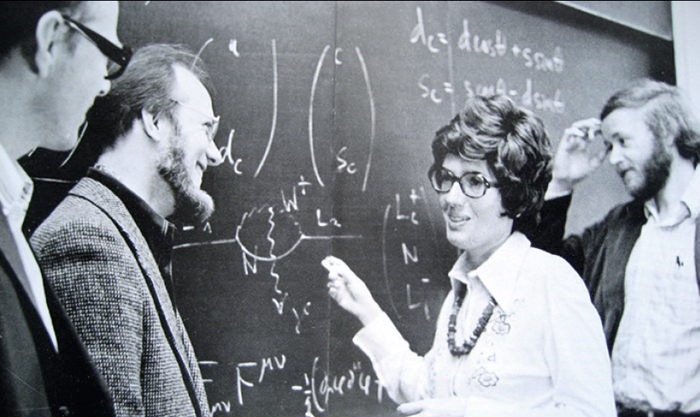
Cecilia Jarlskog

One of my most memorable experiences of CERN is from an early morning in the summer of 1966. I drove to CERN with my two small children, one and three years of age, to fetch their dad who had been on a night shift – there were no guards at the entrance in those days. I found him outside the experimental hall being interviewed by a friendly looking gentleman, who after greeting us continued asking questions and taking notes. The gentleman, as I found out afterwards, was the director-general of CERN, Bernard Gregory. This was for me an inspiring and instructive experience. Since then, CERN has grown a great deal, and attracts so many more people that the probability of a young visiting PhD student being interviewed alone by the director-general must not be so large. For me, there are other exciting new features of CERN these days, such as encountering crowds of enthusiastic young people from across the world.

The young CERN has now turned 60, its official foundation being on 29 September 1954. Its creation was a unique act, based on an unprecedented common effort by a number of distinguished scientists from several countries, not only from Europe but also from the US, among them Robert Oppenheimer and Isidor Rabi. We are all impressed by their dedication and commitment, and are grateful to them for the creation of this organization for basic research in science for peace. Since its creation, CERN has served as a “standard model” for several other international scientific organizations.

However, while CERN has just celebrated its 60th anniversary, there is one part of it that is a little older. The CERN “Group of Theoretical Studies” was created through a resolution passed by the CERN Interim Council in Amsterdam in May 1952. It was possible to form this group very quickly and for it to start work, in Copenhagen, even before the decision had been made as to where CERN would be located. Copenhagen had already been a world centre for theoretical physics for several decades. It was clear that CERN Theory would thrive there, owing to the presence of the great and incredibly influential theoretical physicist Niels Bohr, and his competent local staff. Victor Weisskopf, who was director-general of CERN in the years 1960–1964, knew Bohr well, and used to refer to him as the greatest founder of CERN. CERN Theory in Copenhagen was a lively place, and attracted many distinguished international scientists.

The CERN Annual Report for 1955 informs us that: “The Theoretical Study Division is located in the Theoretical Physics Institute, University of Copenhagen. The work of the Division has proceeded according to the programme fixed during the interim period and includes: a) scientific research on fundamental problems of nuclear physics, including theoretical problems related to the focusing of ion beams in high energy accelerators; b) training of young theoretical physicists; c) development of active co-operation with the laboratories of Liverpool and Uppsala, whose machines and equipment have been placed at the disposal of CERN.” This was what CERN’s “founding fathers” had in mind that the theorists should be doing. But, of course, except for b, that was not what the theorists actually did.

Theory went on to flourish at CERN, and the subsequent history of the Theory Division deserves a book of its own

The 1955 CERN Annual Report also informs us that the Theoretical Study Division in Copenhagen had two full-time senior staff members: Gunnar Källén and Ben R Mottelson (who was to receive the 1975 Nobel Prize in Physics). Note that these “leaders”, both born in 1926, were at the time below the age of 30. This was a general feature of the young CERN – even the accelerators were built by people who many of us would now consider as “youngsters”.

CERN Theory was expected to move gradually to Geneva. However, this took in total about five years, until 1 October 1957, when the Theory Group in Copenhagen was officially closed. The theorists who came to Geneva had their offices first at the University of Geneva, then in barracks at Geneva Airport, until they moved to the current CERN site in Meyrin. Theory went on to flourish at CERN, and the subsequent history of the Theory Division deserves a book of its own.

In 1971, I became the first female fellow of the CERN Theory Division, in 1982 the first female member of CERN’s Scientific Policy Committee, and in 1988 this committee’s first female “old boy”. Later, in the years 1998–2004, I was the adviser on member states to CERN’s director-general. I have enjoyed CERN’s international atmosphere enormously, which has given me ample opportunity to meet and talk with inspiring physicists from across the world. I also feel fortunate to have lived in a period when the amount of information revealed about the nature of the elementary constituents of matter and their interactions has been mind-boggling. CERN has been an important contributor in this respect. Who could have imagined that we would arrive at the Standard Model so “soon” – a highly successful theory of weak, electromagnetic and strong interactions?

In 2004, during the mandate of Robert Aymar as director-general, the CERN Theory Division turned into the Theory Unit, under the CERN Physics Department. Does this imply that CERN wishes to guide the theorists to work on the “focusing of ion beams”, and machines as well as equipment, as envisaged by the founding fathers in 1952? Fortunately, during my visits to CERN since, I have seen no such trend. Long live theory at CERN.

Half a century of Bell’s theorem

John_Bell

This year sees the 50th anniversary not only of the proposal of quarks, but also of what is arguably one of the most groundbreaking theoretical findings in physics: Bell’s theorem (Bell 1964).

To celebrate the theorem and the work of the Irish physicist John Stewart Bell, who was on leave from CERN when he wrote his seminal paper, the university of Vienna held the conference Quantum [Un] Speakables II on 19–22 June. Distinguished invited specialists in the question of non-locality brought up by Bell’s theorem discussed the impacts of the theorem and the future of scientific investigations, together with 400 participants.

John Clauser, who was the first to investigate Bell’s theorem experimentally, mentioned the difficulties he had in acquiring money for his experiments. The breakthrough did not come until the 1980s, when Alain Aspect measured a clear violation of Bell’s proposed inequalities. The philosophical debate between Niels Bohr and Albert Einstein on whether quantum mechanics is complete or not thus seemed also to be settled experimentally – in favour of Bohr. In his talk, Aspect stressed Bell’s ingenious idea to discover the practical implications of what had until then been merely a philosophical debate.

An important further development of Bell’s theorem was the Greenberger– Horne–Zeilinger experiment, in which the entanglement of three instead of only two particles was considered. Another important contribution was achieved with the Kochen–Specker Theorem – next to Bell’s theorem, this is the second important “no-go” theorem for hidden variables in quantum mechanics. In their talks, Daniel Greenberger, Michael Horne and Simon Kochen focused on current questions in their research. Anton Zeilinger, who was co-chair of the conference with Reinhold Bertlmann, stressed the huge impact of Bell’s theorem for technical applications: quantum computing, quantum teleportation and quantum cryptography, which are based on the concept of non-locality as outlined by Bell.

More personal remarks came from Bertlmann, who had worked with Bell as a postdoc at CERN and is the protagonist of his famous paper “Bertlmann’s socks and the nature of reality”, and from Bell’s widow Mary Bell, an accelerator physicist.

The conference title refers to a paper that Bell wrote in 1984, in which he identified what he called “unspeakables”. These are notions that he wanted to eliminate from the vocabulary of physics, because for him they did not qualify as well defined – among them measurement, apparatus and information. However, the title also allowed for another meaning. After 50 years, many important implications of Bell’s theorem have been found, but there is much that follows from the theorem that no one talks or even thinks about yet, and so is still to discover.


Physics With Trapped Charged Particles

By Martina Knoop, Niels Madsen and Richard C Thompson (eds)
World Scientific
Hardback: £78
Paperback: £36
E-book: £27

61Rz1xtBpGL

This is a collection of articles on physics with trapped charged particles, by speakers at the Les Houches Winter School in January 2012. They cover all types of physics with charged particles, and are aimed at introducing the basic issues as well as the latest developments in the field. Topics range from detection and cooling techniques for trapped ions to antihydrogen formation and quantum information processing with trapped ions. The level is appropriate for PhD students and early career researchers, or interested parties new to the subject.

Strong Coupling Gauge Theories in the LHC Perspective (SCGT12)

By Yasumichi Aoki, Toshihide Maskawa and Koichi Yamawaki (eds)
World Scientific
Hardback: £109
E-book: £82

51yIFT6CxSL._SX335_BO1,204,203,200_

The proceedings of the KMI-GCOE Workshop held in Nagoya in December 2012 contain contributions that are focused mainly on strong coupling gauge theories and the search for theories beyond the Standard Model, as well as new aspects in hot and dense QCD. These include many of the latest, important reports on walking technicolour and related subjects in the general context of conformality, discussions of phenomenological implications with the LHC, as well as theoretical implications of lattice studies.

Proceedings of the Sixth Meeting on CPT and Lorentz Symmetry

By V Alan Kostelecký (ed.)
World Scientific
Hardback: £76
E-book: £57

4177xpG+AZL._SX312_BO1,204,203,200_

The Sixth Meeting on CPT and Lorentz Symmetry held in 2013 focused on tests of these fundamental symmetries and on related theoretical issues, including scenarios for possible violations. Topics covered at the meeting include searches for CPT and Lorentz violations in a range of experiments from atomic, nuclear, and particle decays to high-energy astrophysical observations. Theoretical discussions included physical effects at the level of the Standard Model, general relativity, and beyond, as well as the possible origins and mechanisms for Lorentz and CPT violations.

Engines of Discovery: A Century of Particle Accelerators. Revised and Expanded Edition

By Andrew Sessler and Edmund Wilson
World Scientific
Hardback: £58
Paperback: £32
E-book: £24
Also available at the CERN bookshop

CCboo3_08_14

The first edition of Engines of Discovery was published seven years ago to wide acclaim. Since then, particle physics has seen the dramatic start up of the LHC and the subsequent discovery of a Higgs boson – a long-awaited missing piece in the Standard Model of particles and their interactions. At the same time, the field of accelerators has seen further developments to push back frontiers in energy, intensity and brightness, together with growth in the use of accelerators in other areas of science, medicine and industry.

In the revised and expanded edition of their book, Sessler and Wilson have aimed to match this growth, in particular through a number of essentially new chapters. These naturally cover the work that is going into developing new machines for fundamental physics, from high-intensity super-beams and factories for neutrino physics, to future high-energy linear colliders, and back to the low energies of rare-isotope facilities and, lowest of all, the production of antihydrogen. However, most of the new chapters focus on applications beyond the confines of particle and nuclear physics, with dedicated chapters on the use of accelerators in isotope production and cancer therapy, industry, national security, energy and the environment. Here, for example, spallation neutron sources have been promoted to merit a chapter of their own.

Last, the authors have brought the future and the young more into focus by directing all of the final chapter, rather than only the last paragraph, “mainly to the young”. Sadly, Andrew Sessler – a visionary leader in the field of accelerator science – died earlier this year, but this book will stand as part of his legacy to future generations. It would have appealed greatly to me when I was young, and the hope is that it will inspire budding young scientists and engineers today, for they are the future of the field.

Dark Matter and Cosmic Web Story

By Jaan Einasto
World Scientific
Hardback: £82
E-book: £61

617HyPNyTGL

This book describes the contributions that led to a paradigm shift from the point of view of a scientist from behind the “Iron Curtain”. It describes the problems with the classical view, the attempts to solve them, the difficulties encountered by those solutions, and the conferences where the merits of the new concepts were debated. Amid the science, the story of scientific work in a small country – Estonia – occupied by the Soviet Union, and the tumultuous events that led to its break up, are detailed as well.

Innovative Applications and Developments of Micro-Pattern Gaseous Detectors

By Tom Francke and Vladimir Peskov
IGI Global
Hardback: $215
E-book: $215

CCboo1_08_14

Research in nuclear physics is inconceivable without the Geiger counter. This gas-filled instrument allows both the presence and the energy of ionizing particles and radiation to be measured. It is now 100 years since Hans Geiger designed the arrangement of its electrodes, but this construction is still used in most current gaseous detectors. In this arrangement, the electrons produced by collision and ionization of the gas atoms are multiplied in the electric field around a thin wire, and the resulting avalanche of electrons delivers an easily detectable signal.

It is only recently that other electrode arrangements for gas counters have been proposed and tested. Besides offering improved properties such as higher counting rates, a certain number of prior conceptions of the electron amplification process had to be revised. These new counters are called “micro-pattern gaseous detectors” because the same lithographic technique is used for their production as is employed in the semiconductor industry.

In their book, Francke and Peskov describe the complete historical development of these counters and discuss the properties and special features of each type. Smaller detectors with a sensitive window of up to 30 × 30 cm2 can be built using the lithographic technique exclusively. These are mainly detectors in a hermetically sealed housing filled with high-pressure gas. Detectors of this type are very stable for many years. For example, the detector of the two-axis diffractometer D20 at the Institut Laue–Langevin has been operating for 14 years. Detectors with larger sized windows work at normal gas pressure and with constant gas current. Their electrodes still have to be assembled precisely by hand.

This handbook should allow every research scientist to choose and produce the best detector possible for a specific application. Numerous pictures with descriptions and many diagrams assist in making a good choice, while the detailed bibliography is particularly helpful.

Portrait of Gunnar Källén: A Physics Shooting Star and Poet of Early Quantum Field Theory

By Cecilia Jarlskog (ed.)
Springer
Hardback: £62.99 €74.89
E-book: £49.99 €59.49

CCboo2_08_14

This book is extremely interesting. Mainly a collection of testimonies, it helps in understanding the special personality of Gunnar Källén – his kindness and aggressiveness. Cecilia Jarlskog is named as “editor”, but she is more than an editor in having written an informative biography.

Källén worked in the “Group of Theoretical Studies” – one of three groups that were set up as part of the “provisional CERN” in 1952 – which was based in Copenhagen until it was officially closed in 1957. He later became professor at Lund University, and tragically died in 1968 when his plane crashed while he was flying it from Malmö to CERN.

I was impressed by Steve Weinberg’s admiration for Källén – he considers himself a student of Källén, although he was Sam Treiman’s student – as well as by that of James Bjorken and Wolfgang Pauli, who wanted Källén as professor at ETH Zurich. I cannot comment on the fact that it was finally Res Jost who was appointed, because I have the highest esteem for him also.

It is interesting that Pauli disapproved of Källén’s work on the n-point function. It was only long after Pauli’s death that Källén quit this subject, and took a 90° turn with the writing of his book on elementary particles. It is true that Källén failed, while being critical of Jacques Bros, Henri Epstein and Vladimir Glaser because they were not using invariants. However, Bros–Epstein–Glaser succeeded and proved crossing symmetry, allowing proof of the Froissart bound without dispersion relations, and providing a starting point for the Pomeranchuk theorem.

Because the book is based on testimonies, there is a certain redundancy, in particular about the accident, but this is unavoidable. Overall, Cecilia Jarlskog has done an excellent job. The plane crash was a tragedy, and if he had lived, Källén would certainly have made further important contributions. (His two passengers – his wife Gunnel and Matti von Dardel – survived the crash. Matti has told me that her husband Guy von Dardel and Källén were planning a collaboration between a theoretician and an experimentalist. The accident put an end to that.)

Borexino measures the Sun’s energy in real time

CCnew1_08_14

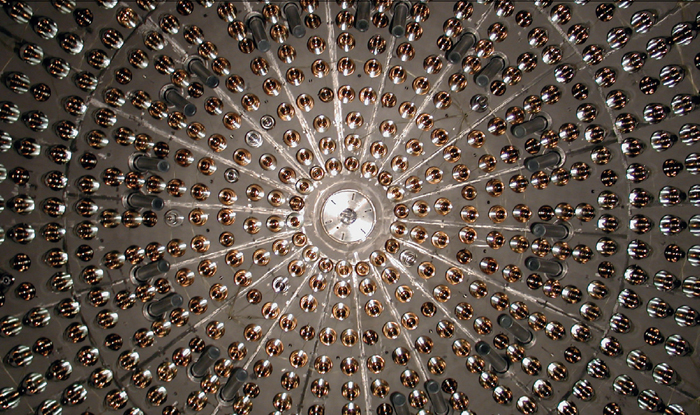
The Borexino experiment at the INFN Gran Sasso National Laboratories has measured the energy of the Sun in real time, showing for the first time that the energy released today at its centre is exactly the same as that produced 100,000 years ago. This has been possible through the experiment’s direct detection of the low-energy neutrinos produced in the initial nuclear reactions occurring in the solar core.

Previous measurements of solar energy have always been made on the radiation (photons) that currently illuminate and heat the Earth. The energy of this radiation originates in the Sun’s nuclear reactions, but, on average, has taken 100,000 years to travel through the dense solar matter and reach the surface. Neutrinos produced by the same nuclear reactions, on the other hand, take only a few seconds to escape from the Sun before making the eight-minute journey to Earth. The comparison between the neutrino measurement now published by the Borexino collaboration and the previous measurements on the emission of radiant energy from the Sun shows that solar activity has not changed during the past 100,000 years.

CCnew2_08_14

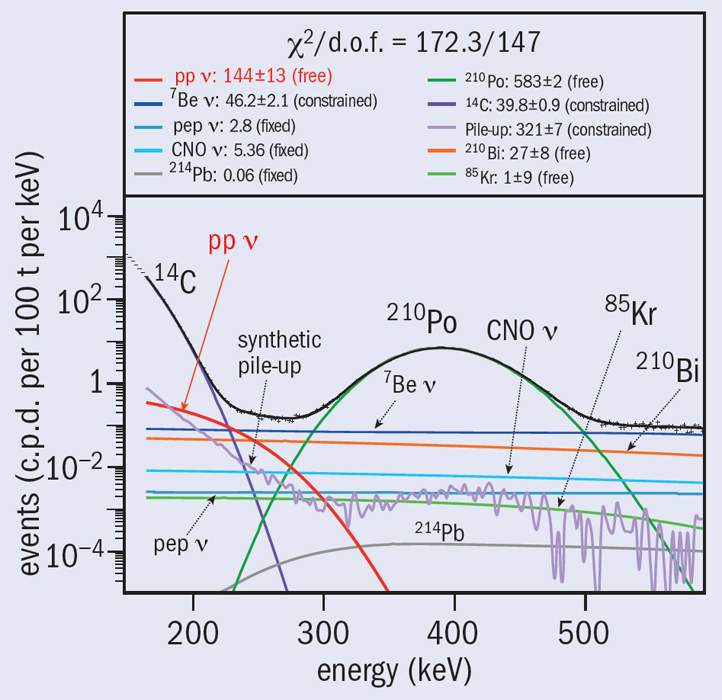
Borexino is an ultra-sensitive liquid-scintillator detector designed to detect low-energy neutrino events in real time at a high rate, in contrast to earlier radioachemical experiments such as Homestake, GALLEX and SAGE. The experiment previously has focussed on measurements of neutrinos from 7Be and 8B – nuclei formed in certain branches of the principal chain of reactions that converts hydrogen to helium at the heart of the Sun. The 7Be neutrinos constitute only 7% of the neutrino flux from the Sun and the 8B neutrinos even less, but they have been key to the discovery and study of the phenomenon of neutrino oscillations, most recently by Borexino. In contrast in this latest work, Borexino has focused on the neutrinos from the fusion of two hydrogen nuclei (protons) to form deuterium – the seed reaction of the nuclear-fusion cycle that produces about 99% of the solar power, some 3.84 × 1033 ergs/s.

The difficulty of the new measurement lies in the extremely low energy of these so-called pp neutrinos, which is smaller than that of the others emitted by the Sun. The capability to do this successfully makes the Borexino detector unique, and has also allowed the study of neutrinos produced by the Earth.

The Borexino experiment is the result of a collaboration between European countries (Italy, Germany, France, Poland), the US and Russia, and it will take data for at least another four years, improving the accuracy of measurements already made and addressing others of great importance, for both particle physics as well as astrophysics.

bright-rec iop pub iop-science physcis connect