For the first time in a single experiment, LHCb has achieved a precision of better than 10° in measuring the angle γ that is linked to CP violation in the Standard Model.
In the celebrated Cabibbo–Kobayashi–Maskawa (CKM) picture of three generations of quarks, the parameters that describe CP violation are constrained by one of the six triangles linked to the unitarity of the 3 × 3 quark-mixing matrix. The angles of this triangle are denoted α, β and γ, and of these it is γ that is the least precisely known. The precise measurement of γ is one of the most important goals of the LHCb experiment because it provides a powerful method to probe for the effects of new physics.
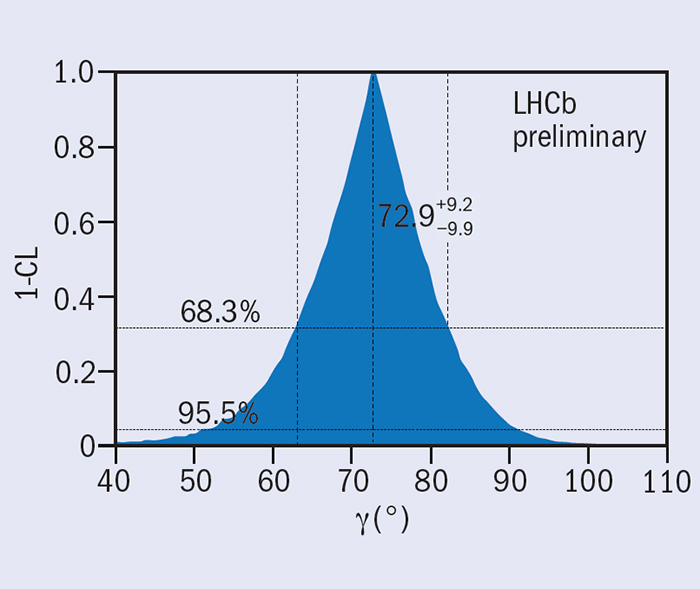
At the 8th International Workshop on the CKM Unitarity Triangle, CKM2014, which was held in Vienna recently, the LHCb collaboration presented a combination of measurements of the angle γ that yields the most precise determination so far from a single experiment. Using the full data set of 3 fb–1 integrated luminosity from the LHC running in 2011 and 2012, the collaboration has combined results on all its current measurements of “tree-level” decays. In particular, in combining results on B(s) →D(s) K(*) decays – the “robust” combination, in which a B or Bs meson decays into a D or Ds meson, respectively, and a kaon – the researchers find a best-fit value of γ = (72.9+9.2–9.9)° at the 68.3% confidence-level interval (see figure). The full combination presented at CKM2014 includes a large set of observables in B → Dπ decays that are also sensitive to γ, but to a lesser extent than the B → DK-like decays (LHCb Collaboration 2014).
Signs of new physics are not expected to show up in these tree-level decays, but they set a precise base for comparison with measurements where the observation of effects of new physics is possible. Moreover, even before taking into account data from LHC Run 2 from spring 2015, LHCb will be able to improve this result further using the data that has already been collected, because there are important analyses that are still to be completed.
The electric charge of lead ions, when accelerated to ultra-relativistic velocities, is the source of an intense flux of high-energy quasi-real photons. Ultra-peripheral collisions – the interaction of a photon with a target at impact parameters larger than the sum of the radii of the incoming particles, where hadronic interactions are suppressed – provide a clean tool to study photon-induced production processes at the LHC.
ALICE has performed the first measurement of exclusive photoproduction of J/ψ mesons off protons in proton–lead collisions at the LHC, using data collected in early 2013 (Abelev et al. 2014). These data cover a range of photon–proton centre-of-mass energies that were not accessible previously. Such interactions have been studied at the electron–proton collider HERA, and are proposed as a key measurement at a future electron–hadron collider, to probe the gluon distribution in the proton.
The J/ψ mesons were reconstructed from their decay into a μ+μ– pair, where the muons were measured by the ALICE muon spectrometer. Requiring no other activity to be present in the detector enforced the exclusivity condition. Around the middle of the data-taking period, the beam direction was inverted, allowing ALICE to take data first when protons, and later lead ions, were travelling towards the muon spectrometer, providing proton–lead and lead–proton collisions, respectively. The rapidity of the J/ψ, measured with respect to the direction of the proton beam, determines the photon–proton centre of mass energy (Wγp). In lead–proton collisions, the acceptance of ALICE corresponds to values of Wγp more than twice as large as was reached at HERA by the H1 and ZEUS experiments, while the proton–lead collisions correspond to values of Wγp studied previously at HERA and in fixed-target experiments.
According to leading-order calculations in perturbative QCD, this process depends on the square of the gluon distribution in the proton evaluated at a scale close to the J/ψ mass (MJ/ψ) and at x-Bjorken x = (MJ/ψ/Wγp)2. The range in x covered by ALICE therefore extends from about 2 × 10⁻² (proton–lead) to 2 × 10⁻⁵ (lead–proton). It is then possible to study the evolution of the gluon density in the proton at a perturbative scale along three orders of magnitude in x, and probe into the region where the gluon density increases, possibly leading to a saturation regime, in which the proton wave-function is described by a coherent colour field created by the many overlapping gluons.
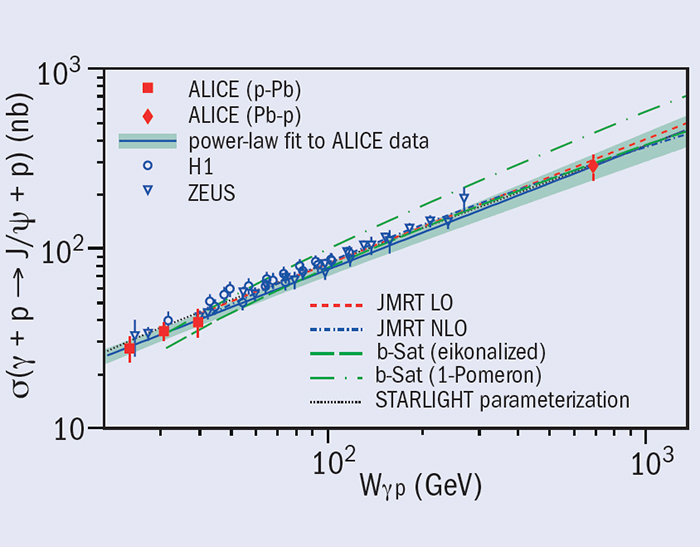
The cross-section measured by ALICE (see figure) has been compared with the predictions of models based on (i) perturbative QCD calculations at leading order (ii) and including the main next-to-leading order contributions, (iii) a saturation prescription including impact parameter dependence and (iv) a parameterization of HERA and fixed-target results. All models were fitted to HERA measurements, and are able to describe the current ALICE data.
ALICE has found that a power law in Wγp can describe the measured cross-section. The value of the power-law exponent is compatible with those found by H1 and by ZEUS. Therefore, no deviation from the same power law is observed up to about 700 GeV, or in a leading-order perturbative QCD context, down to x = 2 × 10⁻⁵, extending by a factor five the maximum x value explored previously.
In conclusion, within the current precision, ALICE has observed no change of regime with respect to what was measured at HERA. Data to be collected during LHC Run 2 at beam energies increased by a factor of two will allow ALICE both to improve the precision of the measurement and to access larger values of Wγp. Lowering the x value to values never reached before will open new opportunities to search for saturation phenomena.
The WW final state was a key component in the discovery of the Higgs boson with a mass of around 125 GeV, and remains essential for the ongoing measurements of the particle’s properties. Now, the ATLAS collaboration has firmly established the existence of this process, observing an excess consistent with H → WW, with a significance of 6.1σ compared with the background-only hypothesis (ATLAS Collaboration 2014a). In addition, ATLAS has measured the inclusive signal strength with a precision of about 20%, thereby taking the next step towards a precision measurement of the strength of the HWW interaction.
The new results are based on the combined 7-and-8-TeV ATLAS datasets from Run 1 of the LHC, and a total integrated luminosity of 25 fb–1. The analysis selects Higgs boson candidate data from events that have two charged leptons: electrons or muons. Improvements since the previous result – including likelihood-based electron identification and missing transverse-energy reconstruction that is more robust to pile-up – have allowed ATLAS to lower kinematic thresholds and so increase the signal acceptance.
The main backgrounds are from WW and top-quark pair production, with important contributions from Drell–Yan, Wγ*, and inclusive W production with a second, “fake” lepton produced by a jet. Categorizing the events by the number of jets separates the signal from the otherwise dominant background of top-quark pair production, and distinguishes between the vector-boson-fusion (VBF) and gluon–gluon fusion (ggF) production modes. Within each category, subdividing the signal regions by the flavours and kinematic properties of the lepton pair enhances the sensitivity by further separating signal from background, and separating different background processes from each other.
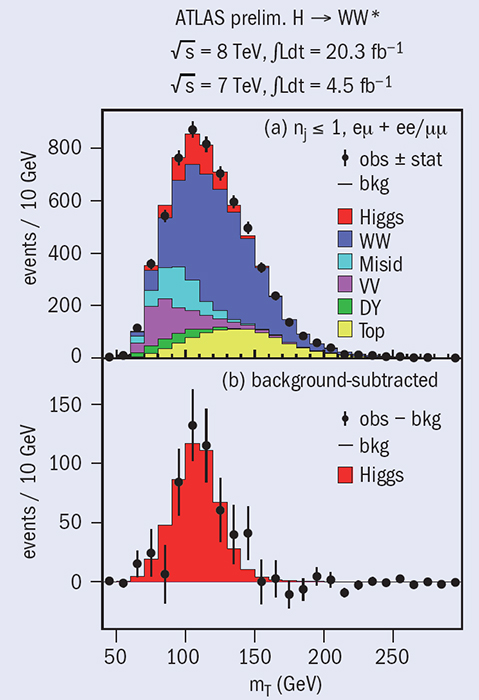
The number of signal events is determined by a fit to the distribution of an event property to separate signal and backgrounds still further. For the ggF categories, the dilepton “transverse mass”, mT, is used. The figure shows the distribution of mT for the 0 and 1 jet categories, compared with the summed signal and background expectation. It demonstrates the good agreement between the prediction, including the Higgs boson signal, and the observed data. For the VBF categories, a fit is made to the output of a boosted decision tree (BDT) – another new development since the previous ATLAS analysis. The BDT is trained using variables that are sensitive to the Higgs boson decay topology, as well as to the distinctive VBF signature of two energetic, well-separated jets.
At 125.36 GeV – the value of the Higgs boson mass measured by ATLAS from the γγ and ZZ* → 4l channels (ATLAS Collaboration 2014b) – the expected significance for an excess in H → WW is 5.8σ, and a significance of 6.1σ is observed. The measured signal strength, defined as the ratio of the measured H → WW cross-section to the Standard Model prediction, is μ = 1.08+0.16–0.15 (statistical) +0.16–0.13 (systematic).
Evidence for VBF production can be seen also from analysis of the categories. The ratio of the VBF and ggF signal strengths does not assume a value for the H → WW branching ratio or the ggF cross-section. A nonzero ratio indicates the presence of the VBF production mode. The result is μVBF/μggF = 1.25+0.79–0.52, which corresponds to a significance of 3.2σ, compared with 2.7σ expected for the Standard Model.
This analysis represents a significant advance in the understanding of the signal and background processes in the challenging dilepton WW channel. It establishes the observation of this decay, and the signal-strength measurement is, at present, the most precise obtained in a single Higgs boson decay channel. The results are consistent with the predictions for a Standard Model Higgs boson, but they remain limited by the statistical uncertainty, pointing to the potential of future measurements with data from Run 2 at the LHC.
Experiments at Fermilab are advancing an intriguing story that began three decades ago, with investigations of coherent neutrino interactions that produce pions yet leave the target nucleus unscathed.
When neutrinos scatter coherently off an entire nucleus, the exchange of a Z0 or W± boson can lead to the production of a pion with the same charge. The first observations of such interactions came in the early 1980s from the Aachen–Padova experiment at CERN’s Proton Synchrotron, followed by an analysis of earlier data from Gargamelle. A handful of other experiments at CERN, Fermilab and Serpukhov provided additional measurements before the end of the 1990s. These experiments determined interaction cross-sections for high-energy neutrinos (5–100 GeV), which were in good agreement with the model of Deiter Rein and Lalit Sehgal of Aachen. Published shortly after the first measurements were made, their model is still used in some Monte Carlo simulations.
More recently, the SciBooNE and K2K collaborations attempted to measure the coherent production of charged pions at lower neutrino energies (less than 2 GeV). However, they found no evidence of the interaction, and published upper limits below Rein and Sehgal’s original estimation. These results, together with recent observations of coherent production of neutral pions by the MiniBooNE and NOMAD collaborations, have now motivated renewed interest and new models of coherent pion production.
In the NuMI beamline at Fermilab – which has a peak energy of 3.5 GeV and energies beyond 20 GeV – coherent charged-current pion production accounts for only 1% of all of the ways that a neutrino can interact. Nevertheless, both the ArgoNeuT and MINERvA collaborations have now successfully measured the cross-sections for charged-current pion production by recording the interactions of neutrinos and antineutrinos.
ArgoNeuT uses a liquid-argon time-projection chamber (TPC), and has results for coherent interactions of antineutrinos and neutrinos at mean energies of 3.6 GeV and 9.6 GeV, respectively (Acciarri et al. 2014). A very limited exposure produced only 30 candidates for coherent interactions of antineutrinos and 24 for neutrinos (figure 1), but a measurement was possible thanks to the high resolution and precise calorimetry achieved by the TPC. It is the first time that this interaction has been measured in a liquid-argon detector. ArgoNeuT’s results agree with the state-of-the-art theoretical predictions (figure 2), but its small detector size (<0.5 tonnes) limits the precision of the measurements.
MINERvA uses a fine-grained scintillator tracker to fully reconstruct and select the coherent interactions in a model-independent analysis. With 770 antineutrino and 1628 neutrino candidates, this experiment measured the cross-section as a function of incident antineutrino and neutrino energy (figure 2). The measured spectrum and angle of the coherently produced pions are not consistent with models used by oscillation experiments (Higuera et al. 2014), and they will be used to correct those models.
The techniques developed during both the ArgoNeuT and MINERvA analyses will be used by larger liquid-argon experiments, such as MicroBooNE, that are part of the new short-baseline neutrino programme at Fermilab. While these experiments will focus on neutrino oscillations and the search for new physics, they will also provide more insight into coherent pion production.
It looks like a small black button, but in tests at Fermilab’s High-Brightness Electron Source Lab it has produced beam currents 103–106 times greater than those generated with a large laser system. Designed by a collaboration led by RadiaBeam Technologies, a California-based technology firm actively involved in accelerator R&D, this electron source is based on a carbon-nanotube cathode only 15 mm across.
Carbon-nanotube cathodes have already been studied extensively in university research labs, but Fermilab is the first accelerator facility to test the technology within a full-scale setting. With its capability and expertise for handling intense electron beams, it is one of relatively few labs that can support a project like this.
Traditionally, accelerator scientists use lasers to strike cathodes to eject electrons through photoemission. With the nanotube cathode, a strong electric field pulls streams of electrons off the surface of the cathode though field emission. There were early concerns that the strong electric fields would cause the cathode to self-destruct. However, one of the first discoveries that the team made when it began testing in May was that the cathode did not explode. Instead, the exceptional strength of carbon nanotubes prevents the cathode from being destroyed. The team used around 22 MV/m to produce the target current of more than 350 mA.
The technology has extensive potential applications in medical equipment, for example, since an electron beam is a critical component in generating X-rays.
• A Department of Energy Small Business Innovation Research grant funds the RadiaBeam-Fermilab-Northern Illinois University collaboration.
On 9–10 September, representatives of about 70 institutes worldwide met at CERN to establish the International Collaboration Board (ICB) at the Future Circular Collider (FCC) study. The study covers the designs of a 100-TeV hadron collider and a high-luminosity lepton collider, the associated detectors and physics studies, and a lepton–hadron collider option. These generic and mostly site-independent studies will be complemented by a civil-engineering study for the Geneva area, requested in the context of the European Strategy for Particle Physics. The large attendance at the preparatory ICB meeting testifies to the attractiveness of the FCC approach, which aims to explore the energy scale of tens of teraelectronvolts.
Opening the meeting, CERN’s director-general, Rolf Heuer, outlined the planned organizational structure of the FCC study, which will operate as an international collaboration under the auspices of the European Committee for Future Accelerators. As the central overseeing body, the ICB will comprise representatives from all participating institutes. The proposed structure was endorsed by all attendees. Prior to the meeting, more than 20 institutes had already signed the FCC Memorandum of Understanding and become official members of the FCC collaboration. Several more institutes joined during the event. The institutes with confirmed participation endorsed Leonid Rivkin of Ecole polytechnique fédérale de Lausanne and PSI – a widely recognized accelerator expert – as interim chair of the ICB.
Delegates were impressed by the progress made on this design since the FCC kick-off event at the University of Geneva in February. The presentations reviewed the status of ongoing work for the study formation, accelerator designs, technologies, infrastructure, and experiments. They highlighted, in particular, the anticipated impact that the study should have on many different types of technologies, such as advanced cryogenics, new production procedures for RF cavities, novel surface treatments of vacuum-chamber materials, lower-cost and more compact high-field magnets. Representatives of most of the institutes participating also described their respective expertise and proposed contributions.
In parallel to the progress being made in forming the international FCC collaboration, a design-study proposal focused on the FCC hadron collider has been submitted to the European Commission in the context of the Horizon 2020 programme. The main technological R&D areas have been identified, and a work plan is being established with potential partners.
The coming months will see enhanced design activities aimed at convergence and down-selection between different alternative options for the overall collider layouts and beam parameters. The next major milestone for the FCC collaboration will be the first large annual workshop, which will take place in Washington DC on 23–27 March 2015.
The Planck collaboration has published an all-sky map of the polarized thermal emission of dust grains in the Milky Way. It shows that the field used by the experiment for Background Imaging of Cosmic Extragalactic Polarization (BICEP2) to measure B-mode polarization of the cosmic microwave background (CMB) is contaminated significantly by galactic-dust emission. The B-mode signal detected by the BICEP2 collaboration would, therefore, at least in part, be due to dust, and not to the claimed primordial gravitational waves giving evidence for inflation (CERN Courier May 2014 p13).
The announcement on 17 March 2014 of the detection of swirling B-mode polarization in the CMB by the BICEP2 collaboration took the scientific community by surprise. This particular type of polarization is not spectacular by itself, but by the interpretation that it is due to primordial space–time metric fluctuations “frozen-in” by inflation and then amplified to degree-scale gravitational waves. The BICEP2 results were therefore seen as evidence for inflation, and for a quantum-gravitational process at an energy approaching the Planck scale, where all of the fundamental forces are thought to be unified.
Soon after the initial excitement about this extraordinary result, suspicion arose on the interpretation of the observations in view of possible foreground contaminations. A prime concern was the production of a similar B-mode polarization signal by the thermal emission of asymmetrical dust grains, which align on the magnetic field of the Galaxy (Picture of the month, CERN Courier June 2014 p17). Some researchers incriminated the weak accuracy of dust data used in the BICEP2 study to estimate foreground contamination. New results from ESA’s Planck mission on galactic-dust polarization were therefore highly anticipated.
This paper appeared on the arXiv preprint server on 19 September. Although not yet peer reviewed, the study casts doubts on the interpretation of the B-mode signal being due to primordial gravitational waves. It shows that the amount of dust in the field observed by BICEP2 is significantly higher than was assumed in the paper by the scientists of the Harvard-Smithsonian Center for Astrophysics. How much of the measured B-mode signal is due to dust emission is not yet clear, owing to large uncertainties. The dust contribution extrapolated from the Planck 353 GHz band is, however, found to be at roughly the same level as the observed BICEP2 signal at 150 GHz.
To establish better whether the entire alleged cosmological signal is due to dust foreground, a more detailed analysis of both the BICEP2 and Planck data is currently being carried out jointly by the two teams. The Planck collaboration expects the results of this cross-correlation of the two maps to be published in the same time frame as the next release of Planck data, and results are foreseen for the end of November 2014.
Even if it turns out that the published BICEP2 signal is due to dust solely, this is not the end of the story. Indeed, Planck has shown that there are other regions in the sky with less dust emission. These would be prime targets to observe primordial B-modes by the next-generation instrument, BICEP3, which will soon improve in sensitivity and operate at a frequency of 100 GHz, which is less affected by dust contamination.
In March 2001, the Brookhaven g-2 storage ring was retired, after producing the world’s best measurements of the muon’s anomalous magnetic moment, aμ = (g-2)/2. However, the experiment produced a cliffhanger: the experimental result differed by 3–4σ from the theoretical prediction for aμ, hinting potentially at the presence of new physics beyond the Standard Model.
Now, a new experiment to measure aμ is under construction at Fermilab, with the goal of confirming or refuting the evidence produced at Brookhaven. The new Muon g-2 collaboration will reuse Brookhaven’s storage-ring magnet and several of its subsystems to do the experiment with a precision four times better. In the summer of 2013, a company specializing in moving large objects brought the centrepiece of the storage-ring system – a 14-m-diameter electromagnet – from Brookhaven to Fermilab (CERN Courier July/August 2013 p11). Then, during summer this year, the next milestone was achieved as re-assembly of the storage ring began in the newly completed MC-1 building at Fermilab (figures 1 and 2).
The superconducting magnet – the design led by Gordon Danby, Hiromi Hirabayashi and Akira Yamamoto, beginning in the late 1980s – provides a highly uniform, essentially pure, 1.45-T dipole field throughout its 44.7-m circumference (Danby et al. 2001). The storage-ring system includes a unique superconducting inflector magnet that enables bunches of 3.1 GeV/cmuons produced in a pion-decay channel to enter the magnetic-field region along a nearly field-free path. A pulsed kicker applies a magnetic deflection to redirect the incoming muons into the ring’s storage volume. A set of four electric quadrupoles provide vertical focusing without perturbing the critical uniform magnetic field. This unique system of devices allows direct injection of the muons – a breakthrough compared with previous g-2 experiments – allowing the Brookhaven experiment to improve the precision by a factor of 14, compared with the series of experiments that took place at CERN in the mid 1970s. The final result from the Brookhaven E821 experiment is aμ = 116 592 089 (63) × 10–11 – a precision of 0.54 ppm – where the error is dominated by statistics, not systematics (Muon g-2 Collaboration 2006).
To measure g-2, polarized muons are injected into the storage ring and their spin evolution is tracked as they circulate. If g were exactly equal to 2, the muon spin would remain in the direction of its momentum. For g > 2, the spin advances, or precesses, proportionally to the anomalous part of the magnetic moment. In this particular storage ring, on every 29.4 revolutions, the spin orientation advances by one turn compared with the momentum. Parity violation in the weak decay of the muon then serves as the spin analyser. The higher-energy electrons in the μ → eνν decay chain are emitted preferentially in the direction of the muon spin at the time of the decay. Because the electrons have lower momentum compared with the muons, they curl to the inside of the storage ring, where they can be detected. Figure 3 shows a histogram of the arrival time vs the time after injection for the higher-energy electrons, measured when they struck one of 24 symmetrically placed electromagnetic calorimeters located just to the inside of the storage volume in the E821 experiment. The characteristic anomalous precession frequency is clearly visible. When combined with the integrated magnetic field that is measured using pulsed proton NMR, the ratio of these quantities – precession frequency to field – leads directly to the quoted result for g-2.
The g-2 measurement tests the completeness of the Standard Model, because aμ arises from quantum fluctuations, as figure 4 illustrates. The theory must account for the quantum fluctuation effects from all known Standard Model particles that influence the muon’s magnetic moment. If something is left out, or there is a contribution from new physics, the theory would not match the experiment. While the contributions from QED and the weak interaction are well known, those from hadronic terms drive the overall theoretical uncertainty of about 0.46 ppm. The largest uncertainty comes from hadronic vacuum-polarization contributions. They can be determined directly from cross-section measurements at e+e– colliders, and vigorous programmes are underway in Novosibirsk, Beijing and Frascati to improve these measurements. More difficult to assess, although much smaller in magnitude, is the (α/π)3 hadronic “light-by-light” diagram. However, a recent dedicated workshop reports significant progress and plans to improve this situation, including progress in lattice-gauge calculations (Benayoun et al. 2014).
The Brookhaven measurement differs from the prediction of the Standard Model by roughly 3–4σ, depending on the details of the hadronic contribution used in the comparison (Blum et al. 2013). While the present comparison is tantalizing, it does not meet the 5σ standard required for a discovery. Nevertheless, many theorists have speculated on what might be implied if it holds up to further scrutiny. Dominant themes include low-energy supersymmetry, dark gauge bosons, Randall–Sundrum models and others with large extra dimensions, to name a few. The impact of the result – whether it remains large and significant, or in the end agrees with the Standard Model – will constrain many theories of new physics.
To push further requires “more muons”. Following the completion of E821, a number of ideas were considered, but the winning concept came from a clever reuse of the Fermilab accelerator complex – in particular, much of the antiproton production facility – to produce a rapidly cycling injection of a pure, high-intensity muon beam, with nearly 100% polarization, into the storage ring. The plan, now part of a more global “Muon Campus” concept that includes the muon-to-electron search experiment (Mu2e), will result in a 20-fold increase in statistics compared with Brookhaven. The only obstacle was that the specialized storage-ring system was in New York and had not been powered for more than a decade. So, how to move it? And, once moved, would it still work? The delicate transcontinental move – by lorry, barge across sea and along river, and finally again by lorry – to deliver the 14-m-diameter superconducting coils to the Fermilab site enjoyed much publicity. With far less fanfare, 50 lorries hauled 650 tonnes of steel and other equipment westward.
The new Muon g-2 experiment at Fermilab, also known as E989, is now a mature effort. The collaboration of 36 institutions from eight countries will use or refurbish many of the components from the past. Nevertheless, much is totally new. With a higher expected beam rate, more rapid filling of the ring, and even more demanding goals in systematic uncertainties, the collaboration has had to devise improved instrumentation. The ring kicker-system will be entirely new, optimized to give a precise kick on the first turn only, to increase the storage fraction. The magnetic field will be even more carefully prepared and monitored. The detectors and electronics are entirely new, and a state-of-the-art calibration system will ensure critical performance stability throughout the long data-taking periods. New in situ trackers will provide unprecedented information on the stored beam. The first physics data-taking is expected in early 2017. The next critical milestone will be the cooling of the superconducting coils and powering of the storage-ring magnet, which is expected by spring 2015.
The magnificent Playfair Library in the historic centre of Edinburgh provided a spectacular setting for the scientific presentations of the 15th International Conference on B-Physics at Frontier Machines (Beauty 2014). The purpose of this conference series is to review the state of the art in the field of heavy-flavour physics, and to address the physics potential of existing and future B-physics experiments. This line of research aims to explore the Standard Model at the high-precision frontier, the goal being to reveal footprints of “new physics” originating from physics beyond the Standard Model in observables that can be predicted reliably. Hosted by the University of Edinburgh on 14–18 July, Beauty 2014 attracted around 90 physicists, including leading experts on flavour physics from across the world, to present and discuss the latest results in the field.
The key topics in flavour physics are strongly suppressed rare decays and decay-rate asymmetries that probe the phenomenon of CP violation. The non-invariance of weak interactions under combined charge-conjugation (C) and parity (P) transformations was discovered 50 years ago through the observation of KL → π+π– decays (CERN Courier July/August 2014 p21). The Cabibbo–Kobayashi–Maskawa (CKM) mechanism, postulated 10 years later, allows CP violation to arise in the Standard Model, in particular in the decays of B mesons (CERN Courier December 2012 p15). These particles are hadronic bound states of a b antiquark and a u, d, s or c quark. In the case of the neutral B0d and B0s mesons, quantum-mechanical particle–antiparticle oscillations give rise to interference effects, which can induce manifestations of CP violation. Flavour-changing neutral currents are forbidden at the tree level in the Standard Model, and are therefore sensitive to new particles that might reveal themselves indirectly through their contributions to loop processes. These features are at the basis of the search for new physics at the high-precision frontier.
The exploration of B physics is dominated currently by the dedicated LHCb experiment, as well as the general-purpose ATLAS and CMS experiments at the LHC. The completion of the upgrade of the KEKB collider and the Belle detector in Japan in the coming years will see KEK re-join the B-physics programme, when the Belle II experiment starts up at SuperKEKB (CERN Courier January/February 2012 p21).
At Beauty 2014, the programme of 13 topical sessions included 61 invited talks. The majority covered a variety of new analyses and experimental results, complemented by a series of review talks on theoretical aspects. In addition, seven early-career researchers (PhD students and postdocs) presented posters in a dedicated session.
Highlights of the conference included a measurement of CP violation in the decay B0s → φφ, new results on the determination of the angle γ of the unitarity triangle from B → DK and B0s → D±sK± decays – the former of which receives contributions from “tree” topologies only – and B0s → K+K– and B0d → π+π– decays, which also receive “penguin” contributions where new particles might enter in the loops. The results for γ are consistent among one another within the uncertainties and the information on the unitarity triangle coming from global fits of various observables. The error on direct γ measurements is now approximately 9°, with significant contributions from the latest results from LHCb, which will continue to improve this precision. Impressive new measurements of the weak phase φs and decay-width difference ΔΓs were presented by CMS and LHCb in B0s → J/ψφ and B0s → J/ψππ decays. The latter is now the most precise φs result, with an uncertainty of 68 mrad, and the results are in agreement with the predictions of the Standard Model.
In the field of rare B-meson decays, there were reports on impressive theoretical progress for B0s → μ+μ– decays. This is one of the rarest decays that nature has to offer, and is therefore a very sensitive probe of new physics. Theoretical improvements relate to the calculation of higher-order electroweak and QCD corrections, which resulted in a higher precision on the predicted theoretical Standard Model branching ratio for this channel. The experimental evidence for this decay was reported by the CMS and LHCb collaborations in the summer of 2013, and is one of the highlights of Run 1 of the LHC. New combined results have recently been made public by the two collaborations.
Measurements of the angular distribution of the rare B0d → K*0μ+μ– decay and comparison with respect to calculations within the Standard Model was another hot topic. A discrepancy is observed in a single bin in the distribution of the so-called P5´ observable. The key question is whether strong-interaction processes or new physics effects are causing this discrepancy. The possibilities led to interesting discussions during the session, which continued during the coffee breaks. Improved statistics on this and related channels from Run 2 at the LHC are awaited eagerly.
The opening talk of the conference was given by John Ellis of King’s College London and CERN, who presented his perspective and vision for the search for new physics
In the ratio of the rates of B+ → K+μ+μ– and B+ → K+e+e– decays, which test lepton-flavour universality, LHCb reported a new 2.6σ deviation from the Standard Model, which has to be explored in more detail. Moreover, first results on measurements of the photon polarization in b → sγ by the B factories and LHCb were presented, and this will be studied in a more powerful way by Belle II and the upgraded LHCb.
Many other interesting measurements and developments were discussed at the conference. One of these concerned the first observation of a heavy-flavoured spin-3 particle, the D*s(2860)– meson, observed by LHCb in the decay of a B0s meson (CERN Courier September 2014 p8). Another was the confirmation of an exotic resonance Z(4430) composed of four quarks, also by LHCb (CERN Courier June 2014 p12). In addition, many more results were presented on heavy-flavour production and spectroscopy at the B factories, at Fermilab’s Tevatron and at the ALICE, ATLAS, CMS and LHCb experiments.
On the theory frontier, there was an excellent review of the spectroscopy of B hadrons and bottomonium. Impressive progress reported in the calculation of non-perturbative parameters with lattice QCD has already had an important impact on various analyses. Other topics included the status of lepton-flavour violation and models of physics beyond the Standard Model, searches for exotic new physics such as Majorana neutrinos, charm physics and rare kaon decays.
The opening talk of the conference was given by John Ellis of King’s College London and CERN, who presented his perspective and vision for the search for new physics – in particular supersymmetry – at the LHC and beyond. A whole session was devoted to prospects for the future B-physics programme, addressing the upgrades of LHCb, ATLAS, CMS and Belle II. An exciting summary and outlook talk by Hassan Jawahery of the University of Maryland concluded the conference.
The University of Edinburgh provided an impressive social programme. No visit to Scotland is complete without whisky tasting, and participants were treated to the option of 25 different samples. A walking tour of the historic Edinburgh Castle was complemented by a bus tour and a boat ride under the famous Forth Bridge. The conference dinner, held at the Dynamic Earth museum, included another Scottish speciality – haggis.
In conclusion, the 15th Beauty conference was a great success, with presentations of exciting new results. Now it is time to look forward to the next edition, to be held in the spring of 2016.
In the field of elementary particle physics, the International Conference on High Energy Physics (ICHEP) is the largest meeting organized at a global level. Having started in 1950 at Rochester in New York, it was for several years known simply as the “Rochester Conference”. Organized by Section C11 (Particles and Fields) of the International Union for Pure and Applied Physics (IUPAP), the conferences have since taken place across the world, in recent years in Philadelphia (2008), Paris (2010) and Melbourne (2012), for example.
For its 37th edition, ICHEP went to Spain for the first time, where it took place at the Valencia Conference Centre on 2–9 July. The selection of Spain as host of the prestigious conference is recognition of the country’s progress in this field of fundamental knowledge. Its importance for Spain was clear from the presence at the inaugural session of Carmen Vela, secretary of state for research, development and innovation from the Ministry of Economy and Competitiveness, as well as several other academic and regional government representatives. ICHEP 2014 attracted a total of 967 scientists from 53 countries, with the largest delegation of 193 participants coming from Spain. The main international laboratories in the field were well represented, many at a high level: the directors of CERN, DESY, Fermilab, KEK and the Institute of High Energy Physics, Beijing, attended the conference, and participated actively in several sessions.
After the formidable impact in the media of the announcement of the discovery of the Brout–Englert–Higgs (BEH) boson at CERN on 4 July 2012, on the eve of the opening of the previous ICHEP in Melbourne (CERN Courier September 2012 p53), it was somehow unrealistic to hope that an announcement or confirmation of a result of similar outstanding scientific consequences would happen in Valencia. In this field of science, spectacular milestones alternate with less glamorous phases in which levels of knowledge are consolidated. In many cases, the construction of complete sets of precision measurements, and a deep understanding of them, reveal the way towards progress, and indicate the right roads of exploration to follow. In this respect, and given the large variety of data sets, analyses and interpretations of results presented, ICHEP 2014 did not disappoint.
Following what has become common practice in the ICHEP series, the programme in Valencia consisted of parallel and plenary sessions. In the 15 parallel sessions, 538 experimental and theoretical communications were presented, covering most of the areas in the field. A summary of the results discussed in these sessions was then given in 55 talks in the 42 plenary sessions that took place in the second half of the conference. The scientific programme was completed with 18 additional talks, as well as a display of more than 200 posters summarizing the work of young researchers.
The results of the experiments at CERN’s LHC and Fermilab’s Tevatron – studying proton–proton, proton–lead, lead–lead and proton–antiproton collisions at high energy – were presented in detail, those from the LHC being based on all of the data collected up to the start of the first long shutdown early in 2013. In particular, the dynamical features of the processes in these energy ranges (the QCD domain), the static and dynamical properties of the BEH boson, the properties of the top quark, the extremely rare decay modes and very small branching ratios of hadrons containing a b quark, and appropriate comparisons with the Standard Model figured in many of the presentations.
Although, the Standard Model explains most of the precise measurements collected up to now at a variety of experimental facilities, it is accepted widely that there are still plenty of questions to be answered – a situation that underlies the need to modify and extend the current paradigm to cure the detected weaknesses. Among the most notorious of these is the lack of understanding of the nature of dark matter – an intriguing form of matter that cannot be explained by the quarks and leptons of the Standard Model, and so points towards new physics. The capability of new models, such as supersymmetry, theories with extra dimensions, technicolour, etc, to overcome this and other conceptual and observational difficulties must be evaluated in the coming years, when the availability of new sets of data become a reality, in particular from the upgraded LHC.
Celebrating CERN’s 60th anniversary
On the occasion of CERN’s 60th anniversary, the ICHEP 2014 organizing committee thought it appropriate to schedule a special session to highlight the contributions of this unique organization to the acquisition of scientific and technological knowledge in basic science, as well as the important role that CERN has played in fostering international collaboration, in the worlds of academia and education, in the training of researchers, engineers and technicians, and in activities dealing with knowledge and technology transfer to the industrial and business communities.
Speaking first, Rolf Heuer, CERN’s director-general, stressed the relevance of basic research in fostering technological development and innovation in a global and open worldwide environment, and sent encouraging key messages to the youngest sector of the audience. Lyn Evans, former head of the LHC Project, then gave a lively recollection of the technical developments and immense challenges involved in bringing the LHC construction project to a happy conclusion. He was followed by Sergio Bertolucci, director of research and computing technology, who reviewed CERN’s current activities and some of its past achievements, as well as the ongoing tasks related to future options following the road map defined by the European Strategy for Particle Physics approved by CERN Council in 2013. The many ongoing technical activities related to the LHC – which will start a new phase of operation at higher energy and luminosity in the spring of 2015 – were then presented by Miguel Jiménez, head of the technology department. Finally, Manuel Aguilar of CIEMAT summarised the successful evolution of high-energy particle physics in Spain, and the important role that CERN has played in this context (see “CERN and Spain”, below).
The presentation and discussion of new and relevant results in neutrino physics, obtained in a diverse set of experimental facilities, was another highlight of the conference, together with many topics in astroparticle physics and cosmology. The recent results obtained at the BICEP2 telescope at the South Pole – which might provide the first experimental evidence of cosmic inflation – and the current status of the analysis of the data collected by the European satellite Planck, together with the theoretical implications of these measurements, deserved particular attention. This special session on cosmology and particle physics, which was a major highlight of the conference, was closed beautifully with a splendid lecture by Alan Guth, one of the distinguished proponents of the theory of cosmic inflation.
The status of projects at different stages of design and prototyping for the construction of new large scientific installations (linear and circular colliders, neutrino beams and detectors, underground laboratories for the study of neutrinos and dark-matter candidates, detector arrays for high-energy cosmic rays, satellites and other space platforms, etc), and the regional strategies and road maps, are topics that were included in another interesting session, leading to ample discussions. The programme of the parallel sessions also included presentations dealing with the formidable effort that, at the global level, is carried out in R&D activities on detectors, accelerators, data acquisition and trigger issues, and computing technologies. Last but not least, the role and relevance of outreach and the relations between science, technology, industry and society were analysed and discussed.
The plenary sessions provided summaries of the contributions presented in the parallel sessions, as well as a concluding synthesis of the contents of the conference and on the future of the field. As emphasized in the closing talks by Young-Kee Kim of the University of Chicago and Antonio Pich of the University of Valencia, a wealth of new data has led to considerable advances in many areas since the previous ICHEP two years ago. However, it became equally clear that, in the years to come, there remains plenty of challenging work to be done to answer the many intricate and fundamental open questions that the field still faces. One subject that will trigger further attention in future is the possible connection between the scalar field responsible for electroweak-symmetry breaking (the BEH boson) and the scalar field that might be at the origin of cosmic inflation in the early stages of the universe (the inflaton). The solution to this and many other fascinating questions is awaiting new experimental data and revolutionary theoretical ideas. With all of these ingredients, this area of fundamental knowledge is clearly facing a challenging and exciting future.
In addition to the scientific programme, participants at the conference were able to appreciate an exhibition of posters concerning the situation of women studying physics in Palestine, while another exhibition showed the connection between art and scientific research. CERN’s travelling exhibition “Accelerating Science”, displayed at the Ciudad de las Artes y las Ciencias in Valencia’s town centre, received plenty of attention from the general public. The conference also had impressive media coverage in the press, the main broadcasting networks and in national and regional television channels. Around 15 journalists from the most relevant media in science communication attended sessions, reported on the main events and interviewed numerous participants.
A highlight of the social programme was the marvellous concert on the theme of “Science and music working for peace”, given by the Orchestra and Chamber Choir of the Professional Conservatoire of Music of Valencia. This was accompanied by the projection of images – many unpublished – relating to the history of CERN and the development of particle physics in Spain. Finally, the conference banquet at the wonderful Huerto de Santa María provided a brilliant ending for the social programme.
• The Spanish institution in charge of organization was the Instituto de Física Corpuscular (IFIC), Joint Centre University of Valencia – CSIC (Council for Scientific Research). There was also ample sponsorship from several domestic and international institutions.
CERN and Spain
This year has seen celebrations of the 30th anniversary of the return of Spain to CERN in November 1983, after a long period of absence that began in 1969. Many generations of Spanish researchers, engineers and technicians have been educated and trained in the international, highly competitive and technological CERN environment, At the same time, numerous companies and industrial firms in Spain have become acquainted with a diverse range of techniques, procedures and innovations, many of them at the forefront of technology and with remarkable potential. It is appropriate to recognize not only the nurturing effect that CERN has had in the positive evolution of science in Spain – particularly the experimental and technological components – but also the importance for CERN of having Spain among its member states. Today, Spain contributes approximately 8.5% to the CERN budget and, beyond this substantial support, brings a well-trained and motivated community that is eager to take part in the CERN adventure.
To provide the best experiences, we use technologies like cookies to store and/or access device information. Consenting to these technologies will allow us to process data such as browsing behavior or unique IDs on this site. Not consenting or withdrawing consent, may adversely affect certain features and functions.
Functional
Always active
The technical storage or access is strictly necessary for the legitimate purpose of enabling the use of a specific service explicitly requested by the subscriber or user, or for the sole purpose of carrying out the transmission of a communication over an electronic communications network.
Preferences
The technical storage or access is necessary for the legitimate purpose of storing preferences that are not requested by the subscriber or user.
Statistics
The technical storage or access that is used exclusively for statistical purposes.The technical storage or access that is used exclusively for anonymous statistical purposes. Without a subpoena, voluntary compliance on the part of your Internet Service Provider, or additional records from a third party, information stored or retrieved for this purpose alone cannot usually be used to identify you.
Marketing
The technical storage or access is required to create user profiles to send advertising, or to track the user on a website or across several websites for similar marketing purposes.