Comsol -leaderboard other pages

Topics

Faraday, Maxwell, and the Electromagnetic Field: How Two Men Revolutionized Physics

By Nancy Forbes and Basil Mahon
Prometheus Books
Hardback: $25.92

CCboo1_10_14

The birth of modern physics coincides with the lifespans of Michael Faraday (1791–1867) and James Clerk Maxwell (1831–1879). During these years, electric, magnetic and optical phenomena were unified in a single description by introducing the concept of the field – a word coined by Faraday himself while vividly summarizing an amazing series of observations in his Experimental Researches in Electricity. Faraday – a mathematical illiterate – was the first to intuit that, thanks to the field concept, the foundations of the physical world are imperceptible to our senses. All that we know about these foundations – Maxwell would add – are their mathematical relationships to things that we can feel and touch.

Today, the field concept – both classically and quantum mechanically – is unavoidable, and this recent book by Nancy Forbes and Basil Mahon sheds fresh light on the origins of electromagnetism by scrutinizing the mutual interactions of Victorian scientists living through a period characterized by great social and scientific mobility. Faraday started as a chemist, became an experimental physicist, then later a businessman and even an inspector of lighthouses – an important job at that time. Maxwell began his career as a mathematician, became what we would call today a theoretical physicist, and then founded the Cavendish Laboratory while holding the chair of experimental physics at the University of Cambridge.

The first seven chapters focus on Faraday’s contributions, while the remainder are more directly related to Maxwell and his scientific descendants or, as the authors like to say, the Maxwellians. The reader encounters not only the ideas and original texts of Faraday and Maxwell, but also a series of amazing scientists, such as the chemist Humphry Davy (Faraday’s mentor), as well as an assorted bunch of mathematicians and physicists including David Forbes (Maxwell’s teacher), John Tyndall, Peter Tait, George Airy, William Thomson (Lord Kelvin) and Oliver Heaviside. All of these names are engraved in the memories of students for contributions sometimes not directly related to electromagnetism, and it is therefore interesting to read the opinions of these leading scientists on the newly born field theory.

The historical account might at first seem a little biased, but it is nonetheless undeniable that the field concept took shape essentially between England and Scotland. The first hints for the unification of magnetic and electric phenomena can be traced back to William Gilbert, who in 1600 described electric and magnetic phenomena in a single treatise called De Magnete. More than 200 years later, the Maxwell equations (together with the Hertz experiment) finally laid to rest the theory of “action at a distance” of André-Marie Ampère and Charles-Augustin de Coulomb.

The last speculative paper written by Faraday (and sent to Maxwell for advice) dealt with the gravitational field itself. Maxwell replied that the gravitational lines of force could “weave a web across the sky” and “guide the stars in their courses”. General relativity was on the doorstep.
CERN Council selects next director-general

CCnew1_10_14

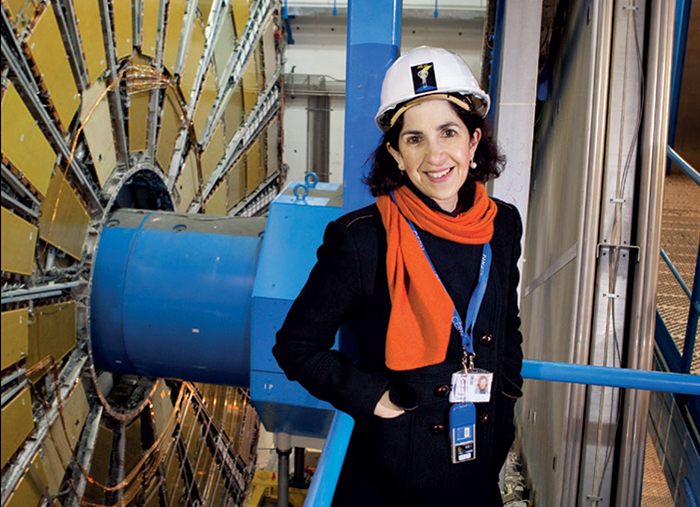
At its 173rd closed session on 4 November, CERN Council selected the Italian physicist Fabiola Gianotti as the organization’s next director-general. The appointment will be formalized at the December session of Council, and Gianotti’s mandate will begin on 1 January 2016 and run for a period of five years. She will be the first woman to hold the position of director-general at CERN.

Council rapidly converged in favour of Gianotti. “We were extremely impressed with all three candidates put forward by the search committee,” said Agnieszka Zalewska, the president of Council, on the announcement of the decision. “It was Dr Gianotti’s vision for CERN’s future as a world-leading accelerator laboratory, coupled with her in-depth knowledge of both CERN and the field of experimental particle physics, that led us to this outcome.”

Gianotti received a PhD in experimental particle physics from the University of Milan in 1989, working on the UA2 experiment at CERN for her thesis on supersymmetry. She has been a research physicist in the physics department at CERN since 1994, being involved in detector R&D and construction, software development and data analysis, for example for supersymmetry searches by the ALEPH experiment at the Large Electron–Positron (LEP) collider.

However, it is for her contributions to the ATLAS experiment at the LHC that Gianotti has become particularly well known. She was leader of the ATLAS experiment collaboration from March 2009 to February 2013, covering the period in which the LHC experiments ATLAS and CMS announced the long-awaited discovery of a Higgs boson, which was recognized by the award of the Nobel Prize to François Englert and Peter Higgs in 2013. Since August 2013, Gianotti has been an honorary professor at the University of Edinburgh.

CUORE has the coldest heart in the known universe

CCnew2_10_14

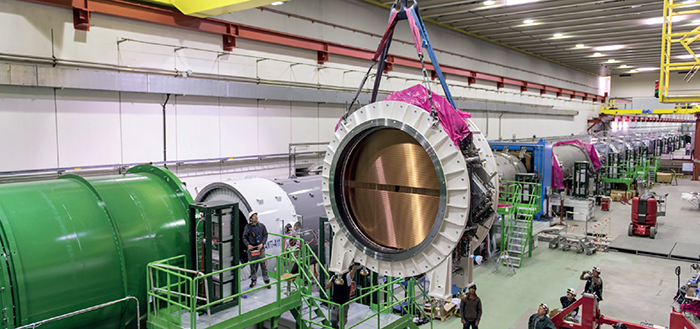
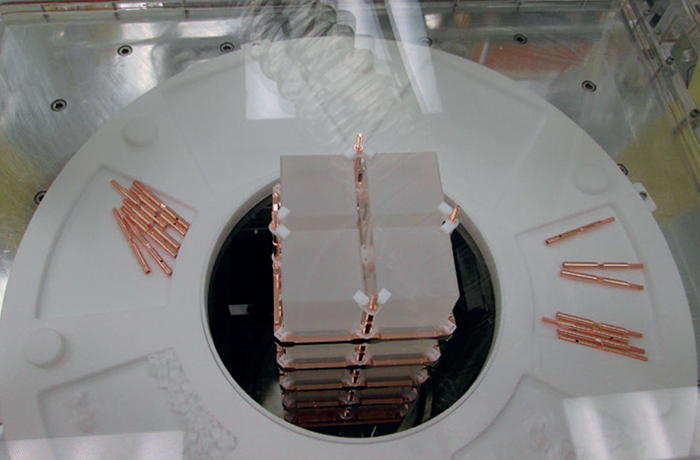
The CUORE collaboration at the INFN Gran Sasso National Laboratory has set a world record by cooling a copper vessel with the volume of a cubic metre to a temperature of 6 mK. It is the first experiment to cool a mass and a volume of this size to a temperature this close to absolute zero. The cooled copper mass, weighing approximately 400 kg, was the coldest cubic metre in the universe for more than 15 days. No experiment on Earth has ever cooled a similar mass or volume to temperatures this low. Similar conditions are also not expected to arise in nature.

CUORE – which stands for Cryogenic Underground Observatory for Rare Events, but is also Italian for heart – is an experiment being built by an international collaboration at Gran Sasso to study the properties of neutrinos and search for rare processes, in particular the hypothesized neutrinoless double-beta decay. The experiment is designed to work in ultra-cold conditions at temperatures of around 10 mK. It consists of tellurium-dioxide crystals serving as bolometers, which measure energy by recording tiny fluctuations in the crystal’s temperature. When complete, CUORE will contain some 1000 instrumented crystals and will be covered by shielding made of ancient Roman lead, which has a particularly low level of intrinsic radioactivity. The mass of material to be held near absolute zero will be almost two tonnes.

The cryostat was implemented and funded by INFN, and the University of Milano Bicocca co-ordinated the research team in charge of the design of the cryogenic system. The successful solution to the technological challenge of cooling the entire experimental mass of almost two tonnes to the temperature of a few millikelvin was made possible through collaboration with high-profile industrial partners such as Leiden Cryogenics BV, who designed and built the unique refrigeration system, and Simic SpA, who built the cryostat vessels.

NA62 gets going at the SPS

CCnew3_10_14

With the end in sight for CERN’s Long Shutdown (LS1), the accelerator chain has been gradually restarting. Since early October, the Super Proton Synchrotron (SPS) has been delivering beams of protons to experiments, including NA62, which has now begun a three-year data-taking run.

NA62’s main aim is to study rare kaon decays, following on from its predecessors NA31 and NA48, which made important contributions to the study of CP violations in the kaon system. To make beams rich in kaons, protons from the SPS strike a beryllium target. The collisions create a beam that transmits almost one billion particles per second, about 6% of which are kaons.

After almost eight years of design and construction, NA62 was ready for the beam by start-up in October. In early September, the last of the four straw-tracker chambers had been lowered into position in the experiment. The straw tracker is the first of its scale to be placed directly into the vacuum tank of an experiment, allowing NA62 to measure the direction and momentum of charged particles with high precision. From the first design to the final plug-in and testing, teams at CERN worked in close collaboration with the Joint Institute for Nuclear Research in Dubna, who helped to develop the straw-tracker technology and who will participate in the running of the detector now that construction and installation has been completed.

Each straw-tracker chamber weighs close to 5000 kg and is made up of 16 layers of state-of-the-art, highly fragile straw tubes. Although heavy, the four chambers had to be delicately transported to the SPS North Area at CERN’s Prévessin site, lowered into the experiment cavern and installed to a precision of 0.3 mm. The chambers were then equipped with the necessary gas connections, pipes, cables and dedicated read-out boards, before beam commissioning began in early October to tune the tracker prior to integrating it with the other sub-detectors for data taking.

This unique tracker, placed directly inside the experiment’s vacuum tank, sits alongside a silicon-pixel detector and a detector called CEDAR that determines the types of particles from their Cherenkov radiation. A magnetic spectrometer measures charged tracks from kaon decays, and a ring-imaging Cherenkov detector indicates the identity of each decay particle. A large system of photon and muon detectors rejects unwanted decays. In total, the experiment extends across a length of 270 m, of which 85 m are in a vacuum.

• For more about the installation and construction of NA62, see the CERN Bulletin http://cds.cern.ch/record/1951890.

The giant slowly awakes

CCnew4_10_14

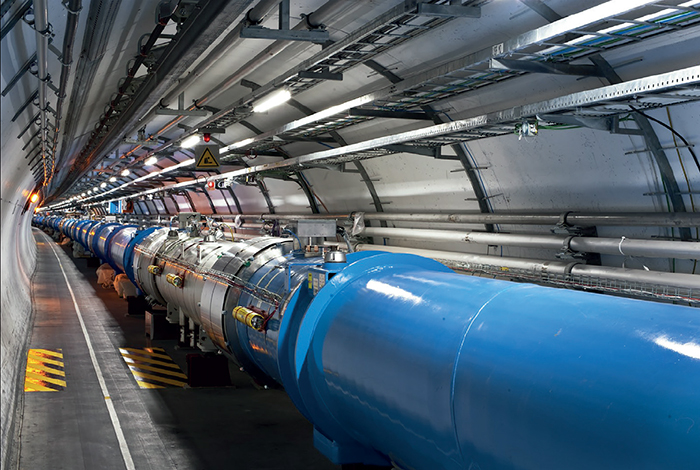
The giant slowly awakes, as the process to cool down the LHC continues in the final stage of the first long shutdown, LS1. By mid-October, the last remaining sector, 3-4 (seen here in 2009), had begun to cool down, and two of the eight sectors of the machine were already at their final cryogenic operating conditions. By the end of October, cooling and ventilation teams were maintaining systems at point 6. Down in the tunnel, sector 8-1 had completed electrical quality-assurance testing, and preparations were under way for powering tests. Measurements of the continuity of the copper stabilizer were completed in sector 5-6, and ongoing in sectors 7-8 and 2-3. Finally, on 31 October, the first magnet training for the LHC began in sector 6-7, successfully reaching a magnetic field of 5.8 T.

How bright is the LHC?

The LHCb Collaboration has published the results of a luminosity calibration with a precision of 1.12%. This is the most precise luminosity measurement achieved so far at a bunched-beam hadron collider.

CCnew6_10_14

The absolute luminosity at a particle collider is not only an important figure of merit for the machine, it is also a necessity for determining the absolute cross-sections for reaction processes. Specifically, the number of interactions, N, measured in an experiment depends on the value of cross-section σ and luminosity L, N = σL, so the precision obtained in measuring a given cross-section depends critically on the precision with which the luminosity is known. The luminosity itself depends on the number of particles in each collider beam and on the size of overlap of both beams at the collision point. At the LHC, dedicated instruments measure the beam currents, and hence the number of particles in each colliding beam, while the experiments measure the size of overlap of the beams at the collision point.

A standard method to determine the overlap of the beams is the van der Meer scan, invented in 1968 by Simon van der Meer to measure luminosity in CERN’s Intersecting Storage Rings, the world’s first hadron collider. This technique, which involves scanning the beams across each other and monitoring the interaction rate, has been used by all of the four large LHC experiments. However, LHCb physicists proposed an alternative method in 2005 – the beam-gas imaging (BGI) method – which they successfully applied for the first time in 2009. This takes advantage of the excellent precision of LHCb’s Vertex Locator, a detector that is placed around the proton–proton collision point. The BGI method is based on reconstructing the vertices of “beam-gas” interactions, i.e. interactions between beam particles and residual gas nuclei in the beam pipe to measure the angles, positions and shapes of the individual beams without displacing them.

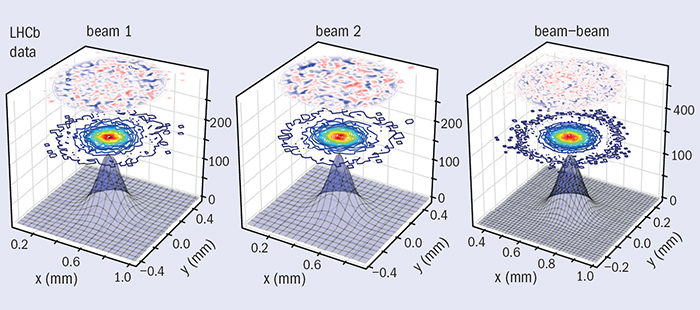
To date, LHCb is the only experiment capable of using the BGI method. The technique involves calibrating the luminosity during special measurement periods at the LHC, and then tracking relative changes through changes in the counting rate in different sub-detectors. However, the vacuum pressure in the LHC is so low that for the technique to work with high precision, the beam–gas collision rate was increased by injecting neon gas into the LHC beam pipe during the luminosity calibration periods. This allowed the LHCb physicists to obtain precise images of the shapes of the individual beams, as illustrated in the left and middle graphs of the figure, which unravelled subtle but important features of the distributions of beam particles. By combining the beam–gas data with the measured distribution of beam–beam interactions, which provides the shape of the luminous region (the right graph in the figure), an accurate calibration of the luminosity was achieved.

The beam–gas data also revealed that a small fraction of the beam’s charge is spread outside of the expected (i.e. “nominal”) bunch locations. Because only collisions of protons located in the nominal bunches are included in physics measurements, it was important to measure which fraction of the total beam current measured with the LHC’s current monitors participated in the collisions, i.e. contributed to the luminosity. Only LHCb could measure this fraction with sufficient precision, so the results of LHCb’s measurements of the fraction of charge outside the nominal bunch locations – the so-called “ghost” charge – were also used by the ALICE, ATLAS and CMS experiments.

For proton–proton interactions at 8 TeV, a relative precision of the luminosity calibration of 1.47% was obtained using van der Meer scans and 1.43% using beam–gas imaging, resulting in a combined precision of 1.12%. The BGI method has proved to be so successful that it will now be used to measure beam sizes as part of monitoring and studying the LHC beams. Dedicated equipment will be installed in a modified region of the LHC ring near Point 4. This system, dubbed the Beam-Gas Vertexing system (BGV), is being developed by a collaboration from CERN, EPFL and RTWH Aachen. It includes a gas-injection system and a scintillating-fibre tracker telescope, which are expected to be commissioned with beam in 2015.

ALICE probes the role of minijets in p–Pb collisions…

ALICE

One of the hottest topics at the LHC is the understanding of potential collective effects in proton–lead collisions, prompted by the discovery of ridge structures in angular correlations of particles (CERN Courier January/February 2013 p9). Further insight is expected from studying the role of multiple parton–parton interactions, as well as from investigating the interplay of these ridge structures with jet structures caused by (semi)hard scatterings. A new study by the ALICE collaboration has characterized minijets – jet-like structures in the regime of low transverse momentum (pT) where the ridge has been observed – to shed light on particle-production mechanisms.

The analysis looks at event activity, characterized by particle multiplicity measured at large rapidity. The jet-like correlations are determined by counting the number of associated particles as a function of their difference in azimuth (Δφ) and pseudorapidity (Δη) with respect to a trigger particle. The minijets reveal themselves as a peak on the “near side” (Δφ = 0, Δη = 0) and an elongated structure in Δη on the “away side” (Δφ = π) on top of the double ridge. The ridge structures themselves are found on the near and away side to be independent of Δη and almost symmetric around π/2. The projection of the correlations onto Δφ makes it possible to quantify the particle production in semi-hard processes. The number of particles in the minijets is given by the integral under the peaks and above the background originating from the underlying event.

The black points in the figure show that the average near-side yield per trigger particle increases from the lowest (95–100%) to the highest (0–5%) event-multiplicity class. To separate the jet-like peak structures from the ridge, the contribution from the near-side ridge can be estimated at large Δη, where the jet-like correlations are absent. Owing to the approximate symmetry around π/2, the near-side ridge is mirrored into the away-side region and subtracted from both sides of the correlation function. Non-symmetric components (e.g. cos 3Δφ) have only small effects limited to the away side. The red data points in the figure show the near-side yield after this ridge subtraction.

While it is not surprising to find agreement between the yields with and without ridge subtraction in the 60–100% event-multiplicity classes, where no significant ridge structures exists, qualitative differences emerge in the 60% highest multiplicity. In this region, there is no dependence on event activity for jet-like per-trigger yields (i.e. after ridge subtraction). This suggests that the hard processes, which are the sources of associated particles, and the soft processes, which together with the hard ones are at the origin of the trigger particles, scale with the same factor with multiplicity. These observations are consistent with a scenario where the minijet yield stems from an incoherent fragmentation of multiple parton–parton scatterings, while the double ridge is not jet related and is additive to the minijets.

…and investigates suppression of ψ(2S)

CCnew9_10_14

Charmonia, bound states of charm (c) and anti-charm (c) quarks, are probes for the formation of hot quark–gluon plasma (QGP) in heavy-ion collisions. The suppression of charmonium, already observed at the lower energies of CERN’s Super Proton Synchrotron (SPS) and the Relativistic Heavy Ion Collider at Brookhaven, has been attributed to the screening of the cc binding by the high density of colour charges present in the QGP. However, the modification of charmonium production in heavy-ion collisions can be induced not only by a hot deconfined medium, but also by effects of cold nuclear matter (CNM). The latter can be studied in proton–nucleus interactions, where the temperature and energy density necessary for QGP formation are not expected to be reached.

CNM affects the cc pair throughout its time evolution, from a pre-resonant state to the fully formed resonance, and it can be investigated by comparing the behaviour of the tightly bound J/ψ and the weakly bound ψ(2S) charmonium states. Effects present in the early stages of the cc evolution – such as nuclear-parton shadowing and initial-state energy loss – do not depend on the final charmonium quantum numbers, and should have similar effects on the J/ψ and ψ(2S). On the other hand, final-state mechanisms, such as the break-up of the bound state via interactions with nucleons or with the hadronic matter produced in the collision, will be sensitive to the binding energy of the resonance, and should have a stronger effect on the ψ(2S) than on the J/ψ.

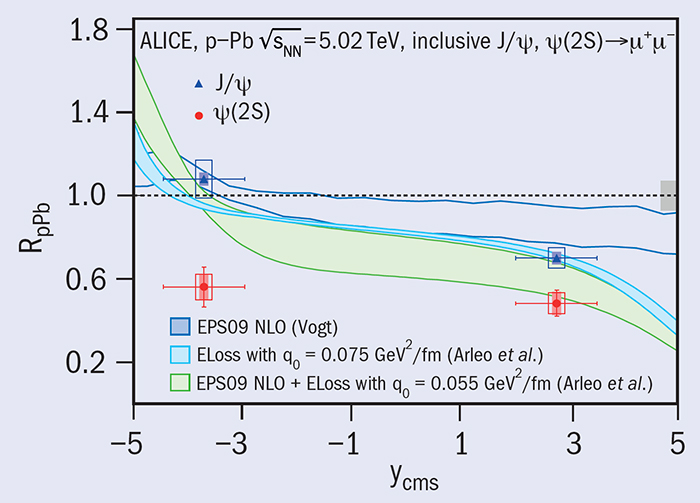
ALICE has studied the production of J/ψ and ψ(2S) in proton–lead collisions at √s = 5.02 TeV, in both the proton-going direction (rapidity 2.03 < ycms < 3.53) and the lead-going direction (–4.46 < ycms < –2.96). The modification of the production yields induced by CNM, with respect to the corresponding proton–proton yield scaled by the number of nucleon–nucleon collisions, is quantified through the nuclear modification factor RpA, which is shown in the figure for J/ψ and ψ(2S). The ψ(2S) suppression is large, and stronger than for the J/ψ, in particular in the backward rapidity region, where the J/ψ is not suppressed at all. This observation implies that final-state effects play an important role, as initial-state mechanisms alone (see also the theory predictions in the figure relative to a pure initial-state scenario) would lead to the same behaviour for both charmonium states.

Such a result was also observed at lower energies (at the SPS, Fermilab and HERA at DESY), where it was related to break-up effects by the nucleons in the nucleus. However, at LHC energies, the resonance formation time (around 0.1 fm/c) is significantly smaller than the time spent by the cc pair in the nucleus, implying that CNM cannot affect the final-state charmonia. This suggests that the difference between the J/ψ and ψ(2S) suppression is due to the interaction with hadrons produced in the proton–lead collision. A detailed study of this effect, still in progress on the theory side, is expected to provide quantitative information on the density and characteristics of such a hadronic medium.

ATLAS takes a closer look at W+jets

The ATLAS collaboration has updated its measurement of the production of W bosons in association with jets (W+jets), which is an important channel at the LHC for precision comparisons with QCD. A precise understanding of these event topologies is also vital for searches for physics beyond the Standard Model because many new models predict a similar experimental signature.

CCnew11_10_14

In recent years, the analysis and understanding of W+jets production has undergone two major advancements. The first is the large amount of data available from the LHC, and the extended kinematic reach that results both from the collider’s centre-of-mass energy – which allows for measurements of jets with a transverse momentum (pT) of up to 1 TeV and multiplicities of up to seven jets – and the expanded detector calorimeter coverage, which can measure jets at large rapidities. Unlike at previous colliders, where the pT values for the jets were a few hundred giga-electron-volts at most, the transverse momentum of the jets at the LHC can be more than an order of magnitude larger than the mass of the W boson itself. In these cases, large QCD corrections can be associated to the multiple scales in the event, and these are difficult to predict by fixed-order calculations. Also, because of the disparity in the scales between the mass of the W boson and the pT of the jet, electroweak corrections can play a major role. The second advancement is the availability of next-to-leading-order (NLO) predictions in perturbative QCD for events with large numbers of associated jets. These calculations have smaller theoretical uncertainties compared with leading-order predictions.

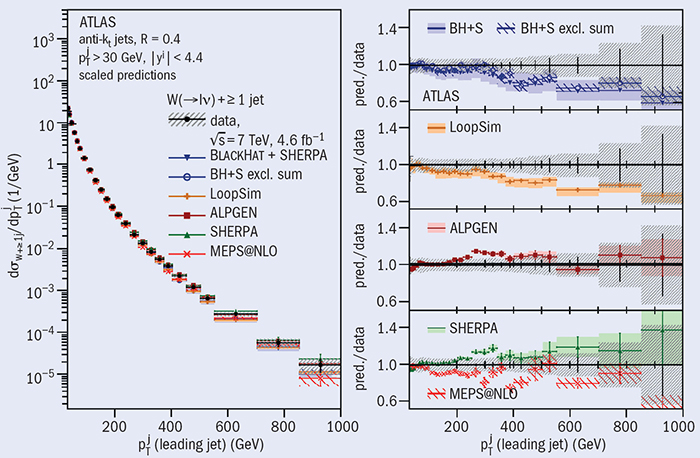
The recent ATLAS measurement of W+jets production focuses on detailed comparisons between the jet and event properties that are observed and several state-of-the-art theory predictions. The figure highlights the differential cross-section as a function of the pT of the leading jet, i.e., the highest transverse momentum. The data are compared with leading-order calculations (Alpgen, Sherpa), NLO calculations (Blackhat+Sherpa, MEPS@NLO), and beyond NLO calculations (LoopSim, Blackhat+Sherpa exclusive sums). At large values of the jet’s pT, the higher-order calculations tend to underestimate the data. In these regions of phase space, additional corrections to the cross-sections from electroweak diagrams are expected to be sizable. However, they are also expected to be negative, and therefore cannot account for this trend. The leading-order predictions model this particular distribution better, but in other kinematic observables, such as the jet rapidity, their description of the data is not as good.

This result is based on the measurement of more than 25 different properties of W+jet events. No single theoretical prediction can describe the data accurately for all distributions. These results will help to improve understanding of QCD and motivate more accurate theoretical calculations for future comparisons with data.

CMS presents precision measurements of the top-quark mass from Run 1

Precise measurements of the mass of the top quark provide key inputs to global electroweak fits and to tests of the internal consistency of the Standard Model. The masses of the Higgs boson and the top quark are the two key parameters that determine whether the vacuum is stable – an issue with broad cosmological implications.

CCnew13_10_14

At the LHC, top quarks are predominantly produced in quark–antiquark pairs, and top-quark events are characterized by the decays of the daughter W bosons and bottom quarks, leading to three experimental signatures. In the “lepton+jets” channel, the two bottom-quark jets are accompanied by a single lepton (e or μ) and one undetected neutrino from the decay of one of the W bosons, together with two light-quark jets from the other W. In the dilepton channel, both W bosons decay to leptons, so two leptons (ee, eμ, μμ) and two undetected neutrinos accompany the bottom-quark jets. Last, if the W bosons both decay to quark–antiquark pairs, the signature will include four light-quark jets – the all-jets channel.

At the recent TOP2014 workshop in Cannes, the CMS collaboration presented a new measurement of the mass of the top quark, based on the full LHC data set recorded during 2012. This corresponds to approximately 20 fb–1 of integrated luminosity at √s = 8 TeV, which is roughly four times the size of the combined data sets at √s = 7 TeV from 2010 and 2011. The latest result comes from a new measurement in the dilepton channel (CMS Collaboration 2014a). It complements the results from the lepton+jets and all-jets channels that were announced earlier this year (CMS Collaboration 2014b and 2014c).

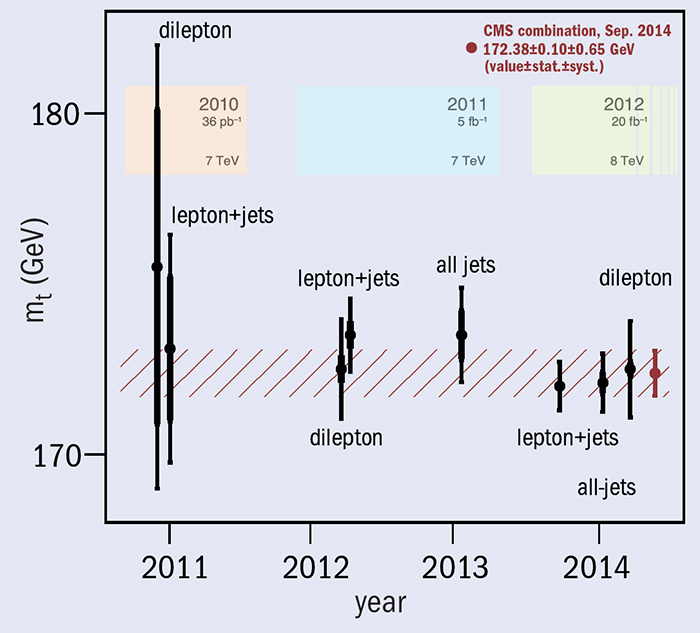
The new measurement uses an analytical matrix-weighting technique to determine the most probable solution for missing transverse energy in the events. The top-quark mass is determined from a fit to the combined results, yielding a value of 172.47±0.17 (stat.) ±1.40 (syst.) GeV. In contrast, for the other two analyses, two-dimensional likelihood functions were used to determine simultaneously the top-quark mass and the overall jet-energy scale. The measurements of 172.04±0.11 (stat.) ±0.74 (syst.) GeV and 172.08±0.27 (stat.) ±0.84 (syst.) GeV, together with the new result, complete the initial set of high-precision analyses using the Run 1 data.

At the TOP2014 workshop, CMS also presented a combination of these results with five previous measurements using the 2010 and 2011 data sets (CMS Collaboration 2014d). The figure shows the combination and the evolution of the CMS measurements as a function of time. The combined value for the top-quark mass is found to be 172.38±0.10 (stat.) ±0.65 (syst.) GeV. With a precision of 0.38%, this is the most precise result from any single experiment. Work continues on additional analyses using alternative techniques, and results from these are expected in the coming months.

bright-rec iop pub iop-science physcis connect