Comsol -leaderboard other pages

Topics

Gauge Theories of the Strong, Weak, and Electromagnetic Interactions (2nd edition)

By Chris Quigg
Princeton University Press
Hardback: £52.00 $75.00
Also available as an e-book, and at the CERN bookshop

CCboo2_03_15

The answer lies in the second edition of Chris Quigg’s Gauge Theories of the Strong, Weak, and Electromagnetic Interactions. By a remarkable coincidence, this essentially revised volume fills in much of what the “gifted amateur” wants to know about how QFT is applied in traditional particle physics. It is hard to find words to describe Quigg’s clean, high-quality work; as an author he is a virtuoso performer. He takes the reader through the Standard Model of particle physics to the first steps beyond it, showing the most important insights, describing open questions and proposing original literature and further reading. He has designed or collected many insightful figures that illustrate beautifully the intriguing properties of the Standard Model.

However, it’s hard for me personally to end the review on this high note since the research in the field of gauge theories of strong interactions does not end with the perturbative processes. Over the past 30 years, a vast new area has opened up with many fundamental insights. These connect to the QCD vacuum structure, the Hagedorn temperature and colour deconfinement as encapsulated in the new buzzword – quark–gluon plasma, the strongly-interacting colour-charged many-body state of quarks and gluons. Moreover, there is a wealth of numerical lattice results that accompany these developments.

I find no key word for this in the index of Quigg’s book, although there is mention of “confinement” (p336ff). On page 340, a phrase-long summary mentions the temperature of a chiral-symmetry-restoring transition (from what to what is not stated) that characterizes the lattice QCD results seen in figure 8.47 on p342. This one-phrase entry is all that describes in my estimate 20% of the experimental work at CERN of the past 25 years, and the majority of particle physics at Brookhaven for the past 15 years. In this section I also read how vacuum dielectric properties relate to confinement. I know this argument from Kenneth Wilson, as refined and elaborated on by TD Lee, and the lattice-QCD work initiated by Michael Creutz at Brookhaven, yet Quigg attributes this to an Abelian-interaction model that I did not think functioned.

The author, renowned for his work addressing two-particle interactions, represents in his book the traditional particle-physics programme as continued today at Fermilab, where the novel area of QCD many-body physics is not on the research menu, though it has come of age at CERN and Brookhaven. One can argue that this new science is not “particle physics” – but it is definitively part of “gauge theories of strong interactions”, words embedded in the title of Quigg’s book. Thus, quark–gluon plasma, vacuum structure and confinement glare brightly by their absence in this volume.

Looking again at both books it is remarkable how complementary they are for a CERN Courier reader. These are two excellent texts and together they cover most of modern QFT and its application in particle physics in 1000 pages at an affordable cost. I strongly recommend both, individually or as a set. As noted, however, the reader who purchases these two volumes may need a third one covering the new physics of deconfinement, QCD vacuum and thermal quarks and gluons – the quark–gluon plasma.

Neutrinos in High Energy and Astroparticle Physics

By José W F Valle and Jorge C Romão
Wiley-VCH
Paperback: £75 €€90
Also available at the CERN bookshop

CCboo3_03_15

Neutrinos have kept particle physicists excited for at least the past 20 years. After they were finally proved to be massive, two mass-squared differences and all three mixing angles have now been determined, the final remaining angle, θ13, in 2012 by the three reactor experiments: Daya Bay, RENO and Double Chooz. As neutrino masses are expected to be linked intimately to physics beyond the Standard Model that can be probed at the LHC, and as neutrinos are about to start a “second career” as astrophysical probes, it seems a perfect time to publish a new textbook on the elusive particle. The authors Jose Vallé and Jorge Romão are leading protagonists in the field who have devoted most of their careers to the puzzling neutrino. In this new book they share their experience of many years at the forefront of research.

They begin with a brief historical introduction, before reviewing the Standard Model and its problems and discussing the quantization of massive neutral leptons. The next three chapters deal with neutrino oscillations and absolute neutrino masses – the mass being one of the fundamental properties of neutrinos that is still unknown. Here the authors give a detailed discussion of the lepton-mixing matrix – the basic tool to describe oscillations – and seesaw models of various types. An interesting aspect is the thorough discussion of what could be called “Majorananess” and its relation to neutrino masses, lepton-number violation and neutrinoless double beta decay – for example, in the paragraphs dealing with the Majorana–Dirac confusion and black-box theorems, a point that is rarely covered in text books and often results in confusion.

Next, the book discusses how neutrino masses are implemented in the Standard Model’s SU(2) × U(1) gauge theory and the relationship to Higgs physics. This is followed by a detailed treatment of neutrinos and physics beyond the Standard Model (supersymmetry, unification and the flavour problem), which constitutes almost half of the entire book. Here the text exhibits its particular strength – also in comparison to the competing books by Carlo Giunti and Chung Kim, and by Vernon Barger, Danny Marfatia and Kerry Whisnant, both of which concentrate more on neutrino oscillation phenomenology – by discussing exhaustively how neutrino physics is linked to physics beyond Standard Model phenomenology, such as lepton-flavour violation or collider processes. The inclusion of a detailed discussion of these topics is a good choice and it makes the book valuable as a textbook, although it does make this part rather long and encyclopedic. Another strong point is the focus on model building. For example, the book discusses in detail the challenges in flavour-symmetry model building to accommodate a non-zero θ13, and the deviation of the lepton-mixing matrix from the simple tri-bi-maximal form.

The authors end with a brief chapter on cosmology, concentrating mainly on dark matter and its connection to neutrinos. While this chapter obviously cannot replace a dedicated introduction to cosmology, a few more details such as an introduction of the Friedmann equation could have been helpful here. In general, the treatment of astroparticle physics is shorter than expected from the title of the book. For example, the detection of extragalactic neutrinos at IceCube is not covered – indeed, IceCube is only mentioned in passing as an experiment that is sensitive to the indirect detection of dark matter. Also leptogenesis and supernova neutrinos are mentioned only briefly.

The book mainly serves as a detailed and concise, thorough and pedagogical introduction to the relationship of neutrinos to physics beyond the Standard Model, and in particular the related particle-physics phenomenology. This subject is highly topical and will be more so in the years to come. As such, Neutrinos in High Energy and Astroparticle Physics does an excellent job and belongs on the bookshelf of every graduate student and researcher who is seriously interested in this interdisciplinary and increasingly important topic.

Canonical Quantum Gravity: Fundamentals and Recent Developments

By Francesco Cianfrani et al
World Scientific
Hardback: £84
E-book: £63
Also available at the CERN bookshop

media_10585765

This book aims to present a pedagogical and self-consistent treatment of the canonical approach to quantum gravity, starting from its original formulation to the most recent developments in the field. It begins with an introduction to the formalism and concepts of general relativity, the standard cosmological model and the inflationary mechanism. After presenting the Lagrangian approach to the Einsteinian theory, the basic concepts of the canonical approach to quantum mechanics are provided, focusing on the formulations relevant for canonical quantum gravity. Different formulations are then compared, leading to a consistent picture of canonical quantum cosmology.

Quantum Field Theory for the Gifted Amateur

By Tom Lancaster and Stephen J Blundell
Oxford University Press
Hardback: £65 $110
Paperback: £29.99 $49.95
Also available as an e-book, and at the CERN bookshop

CCboo1_03_15

Many readers of CERN Courier will already have several introductions to quantum field theory (QFT) on their shelves. Indeed, it might seem that another book on this topic has missed its century – but that is not quite true. Tom Lancaster and Stephen Blundell offer a response to a frequently posed question: What should I read and study to learn QFT? Before this text it was impossible to name a contemporary book suitable for self-study, where there is regular interaction with an adviser but not classroom-style. Now, in this book I find a treasury of contemporary material presented concisely and lucidly in a format that I can recommend for independent study.

Quantum Field Theory for the Gifted Amateur is in my opinion a good investment, although of course one cannot squeeze all of QFT into 500 pages. Specifically, this is not a book about strong interactions; QCD is not in the book, not a word. Reading page 308 at the end of subsection 34.4 one might expect that some aspects of quarks and asymptotic freedom would appear late in chapter 46, but they do not. I found the word “quark” once – on page 308 – but as far as I can tell, “gluon” did not make its way at all into the part on “Some applications from the world of particle physics.”

If you are a curious amateur and hear about, for example, “Majorana” (p444ff) or perhaps “vacuum instability” (p457ff, done nicely) or “chiral symmetry” (p322ff), you can start self-study of these topics by reading these pages. However, it’s a little odd that although important current content is set up, it is not always followed with a full explanation. In these examples, oscillation into a different flavour is given just one phrase, on p449.

Some interesting topics – such as “coherent states” – are described in depth, but others central to QFT merit more words. For example, figure 41.6 is presented in the margin to explain how QED vacuum polarization works, illustrating equations 41.18-20. The figure gives the impression that the QED vacuum-polarization effect decreases the Coulomb–Maxwell potential strength, while the equations and subsequent discussion correctly show that the observed vacuum-polarization effect in atoms adds attraction to electron binding. The reader should be given an explanation of the subtle point that reconciles the intuitive impression from the figure with the equations.

Despite these issues, I believe that this volume offers an attractive, new “rock and roll” approach, filling a large void in the spectrum of QFT books, so my strong positive recommendation stands. The question that the reader of these lines will now have in mind is how to mitigate the absence of some material.

The LHC: a machine in training

After the long maintenance and consolidation campaign carried out during the first long shutdown, LS1, the early part of 2015 has been dominated by tests and magnet training to prepare the LHC for a collision energy of 13 TeV. With all of the hardware and software systems to be checked, a total of more than 10,000 test steps needed to be performed and analysed on the LHC’s magnet circuits.

The LHC’s backbone consists of 1232 superconducting dipole magnets with a field of up to 8.33 T operating in superfluid helium at 1.9 K, together with more than 500 superconducting quadrupole magnets operating at 4.2 K or 1.9 K. Many other superconducting and normal resistive magnets are used to allow the correction of all beam parameters, bringing the total number of magnets to more than 10,000. About 1700 power converters are necessary to feed the superconducting circuits.

The dipole magnets in the first of the LHC’s eight sectors were trained successfully to nominal current in December, and training continued throughout the first three months of 2015. Although all of the dipole magnets were tested individually before installation, they had to be trained together in the tunnel up to 10,980 A, the current that corresponds to a beam energy of 6.5 TeV.

Training involves repetitive quenches before a superconducting magnet reaches the target magnetic field. The quenches are caused by the sudden release of electromechanical stresses and a local increase in temperature that triggers a change from the superconductive to the resistive state. The entire coil is then warmed up and cooled down again – for the LHC dipoles, this might take several hours. The magnet protection system is crucial for detecting a quench and safely extracting the energy stored in the circuits – about 1 GJ per dipole circuit at nominal current.

The typical time needed to commission a dipole circuit fully is in the order of three to five weeks, and all of the interlock and protection systems have to be tested, both before and while ramping-up the current in steps. By mid-February, the dipole circuits in three sectors had been trained to the level equivalent to 6.5 TeV, with the total number of quenches confirming the initial prediction of about 100 quenches for all of the dipoles in the machine. By early March, four sectors were fully trained for 6.5-TeV operation, with a fifth well into its training programme.

If commissioning remains on schedule, the LHC should restart towards the end of March

On the weekend of 7–8 March, operators performed injection tests with beams of protons being sent part way around the LHC. Beam 1 passed through the ALICE detector up to point 3 of the LHC, where it was dumped on a collimator, and beam 2 went through the LHCb detector up to the beam dump at point 6. The team recorded various parameters, including the timings of the injection kickers and the beam trajectory in the injection lines and LHC beam pipe.

The ALICE and LHCb collaborations prepared their experiments to receive pulses of particles and recorded “splash” events as the particles travelled through their detectors. LHCb used the tests to commission the detector and the data-acquisition system, as well as to perform detector studies and alignments of the different sub-detectors. The ALICE collaboration meanwhile used muons originating from the Super Proton Synchrotron beam dump for timing studies of the trigger and to align the muon spectrometer.

If commissioning remains on schedule, the LHC should restart towards the end of March, with first collisions at 13 TeV in late May/early June.

NUCLEON takes its place in space

CCnew2_03_15

On 13 January, less than three weeks after being launched into space, the NUCLEON satellite experiment was switched on to collect its first cosmic-ray events. Orbiting the Earth on board the RESURS-P No.2 satellite, NUCLEON has been designed to investigate directly the energy spectrum of cosmic-ray nuclei and their chemical composition from 100 GeV to 1000 TeV (1011–1015 eV), as well as the cosmic-ray electron spectrum from 20 GeV to 3 TeV. It is well known that the region of the “knee” – 1014–1016 eV – is crucial for understanding the origin of cosmic rays, as well as their acceleration and propagation in the Galaxy.

NUCLEON has been produced by a collaboration between the Skobeltsyn Institute of Nuclear Physics of Moscow State University (SINP MSU) as the main partner, together with the Joint Institute for Nuclear Research (JINR) and other Russian scientific and industrial centres. It consists of silicon and scintillator detectors, a carbon target, a tungsten γ-converter and a small electromagnet calorimeter.

CCnew3_03_15

The charge-detection system, which consists of four thin detector layers of 1.5 × 1.5 cm silicon pads, is located in front of the carbon target. It is designed for precision measurement of the charge of the primary-particle charge.

A new technique, based on the generalized kinematical method developed for emulsions, is used to measure the cosmic-ray energy. Avoiding the use of heavy absorbers, the Kinematic Lightweight Energy Meter (KLEM) technique gives an energy resolution of 70% or better, according to simulations. Placed just behind the target, this energy-measurement system consists of silicon microstrip layers with tungsten layers to convert secondary γ-rays to electron–positron pairs. This significantly increases the number of secondary particles and therefore improves the accuracy of the energy determination for a primary particle.

The small electromagnet calorimeter (six tungsten/silicon microstrip layers 180 × 180 mm weighing about 60 kg, owing to satellite limitations) has a thickness of 12 radiation lengths, and will measure the primary cosmic-ray energy for some of the events. The effective geometric factor is more than 0.2 m2sr for the full detector and close to 0.1 m2sr for the calorimeter. The NUCLEON device must allow separation of the electromagnetic and hadronic cosmic-ray components at a rejection level of better than 1 in 103 for the events in the calorimeter aperture.

CCnew4_03_15

The design, production and tests of the trigger system were JINR’s responsibility. The system consists of six multistrip scintillator layers to select useful events by measuring the charged-particle multiplicity crossing the trigger planes. The two-level trigger systems have a duplicated structure for reliability, and will provide more than 108 events with energy above 1011 eV during the planned five years of data taking.

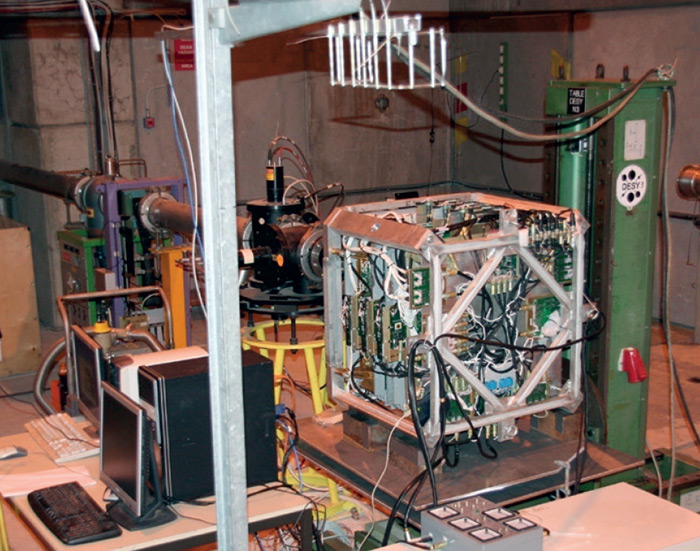
The NUCLEON prototypes were tested many times at CERN’s Super Proton Synchrotron (SPS) with high-energy electron, hadron and heavy-ion beams. The last test at CERN, which took place in 2013 at the H2 heavy-ion beam, was dedicated to testing NUCLEON’s charge-measurement system. The results showed that it provides a charge resolution better than 0.3 charge units in the region up to atomic number Z = 30 (figure 2). The Z < 5 beam particles were suppressed by the NUCLEON trigger system.

In 2013, NUCLEON was installed on the RESURS-P No. 2 satellite platform for combined tests at the Samara-PROGRESS space-qualification workshop, some 1000 km southeast of Moscow. The complex NUCLEON tests were continued in 2014 at the Baikonur spaceport, in conjunction with the satellite and the Soyuz-2.1b rocket, before the successful launch on 26 December. The satellite is now in a Sun-synchronous orbit with inclination 97.276° and a middle altitude of 475 km. The total weight of the NUCLEON apparatus is 375 kg, with a power consumption of 175 W.

The flight tests of the NUCLEON detector were continued during January and February, and the NUCLEON team hopes to present the preliminary results at the summer conferences this year. The next step after this experiment will be the High-Energy cosmic-Ray Observatory (HERO) to study high-energy primary cosmic-ray radiation from space. The first HERO prototype is to be tested at the SPS in autumn.

LHCb gets a precise handle on sin 2β

In the first week of March, at Les Rencontres de Physique de la Vallée d’Aoste, La Thuile, the LHCb collaboration announced a precision measurement of CP (charge/parity) violation in decays of neutral B0 mesons to the J/ψ K0S final state.
CCnew6_03_15

The “golden channel”, B0 → J/ψ K0S, allows for a clean determination of the angle β of the triangle that represents the unitarity of the Cabibbo–Kobayashi–Maskawa (CKM) quark-mixing matrix. The matrix describes CP violation in the Standard Model as the result of a single irreducible complex phase. Its unitarity relates observables of many different measurements to a small number of parameters, thereby allowing for a stringent test of the electroweak sector of the Standard Model.

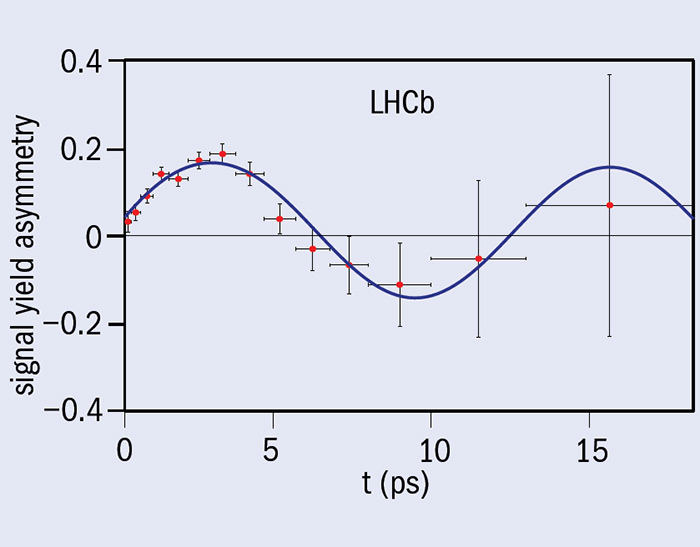
The CP violation in B→ J/ψ K0S arises from the interference of the direct decay and the decay after B0B0 oscillation. It manifests itself as an asymmetry between the decay rates of B0 and B0 mesons that depends on the decay time, t:

CCnew7_03_15

Here, S and C are the CP observables, and Δm/2π is the frequency of the B0B0 oscillation. Because the decay is dominated by a single decay amplitude, C is expected to vanish and S can be identified as sin 2β.

The LHCb collaboration has now analysed the full data set from Run 1 of the LHC, comprising 114,000 reconstructed and selected B→ J/ψ K0S decays (LHC Collaboration 2015). The analysis relies on identifying the initial flavour of the B meson, i.e. whether it was produced as a B0 or a B0 meson. This so-called flavour tagging exploits event properties that are correlated to the production flavour of the B meson. The flavour identification succeeds for 41,560 B→ J/ψ K0S decays, and is correct in 64% of the cases.

The LHCb measurement yields S = 0.731±0.035 (stat.) ±0.020 (syst.), and is in good agreement with the value expected from CKM unitarity when excluding direct measurements of sin 2β 0.771+0.017–0.041 (Charles et al. 2015). Despite the challenges of the hadronic environment of the LHC, the result is at a similar precision to the B→ J/ψ K0S analyses of the BaBar and Belle experiments at the PEP-II and KEKB B factories.

BaBar and Belle established CP violation in the B0 meson system by observing it in B→ J/ψ K0S decays for the first time in 2001. They have since contributed with measurements of sin 2β leading to a very precise world-average value of 0.682±0.019 (Heavy Flavor Averaging Group 2014). Although LHCb’s new result is not yet as precise, it notably demonstrates that the experimental challenges are met, and that a similar precision will be achievable with the data to be collected in the LHC’s Run 2. LHCb will then contribute significantly to our knowledge of this fundamental parameter, and will allow for more stringent tests of CKM unitarity.

ATLAS sets limits on anomalous quartic-gauge couplings

Experiments at the LHC have been exploring every corner of predictions made by the Standard Model in search of deviations that could point to a more comprehensive description of nature. The LHC detectors have performed superbly, producing measurements that, to date, are consistent with the model in every area tested, the discovery of the Higgs boson with Standard Model properties being a crowning achievement of LHC Run 1 data-taking.

CCnew9_03_15

The ATLAS and CMS collaborations are now looking into deeper levels of Standard Model predictions by probing additional ways in which the gauge bosons (W+, W, Z and photon) interact with each other. These self-interactions are at the heart of the model’s electroweak sector. The gauge bosons are predicted to interact through point-like triple and quartic couplings. The triple-gauge couplings have been tested both at the LHC and at Fermilab’s Tevatron, following on from beautiful studies at the Large Electron–Positron collider that demonstrated the existance of these couplings and measured their properties. A new frontier at the LHC is to explore the quartic coupling of four gauge bosons. This can be done through the two-by-two scattering of the bosons, or more directly through the transition of one of the bosons to a final state with three bosons.

The ATLAS experiment has used data collected in 2012 from 8 TeV proton–proton collisions to make a measurement of triple-gauge boson production. The measurement isolates a final state with a W boson decaying to leptonic final states eν or μν plus the production of two photons with transverse energy ET > 20 GeV, and additional kinematic requirements defined by the acceptance of the ATLAS detector and the need to suppress soft photons. This process is sensitive to possible deviations of the quartic-gauge coupling WWγγ from Standard Model predictions.

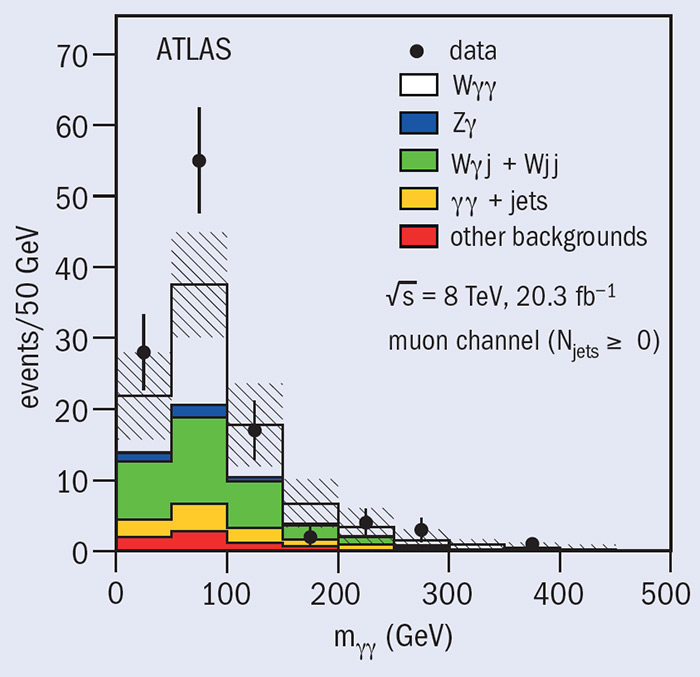
The rate of WWγγ is six orders of magnitude lower than that of inclusive W production. The isolation of this signal is a challenge, owing to both the small production rate and competition from similar processes containing a W boson with jets and single photons. The measurement relies upon the ability of the ATLAS electromagnetic calorimeter to select isolated, directly produced photons from those embedded in the more prolific production of hadronic jets. The figure shows the m(γγ) mass distribution from the 110 events that pass the final pp → W(μν) γγ + X selection cuts. The data are compared with the sum of backgrounds plus the Wγγ signal expected from the Standard Model.

These data are used to put limits on deviations of the quartic gauge coupling WWγγ from Standard Model predictions by introducing models for anomalous (non-Standard Model) contributions to pp → Wγγ + X production. These contributions typically enhance events with large invariant mass of the two photons. The anomalous quartic coupling limits are imposed using a subset of the pp → Wγγ + X events with m(γγ) > 300 GeV and no central high-energy jets. The resulting limits on various parameters that introduce non-Standard Model quartic couplings show that they are all consistent with zero (ATLAS Collaboration 2015). Once again, the Standard Model survives a measurement that probes a new aspect of its electroweak predictions.

CMS prepares to search for heavy top-quark partners in Run 2

As the experiment collaborations get ready for Run 2 at the LHC, the situation of the searches for new physics is rather different from what it was in 2009, when Run 1 began. Many models have been constrained and many limits have been set. Yet a fundamental question remains: why is the mass of the newly discovered Higgs boson so much below the Planck energy scale? This is the so-called hierarchy problem. Quantum corrections to the mass of the Higgs boson that involve known particles such as the top quark are divergent and tend to push the mass to a very high energy scale. To account for the relatively low mass of the Higgs boson requires fine-tuning, unless some new physics enters the picture to save the situation.

CCnew11_03_15

A variety of theories beyond the Standard Model attempt to address the hierarchy problem. Many of these predict new particles whose quantum-mechanical contributions to the mass of the Higgs boson precisely cancel the divergences. In particular, models featuring heavy partners of the top quark with vector-like properties are compelling, because the cancellations are then achieved in a natural way. These models, which often assume an extension of the Standard Model Higgs sector, include the two-Higgs doublet model (2HDM), the composite Higgs model, and the little Higgs model. In addition, theories based on the presence of extra dimensions of space often predict the existence of vector-like quarks.

The discovery of the Higgs boson was a clear and unambiguous target for Run 1. In contrast, there could be many potential discoveries of new particles or sets of particles to hope for in Run 2, but currently no model of new physics is favoured a priori above any other.

One striking feature common to many of these new models is that the couplings with third-generation quarks are enhanced. This results in final states containing b quarks, vector bosons, Higgs bosons and top quarks that can have significant Lorentz boosts, so that their individual decay products often overlap and merge. Such “boosted topologies” can be exploited thanks to dedicated reconstruction algorithms that were developed and became well established in the context of the analyses of Run-1 data.

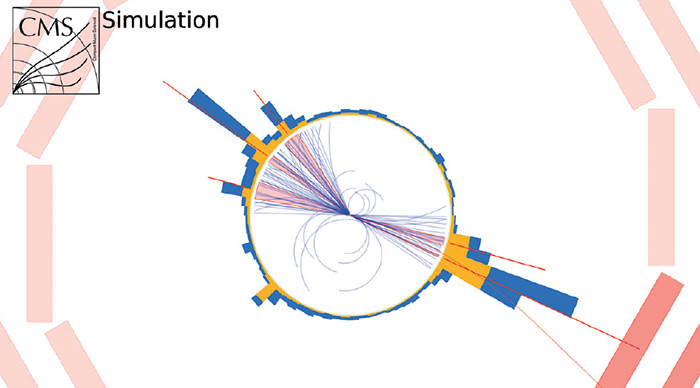
Searches for top-quark partners performed by CMS on the data from Run 1 span a large variety of different strategies and selection criteria, to push the mass-sensitivity as high as possible. These searches have now been combined to reach the best exclusion limit from the Run-1 data: heavy top-quark partners with masses below 800 GeV are now excluded at the 95% confidence level. The figure shows a simulated event with a top-quark partner decaying into a top-quark plus a Higgs boson (T → tH) in a fully hadronic final state.

CMS plans to employ these techniques to analyse boosted topologies not only in the analysis framework, but for the very first time also in the trigger system of the experiment when the LHC starts up this year. The new triggers for boosted topologies are expected to open new regions of phase space, which would be out of reach otherwise. Some of these searches are expected to already be very sensitive within the first few months of data-taking in 2015. The higher centre-of-mass energy increases the probability for pair production of these new particles, as well as of single production. The CMS collaboration is now preparing to exploit the early data from Run 2 in the search for top-quark partners produced in 13 TeV proton collisions.

Proto-collaboration formed to promote Hyper-Kamiokande

CCnew12_03_15

The Inaugural Symposium of the Hyper-Kamiokande Proto-Collaboration, took place in Kashiwa, Japan, on 31 January, attended by more than 100 researchers. The aim was to promote the proto-collaboration and the Hyper-Kamiokande project internationally. In addition, a ceremony to mark the signing of an agreement for the promotion of the project between the Institute for Cosmic Ray Research of the University of Tokyo and KEK took place during the symposium.

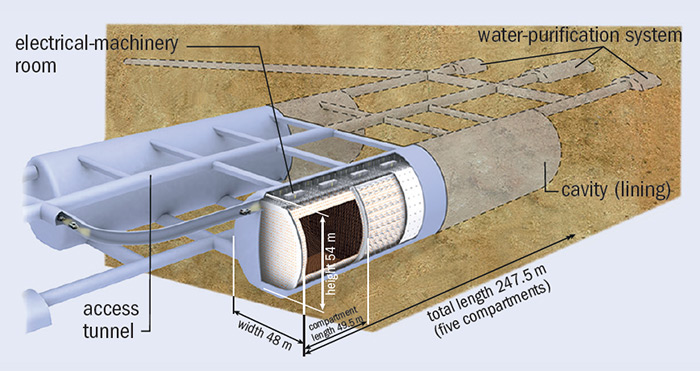
The Hyper-Kamiokande project aims both to address the mysteries of the origin and evolution of the universe’s matter and to confront theories of elementary-particle unification. To achieve these goals, the project will combine a high-intensity neutrino beam from the Japan Proton Accelerator Research Complex (J-PARC) with a new detector based on precision experimental techniques developed in Japan – a new megaton-class water Cherenkov detector to succeed the highly successful Super-Kamiokande detector.

CCnew13_03_15

The Hyper-Kamiokande detector will be about 25 times larger than Super-Kamiokande, the research facility that first found evidence for neutrino mass in 1998. Super-Kamiokande’s discoveries that, in comparison to other elementary particles, neutrinos have extremely small masses, and that the three known types of neutrino mix almost maximally in flight, support the ideas of theories that go beyond the Standard Model to unify the elementary particles and forces.

In particular, the Hyper-Kamiokande project aspires not only to discover CP violation in neutrinos, but to close in on theories of elementary-particle unification by discovering proton decay. By expanding solar, atmospheric, and cosmic neutrino observations, as well as advancing neutrino-interaction research and neutrino astronomy, Hyper-Kamiokande will also provide new knowledge in particle and nuclear physics, cosmology and astronomy.

As an international project, researchers from around the world are working to start the Hyper-Kamiokande experiment in 2025.The Hyper-Kamiokande proto-collaboration now includes an international steering committee and an international board of representatives with members from 13 countries: Brazil, Canada, France, Italy, Japan, Korea, Poland, Portugal (observer state), Russia, Spain, Switzerland, the UK and the US.

bright-rec iop pub iop-science physcis connect