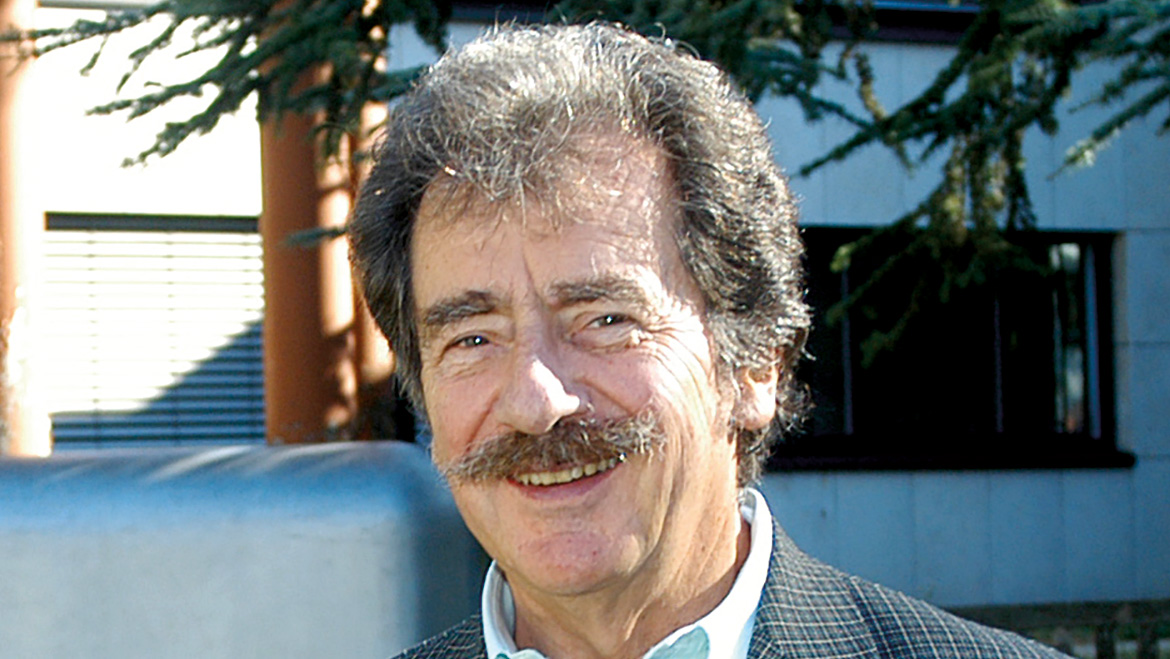
Glen Lambertson, one of the early giants of US accelerator physics, passed away on 30 August aged 94. Glen is best known for the injection/extraction magnet that bears his name. His greatest achievements, however, were, to quote from the American Physical Society (APS) 2006 Wilson Prize citation, “… fundamental contributions … in the area of beam electrodynamics including the development of beam instrumentation for the feedback systems that are essential for the operation of high luminosity electron and hadron colliders”.
Glen’s studies at the University of Colorado were interrupted by World War II, during which he saw action serving in the legendary 10th Mountain Division. Severely wounded in Northern Italy, his life was saved by the newly discovered wonder drug “penicillin”. (Incidentally, he remained an avid skier well into his 80s.) After the war he completed his degree at Colorado in engineering physics and did graduate work at the University of California, quickly becoming involved with accelerators. His first contact was as an operator of the 184-Inch Synchrocyclotron, where he commented that Ernest Lawrence would often reach over his shoulder to “tweak a knob”.
Glen played a large part in the design of the magnet system for the Bevatron at Lawrence Berkeley National Laboratory, and in 1960 was instrumental in the retrofitting of a resonant extraction system for this machine, vastly improving its performance and effectiveness as a discovery tool for the newly established field of particle physics. His patent for the “Lambertson magnet” is dated 1965, and this concept is still widely used for the injection and extraction of beams in synchrotrons and storage rings.
In the mid-1970s Glen was a major contributor to the ESCAR project – a first attempt to build a small (4 GeV) superconducting accelerator to provide data and experience for future large superconducting machines. While funds were not available to complete the project, two quadrants of dipoles were built and successfully tested, along with the necessary cryogenic and control-system infrastructures. Later in the 1970s, following the developments in stochastic cooling by Simon Van der Meer, Glen led the successful experiment to demonstrate stochastic cooling at the Fermilab 200 MeV cooling test ring. His techniques were transferred to rings at Fermilab and Brookhaven.
His most productive studies were in beam instabilities, in particular the instrumentation to detect and control electron-cloud instabilities. He was a key figure in the successful commissioning of both the PEP-II B-factory at SLAC, and the Advanced Light Source at Berkeley. He also had close contacts with CERN, serving as a visiting scientist in 1993 and later playing an important role in calculating the impedance of injection-line components for the LHC.
Glen’s work was widely recognised. In addition to the APS Wilson prize, he was an APS fellow and also won the US Particle Accelerator School Prize for Achievement in Accelerator Science and Technology.
His always relaxed demeanour and sage advice were a constant inspiration to us, and we forgave him his incredibly awful puns. Rest in peace, Glen!
CERN’s Super Proton Synchrotron (SPS) could be upgraded so that not only protons have the possibility to be accelerated, but also electrons. A 173-page conceptual design report posted on arXiv on 15 September describes the installation of a high-energy electron accelerator that could have the potential to be used for accelerator R&D, dark-sector physics, and for electro-nuclear measurements crucial for future neutrino experiments. The “eSPS”, proposed in 2018 by Torsten Åkesson of Lund University and colleagues at CERN, would marry technology developed for the Compact Linear Collider (CLIC) and the Future Circular Collider (FCC), and could also provide a step towards a potential electron-positron Higgs factory. The facility could be made operational in about five years and would operate in parallel and without interference with the next run of the LHC, Run 4, write the authors.
The SPS is one of CERN’s longest running accelerators, commissioned in June 1976 at an energy of 400 GeV and serving numerous fixed-target experiments ever since. It was later converted into a proton-antiproton collider which was used to discover the W and Z bosons in 1983. Then, in addition to its fixed-target programme, the SPS became part of the injection chain for LEP, and most recently, has been used to accelerate protons for the LHC.
The changeover time for using the SPS as a proton accelerator to an electron accelerator is estimated to be around ten minutes
Electrons would be injected into the SPS at an energy of 3.5 GeV by a new compact high-gradient linac based on CLIC’s X-band radio-frequency (RF) cavity technology, which would fill the circular machine with 200 ns-duration pulses at a rate of 100 Hz. An additional 800 MHz superconducting RF system, similar to what is needed for FCC-ee, would then accelerate the electron beam from 3.5 GeV to an extraction energy up to 18 GeV. The changeover time for using the SPS as a proton accelerator to an electron accelerator is estimated to be around ten minutes.
Serving experiments
The requirements of the primary electron beam to be delivered by the eSPS were determined by the needs of the proposed Light Dark Matter eXperiment (LDMX), which would use missing-momentum techniques to explore potential couplings between hidden-sector particles and electrons in uncharted regions. The experiment could be housed in a new experimental area (see figure). The beam directly from the linac could also serve two experimental areas for a broad range of accelerator R&D; for example, it could provide multi-GeV drive beam bunches and electron witness bunches for plasma wakefield acceleration.
In a second phase, the facility could be geared to deliver positron witness bunches, which would make it a “complete facility” for plasma wakefield collider studies. Such a programme would naturally build on the work done by the AWAKE collaboration, which uses protons as a drive beam, and significantly broaden plasma wakefield R&D at CERN in line with priorities set out by the recent update of the European strategy for particle physics. Positron production would be a crucial element for any future Higgs-factory, while it would also allow studies of the Low EMittance Muon Accelerator (LEMMA) – a novel scheme for obtaining a low-emittance muon beam for a muon collider, by colliding a high-energy positron beam with electrons in a fixed target configuration at the centre of mass energy required to create muon pairs.
The eSPS proposal came about as a result of work in CERN’s Physics Beyond Colliders study group, and an Expression of Interest that was submitted to the SPS Committee in September 2018.
Quarkonia, the bound states of charm and anti-charm or bottom and anti-bottom quarks, are an important tool to test our knowledge of quantum chromodynamics (QCD). At the LHC, the study of quarkonia polarisations offers a valuable new window onto how heavy quarks bind together in such states. Understanding quarkonium polarisation has already proven to be difficult at lower energies, however, and measurements at the LHC pose significant further challenges.
ALICE measures quarkonia spin orientations with respect to a chosen axis via a measurement of the anisotropy in the angular distribution of the decay products. The angular distribution is parametrised in terms of the polarisation parameters, λθ, λφ and λθφ, where θ and φ are the polar and azimuthal emission angles. If all of them are null, no polarisation is present, whereas (λθ = 1, λφ = 0, λθφ = 0) and (λθ = –1, λφ = 0, λθφ = 0) indicate a polarisation of the spin in the transverse and longitudinal directions, respectively.
Polarisation studies represent a valuable tool for the study of the properties of quark–gluon plasma
In pp collisions, polarisation has been mainly used to investigate the J/ψ production mechanism. Reproducing the small values of polarisation parameter λθ observed at the LHC is a challenge for many theoretical models. Until recently, no corresponding results were available for nucleus–nucleus collisions, and in this domain polarisation studies represent a valuable tool for the study of the properties of quark–gluon plasma (QGP). The formation of this deconfined, strongly interacting medium impacts differently on the various quarkonium resonances, inducing a larger suppression on the less bound excited states ψ(2S) and χc, and modifying their feed-down fractions into the ground state, J/ψ. This effect may lead to a variation of the overall polarisation values since different charmonium states are expected to be produced with different polarisations. In addition, the recombination of uncorrelated heavy-quark pairs inside the QGP gives rise to an extra source of J/ψ, which can further modify the overall polarisation with respect to pp collisions.
The ALICE experiment has recently made the first measurements of the J/ψ and ϒ(1S) polarisation in Pb–Pb collisions. The data correspond to a centre-of-mass energy √(sNN) = 5.02 TeV, and the rapidity range 2.5 < y < 4. The measurements were carried out in the dimuon decay channel, and results were obtained in two different reference frames, helicity and Collins–Soper, each of them with its own definition of the quantisation axis. In the helicity frame, the quarkonium momentum direction in the laboratory is chosen, while the bisector of the angle formed by the two colliding beams boosted in the quarkonium rest frame is used in the Collins–Soper frame. The J/ψ polarisation parameters, evaluated in three pT bins covering the range between 2 and 10 GeV, are close to zero, but with a maximum positive deviation for λθ (corresponding to a transverse polarisation) of 2σ for 2 < pT < 4 GeV in the helicity reference frame. Interestingly, the corresponding LHCb pp result for prompt J/ψ at √(sNN) = 7 TeV instead shows a small but significant longitudinal polarisation.
The observation of a significant difference between J/ψ polarisation results in pp and Pb–Pb collisions motivates further experimental and theoretical studies, with the main goal of connecting this observable with the known suppression and regeneration mechanisms in heavy-ion collisions. For the rarer ϒ(1S), a bound state of a bottom and an antibottom quark, the inclusive polarisation parameters were found to be compatible with zero within sizeable uncertainties. A higher precision and momentum-differential measurement will be enabled by the ten-fold larger Pb–Pb luminosity expected in Run 3 of the LHC.
The possibility that dark-matter particles may interact via an unknown force, felt only feebly by Standard Model (SM) particles, has motivated substantial efforts to search for dark forces. The force-carrying particle for such hypothesised interactions is often referred to as a dark photon, in analogy with the ordinary photon that mediates the electromagnetic interaction.
In the minimal dark-photon scenario, the dark photon does not couple directly to SM particles; however, quantum-mechanical mixing between the photon and dark-photon fields can generate a small interaction, providing a portal through which dark photons may be produced and through which they might decay into visible final states.
Hidden-valley scenarios exhibit confinement in the dark sector, similarly to how the strong nuclear force confines quarks
While the minimal dark-photon model is both compelling and simple, it is not the only viable dark-sector scenario. Many other well-motivated dark-sector models exist, and some of these would have avoided detection in all previous experimental searches. Fully exploring the space of dark sectors is vital given the lack of signals observed thus far in the simplest scenarios. For example, so-called hidden-valley (HV) scenarios exhibit confinement in the dark sector, similarly to how the strong nuclear force confines SM quarks, would produce a high multiplicity of light hidden hadrons from showering processes in a similar way to jet production in the SM. These hidden hadrons would typically decay displaced from the proton–proton collision, thus failing the criteria employed in previous dark-photon searches to suppress backgrounds due to heavy-flavour quarks. Therefore, it is desirable to perform experimental searches for dark sectors that are less model dependent, by not focusing solely on the minimal dark-photon scenario.
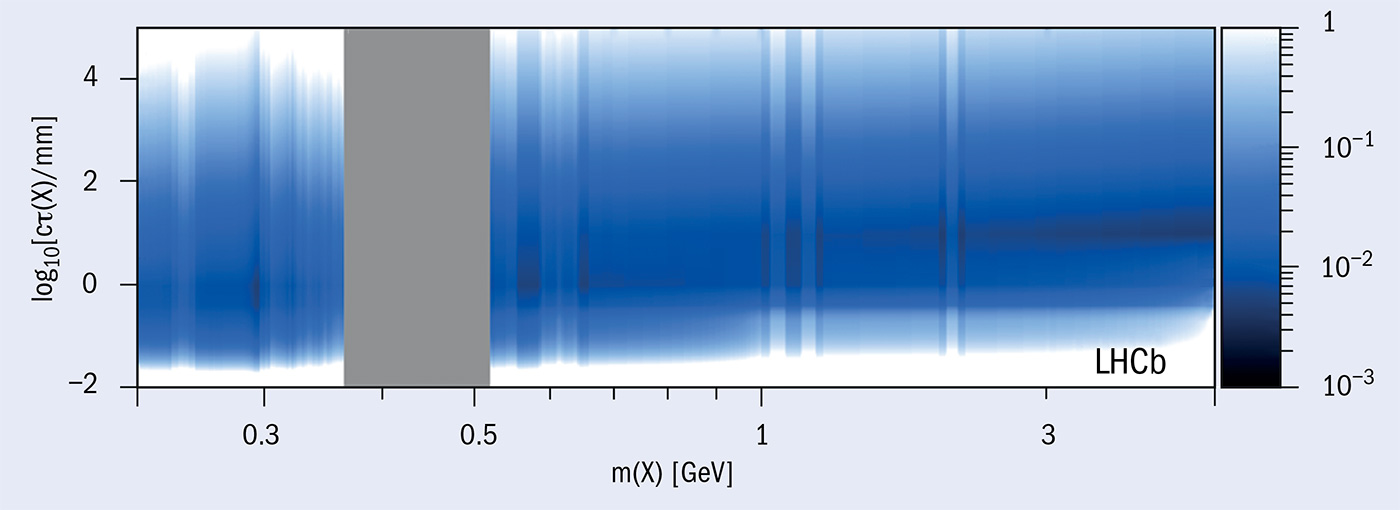
Using its Run-2 data sample, LHCb recently performed searches for both short-lived and long-lived exotic bosons that decay into the dimuon final state. These searches explored the invariant mass range from near the dimuon threshold up to 60 GeV. None of the searches found evidence for a signal and exclusion limits were placed on the X →μ+μ– cross sections, each with minimal model dependence.
For many types of dark-sector models, these limits are the most stringent to date. This is especially true for the HV scenario (see figure), for which LHCb has placed the first such constraints on physically relevant HV mixing strengths in this mass range.
These results demonstrate the unique sensitivity of the LHCb experiment to dark sectors. Looking forward to Run 3, the trigger will be upgraded, greatly increasing the efficiency to low-mass dark sectors, and the luminosity will be higher. Taken together, these improvements will further expand LHCb’s world-leading dark-sector programme.
Exotic charmonium-like states are a very active field of study at the LHC. These states have atypical properties such as non-zero electric charges and strong decays that violate isospin symmetry. The exotic X(3872) charmonium state discovered by the Belle collaboration in 2003 displays such isospin-violating strong decays and has a natural width of about 1 MeV, which is unexpectedly narrow for a state with mass very close to the D*0D0 threshold.
Luciano Maiani and collaborators pointed out that the new CMS measurement can naturally be explained by a tetraquark model of X(3872)
Several theoretical interpretations of the internal structure of these charmonium-like states have been proposed to explain their peculiar properties. To choose the most adequate model for each state, we must continue studying their properties and improving the determination of their parameters. As for the X(3872), although it is inconsistent with the predicted conventional charmonium states and does not have a definite isospin, its production partially resembles that of ordinary charmonium states such as ψ(2S) or χc1(1P). One of the ways to evaluate the degree of similarity between X(3872) and ψ(2S) is to compare their production rates in exclusive b-hadron decays. In the case of ψ(2S), which is a conventional charmonium state, the branching fractions of the decays B0s → ψ(2S)φ, B+ → ψ(2S)K+, and B0 → ψ(2S)K0, are approximately equal to each other. Recent CMS measurements of the corresponding rates for decays to X(3872) show differences, however, which may provide a clue to the nature of this exotic charmonium-like state.
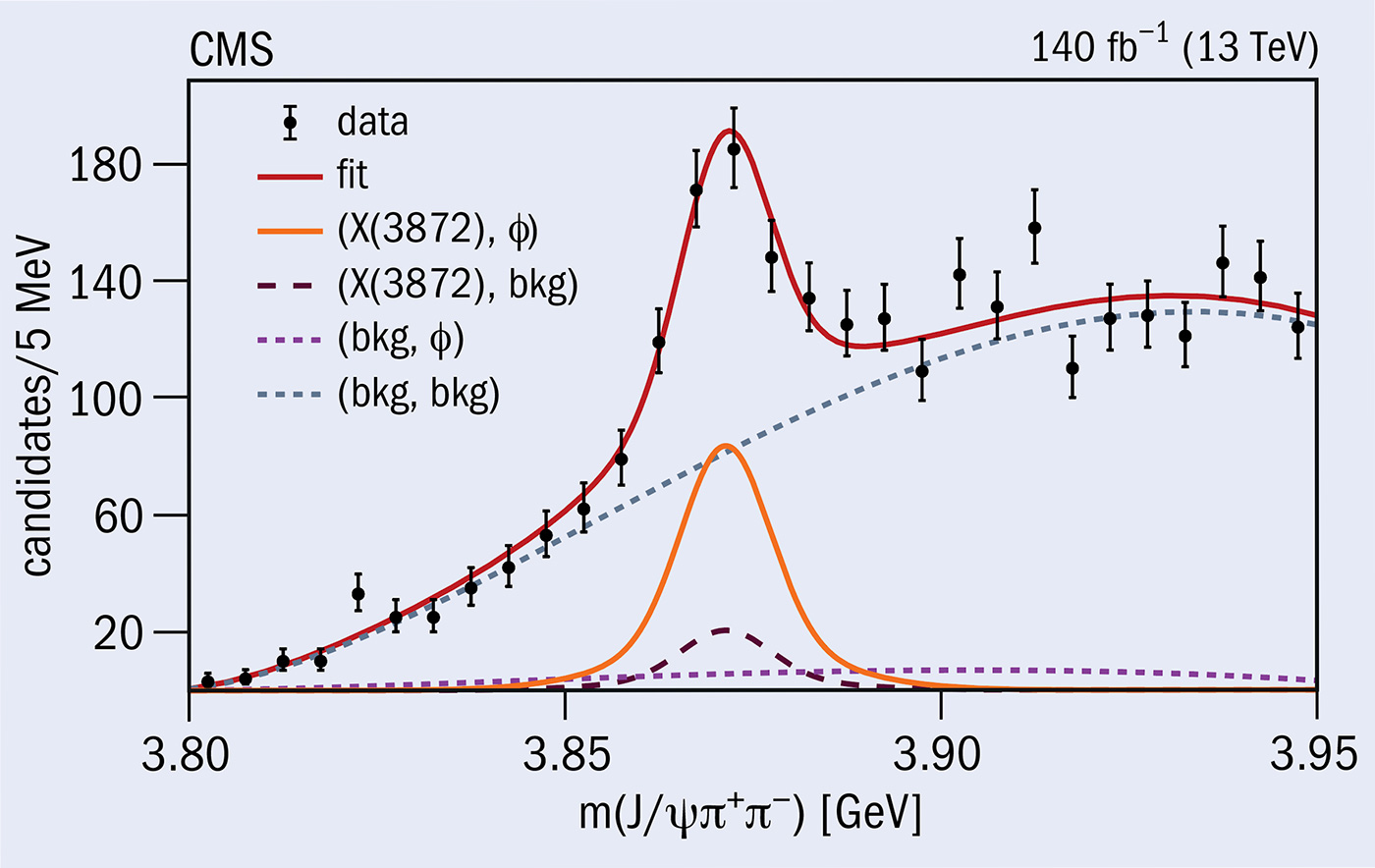
Recently the CMS collaboration observed the decay B0s → X(3872)φ for the first time, with a significance exceeding five standard deviations. The X(3872) is reconstructed via its decay to J/ψπ+π–, followed by a decay of the J/ψ meson into a pair of muons, and of the φ meson to a pair of charged kaons (figure 1).
Diquark hypothesis
At a simple Feynman-diagram level, this decay is a close analogue to the B+ → X(3872)K+ and B0 → X(3872)K0 decays that have previously been observed. The ratio of the branching fractions of this new B0s decay to that of the B+ decay is significantly below unity at 0.48 ± 0.10, while a similar ratio for the decays involving ψ(2S) is consistent with unity. This is not expected from naive “spectator-quark” considerations, based on a simple tree-level diagram, and assuming X(3872) is a pure charmonium state. The measured ratio also happens to be consistent with the analogous ratio for the B0 → X(3872)K0 to B+ → X(3872)K+ decays, though the latter ratio has not yet been measured with high accuracy. The results suggest that spectator quarks behave differently in the B+ and B0(s) two-body decays into X(3872) and a light meson. In a recent theoretical paper, former CERN Director-General Luciano Maiani and collaborators pointed out that the new CMS measurement can naturally be explained by a tetraquark model of X(3872), which describes this exotic particle as a bound state of a diquark (charm and up quarks) and its anti-diquark.
Further studies of X(3872) are now important in order to gain a deeper understanding of its exotic properties and uncover its mysterious nature. The results may have interesting consequences for our understanding of quantum chromodynamics.
Ever since I was an undergraduate, I wanted to know why there was a lot more matter in the universe than antimatter – an asymmetry that permits us to exist. My thesis was on CP violation in the kaon system as part of the NA31 experiment at CERN. I had the opportunity to help build a muon detector and we found the first evidence that matter and antimatter behave differently as they disintegrate; subsequently established with greater significance by NA48 and by KTeV at Fermilab. NA31 was a wonderfully nurturing environment with many brilliant physicists. Like many European students at that time, I was strongly encouraged to head to the US for post-PhD finishing school and decided to join the CLEO experiment at the Cornell Electron Storage Ring (CESR) – for two reasons: first, CLEO studied beauty quarks, which were expected to have much larger CP violating effects than kaons; and second because I had fallen in love with a student (now my wife, Daniela Bortoletto) working on CLEO whom I had met at CERN. CLEO was another astonishingly nurturing environment. I joined Purdue University as an assistant professor just a couple of years after arriving in the US.
How did you make the transition to the LHC experiments?
While I’d help build the CLEO muon spectrometer and worked on analyses,there was an expectation to work on a far-future project as well. I set up a fledgling research group to develop micro pattern gas detectors (MPGDs) for the SDC collaboration at the Superconducting Super Collider (SSC). Fairly quickly we concluded that silicon microstrip and pixel detectors were a better technology choice for this application, but then, in 1993, the SSC was cancelled and a lot of people went towards the LHC. I was invited to join ATLAS due to my MPGD expertise, but I decided to focus on CLEO and the surety of great physics results, which were needed to win tenure. Shortly afterwards, with CLEO colleagues, I received a large grant to build a silicon vertex detector for CLEO III, which was commissioned successfully in 2000. Almost immediately I and my group were invited to join CMS to help build the forward silicon pixel detector. After the pixel detector was installed I was asked to co-lead the LHC Physics Center (LPC) at Fermilab. Then the LHC began operation and I moved to CERN, serving also as the co-convener of the CMS quarkonia working group. The atmosphere at CERN was electric and analysing those first LHC data was one of the most exciting moments of my career. CMS has been a wonderful, supportive environment in which to learn and grow as a physicist. Then, in 2013, I took up a position at Oxford, which is a founding member of ATLAS. I joined ATLAS in 2016 and brought with me experience with muons, silicon and data analysis. It’s very exciting to be part of ATLAS and the collaboration has been very welcoming.
What attracted you to work on the Vera C Rubin Observatory?
The Rubin Observatory is a ground-based 8.4 m, 10 square-degree field-of-view telescope that will see more of the universe at optical wavelengths in its first month of operation than all previous telescopes combined. Scheduled to start in late 2022, (but delayed by COVID-19 situation), it will revolutionise astronomical observations by conducting the Legacy Survey of Space and Time – an optical survey of faint astronomical objects across the entire sky every three nights, enabling precision dark-energy measurements, studies of dark matter and opening a movie-like window on objects that change or move on rapid timescales. I have been a member since 2007, when I was asked to help out in the pitch to the US Department of Energy (DOE) to participate in the project. The scope of particle physics was broadening and the US national laboratories engaged in particle physics had significant capabilities, for example in silicon detector construction, that were an excellent match to the technical challenges of building the Rubin Observatory’s 3 Gigapixel CCD camera. We met healthy scepticism at DOE, given the completely unknown nature of dark energy. From a science perspective we found two lines of argument were useful. First, the job of particle physicists is to understand the fundamental nature of energy, matter, space and time, and in so doing to understand the origin, evolution and fate of the universe. Second, by analogy to the Higgs field and Higgs boson, the cosmological observations are consistent with dark energy being a scalar field, which if correct implies an associated scalar particle. The pitch was successful and the DOE approved funding for the construction of the CCD camera. Soon after arriving at Oxford I was asked to help make the case for UK participation in the project. Like everyone else in the Rubin Observatory community, I am eagerly anticipating first data.
Did you plan to enter scientific management?
I had no plan to be involved in scientific management of any kind! At around the time I joined CMS a few of us had been developing the idea to transform CLEO and CESR into a machine that would preferentially produce charm quarks rather than beauty quarks to test ultra-precise lattice-QCD predictions used by B-physics experiments to extract CKM matrix elements. When getting the idea funded I became the public face of the experiment, and around that time I was also elected by the collaboration to be co-spokesperson.
As CLEO entered its twilight phase, the success of the LPC led to me being elected chairperson of the CMS collaboration board in 2012. I was also elected chair of the APS division of particles and fields. Moving back to Europe I was elected head of the Oxford particle-physics group in 2014 and I was elected head of the physics department in 2018. Throughout this entire period, leadership roles have occupied about 50% of my working day, which has meant that to get research done I tend to be connected to my laptop until the early hours on most days. Fortunately, five to six hours of sleep each night is sufficient. I have also been blessed with wonderful colleagues, students, postdocs, and administrative support. In my opinion the best leaders are those people who don’t want to be leaders per se, and I think I was selected for this reason. Particle physics is a team effort, quite distinct to the way an army or a corporation is organised. Our leaders are not generals or CEOs, but colleagues called to serve for a time before returning to the rank and file.
How did you wind up leading the quantum-sensor programme for the UK’s Quantum Technologies initiative?
In 2017 the DOE invited me and a colleague to articulate the case for quantum sensing in particle physics. We co-organised a workshop bringing together many disparate communities from which an influential whitepaper (arXiv.org:1803.11306) emerged and contributed to the creation of a new DOE-funded quantum-sensing programme in 2018. I then conducted a similar activity in the UK at the invitation of the Science and Technology Facilities Council (STFC), bringing together the particle-physics and particle-astrophysics community with the atomic, molecular and optical and condensed-matter communities to form a Quantum Sensing for Fundamental Physics (QSFP) consortium, targeting strategic UK government funding to support interdisciplinary research. STFC announced around £40M for the programme in September 2019 and a call for proposals led to the identification of seven projects for funding, for which an official announcement is imminent. I am a member of one of them: AION (the Atom Interferometer Observatory Network).
What is driving current interest in quantum technologies?
The birth of quantum mechanics nearly 100 years ago has led to the information and communication technology that is now central to modern civilisation – sometimes referred to as the first quantum revolution. But none of the existing technologies use any of the iconic characteristics of quantum mechanics such as the uncertainty principle, superposition states, macroscopic quantum interference, or two-particle quantum entanglement. Second-generation quantum technology that exploits these phenomena is just coming online.
NA31 was a wonderfully nurturing environment with many brilliant physicists
Most well-known is quantum computing, which exhibits extraordinary capabilities and is steadily entering the scientific and corporate marketplaces. As humankind harnesses the characteristics of quantum mechanics and gains mastery over them we will witness the second quantum revolution that will transform our society in as profound a way as the first quantum revolution did. It is no different to the transistor in the 1950s: if people told you back then that transistors could change your life, no one would have believed you; now we have a billion of them in a smart phone. So we can start to harness (crudely) phenomena such as entanglement and the promise is that over the next 20–30 years we can put this technology in your phone. We can’t even begin to think what that would enable because it’s beyond our imagination. Think quantum internet, quantum liquid crystals and quantum artificial neural networks.
What do quantum technologies offer high-energy physics?
A revolution in the theory and tools of quantum mechanics has produced new sensitive measurement techniques that allow measurements to be made near the intrinsic noise limits imposed by the uncertainty principle, as well as enabling new capabilities in sensitivity, resolution and robustness. This can now be harnessed to accelerate searches for new physics including, for example, dark matter, hidden dark sectors and electric dipole moments. For decades, one way that we’ve hunted for dark-matter particles is with large detectors via nuclear recoils, but the allowable mass ranges from 10-22 eV to the Planck scale, which demands new detection technologies. Related fields that will also be impacted by quantum sensing are gravitational wave cosmology, astrophysics and fundamental tests of quantum mechanics. Quantum computing, along with traditional high-performance computing and advances in machine learning and artificial intelligence, will be absolutely necessary to analyse HL-LHC data. Quantum communication is also key to this.
What can high-energy physics contribute to quantum technologies?
Bringing the unique resources and expertise of the particle-physics community to bear on the development of quantum sensors will lead to rapid technology advances. For example, Fermilab develop high-Q superconducting RF cavities. Some searches for ultra-light dark matter use these.
Our leaders are not generals or CEOs, but colleagues called to serve for a time before returning to the rank and file
Additionally, they provide a high-coherence environment for qubits used as detectors, isolating them from a noisy environment. CERN, as the premier particle-physics laboratory in the world, will also find ways to contribute. In quantum sensing, CERN can help with its deep shafts potentially suited to atom interferometry. Several fledglingefforts exist, and collaboration can be enhanced by structures and funding and a world lab that brings people together from a wide range of disciplines.
How has becoming profoundly deaf at the age of 29 affected your career?
I was eight-months married and had just been appointed assistant professor when suddenly I fell very ill and was diagnosed with a rare cancer of the blood and bone marrow called acute myeloid leukemia, which few people at that time survived. I underwent intense chemotherapy, which weakened my immune system and caused me to fall into a coma. The hair cells in my cochlea were destroyed as a result of the antibiotics that were medically necessary to keep me safe until my own immune system had returned, rendering me permanently deaf. I was taught to lip read but I didn’t learn to sign because in general physics is not a culture where it is used. I also didn’t develop deaf speak. However, without hearing it was a slow process to communicate. There was immense support from my colleagues at Cornell and Persis Drell, who is now Provost at Stanford, was essential in taking it to the next level because she suggested she write down what people said. Others quickly followed suit, allowing me to communicate instantly for the first time. In 2003 I had a cochlear implant installed. When I couldn’t hear, I was treated completely like everyone else. I didn’t sense any discrimination. It taught me to be positive and to believe in myself and in life. Belief is important in everything we do both as individuals and as scientific institutions. Believing a 100 km circumference future circular collider is possible is a prerequisite for it to happen – and I believe!
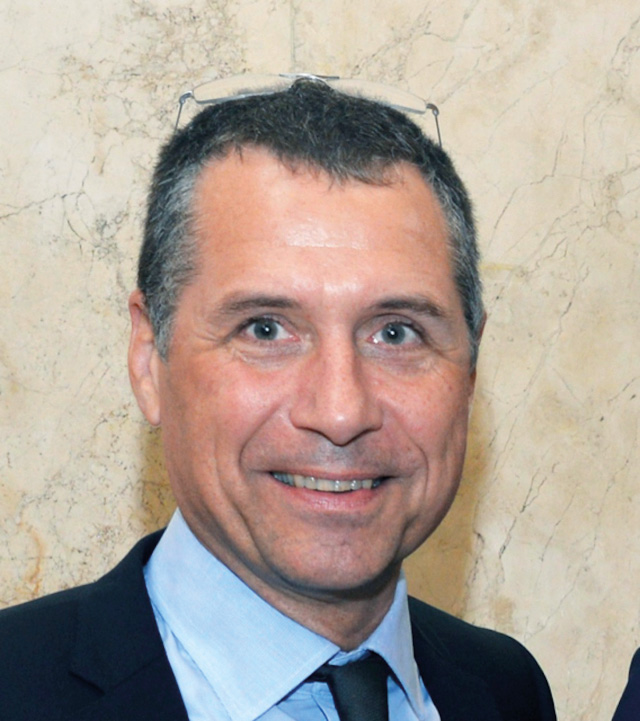
CERN’s Oliver Brüning has succeeded Lucio Rossi, who retires this year, as project leader for the High-Luminosity LHC (HL-LHC). Brüning, who completed his PhD on particle dynamics at HERA, joined CERN in 1995 one year after the LHC was approved. He has been at the forefront of accelerator and beam physics ever since, being one of the initial six machine coordinators during the LHC start-up and leading the LHC full-energy exploitation study from 2015–2019. Among the next significant steps for the HL-LHC are the testing of the first triplet quadrupole prototype, and the RF-dipole crab cavities in the SPS.
Brookhaven National Laboratory (BNL) has appointed Jim Yeck as the project director for the Electron–Ion Collider (EIC), which will open new vistas on the properties and dynamics of quarks and gluons. Yeck has held leading roles in BNL’s Relativistic Heavy Ion Collider and National Synchrotron Light Source II, the US hardware contribution to the LHC project, and the IceCube neutrino observatory. He was also former director general of the European Spallation Source. Yeck will head a newly created EIC directorate at BNL, working in partnership with Jefferson Laboratory and others. The EIC is scheduled to begin operations at BNL at the end of the decade.
Henri Laporte, who led the civil-engineering work for the Large Electron Positron collider (LEP) at CERN, passed away on 18 May. Built in the 1980s, LEP was the biggest construction project for fundamental research ever undertaken and included the construction of the 27 km-circumference tunnel that now houses the LHC.
A native of Sète in the south of France, Laporte graduated from the École Polytechnique and École des Ponts et Chaussées, and began his career in marine engineering in the early 1950s. He was appointed as chief engineer, first for the construction of the port of Oran and then the Toulon naval base, before moving to French Polynesia in 1963 to preside over the extension of the Port of Papeete. In 1967 he was recruited by CERN to lead the technical services and buildings division.
Known for his relentless work ethic, expertise and authority, Laporte joined LEP at the start of the 1980s and was given responsibility for the hugely ambitious civil-engineering project by project leader Emilio Picasso. Before excavation could begin, however, CERN had to get the local authorities on board as the tunnel would pass underneath about 10 Swiss and French communes, and nine sites would be built on the surface. Under Robert Lévy-Mandel, who was in charge of the impact study, dozens of consultation meetings were held. Laporte shone on these occasions thanks to his oratory and interpersonal skills.
The flagship construction project began in 1983 with the excavation of 18 shafts, followed by the excavation of the tunnel itself. Three tunnel-boring machines were required to dig out 23 km’s worth of earth under the plain. Explosives were used to excavate the section of the tunnel below the Jura mountains due to fears that a geological incident could halt the progress of the machines. And such an incident did indeed occur in 1986, when high-pressure inflows of water flooded the tunnel, causing delays to the project. Laporte’s expertise and leadership were decisive in the response to this incident and throughout the project as a whole. It was a regular occurrence for him to arrive on site any time of day or night to study damage and take urgent decisions. In 1988 the tunnel was finally completed.
But the main tunnel represented less than half the total excavation work, as the ring is punctuated with access shafts, caverns and service tunnels. In addition, around 80 buildings were built on the surface. Jean-Luc Baldy, who managed the surface work, and Michel Mayoud, who was in charge of the crucial work of the surveyors, remember the trust that Laporte placed in them, giving them considerable room for manoeuvre.
Once the construction work had been completed, CERN became entangled in protracted legal proceedings involving the consortium of companies that had carried out the work. Laporte spent several years working with the CERN legal service, once more demonstrating his trademark persistence. At the arbitration tribunal, Laporte distinguished himself not only for his technical knowledge, but also his talent as an actor and his humour. He retired in 1993 and devoted himself to numerous intellectual and artistic pursuits.
Henri Laporte was a man of great curiosity and was highly knowledgeable in many fields. He will be remembered as a charismatic man, with a firm hand and great tenacity, but also someone who exuded a contagious joviality and always showed compassion towards his colleagues.
Claude Détraz was born on 20 March 1938 in Albi, in the south of France. He graduated from the École Normale Supérieure and began his research career at CNRS in 1962, studying atomic nuclei. Détraz then joined the Institut de Physique Nucléaire d’Orsay, founded by Irène and Frédéric Joliot Curie, which has recently been merged with its neighbouring laboratories in Orsay to form the Laboratoire de Physique des 2 Infinis Irène Joliot-Curie (IJCLab).
At CERN’s Proton Synchrotron (PS), in collaboration with Robert Klapisch’s team, he contributed to the discovery of the first evidence of deformation in exotic nuclei at a shell closure. Drawing on these results, he became convinced that the beams at the Grand Accélérateur National d’Ions Lourds (GANIL) laboratory in Caen could also become a unique tool in this field.
As director of GANIL from 1982 to 1990, he launched several research projects on exotic nuclei. The legacy of these projects is still with us today and will continue into the future. Détraz was one of the main founders of NuPECC (the Nuclear Physics European Collaboration Committee) and was its first chair from 1989 to 1992, cementing its position as the main coordinating committee for nuclear physics in Europe.
In 1991 Détraz became a technical adviser in the office of the French minister for research, Hubert Curien. Through his involvement with decision-making bodies at all levels in France, Détraz made a major contribution to ensuring that the LHC project was approved in 1994. For example, he played a key role in Curien’s appointment as president of the CERN Council, a position from which he was able to exert a major influence in the final phases of the decision. As director of IN2P3 at CNRS from 1992 to 1998, he helped to provide the impetus, first with Robert Aymar and then with Catherine Cesarsky of the CEA, to France’s wholehearted participation in the LHC adventure.
Détraz made a major contribution to ensuring that the LHC project was approved in 1994
In 1999 Luciano Maiani, CERN Director-General at that time, appointed Détraz as director of research, jointly with Roger Cashmore, until 2003. This was a period filled with important events for CERN, including the shutdown of LEP, the excavation of new caverns for the LHC and the start of a project to send neutrinos from CERN to the underground laboratory at Gran Sasso, to which Claude contributed substantially.
Throughout his career Détraz promoted and supported interaction between scientific disciplines. As a nuclear physicist he established strong links with particle physics. He was also one of the architects of the emergence of astroparticle physics, and received multiple honours both in France and abroad.
Détraz was a great scientist and a true visionary, who played a major role in nuclear and particle physics in France and Europe. As well as being a brilliant scientist and occupying several high-level positions, Claude was a true “Enlightenment. man” of great culture and finesse. He was a shining light of our generation.
To provide the best experiences, we use technologies like cookies to store and/or access device information. Consenting to these technologies will allow us to process data such as browsing behavior or unique IDs on this site. Not consenting or withdrawing consent, may adversely affect certain features and functions.
Functional
Always active
The technical storage or access is strictly necessary for the legitimate purpose of enabling the use of a specific service explicitly requested by the subscriber or user, or for the sole purpose of carrying out the transmission of a communication over an electronic communications network.
Preferences
The technical storage or access is necessary for the legitimate purpose of storing preferences that are not requested by the subscriber or user.
Statistics
The technical storage or access that is used exclusively for statistical purposes.The technical storage or access that is used exclusively for anonymous statistical purposes. Without a subpoena, voluntary compliance on the part of your Internet Service Provider, or additional records from a third party, information stored or retrieved for this purpose alone cannot usually be used to identify you.
Marketing
The technical storage or access is required to create user profiles to send advertising, or to track the user on a website or across several websites for similar marketing purposes.