The most common neutrino interactions are the most difficult to detect. But thanks to advances in detector technology, coherent elastic neutrino–nucleus scattering (CEνNS) is emerging from behind backgrounds, 50 years after it was first hypothesised. These low-energy interactions are insensitive to the intricacies of nuclear or nucleon structure, making them a promising tool for precision searches for physics beyond the Standard Model. They also offer a route to miniaturising neutrino detectors.
“I am convinced that we are seeing the beginning of a new field in neutrino physics based on CEνNS observations,” says Manfred Lindner (Max Planck Institute for Nuclear Physics in Heidelberg), the spokesperson for the CONUS+ experiment, which reported the first evidence for fully coherent CEνNS in July. “The technology of CONUS+ is mature and seems scalable. I believe that we are at the beginning of precision neutrino physics with CEνNS and CONUS+ is one of the door openers!”
Act of hubris
Daniel Z Freedman is not best known for CEνNS, but in 1974 the future supergravity architect suggested that experimenters search for evidence of neutrinos interacting not with nucleons but “coherently” with entire nuclei. This process should dominate when the de Broglie wavelength of the neutrino is the diameter of the nucleus or larger. The question of which specific neutron exchanged a Z boson with the incoming neutrino would sum in the quantum amplitude rather than the probability, leading to an N2 dependence on the number of neutrons. As a result, CEνNS cross sections are typically enhanced by a factor of between 100 and 1000.
Freedman noted that his proposal may have been an “act of hubris”, because the interaction rate, detector resolution and backgrounds would all pose grave experimental difficulties. His caveat was perspicacious. It took until 2017 for indisputable evidence for CEνNS to emerge at Oak Ridge National Laboratory in the US, where the COHERENT experiment observed CEνNS by neutrinos with a maximum energy of 52 MeV, emerging from pion decays at rest (CERN Courier October 2017 p8). At these energies, the coherence condition is only partially fulfilled, and nuclear structure still plays a role.
The CONUS+ collaboration now presents evidence for CEνNS in the fully coherent regime. The experiment – one of many launched at nuclear reactors following the COHERENT demonstration – uses reactor electron anti-neutrinos with energies below 10 MeV generated across 119 days at the Leibstadt Nuclear Power Plant in Switzerland. The team observed 395 ± 106 neutrinos compared to a Standard Model expectation of 347 ± 59 events, corresponding to a statistical significance for the observation of CEνNS of 3.7σ.
I am convinced that we are seeing the beginning of a new field in neutrino physics based on CEνNS observations
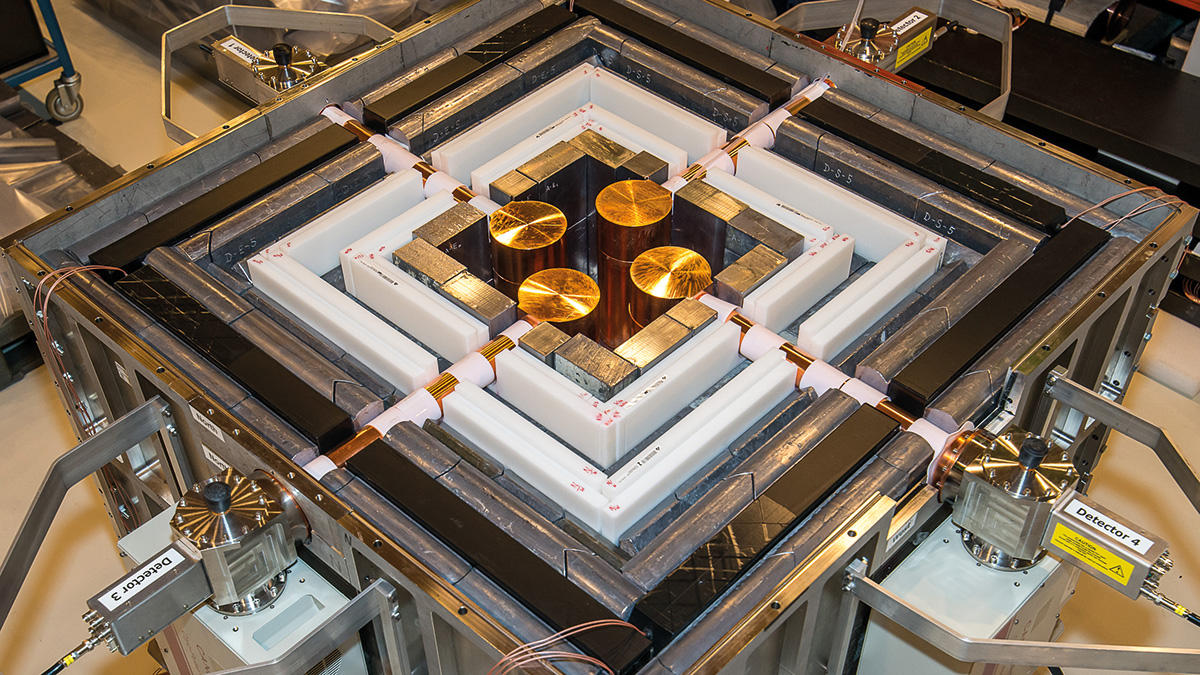
It is no wonder that detection took 50 years. The only signal of CEνNS is a gentle nuclear recoil – an effect often compared to the effect of a ping-pong ball on a tanker. In CONUS+, the nuclear recoils of the CEνNS interactions are detected using the ionisation signal of point-contact high-purity germanium detectors with ultra-low energy thresholds as low as 160 eV.
The team has now increased the mass of their four semiconductor detectors from 1 to 2.4 kg to provide better statistics and potentially a lower threshold energy. CONUS+ is highly sensitive to physics beyond the Standard Model, says the team, including non-standard interaction parameters, new light mediators and electromagnetic properties of the neutrino such as electrical millicharges or neutrino magnetic moments. Lindner estimates that the CONUS+ technology could be scaled up to 100 kg, potentially yielding 100,000 CEνNS events per year of operation.
Into the neutrino fog
One researcher’s holy grail is another’s curse. In 2024, dark-matter experiments reported entering the “neutrino fog”, as their sensitivity to nuclear recoils crossed the threshold to detect a background of solar-neutrino CEνNS interactions. The PandaX-4T and XENONnT collaborations reported 2.6σ and 2.7σ evidence for CEνNS interactions in their liquid–xenon time projection chambers, based on estimated signals of 79 and 11 interactions, respectively. These were the first direct measurements of nuclear recoils from solar neutrinos with dark-matter detectors. Boron-8 solar neutrinos have slightly higher energies than those detected by CONUS+, and are also in the fully coherent regime.
CEνNS has promise for nuclear-reactor monitoring
“The neutrino flux in CONUS+ is many orders of magnitude bigger than in dark-matter detectors,” notes Lindner, who is also co-spokesperson of the XENON collaboration. “This is compensated by a much larger target mass, a larger CEνNS cross section due to the larger number of neutrons in xenon versus germanium, a longer running time and differences in detection efficiencies. Both experiments have in common that all backgrounds of natural or imposed radioactivity must be suppressed by many orders of magnitude such that the CEνNS process can be extracted over backgrounds.”
The current experimental frontier for CEνNS is towards low energy thresholds, concludes COHERENT spokesperson Kate Scholberg of Duke University. “The coupling of recoil energy to observable energy can be in the form of a dim flash of light picked up by light sensors, a tiny zap of charge collected in a semiconductor detector, or a small thermal pulse observed in a bolometer. A number of collaborations are pursuing novel technologies with sub-keV thresholds, among them cryogenic bolometers. A further goal is measurement over a range of nuclei, as this will test the SM prediction of an N2 dependence of the CEνNS cross section. And for higher-energy neutrino sources, for which the coherence is not quite perfect, there are opportunities to learn about nuclear structure. Another future possibility is directional recoil detection. If we are lucky, nature may give us a supernova burst of CEνNS recoils. As for societal applications, CEνNS has promise for nuclear-reactor monitoring for nonproliferation purposes due to its large cross section and interaction threshold below that for inverse-beta-decay of 1.8 MeV.”
Further reading
N Ackermann et al. 2025 Nature 643 1229.
PandaX Collab. 2024 Phys. Rev. Lett. 133 191001.
XENON Collab. 2024 Phys. Rev. Lett. 133 191002.