How are community inputs and debates shaping the ongoing update to the European strategy for particle physics? The Courier consults two scientists tasked with representing CERN Member States and the high-energy-physics community.
A community-driven process is building consensus
CERN Council president Costas Fountas sums up the vision of CERN’s Member States.
In March 2024, the CERN Council called on the particle-physics community to develop a visionary and concrete plan that greatly advances human knowledge in fundamental physics through the realisation of the next flagship project at CERN. This community-driven strategy will be submitted to the CERN Council in March 2026, leading to discussions among CERN Member States. The CERN Council will update the European strategy for particle physics (ESPP) based on these deliberations, with a view to approving CERN’s next flagship collider in 2028.
This third update to the ESPP builds on a process initiated by the CERN Council in 2006 and updated in 2013 and 2020. It is designed to convey to the CERN Council the views of the community on strategic questions that are key to the future of high-energy physics (HEP). The process involves all CERN Member States and Associate Member States, with the goal of developing a roadmap for the field for many years to come. The CERN Council asked that the newly updated ESPP should take into account the status of implementation of the 2020 ESPP, recent accomplishments at the LHC and elsewhere, progress in the construction of the High-Luminosity LHC (HL-LHC), the outcome of the Future Circular Collider (FCC) Feasibility Study, recent technological developments in accelerator, detector and computing technology, and the international landscape of the field. Scientific inputs were requested from across the community.
On behalf of the CERN Council, I would like to thank the high-energy community for understanding that this is a critical time for our field and participating very actively. Throughout this time, the various national groups have held a large number of meetings to debate which would be the best accelerator to be hosted at CERN after the HL-LHC. They also discussed and proposed alternative options as requested by the CERN Council, which followed the process closely.
By June 2025 we were delighted to hear from the ESPP secretariat that the participation of the community had been overwhelming and that a very large number of proposals had been submitted (CERN Courier May/June 2025 p8). These submissions show a broad consensus that CERN should be maintained as the global centre for collider physics through the realisation of a new flagship project. Europe’s strategy should be ambitious, innovative and forward looking. An overwhelming majority of the communities from CERN Member States express their strong support for the FCC programme, starting with an electron–positron collider (FCC-ee) as a first stage. Their strong support is largely based on its superb physics potential and its long-term prospects, given the potential to explore the energy frontier with a hadron collider (FCC-hh) following a precision era at FCC-ee.
CERN’s future flagship collider – Member State preferences
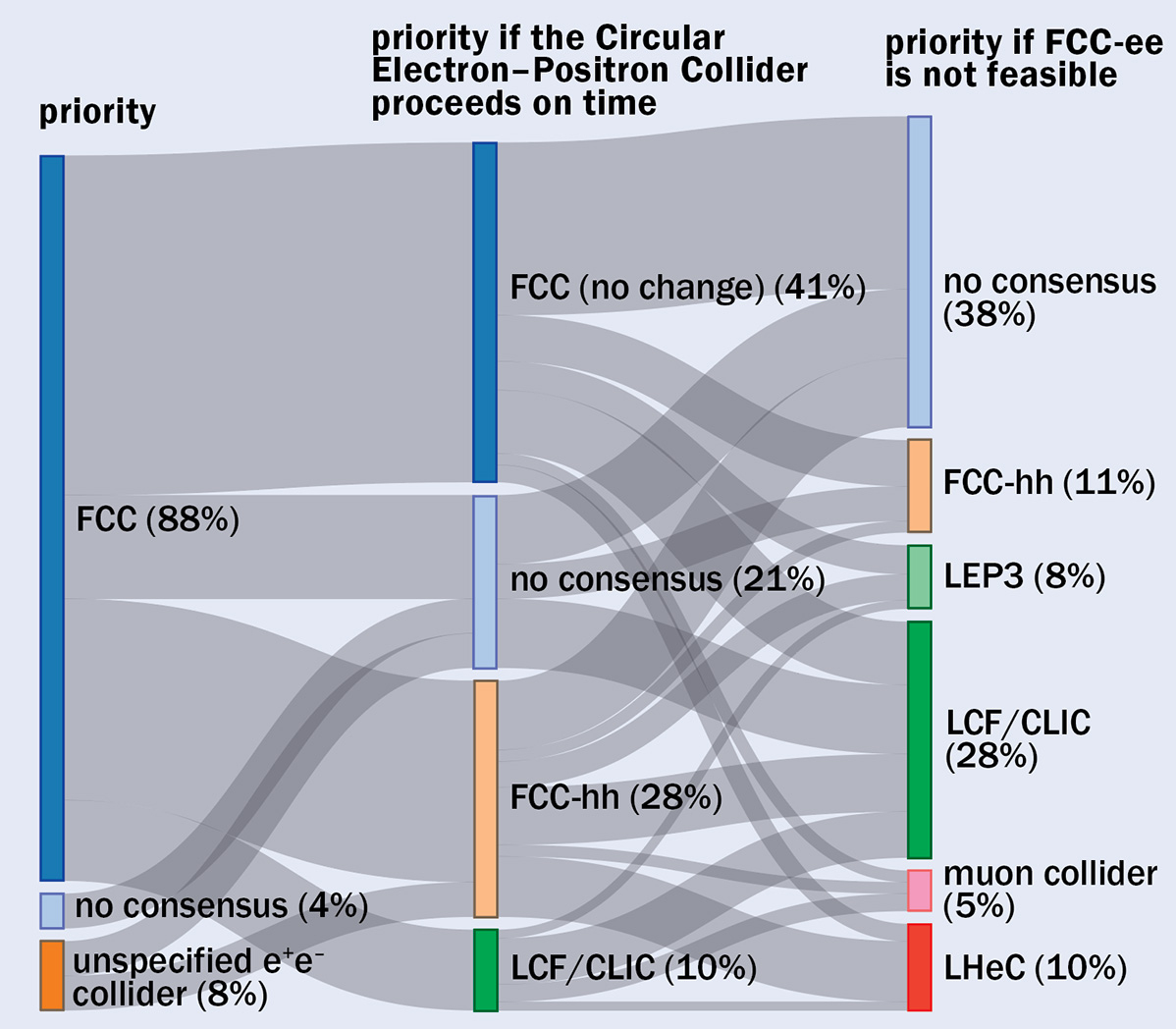
Based on an unofficial analysis by CERN Courier of national submissions to the 2026 update to the European strategy for particle physics. Each national submission is accorded equal weight, with that weight divided equally when multiple options are specified. With the deadline for national submissions passing before Slovenia acceded as CERN’s 25th Member State, 24 national submissions are included. These data are not endorsed by the authors, the CERN Council, the strategy secretariat or CERN management.
This strategy coherently develops the vision of ESPP 2020, which recommended to the CERN Council that an electron–positron Higgs factory be the highest-priority next collider. The 2020 ESPP update further recommended that Europe, together with its international partners, should investigate the technical and financial feasibility of a future hadron collider at CERN with a centre-of-mass energy of at least 100 TeV and with an electron–positron Higgs and electroweak factory as a possible first stage. Such a feasibility study of the colliders and related infrastructure should be established as a global endeavour and be completed on the timescale of the next strategy update.
Based on ESPP 2020, the CERN Council mandated the CERN management to undertake a feasibility study for the FCC and approved an initial budget of CHF 100 million over a five-year period. Throughout the past five years, the FCC feasibility study was undertaken by CERN management under the oversight of the CERN Council. Council heard presentations on its progress at every session and carefully scrutinised a very successful mid-term review (CERN Courier March/April 2024 p25). The FCC collaboration completed the FCC feasibility study ahead of schedule and summarised the results of the study in a three-volume report that was released in March 2025 (CERN Courier May/June 2025 p8). The results are currently under review by panels which will scrutinise both the scientific aspects of the project as well as its budget estimates. The project will be presented to the Scientific Policy and Finance committees in September 2025 and to the CERN Council in November 2025.
It is rewarding to see that the scientific opinion of the community is in sync with ESPP 2020, the decision of the CERN Council to initiate the FCC feasibility study, and the efforts of CERN management to steer and complete it. This is a sign of the strength of the HEP community. While respecting a healthy diversity of opinion, a clear consensus has emerged across the community that the FCC is the highest priority project.
Crucially, however, the CERN Council requested that the community provide not only the scientifically most attractive option, but also hierarchically ordered alternative options. Specifically, the Council requested that the strategy update should include the preferred option for the next collider at CERN and prioritised alternative options to be pursued if the chosen preferred plan turns out not to be feasible or competitive. No consensus has yet been reached here, however two projects have the required readiness to be candidates for alternative programmes: the Linear Collider Facility (LCF, 250 GeV) and the Compact Linear Collider (CLIC, 380 GeV), with additional R&D required in the latter case. A third proposal, LEP3, also requires further study, but could be a promising candidate for a Higgs factory in the existing LEP/LHC tunnel, albeit at a significantly reduced luminosity relative to FCC-ee.
On behalf of the CERN Council, I would like to thank the high-energy community for understanding that this is a critical time for our field and participating very actively
The R&D for several of these projects has been supported by CERN for a long time. Research on linear colliders has been an active programme for the past 30 years and has received significant support, not only ensuring their readiness for consideration as future HEP facilities, but also sparking an exceptional R&D programme in the applications of fundamental research, for example in accelerators for cancer treatment (CERN Courier July/August 2024 p46). Over the past five years, CERN has also invested in muon colliders and hosts the International Muon Collider Collaboration. CERN also leads research into the application of plasma-wakefield acceleration for fundamental physics, having supported the AWAKE experiment for 10 years now (CERN Courier May/June 2024 p25).
The next milestone for updating the ESPP is 14 November: the deadline for submission of the final national inputs. The final drafting session of the strategy update will then take place from 1 to 5 December 2025 at Monte Verità Ascona, where the community recommendations will be finalised. These will be presented to the CERN Council in March 2026 and discussed at a dedicated meeting of the CERN Council in May 2026 in Budapest.
Meanwhile, a key milestone for community deliberations recently passed. The full spectrum of community inputs was presented and debated at an Open Symposium held in Venice in June. As strategy secretary Karl Jakobs reports on the following pages, the symposium was a smashing success with lively discussions and broad participation from our community. On behalf of Council, I would like to convey my sincere thanks to the Italian delegation for the superb organisation of the symposium.
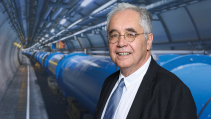
Costas Fountas has served as president of the CERN Council since his appointment in January this year, and as the Greek scientific delegate to the Council since 2016. A professor of physics at the University of Ioannina and longstanding member of the CMS collaboration, he previously served as vice-president of the Council from 2022 to 2024. (Image credit: M Brice, CERN)

Venice symposium debates decades of collider strategy
Strategy secretary Karl Jakobs reports from a vibrant Open Symposium in Venice.
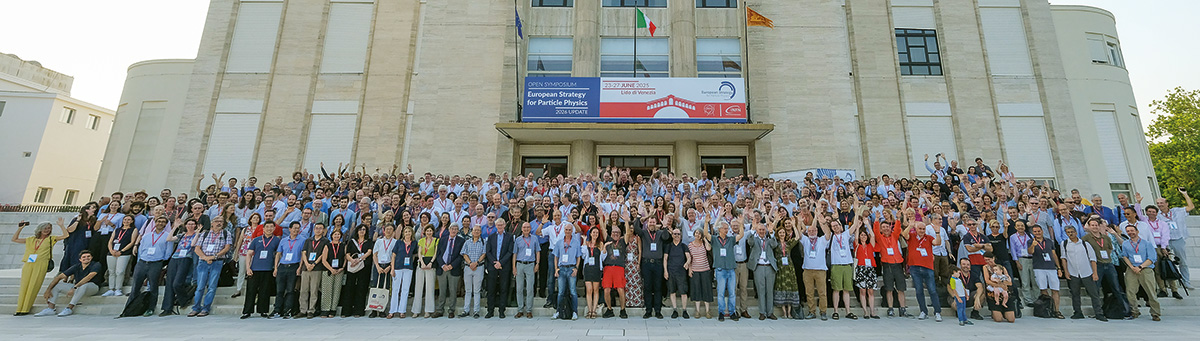
The Open Symposium of the European Strategy for Particle Physics (ESPP) brought together more than 600 physicists from almost 40 countries in Venice, Italy, from 23 to 27 June, to debate the future of European particle physics. In the focus was the discussion on the next large-scale accelerator project at CERN to follow the HL-LHC, which is scheduled to operate until the end of 2041. The strategy update should – according to the remit defined by the CERN Council – define a preferred option for the next collider and prioritised alternative options to be pursued if the preferred plan turns out not to be feasible or competitive. In addition, the strategy update should indicate areas of priority for exploration complementary to colliders and other experiments to be considered at CERN and at other European laboratories, as well as for participation in projects outside Europe.
The Open Symposium is an important step in the strategy process. The aim is to involve the full community in discussions of the 266 scientific contributions that had been submitted by the community to the ESPP process before the symposium (CERN Courier May/June 2025 p8).
In the opening session of the symposium CERN Director-General Fabiola Gianotti summarised the impressive achievements of the CERN community in the implementation of the recommendations from the 2020 update to the ESPP. Eric Laenen (Nikhef) stressed that the outstanding questions in particle physics require a broad and diverse experimental programme, including the HL-LHC, a new flagship collider, and a wide variety of other experiments including those in neighbouring fields. A broad consensus emerged that a future collider programme should be realised that can fully leverage both precision and energy, covering the widest range of observables at different energy scales. To match experimental precision, significant progress on the theoretical side is also required, in particular regarding higher-order calculations.
An important part of the symposium was devoted to presentations of possible future large-scale accelerator projects. Detailed presentations were given on the FCC-ee and FCC-hh colliders, either in the integrated FCC programme or proceeding directly to FCC-hh as a standalone realisation at an earlier time. Linear colliders were presented as alternative options, with a Linear Collider Facility (LCF) based on the design of the International Linear Collider (ILC) and CLIC both considered. In addition, smaller collider options were presented, based on re-using the LHC/LEP tunnel. A first proposal, LEP3, suggests accelerating electrons and positrons up to energies of 230 GeV, while a second proposal, LHeC, proposes the realisation of electron–proton collisions in one interaction point of the LHC. LHeC would require the construction of an additional new energy-recovery linac for the acceleration of electrons.
Moving focus from the precision frontier to the energy frontier, several ways to reach the 10 TeV “parton scale” were presented. (Comparisons between the energy reach of hadron and lepton colliders must discuss parton–parton centre-of-mass energies, where partons refer to the pointlike constituents of hadrons, as only a fraction of the energy of collisions between composite particles can be used to probe the existence of new particles and fields.) If FCC-ee is realised, a natural path is to proceed with proton-proton collisions with proton–proton centre-of-mass energies in the range of 85 to 120 TeV, depending on the available high-field magnet technology. As an alternative, a muon collider could provide a path towards high-energy lepton collisions, however, demonstrations of how to address the significant technological challenges, such as six-dimensional cooling in transverse and longitudinal phase space, and other items associated with the various acceleration steps, need to be achieved. Likewise, plasma-based acceleration techniques for electrons and positrons capable of exceeding the 1 TeV energy scale are yet to be demonstrated.
A broad consensus emerged that a future collider programme should be realised that can fully leverage both precision and energy
The symposium was organised to foster strong engagement by the community in discussion sessions. Six physics topics – covering electroweak physics, strong interactions, flavour physics, physics beyond the Standard Model, neutrino physics and cosmic messengers, and dark matter and the dark sector, as well as the three technology areas on accelerators, detectors and computing, were summarised in rapporteur talks, followed by 45-minute discussions, where the people present in Venice strongly engaged.
For the study of precision Higgs measurements, the performance of all the considered electron–positron (e+e–) colliders is comparable. While a sub-percent precision can be reached in several measurements of Higgs couplings to fermions and bosons, HL-LHC measurements would prevail for rare processes. On the determination of the important Higgs-boson (H) self-coupling, the precision obtained at the HL-LHC will prevail until either e+e– linear colliders can improve it in direct HH production measurements at collision energies above 500 GeV, or before precisions at the level of a few percent can be reached at FCC-hh or a muon collider. It was further stressed that precision measurements in the Higgs, electroweak (Z, W, top) and flavour physics constitute three facets for indirect discoveries and that their synergy is essential to maximise the discovery potential of future colliders. Due to its high luminosity at low energies and its four experiments, the FCC-ee shows a superior physics performance in the electroweak programme.
In flavour physics, a lot of progress will be achieved in the coming decade by the LHCb and Belle-II experiments. While the tera-Z production at a future FCC-ee would provide a major step forward, the giga-Z data samples available at linear colliders do not seem to be a good option for flavour physics. The FCC-ee and LHeC would also achieve high precision on QCD measurements, leading, for example, to a per-mille level determination of the strong coupling constant αs. The important investigations of the quark–gluon plasma at the HL-LHC could be continued in parallel to an e+e– collider operation at CERN at the SPS fixed target programme, before FCC-hh would eventually allow for novel studies in the high-temperature QCD domain.
Keeping diversity in the particle-physics programme was also felt to be essential: the next collider project should not come at the expense of a diverse scientific programme in Europe. Given that we do not know where new physics will show up, ensuring a diverse and comprehensive physics programme is vital, including fixed-target, neutrino, flavour, astroparticle and nuclear-physics experiments. Experiments in these areas have the potential for groundbreaking discoveries.
The discussions in Venice revealed a community united in its desire for a future flagship collider at CERN
At the technology frontier, essential work on accelerator R&D, such as on high-field and high-temperature superconducting magnets and RF systems, remain a high priority and appropriate investments must be made. R&D on advanced acceleration concepts should continue with adequate effort to prepare future projects. In the detector area, the establishment of the Detector Research & Development (DRD) collaborations as a result of the implementation of the recommendations of the 2020 ESPP update were considered to provide a solid basis to tackle the challenges related to the developments for high-performing detectors for future colliders and beyond. It is also expected that the required software and computing challenges for future colliders can be mastered, provided that adequate person power and funding are available and adaptations to new technologies, in particular GPUs, AI and – on a longer timescale – quantum computing, can be made.
The discussions in Venice revealed a community united in its desire for a future flagship collider at CERN. Over the past years, very significant progress has been made in this direction, and the discussions on the prioritisation of collider options will continue over the next months. In addition to the FCC-ee, linear colliders (LCF, CLIC) present mature options for a Higgs factory at CERN. LEP3 and LHeC could alternatively be considered as intermediate collider projects, followed by a larger accelerator capable of exploring the 10 TeV parton scale.
The differences in the physics potential between the various collider options will be documented in the Physics Briefing Book that will be released by the Physics Preparatory Group by the end of September. In parallel, the technical readiness, risks, timescales and costs will be reviewed by the European Strategy Group (ESG). Alongside the final national inputs, these assessments will provide the foundation for the final recommendations to be drafted by the ESG in early December 2025.
Karl Jakobs is the secretary of the 2026 update to the European strategy for particle physics. A professor at the University of Freiburg, Jakobs served as spokesperson of the ATLAS collaboration from 2017 to 2021 and as chairman of the European Committee for Future Accelerators from 2021 to 2023. (Image credit: K Jakobs)