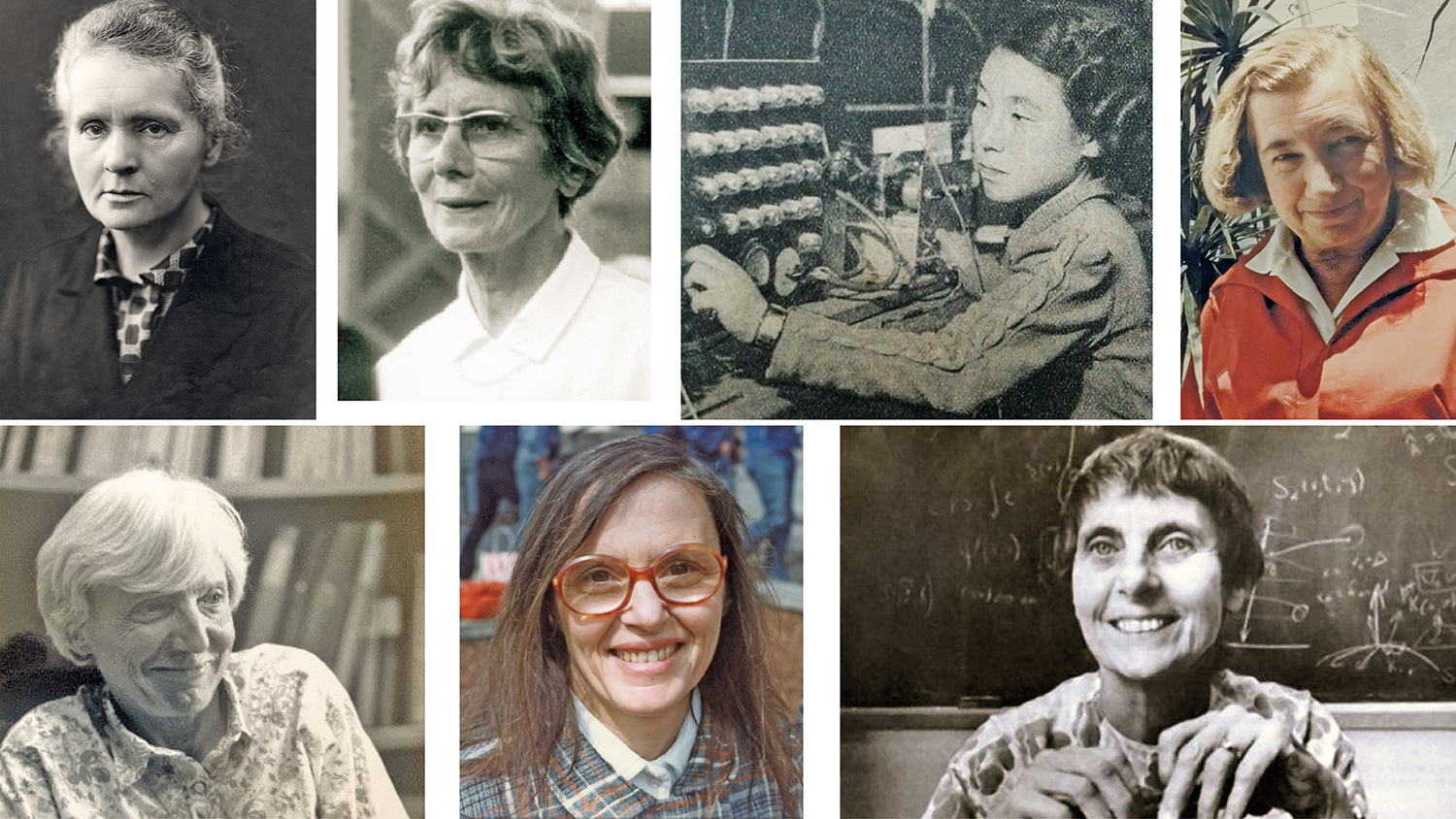
When the Eiffel Tower opened for the 1889 Exposition Universelle, its girders bore in gold lettering the names of scientists whom Gustave Eiffel said had honoured France since 1789. Every one of them was a man. 137 years later, on 26 January 2026, Anne Hidalgo, the mayor of Paris, accepted the nomination of 72 women scientists to join them.
The list spans nearly 250 years and multiple disciplinary domains. Many made important contributions to nuclear and particle physics, and several had close associations with strong partners to CERN such as the Centre national de la recherche scientifique (CNRS) and the Commissariat à l’énergie atomique et aux énergies alternatives (CEA).
Foremost among the women to be honoured is Polish–French physicist Marie Skłodowska Curie (1867–1934), who discovered polonium and radium, helping to establish radioactivity as an intrinsic property of atoms. She carried out systematic measurements of radioactive substances, determined radium’s atomic weight and developed methods to isolate radioactive elements from pitchblende. She shared the 1903 Nobel Prize in Physics and later won the 1911 Nobel Prize in Chemistry, becoming the first woman laureate and the only person to receive Nobel prizes in two different scientific fields.
A pioneer in X-ray spectroscopy, Yvette Cauchois (1908–1999) invented the Cauchois spectrometer, a curved-crystal spectrometer widely used for the analysis of X-rays and gamma rays. She introduced X-ray spectroscopy using synchrotron radiation to Europe and later studied the X-ray spectrum of the Sun.
A trailblazer for women physicists in Japan, nuclear physicist Toshiko Yuasa (1909–1980) studied the continuous spectrum of beta radiation emitted by artificial radioactive substances and developed her own double-focusing spectrometer. In 1955 she warned of the dangers of nuclear tests at Bikini Atoll. In the 1960s, promoted to senior research fellow at CNRS, she studied nuclear reactions using a synchrocyclotron.
Marie-Antoinette Tonnelat (1912–1980) worked on early unified theories that sought to connect gravity and electromagnetism. She served as director of research at CNRS.
Henriette Faraggi (1915–1985) introduced new techniques with photographic emulsions and directed the CEA Department of Nuclear Physics from 1972 to 1978. She also served as chair of the Nuclear Physics Commission of IUPAP and became the first woman elected president of the French Physical Society. Convinced early on of the importance of high-energy heavy-ion physics for studying quark–gluon plasma, she played a key role in the decision to build GANIL in Caen.
Cécile DeWitt-Morette (1922–2017) worked in quantum field theory and gravitation, and founded the Les Houches Summer School in 1951, which became a major international centre for theoretical physics training. She later contributed to path-integral methods in quantum theory.
Yvonne Choquet-Bruhat (1923–2025) placed Einstein’s field equations of general relativity on a firmer mathematical ground, showing how their behaviour follows from appropriate initial conditions. In 1979 she became the first woman elected as a full member of the Académie des Sciences.
A specialist in cosmic radiation, Lydie Koch (1931–2023) led stratospheric-balloon experiments to detect cosmic rays, contributed to the development of innovative germanium and silicon detectors for the HEAO-3 and COS-B satellites, and advanced X-ray and gamma-ray astronomy. She played a central role in the development of astrophysics at the CEA and was head of the Astrophysics Section from 1967 to 1979.
“It is time for this highly symbolic landmark to embrace the cause of equality between women and men, and to restore women to their rightful place on this monument dedicated to the glory of science and scientists,” said Hidalgo.