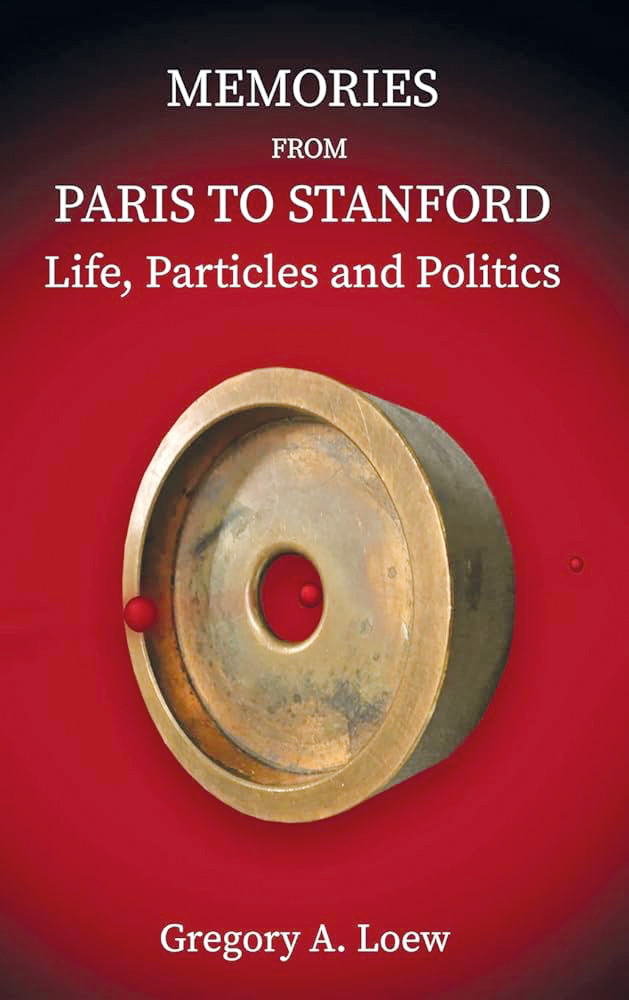
Memories from Paris to Stanford: Life, Particles and Politics, by Gregory A Loew, Regent Press
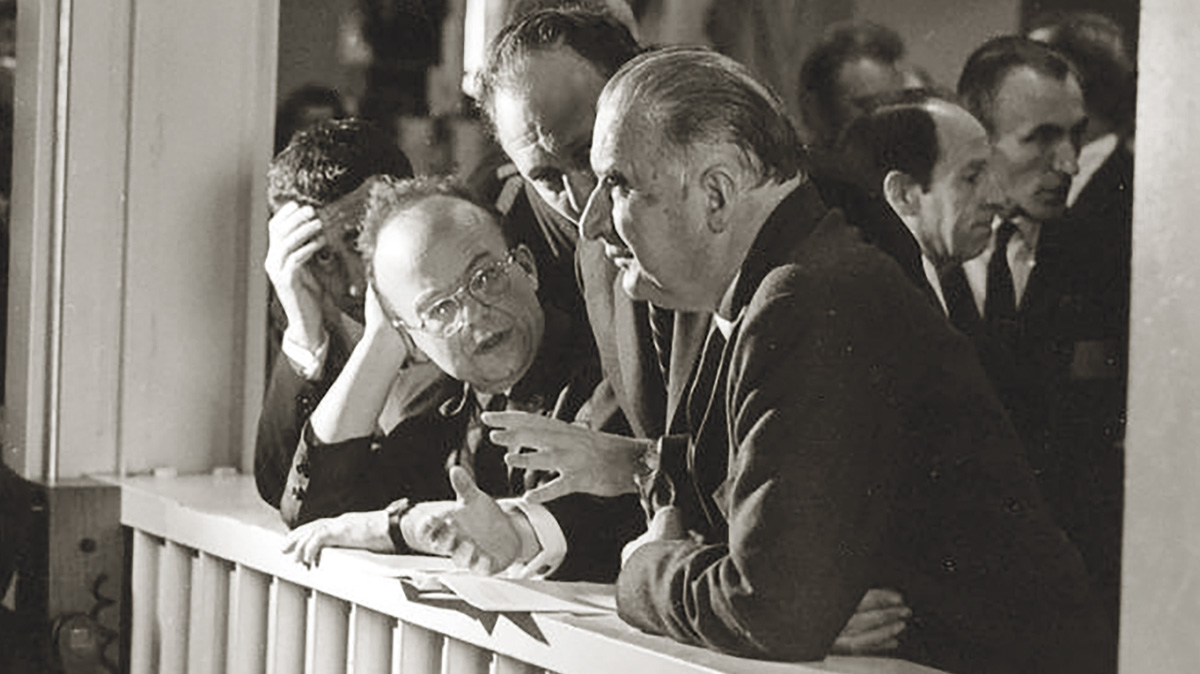
Memories from Paris to Stanford is a deeply personal account of the fascinating and varied life of Gregory Loew. A renowned accelerator physicist, Loew made seminal contributions to the accelerators at the Stanford Linear Accelerator Center (SLAC) that underpinned its Nobel Prize-winning scientific programme. Among them were the klystron drive and phasing systems for the 20 GeV linac, the S-band radiofrequency (RF) particle separators for the initial linac-based experiments, and the electron–positron injection system for the B-factory. He also directed the three-year effort that cured the beam breakup plaguing early operation, and through the 1970s, as head of the Accelerator Physics Department, led all the linac improvement projects. Later, Loew went on to chair two large international committees, whose comparisons of the competing linear-collider proposals paved the way for the 2004 selection of the superconducting technology of the DESY-led TESLA collaboration.
Core values
The memoir is divided into three parts: his early life and education, his career at SLAC, and his later engagement in politics. The diverse cultural environments and upheavals of his pre-college years recur throughout, intertwined with his science and activism, and matched by the value he places on family, friendship and collegiality.
The early chapters follow a childhood scattered by war. Loew was born in Vienna in 1930 to Jewish parents, with roots in Prague and Hamburg. In 1932, the family moved from Bucharest to Paris and switched their home tongue from German to French. In 1939, with antisemitism rife and war declared, they were forced out again, reaching Buenos Aires on 1 January 1940 – two weeks after the German battleship Admiral Graf Spee was scuttled off Montevideo. Somewhat screened in Argentina from the ravages of the war, the family nonetheless followed its perils, finding immense relief in the liberation of Paris in August 1944. A three-month visit to New York at the end of the same year marked his first encounter with the United States of America. There, operas at the Met and concerts conducted by Toscanini and Stravinsky sparked a lifelong love of the performing arts.
Loew knew from an early age that he wanted to pursue a career in physics, a desire cemented by excellent maths and science teachers at his high school in Buenos Aires. He returned to Paris in 1948 for undergraduate studies at the Sorbonne, and his account of those four highly eventful years is captivating. After his licence-ès-sciences in mathematics, physics, chemistry and radioactivity, he chose Caltech for his PhD studies, where he enjoyed easy access to figures such as Richard Feynman, Robert Millikan, Fred Hoyle and James Watson. Gregarious by nature, Loew never quite took to campus life at Caltech and, on completing his master’s in electrical engineering, accepted a generous scholarship from Stanford University to do his PhD. So began an illustrious 54-year career at Stanford and SLAC, including about five years as deputy director from 2001 to 2005.
The heart of the book, and its strongest claim on a physicist’s attention, is Loew’s chronicle of the internationally competitive development of linear electron accelerators from its Stanford origins. It began with William Hansen in the 1930s and advanced when the Varian brothers, Sigurd and Russell, arrived in 1937. That year, they built the first working klystron, a technology that still powers RF cavities today (CERN Courier May/June 2025 p30). After the war, Hansen resumed the work with Ed Ginzton and Richard Neal. Hansen died in 1949, and in 1951 Wolfgang “Pief” Panofsky arrived from Berkeley and carried the programme forward. By the mid-1950s, Stanford had a machine capable of delivering electron beams up to 1 GeV, which Robert Hofstadter used for his Nobel Prize-winning study of the structure of protons and neutrons. Loew himself arrived in 1954 as an electrical-engineering graduate student. His thesis, fortuitous given his later role, involved a microwave amplifier and oscillator system much like those used in the 1 GeV machine.
The Monster
Panofsky had larger ambitions. In 1957, he led a Stanford group that audaciously proposed Project M, the Monster, a two-mile accelerator for electron beams of up to 20 GeV. Loew completed his PhD in 1958 and joined the project, taking on the critical task of designing copper microwave structures to accelerate the electrons. Project M was funded in 1961, with Panofsky as SLAC’s first director, and construction began in 1962.
SLAC’s scientific breakthroughs resulted from decade after decade of far-reaching technical invention driven by a group of brilliant, ambitious and colourful scientists. And who better to describe that history than Loew? From the start until his retirement in 2008, he contributed to the technical development, the unfolding science and the laboratory’s management. His astute people skills and benevolent character enliven his account and lend it veracity.
One further thread gives these chapters their texture: the laboratory’s role, largely driven by Panofsky, in building relationships and intergovernmental agreements with high-energy physics laboratories in Russia, Japan and China. Those friendships outlasted the science and at times served as back channels during political tension, and Loew’s insider account of those brave endeavours opens a window onto their workings.
Ambassador extraordinaire
As SLAC’s “ambassador extraordinaire”, Loew was often called on to host its most prominent visitors. He describes two, the visits of French president Georges Pompidou in 1970 and of the emperor and empress of Japan in 1994. He also devotes a chapter to his wife of 30 years, Gilda, who passed away in 2001. She was a PhD quantum chemist, with an adjunct professorship at Stanford, and worked with Nobel laureate Joshua Lederberg.
A fascinating blend of Stanford and SLAC’s groundbreaking accelerator-based science
The third part of the book steps outside SLAC. Loew had been alert to politics and the causes of war since boyhood, and a call from the Stanford administration prompted him, in 1970, to devise a one-quarter course on the origins of war. It proved popular enough to run for more than a decade. Its range, from international relations and history to economics, anthropology and biology, later fed his first book, The Human Condition: Reality, Science and History (CERN Courier March/April 2020 p68). Since 1995, he has been active in democratic politics, serving on local and national committees and as a delegate to the 2012 convention. He closes with chapters on the threats to democracy and the existential threat of global warming.
Memories from Paris to Stanford is a fascinating blend of Stanford and SLAC’s groundbreaking accelerator-based science from the early 1950s to the present and the socio-political currents that shaped that post-WWII period. The scientific reader will likely be captivated by the discovery potential unleashed by innovative technology in the hands of brilliant practitioners and by how world events played into that adventure. The non-scientific reader can equally appreciate the transformative nature of the technology, but for them the primary fascination may well be how dramatic world events shaped the multifaceted career of a brilliant scientist and humanitarian.