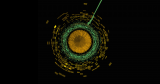
Read article 'First oxygen and neon collisions at the LHC'
First oxygen and neon collisions at the LHC
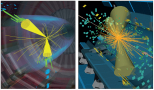
Between 29 June and 9 July 2025, LHC physicists pushed the study of the quark–gluon plasma into new territory.
Thank you for registering
If you'd like to change your details at any time, please visit My account
Read article 'First oxygen and neon collisions at the LHC'
Between 29 June and 9 July 2025, LHC physicists pushed the study of the quark–gluon plasma into new territory.
Read article 'ALICE observes ρ–proton attraction'
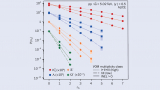
The ALICE collaboration achieved the first direct measurement of the ρ⁰–proton interaction in high-multiplicity pp collisions.
Read article 'Memories of quarkonia'
As the story of quarkonia draws to a close, John Ellis shares personal recollections of five decades of discoveries and debates about the simplest composite objects in QCD.
Read article 'ATLAS confirms top–antitop excess'
The ATLAS collaboration has confirmed the threshold excess in top–antitop production first reported by CMS, consistent with the formation of toponium.
Read article 'Charming energy–energy correlators'
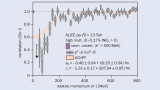
The ALICE collaboration has measured energy–energy correlators of charm-quark jets for the first time, observing the expected suppression at small angles.
Read article 'Ultra-peripheral physics in the ultraperiphery'
In June 2025, physicists met at Saariselkä, Finland, to discuss recent progress in the field of ultra-peripheral collisions.
Read article 'A new probe of radial flow'
The ATLAS and ALICE collaborations have announced the first results of a new way to measure the “radial flow” of quark–gluon plasma.
Read article 'STAR hunts QCD critical point'
The STAR collaboration at BNL has narrowed the search for a long-sought-after “critical point” in the still largely conjectural phase diagram of QCD.
Read article 'Hadrons in Porto Alegre'
The 16th International Workshop on Hadron Physics welcomed 135 physicists to the Federal University of Rio Grande do Sul in Porto Alegre, Brazil.
Read article 'Clean di-pions reveal vector mesons'
LHCb has isolated a precisely measured, high-statistics sample of di-pions.