 Read article 'Seven colliders for CERN'
Seven colliders for CERN
The European Strategy Group tasked a working group to compare seven proposals for CERN’s next large-scale collider.

 Read article 'Seven colliders for CERN'
The European Strategy Group tasked a working group to compare seven proposals for CERN’s next large-scale collider.
 Read article 'European Strategy Group recommends FCC-ee'
The European Strategy Group has recommended FCC-ee as the preferred option for the next flagship collider at CERN.
 Read article 'Private donors pledge support for FCC'
Private donors have pledged funds towards the construction of the Future Circular Collider.
 Read article 'Ten windows on the future of particle physics'
Paris Sphicas highlights key takeaways from the briefing book of the 2026 update of the European Strategy for Particle Physics.
 Read article 'Standardising sustainability: step one'
The Laboratory Directors Group has published guidance on evaluating the carbon impact of accelerator projects.
 Read article 'ICFA meets in Madison'
The 99th meeting of the International Committee for Future Accelerators took place on 24 August 2025, in Madison.
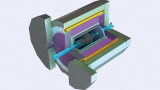 Read article 'CEPC matures, but approval is on hold'
The Circular Electron–Positron Collider (CEPC), a 100-km electron–positron “Higgs factory” proposed in China, has reached the technical-design stage but will not be included for approval or co...
 Read article 'Europe’s collider strategy takes shape'
How are community inputs and debates shaping the ongoing update to the European strategy for particle physics? The Courier consults two scientists tasked with representing CERN Member States and the h...
 Read article 'US publishes 40-year vision for particle physics'
In June, the US National Academies of Sciences, Engineering, and Medicine published an unprecedented 40-year strategy for US particle physics.
 Read article 'Two takes on the economics of big science'
Economist from the University of Milan, Massimo Florio, reviews "Big Science, Innovation & Societal Contributions" and "The Economics of Big Science 2.0".