 Read article 'Stable beams at 13 TeV'
Stable beams at 13 TeV
The LHC is back in business.

 Read article 'Stable beams at 13 TeV'
The LHC is back in business.
 Read article 'LHC and Planck: where two ends meet'
Links between research at opposite ends of the distance scale.
 Read article 'Frontier detectors for the future'
The last week of May saw a gathering of 390 physicists from 27 countries and four continents on the island of Elba.
 Read article 'New possibilities for particle physics with IceCube'
The IceCube Neutrino Observatory has measured neutrino oscillations via atmospheric muon-neutrino disappearance.
Read article 'The experiment now known as DUNE'
The long-baseline neutrino experiment formerly known as LBNE has a new name: Deep Underground Neutrino Experiment (DUNE). Served by an intense neutrino beam from Fermilab’s Long Baseline Neutrino Fa...
Read article 'ALICE: from LS1 to readiness for Run 2'
It is nearly two years since the beams in the LHC were switched off and Long Shutdown 1 (LS1) began. Since then, a myriad of scientists and engineers have been repairing and consolidating the ...
 Read article 'NUCLEON takes its place in space'
On 13 January, less than three weeks after being launched into space, the NUCLEON satellite experiment was switched on to collect its first cosmic-ray events.
 Read article 'ATLAS sets limits on anomalous quartic-gauge couplings'
The ATLAS and CMS collaborations are now looking into deeper levels of Standard Model predictions by probing additional ways in which the gauge bosons interact with each other.
 Read article 'Proto-collaboration formed to promote Hyper-Kamiokande'
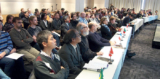
The Inaugural Symposium of the Hyper-Kamiokande Proto-Collaboration, took place in Kashiwa, Japan, on 31 January, attended by more than 100 researchers.
Read article 'Detection techniques for future neutrino observatories'
The discovery of high-energy astrophysical neutrinos initially announced by IceCube in 2013 provided an added boost to the planning for new, larger facilities that could study the signal in detail and...