In June last year, an updated theory prediction and a new measurement of the magnetic moment of the muon may have resolved a longstanding tension. Is this the end of the road for muon g–2?
Some have argued that the good agreement between lattice–QCD and the final measurement of Fermilab’s muon g–2 experiment means that the g–2 anomaly has now been solved. However, this dramatically oversimplifies the situation: the magnetic moment of the muon remains an intriguing puzzle.
The extraordinary precision of 127 parts per billion (ppb) achieved at Fermilab deserves to be matched by an equally impressive theoretical prediction. At 530 ppb, theory is currently the limiting factor in any comparison. This is the longer-term goal that the Muon g–2 Theory Initiative is now working towards, with inputs from all possible sources (see “How I learnt to stop worrying and love QCD predictions“). In the near future, it will not be possible to reach this precision with lattice QCD alone. Other approaches are needed to make a competitive Standard Model prediction.
Tensions remain
Essentially, all of the uncertainty in g–2 arises from the hadronic vacuum polarisation (HVP) – a quantum correction whereby a radiated virtual photon briefly transforms into a hadronic state before being reabsorbed. Historically, HVP has been evaluated by applying a dispersion relation to cross sections for hadron production in electron–positron collisions, but this method was displaced by lattice–QCD calculations in the theory initiative’s most recent white paper. The lattice community must be congratulated for the level of agreement that has been reached between groups working independently (CERN Courier July/August 2025 p7). By contrast, data-driven predictions are at present inconsistent across the experiments in the low-energy region; even if results from the CMD-3 experiment are excluded as an outlier, tensions remain, suggesting that some systematic errors may not have been completely addressed (CERN Courier March/April 2025 p21). Could a novel experimental technique help resolve the confusion?
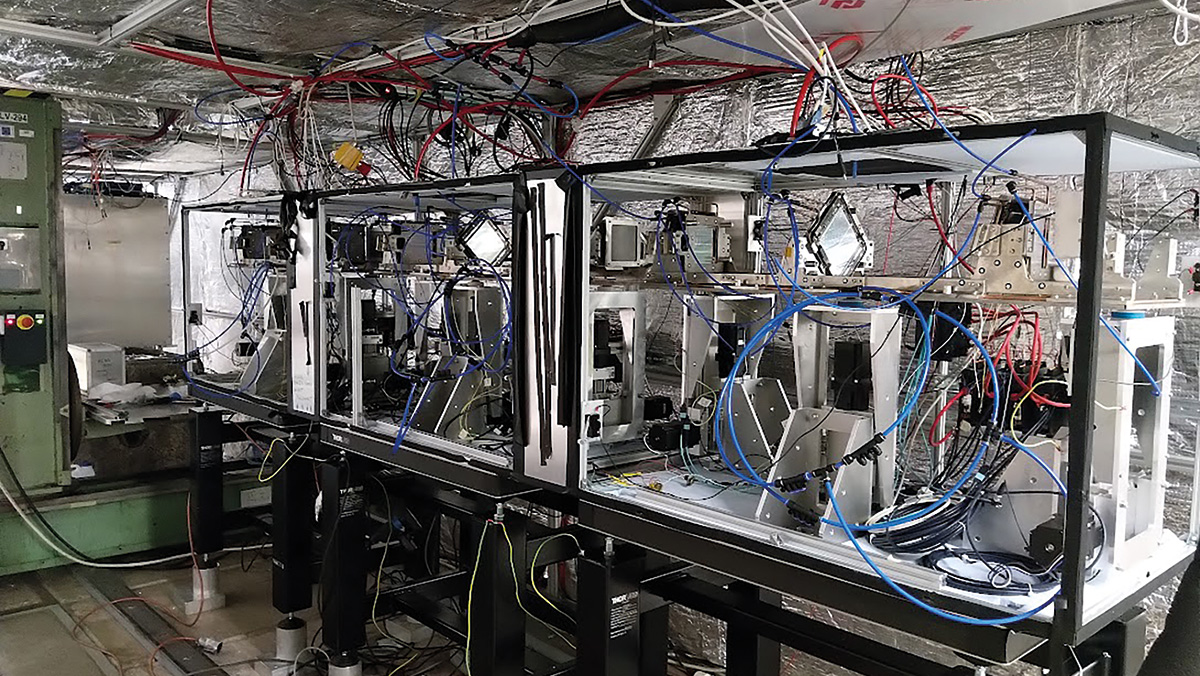
The MUonE collaboration proposes a completely independent approach based on a new experimental method. In MUonE, we will determine the running of the electromagnetic coupling, a fundamental quantity that is driven by the same kinds of quantum fluctuations as muon g–2. We will extract it from a precise measurement of the differential cross section for elastic scattering of muons from electrons as a function of the momentum transferred.
MUonE is a relatively inexpensive experiment that we can set up in the existing M2 beamline in CERN’s North Area, already home to the AMBER and NA64-µ experiments. Three years of running, within the conditions of M2 parameters and the performance of the MUonE detector, would reach a statistical precision of approximately 180 ppb with a comparable level of systematic uncertainty.
MUonE will take advantage of silicon sensors that are already being developed for the CMS tracker upgrade. From the results, we will be able to use a dispersion relation to extract HVP’s contribution to g–2. Perhaps more importantly, however, as our method directly measures a function that is part of the lattice calculation, we can directly verify that method. The big challenge will be to keep the systematic uncertainties in the measurement small enough. However, MUonE does not suffer from the intrinsic problem that existing data-driven techniques have, which is that they must numerically integrate over the sharp peaks of hadron production by low-energy resonances. In contrast, the function derived from the space-like process that it will measure is smooth and well-behaved.
Piecing the puzzle
CERN was the origin of the first brilliant muon g–2 measurements starting back in the 1950s (CERN Courier September/October 2024 p53), and now the laboratory has an opportunity to put another important piece into the g–2 puzzle through the MUonE project. Another component of great importance in this domain will be the new g-2/EDM experiment planned for J-PARC, which will also be performed in completely different conditions, and therefore with very different systematics to the Fermilab experiment.
Further reading
J Komijani et al. 2024 CERN-SPSC-2024-015.