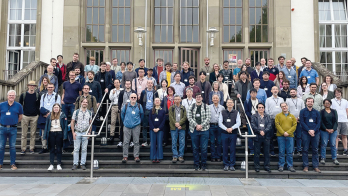
The 15th edition of the Implications of LHCb Measurements and Future Prospects annual workshop took place at CERN from 4 to 7 November 2025, attracting more than 180 participants from the LHCb experiment and the theoretical physics community.
Peilian Li (UCAS) described how, thanks to an upgraded trigger that is fully software-based, the dataset gathered in 2025 alone already exceeded the total one from Run 1 and Run 2 combined. The future of LHCb was discussed, with prospects for an upgrade targeting the high-luminosity phase of the LHC, where timing information will be introduced. Theorist Monika Blanke (KIT) concluded the workshop with a keynote on the status of B-decay anomalies, highlighting the importance of LHCb measurements on constraining new physics models.
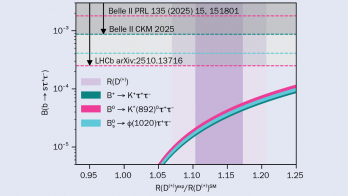
Much attention went to the long-standing discrepancies between data and theory on lepton–flavour–universality tests – such as the measurement of the R(D) and R(D*) ratios in semileptonic B-meson decays. Marzia Bordone (UZH) gave a theoretical overview of the determination of the form factors describing B → D* transitions, highlighting discrepancies in the determination of some form-factor shapes, both among different lattice–QCD determinations and within extractions from different experimental datasets.
A new combination of all LHCb measurements of the CKM angle γ, which quantifies a key CP-violating phase in b-hadron decays, yielded an overall value of (62.8 ± 2.6)°. The collaboration reported flagship electroweak precision measurements of the effective weak mixing angle and the W-boson mass, as well as the first dedicated measurement of the Z-boson mass at the LHC.
An exciting focus for 2026 will be the search for the double open-beauty tetraquark Tbb(bbud)
An exciting focus for 2026 will be the search for the double open-beauty tetraquark Tbb(bbud) – the first accessible exotic hadron expected to be stable against strong decay (CERN Courier November/December 2024 p34). Saša Prelovšek (UL) presented the first lattice-QCD calculation of the state’s electromagnetic form factors, allowing her to rule out an interpretation of the tetraquark as a loosely–bound B–B* molecule.
The legacy Run 1+2 B → K*μ+μ– angular analysis, based on a dataset roughly twice as large as that used in previous ones, was presented. Previously seen tensions were confirmed with much increased precision and new observables are reported for the first time. Theorists Arianna Tinari (UZH), Giuseppe Gagliardi (INFN Rome3) and Nazila Mahmoudi (IP2I, CERN) reviewed the status of the non-local hadronic contributions that could affect this channel, discussing how the use of different theoretical approaches can be employed to determine these contributions and how compatible the current results are with the theoretical expectations.
Zhengchen Lian (THU, INFN Firenze) showed the characteristic “bowling–pin” deformation of neon nuclei as it was recently observed using the SMOG2 apparatus, which allows collisions of LHC protons with a variety of fixed-target light nuclei injected into the beampipe (CERN Courier November/December 2025 p8).