Quarkonium physics dates back to the November Revolution of 1974 and the discovery of the J/ψ, a bound state of a charm quark and its antiquark; this was soon followed by the excited ψ(2S) state and its bottom–antibottom analogue ϒ(1S) (CERN Courier September/October 2025 p35). These non-relativistic systems hold a unique place in QCD, encompassing a precise hierarchy of characteristic energy scales. Some, such as heavy-quark masses, are amenable to perturbative treatment, while others, such as the confinement scale, are inherently non-perturbative. To capture this interplay systematically, effective field theories such as non-relativistic quantum chromodynamics (NRQCD) were developed from the 1990s onwards.
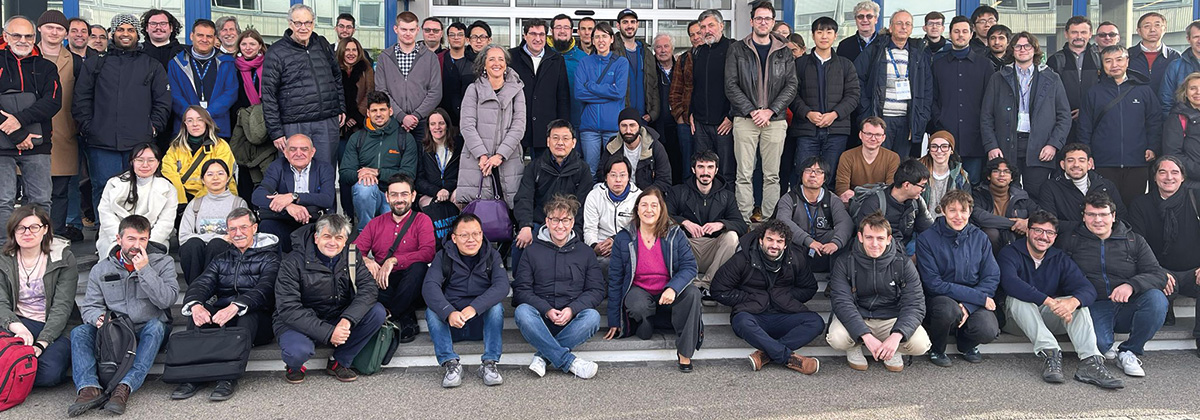
The quest to interpret quarkonium phenomena within this unified framework, combined with an explosion of experimental results from B factories and hadron colliders, sparked the creation of the Quarkonium Working Group (QWG) Workshop in 2002. Now organised roughly every 18 months at research institutions around the world, the workshop has become a regular meeting point for the quarkonium community. The 17th QWG brought together more than 200 researchers at CERN from 17 to 21 November.
Renaissance
The first part of the workshop naturally reflected this historical and conceptual foundation, focusing on spectroscopy and decays. In recent years, quarkonium spectroscopy has become a driver of new discoveries in QCD. A prime example is the so-called charmonium renaissance, marked by the observation of several exotic states – including the χc1(3872), Tcc+(3875) and charged Zc states. These “XYZ” states can’t be interpreted as conventional charmonia and their internal structure remains under active investigation both at the experimental and theoretical levels (CERN Courier November/December 2024 p33).
Experimental talks in the opening sessions reported on searches for exotic hadrons and their decay channels. Dmytro Meleshko (Giessen University) from the Belle II collaboration reported on excited bottomonium states, placing particular emphasis on the ongoing analysis of the ϒ(10753) resonance, and the experimental signatures that can distinguish between a tetraquark, a hybrid and a S–D mixed bottomonium state. Ilya Segal (Bochum University) presented recent results by the LHCb collaboration on the radiative decay χc1(3872) → ψ(2S)γ. Yue Xu (University of Washington) illustrated an analysis for fully-charmed tetraquarks in the J/ψ–ψ(2S) channel by the ATLAS collaboration, confirming the X(6900) resonance with high significance.
On the theory side, Abhishek Mohapatra (TUM) described ongoing efforts to extend effective-field-theory methods originally developed for quarkonium to more complex exotic systems using the Born–Oppenheimer (BOEFT) approach, which takes lattice QCD inputs to address the QCD non-perturbative dynamics without assuming a specific internal structure for the exotic states.
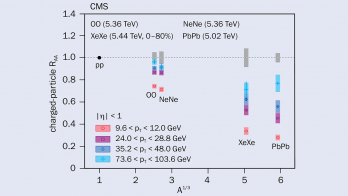
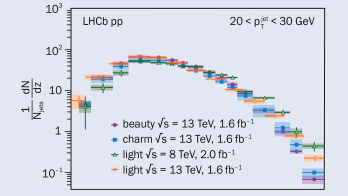
The third day turned to production. Some NRQCD calculations predict negative production rates for J/ψ and χc mesons at high transverse momentum, a clearly unphysical result. Hee Sok Chung (Gangneung-Wonju National University) highlighted how this problem can be addressed by improving the formal treatment of emissions near the production threshold. New production measurements for J/ψ and ψ(2S) from the CMS and ALICE collaborations were presented, alongside new calculations for the production of the χc1(3872) and of the pentaquarks Pcc(4312) and Pcc(4457).
The field’s rapid evolution makes the time ripe for a third, comprehensive QWG document
The programme then broadened to Standard Model applications, where quarkonium observables can constrain fundamental QCD parameters such as the strong coupling constant and gluelump masses – the gluonic mass contribution in quarkonium hybrid states, as obtained from lattice QCD. Laurids Jeppe (DESY) from the CMS collaboration discussed the enhancement observed around the top–antitop threshold in the invariant mass spectrum, first measured by CMS and later confirmed by ATLAS (CERN Courier September/October 2025 p9). In a round-table discussion, participants debated the signal’s interpretation in terms of a quasi-bound top–antitop meson or a possible new-physics origin, with both scenarios allowed by the current level of experimental precision, and with the main uncertainties coming from the background modelling. The workshop closed with sessions on quarkonium in media, featuring recent progress in calculating quarkonium transport coefficients from both lattice QCD and perturbation theory.
Progress and puzzles
The discussions across previous QWG workshops crystallised into two foundational documents named “Heavy quarkonium physics” and “Heavy quarkonium: progress, puzzles, and opportunities”, that have since trained generations of young physicists and stand as key references for the community. The field’s rapid evolution makes the time ripe for a third, comprehensive QWG document to capture the wide range of new and enduring topics that currently define it, including the BOEFT framework as a tool to achieve a unified description of all XYZ exotic states, studies of non-equilibrium quarkonium evolution in the QCD medium, informed by new data from the CBM experiment, and the recent development of new automated event generators for quarkonium production.
The next workshop will take place in spring 2027.