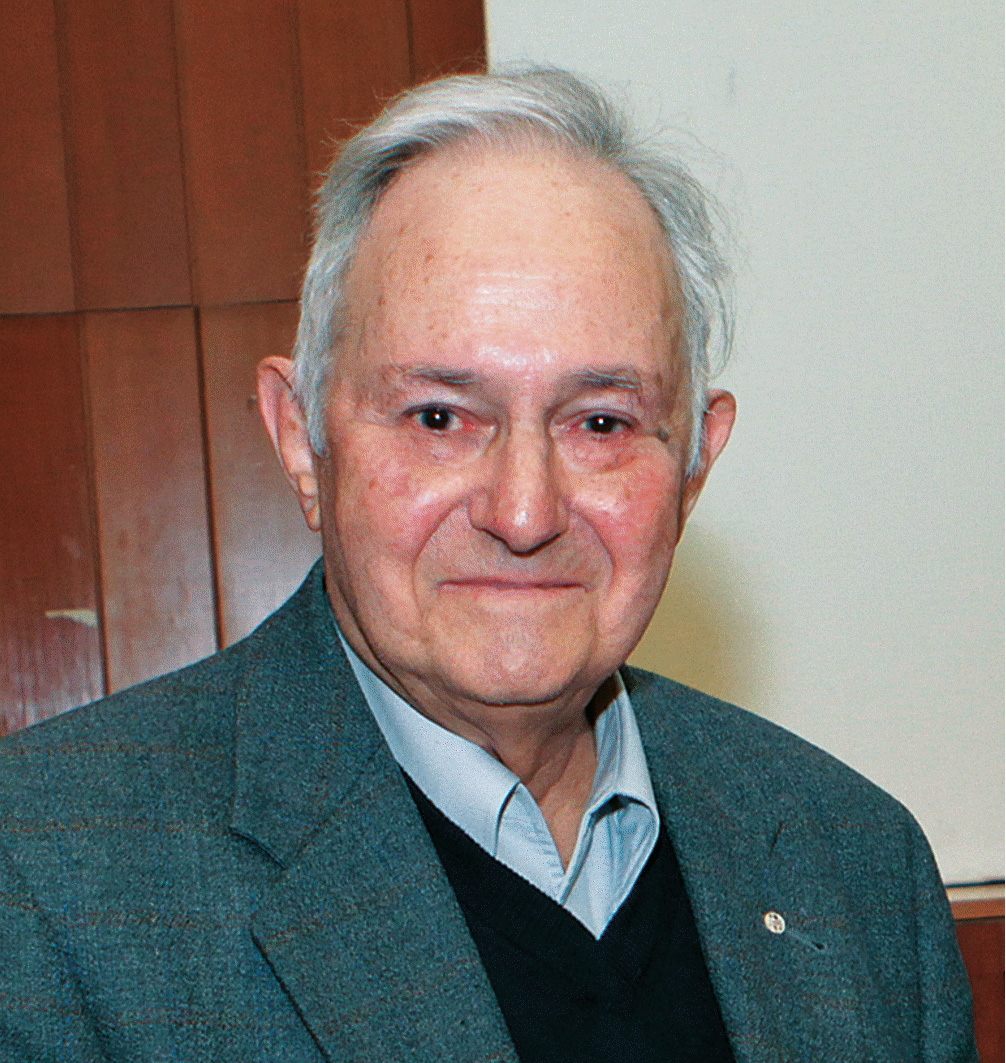
Erich Lohrmann, an experimental physicist who shaped the research programme at DESY, passed away on 10 January 2026 at the age of 94.
Lohrmann was born on 25 May 1931 in Esslingen am Neckar near Stuttgart. From 1950 to 1955 he studied at the Technische Hochschule Stuttgart (TH Stuttgart), where in his doctoral dissertation, completed in 1956, he investigated particle production by cosmic rays in nuclear emulsions and together with Martin Teucher observed the creation and annihilation of an antiproton shortly after its discovery at Berkeley. For this discovery, Owen Chamberlain and Emilio Segrè were awarded the Nobel Prize in Physics in 1959. From 1956 to 1961, Lohrmann continued his work on cosmic rays at TH Stuttgart and at the universities of Bern, Frankfurt and Chicago. In Chicago he also met Masatoshi Koshiba, with whom he shared a lifelong friendship.
Lohrmann joined DESY in 1961. He convinced the director, then Willibald Jentschke, that a liquid-hydrogen bubble chamber exposed to the photon beam from the 6 GeV electron synchrotron would be ideally suited to investigate hadronic reactions. Five million bubble-chamber photographs were analysed by a large collaboration, resulting in a rich scientific harvest that received great international recognition. To facilitate the measurement and analysis of millions of photographs, Erich worked on automated measurement methods and data analysis, and founded DESY’s IT group. In 1969, together with Peter Stähelin, he established the Institute of Informatics at Hamburg University, where he and members of the DESY IT group gave lectures on informatics and data analysis.
As research director from 1968 to 1972 and from 1979 to 1981, he played a key role in strategic decisions at DESY. He was one of the few scientists who encouraged Jentschke to build the electron–positron storage ring DORIS. In the years from 1966 to 1968, it was a risky decision to base DESY’s future on this technique, since the prevailing opinion among particle physicists was that it would only allow tests of the validity of QED. The discovery of the “new particles” in the November Revolution of 1974 (CERN Courier November/December 2024 p41) showed that this was the right decision, and it has shaped research at DESY until today.
Lohrmann was the driving force behind the conception and realisation of the PLUTO detector at the DORIS storage ring. Against considerable opposition, he insisted on a superconducting coil, which laid the foundation for DESY’s expertise in superconducting technology. This was subsequently a crucial prerequisite for the construction of HERA. The experimental programme at DORIS, in which Koshiba’s group was also heavily involved, proved to be extremely successful. The strong Japanese–German collaboration was continued at the large electron–positron storage ring PETRA and later at HERA. The PETRA experiments produced a wealth of new results, the most important of which was the discovery of gluons. After his term as research director ended, Erich then played an influential role in the TASSO experiment.
In the HERA project, he strongly supported Björn Wiik’s forward-looking proposal to build an electron–proton collider with a superconducting proton storage ring 6 km in circumference. In the ZEUS experiment, Lohrmann played a central role in setting up the collaboration, designing the interaction region and in data analysis, to name just a few examples. His important contributions to the critical analysis of publications continued until very recently.
Erich also promoted research with synchrotron radiation through the conversion of DORIS into a high-brilliance radiation source. Later, PETRA was also converted into a synchrotron radiation source. Today, DESY is a world leader in photon science.
From 1976 to 1978, Lohrmann served as CERN director responsible for research. Until his retirement in 1996, he was a professor at the University of Hamburg. With his lectures on physics, statistics and methods of data analysis, he inspired numerous students and provided them with a solid education. Based on his teaching experience, he also authored three books, one of them, Statistical and Numerical Methods of Data Analysis, with his colleague Volker Blobel. Together with Paul Söding, he described the history of DESY in detail up to 2008 in the book Von schnellen Teilchen und hellem Licht. Even after his retirement, Lohrmann was frequently at DESY and remained active in research. One example is the GRAVI experiment, which investigates Newton’s law of gravitation in weak fields.
Despite his great scientific achievements, Erich remained modest. Thanks to his sober yet humorous Swabian manner, his expertise and his commitment to scientists, he enjoyed great trust and esteem.
With the passing of Erich Lohrmann, physics loses a scientist of great foresight and an inspiring teacher. His contributions to physics and his scientific legacy will continue to inspire us in the future.