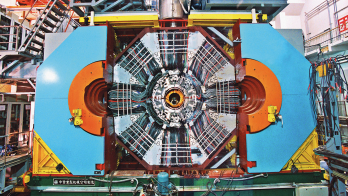
In a sample of 58 million J/ψ events, the BES collaboration at the Beijing Electron Positron Collider (BEPC) has found a clear signal (7.7σ statistical significance) for a new resonance, the X(1835). The signal appears in the π +π –η‘ mass distribution of the process J/ψ → ψγπ+π–η‘, where the η‘ meson is detected in two decay modes, η‘ → π+π–η (η→ γγ) and η‘ →γρ (ρ → π+π–). The results were reported at the Lepton-Photon 2005 conference held in Uppsala.
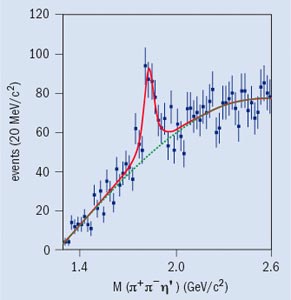
The peak in the π+π–η‘ mass spectrum is well described by a Breit-Wigner resonance function, with a mass of 1834 MeV/c2 and a width of 68 MeV/c2 (BES Collaboration 2005). This mass and width are not compatible with any known meson resonance. However, the properties are consistent with its being the state responsible for the strong threshold enhancement in the pp- mass that BESII observed in J/ψ → γppbar two years ago. One possible interpretation of the enhancement is that it is the tail of a “deuteron-like” spin-0 proton-antiproton bound state (baryonium) and its properties match well predictions for a state with a mass around 1.85 GeV/c2 (Ding and Yan 2005). However, until the spin of the X(1835) is determined and other expected decay modes measured, alternative interpretations cannot be excluded.
Further reading
BES Collaboration, M Ablikim et al. 2005
G J Ding and M L Yan 2005 Phys. Rev. C 72 015208.