With the High-Luminosity LHC on the horizon, the ATLAS collaboration took stock of itself through a survey of its members on strategy, operations and work culture.
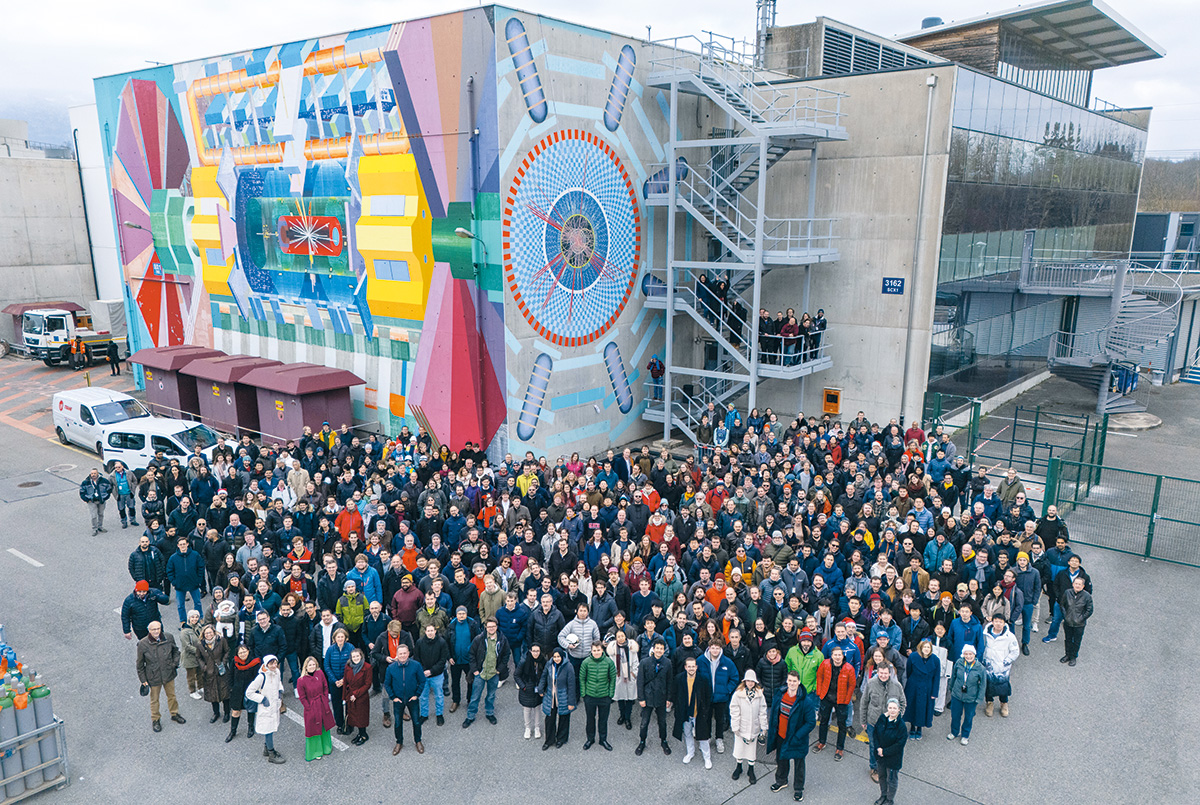
The ATLAS collaboration has approximately 6000 members from 262 institutes in 40 countries, about half of them scientific authors. This large and diverse community has spent the past few years carrying out detector operations, data analyses and upgrades all at once, through a global pandemic and a succession of geopolitical crises. As the High-Luminosity LHC (HL-LHC) era draws closer, the collaboration decided to find out where its members stand on fundamental strategic questions and how they feel about its organisation and operating model.
Collaborations in particle physics have not always been this large. The Gargamelle team that discovered weak neutral currents in 1973 counted 55 authors from seven European laboratories, with guests from Japan, the Soviet Union and the United States. The W boson was found a decade later by two collaborations, UA1 and UA2, of roughly 140 and 60 physicists, respectively. At LEP, the four experiments ALEPH, DELPHI, L3 and OPAL each counted several hundred physicists from a few tens of institutes. When ATLAS and CMS jointly measured the Higgs-boson mass in 2015, in the first paper the two collaborations signed together, the author list ran to 5154 names and filled 24 of the article’s 33 pages.
Most members plan to take part in the HL-LHC programme and stressed the importance of remaining engaged with the collaboration to successfully complete the upgrade
A collaboration of this scale can only be consulted through an organised, sustained effort. In the case of ATLAS, this meant establishing a working group of 14 members to draft survey questions, collecting responses from July to September 2024, and forming an analysis team of five to read and interpret the results, with each step of the process taking several months. Designed to be concise, focused and actionable, the “Big Survey” still comprised more than 200 questions. To limit the burden on participants and maximise reach, these were divided into four modules of approximately 20 minutes each, the first on strategic collaboration issues, the second on physics and performance, the third on operations, the upgrade and practical matters such as travel, meetings and remote working, and the fourth on career development and work culture.
Survey rates
Replies came from nearly 1500 members (see “Demographics” figure). The rate of participation rose steeply with seniority, from fewer than 10% of master’s and undergraduate students, engineers and technicians, and about 17% of PhD students, to around 30% of scientific authors with fewer than 5 years of authorship and nearly 60% of those with between 10 and 15. The overall response rate was slightly below 25% and was approximately uniform across world regions.

The results were examined across demographic groups, compiled into an internal document and then discussed with the collaboration at large during plenary meetings. An online tool also allowed members to explore the correlations for themselves. The conclusions comprise 37 actions to address the areas of improvement identified in the survey, and many have already been implemented. For instance, all active members, not only scientific authors and students, now have access to the collaboration’s complete internal documentation, and the operational workload institutions must cover has been rebalanced towards those less engaged in upgrade construction.
The survey showed overall satisfaction. Asked whether the ATLAS organisational structure is well suited to current and future challenges in data-taking, analysis and upgrades, 62% of respondents agreed, and 14% disagreed (see “Four of two hundred” figure). Most plan to take part in the HL-LHC programme, and they stressed the importance of remaining engaged with the collaboration to successfully complete the upgrade, move smoothly from construction to operations with the new detector, and then sustain years of running to collect much larger datasets. Responses highlighted the need for simple, intuitive workflows and well-documented tools for data analysis. The collaboration is strengthening its documentation team to bring order and searchability to the sprawling records. Moreover, over the past few years, its many analysis frameworks have been consolidated into a few broadly used ones with common statistical tools. On the physics programme itself, respondents see much still to explore, with the caution that effort remains balanced across topics and analysis teams are sufficiently staffed.
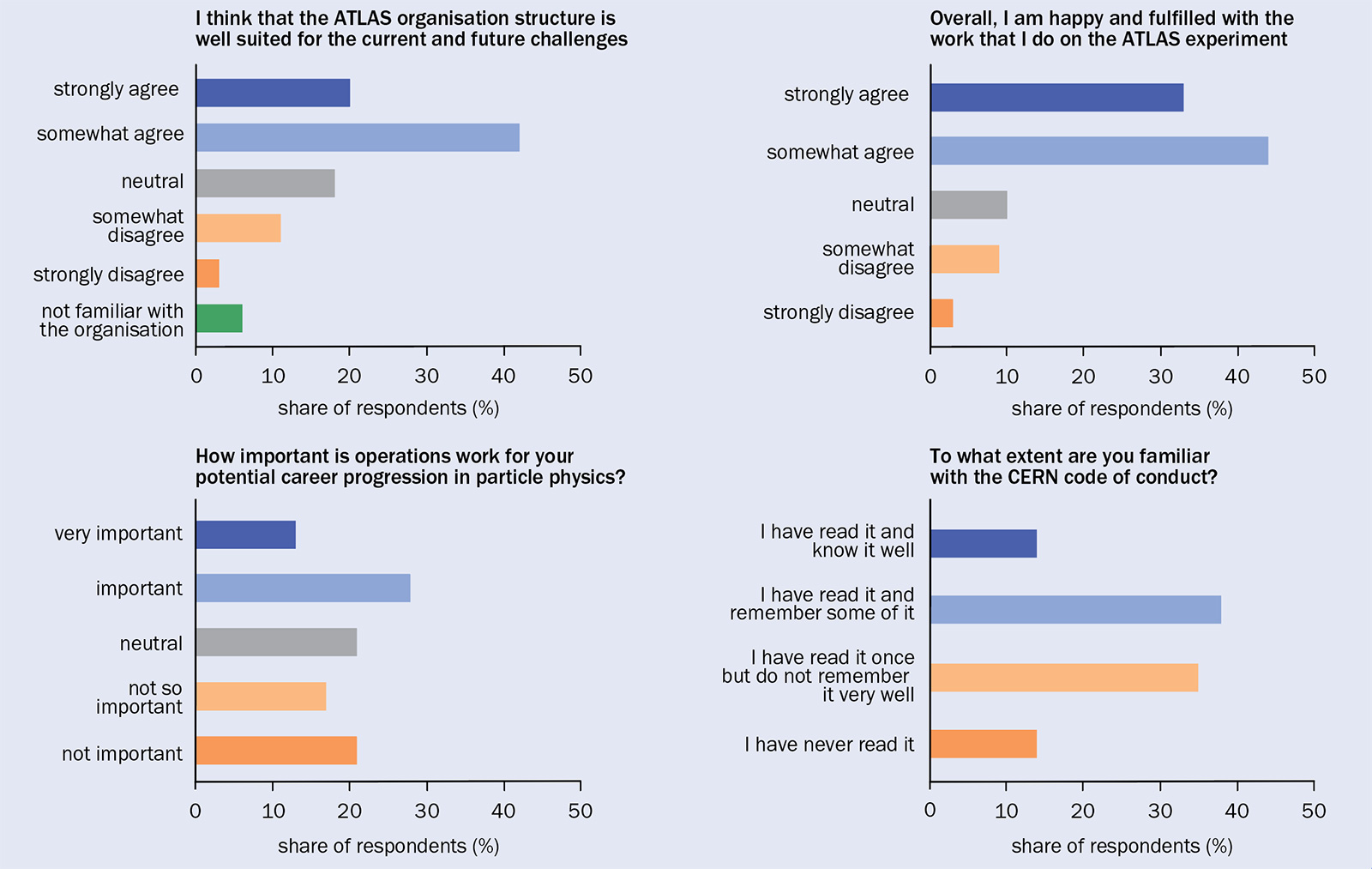
Among the aspects examined in detail were participation in detector upgrade activities, the organisation of physics analyses and publications, and the long-term operation of the experiment. One finding stands out. Contributions such as detector operation and maintenance are regarded as insufficiently recognised by the broad scientific community and research institutions. While most respondents feel satisfied with the recognition received within the collaboration for their work in operations, a large share does not consider this work important for their career progression in particle physics. The actions proposed in response are to make the rules behind authorship, speaker selection and operational credit public on an accessible, single web page, so that committees outside ATLAS can weigh a member’s contributions, and to brief funding agencies more often on technical achievements while pressing the need for long-term contracts for experimental experts.
The responses from early-career scientists showed that further attention is needed to fulfil their aspirations and underscored the importance of understanding the mindsets of the collaboration’s different generations. The ATLAS Early Career Scientists Board took an active part in the analysis and proposed measures to strengthen its initiatives and its role in connecting young researchers with the wider community. Those adopted include allowing all individuals, not only PhD students, to share non-controversial internal results confidentially with job and grant panels, and deepening ties with the CERN Alumni network.
The responses underscored the importance of understanding the mindsets of the collaboration’s different generations
ATLAS strives to provide an equal-opportunity environment, and inclusion and diversity are among its founding values. Members rated its multicultural character highly, with 80% of respondents agreeing that it is inclusive and open, 16% being neutral, and 4% finding it non-inclusive and closed. Since 2017, ATLAS has appointed four collaboration members as diversity and inclusion contacts, and a dedicated equity, diversity and inclusion office has been created to enhance their work. Nevertheless, many collaborators were not fully aware of the CERN code of conduct, and the ATLAS management is now communicating the code more actively, including whom to approach in the event of a potential violation.
The strength within
Overall, the actions resulting from the survey were defined to strengthen communication within ATLAS and with external stakeholders, improve documentation and accessibility for greater efficiency and transparency, and ensure an effective transition from Phase-II construction to optimal Run 4 operations, across data-taking and analysis. They also seek to retain expertise, recognise diverse contributions, and continue promoting the CERN code of conduct and a working environment that supports mental health and wellbeing. The 37-item list concluded a broad, introspective exercise and delivered a roadmap for preparing ATLAS for its high-luminosity phase.