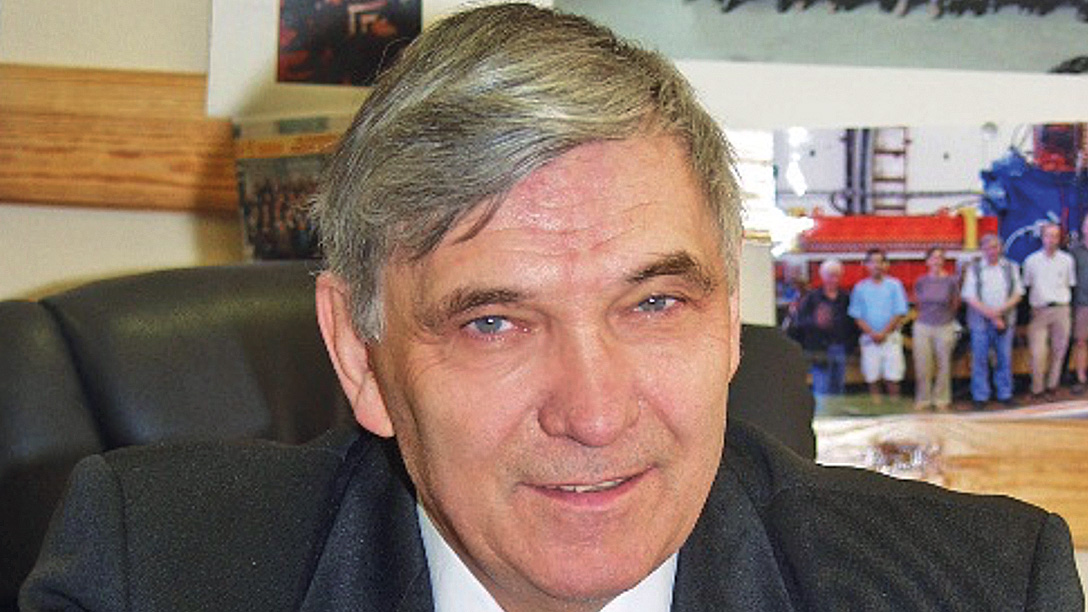
Vasily Vasilievich Parkhomchuk, who passed away on 23 July 2026 at the age of 79, was among the most gifted accelerator physicists of his generation, an experimentalist of rare physical intuition whose influence stretched across continents and decades, and whose warmth and generosity shaped the careers of countless scientists around the world.
Born on 1 September 1946 in the Ukrainian village of Torchyn, he grew up in the remote Altai village of Rodino and came of age at a moment of extraordinary intellectual ferment in Siberia. In 1963 he joined the inaugural class of Novosibirsk State University’s celebrated physics–and–mathematics boarding school, and was admitted to the university itself the following year. After graduating from its physics department, he joined the Budker Institute of Nuclear Physics (BINP). He would remain there for the rest of his life, becoming one of the truest embodiments of the scientific culture that Gersh Budker had created – bold, inventive and rigorous.
The central achievement of Vasily’s career was electron cooling. In the early 1970s he joined the experiments at the NAP-M storage ring, a model for antiproton accumulation, and played a decisive role in the world’s first demonstration of electron cooling of ion beams in 1974, establishing the physical foundations of the magnetised cooling regime. His semi-empirical formula for cooling rates, which distils complex beam physics into practical, reliable engineering guidance, became an international standard and remains in use today.
Under his leadership, BINP grew into the world’s leading centre for electron-cooling technology, and Parkhomchuk personally guided its transfer to laboratories across the globe, at Uppsala, GSI in Darmstadt, COSY in Jülich, CERN’s Low Energy Ion Ring (LEIR) and the Institute of Modern Physics in Lanzhou. The applications that followed were far-reaching, from high-current heavy-ion accumulation and proton cooling to heavy-ion cancer therapy and the heavy-ion programme of the LHC. Late in his career, he helped bring Russia’s first heavy-ion electron-cooling systems into operation at the NICA complex in Dubna.
One of the truest embodiments of the scientific culture of the Budker Institute
Vasily had an extraordinary talent for elegant, unconventional solutions. He devised a compass-based system capable of measuring the inclination of magnetic field lines to a precision of one microradian. Once, he needed a quartz fibre of micron-scale diameter – invisible to the naked eye – for a flying-wire beam-profile monitor. His team made one by firing molten quartz from a bow into a tube lined with black velvet from his wife’s dress, so that the fibre would catch the light and could be seen. It worked.
His physical instincts ranged well beyond cooling. Leading a team that analysed the effects of diffusive ground motion on beam dynamics in the VLEPP linear electron–positron collider project and the Superconducting Super Collider in the early 1990s, he coined the term “ATL law”, which has since become a widely accepted concept in accelerator alignment and stability. His studies of magnetised electron beams helped lay the groundwork for the electron lenses used in beam–beam compensation, and his kinetic theory of ionisation cooling contributed to the theoretical basis for muon colliders. He also founded Russia’s first accelerator mass spectrometry centre, in Novosibirsk, which today serves researchers in radiocarbon dating and biomedical science.
Elected a full member of the Russian Academy of Sciences in 2016, Parkhomchuk was honoured with the Chinese Government Friendship Award (2004), the Dieter Möhl Medal (2013), the Robert R Wilson Prize of the American Physical Society (2016) and the Budker Gold Medal of the Russian Academy of Sciences (2023). He wore these distinctions lightly. Colleagues remember him not for the awards but for his presence in the accelerator control room, working side by side with colleagues and students until the very end, patient and curious and always ready to laugh.
Vasily’s ideas live on in many of the world’s most advanced accelerators. His humanity lives on in everyone who had the privilege of knowing him.