A report from the CMS experiment.
Most of the unstable particles produced in LHC collisions decay promptly. Some theories of physics beyond the Standard Model (SM), however, predict particles that interact only feebly with ordinary matter and can therefore travel a measurable distance before decaying. These long-lived particles (LLPs) have long been a target in the search for physics beyond the SM (CERN Courier July/August 2015 p9). The CMS collaboration has now presented a search for LLPs using a dedicated trigger for high-multiplicity showers in its muon system. This technique improves the trigger efficiency by a factor of 10, extending sensitivity to a previously inaccessible region of low missing transverse momentum.
The search relies on the structure of the CMS muon system, with detectors interleaved with the steel of the magnet’s return yoke, where an LLP can decay and initiate an electromagnetic or hadronic shower. Secondary particles from the shower would then pass through the gas-filled detector chambers, producing a large number of localised hits. By searching for clusters of these hits, the collaboration can effectively turn the muon system into a sampling calorimeter for particles that would otherwise be difficult to detect.
This unconventional approach was first demonstrated in 2021 (CERN Courier November/December 2021 p19). That study used 137 fb–1 of data collected during 2016–2018 and improved sensitivity to GeV-scale particles by up to a factor of six. The method also allowed CMS to search for LLPs decaying several metres from the interaction point, with proper decay lengths of up to about 1 km. The latest CMS search took this approach further by introducing a dedicated high-multiplicity trigger for muon detector showers in Run 3.
The analysis searches for pairs of muon detector showers with a high-hit multiplicity. The substantial amount of material interleaving the muon detectors provides substantial shielding from SM particles that can mimic the signature of an LLP. Requiring showers with a large number of hits further suppresses backgrounds, such as muons, that radiate in the detector and hadrons that penetrate the calorimeters. The remaining background is estimated directly from collision data using control regions, avoiding reliance on a detailed simulation of these rare detector effects.
The new trigger broadens the range of LLP scenarios CMS can explore
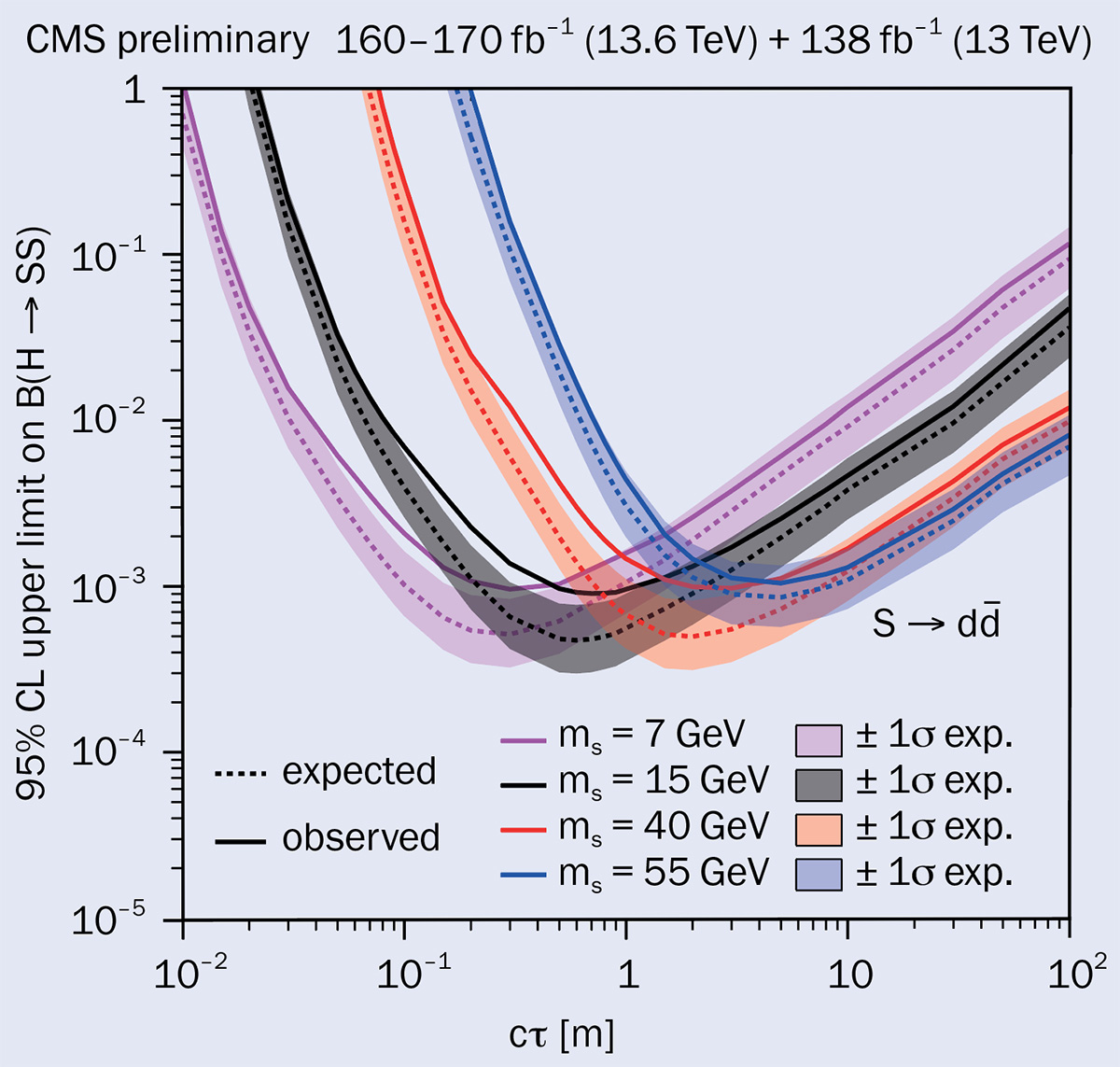
The new search uses up to 170 fb–1 of proton–proton collision data collected by CMS at 13.6 TeV between 2022 and 2024. No significant excess above the predicted SM background is observed in the data. The study sets 95% CL upper limits on the branching fraction of Higgs-boson decays to a pair of LLPs, reaching sensitivity to branching fractions at the sub-percent level (see figure 1). For LLP masses below 10 GeV, it provides the most stringent limits from LHC data to date.
The new dedicated trigger also broadens the range of LLP scenarios that CMS can explore. In 2024, for instance, it was extended to collect events in which an LLP is produced alongside a lepton or photon. Looking ahead to the HL-LHC, the collaboration is developing further triggers and new reconstruction techniques, including machine-learning methods that make greater use of the information recorded in the muon detectors. Together, these developments will extend the reach of the LHC programme’s sensitivity to increasingly long-lived and weakly interacting forms of new physics.
Further reading
CMS Collab. CMS-PAS-EXO-25-005.