Fourteen years on, the 125 GeV Higgs boson is still the only known fundamental scalar. Whether it will remain so, is the business of a community spanning collider physics, phenomenology, cosmology and particle astrophysics. From 1 to 5 June, the second edition of Extended Scalar Sectors From All Angles brought 132 of its members to CERN to assess the theories that call for additional scalars and the searches that constrain them.
Discussions ranged from ongoing searches at the LHC to the prospects offered by future facilities. ATLAS and CMS supplied most of the experimental talks, covering their direct searches for new scalars as well as their indirect ones, through precision studies of the Higgs boson’s CP properties and rare decays. LHCb presented searches for light scalars produced in b-hadron decays, while FASER, which sits far downstream of the ATLAS collision point to catch light, long-lived particles, reported searches probing new scalars with masses down to a few GeV.
A recurring theme was the close interplay between theoretical ideas and experimental discoveries, with new theoretical developments inspiring novel search strategies and increasingly precise measurements guiding the exploration of new physics. Examples came from the recent searches for the Inert Doublet Model by the CMS experiment, corresponding to the first dedicated study for this model using LHC data. Many presentations focused on how additional scalar particles could help address outstanding puzzles in modern physics, such as the nature of dark matter and the origin of the asymmetry between matter and antimatter, the latter – for example – by allowing for CP violation in the extended scalar sector that leads to a viable mechanism of baryogenesis.
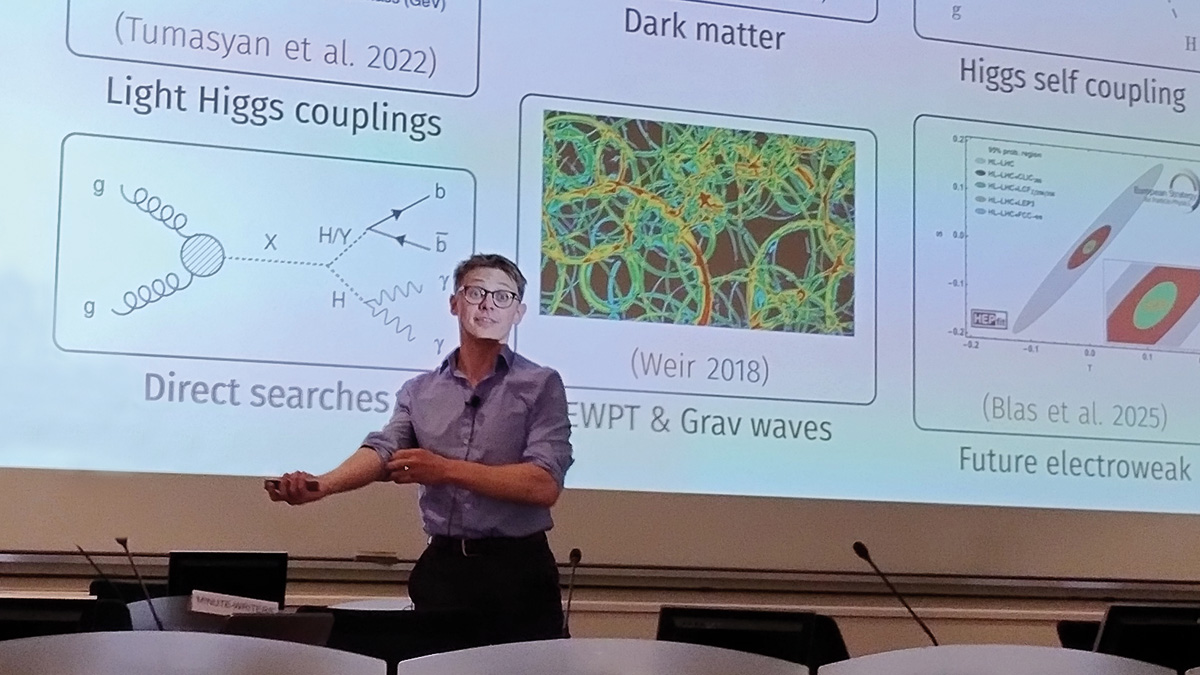
The conference also reflected the growing importance of precision measurements. A striking example was a CERN theory colloquium by David Sutherland (University of Glasgow), embedded in the conference programme. Sutherland argued that although we know that nature is Standard Model-like around the vacuum expectation value of the Higgs boson, it may be very different at different values. Searching for extended Higgs sectors will cover this possibility and has to be done both directly, through searches for new resonances, and indirectly, by constraining effective field theories with precision measurements.
While no definitive evidence for new scalar particles has yet emerged, the conference conveyed a strong sense of optimism and momentum. With the High-Luminosity LHC on the horizon and future collider projects under active consideration, the search for an extended Higgs sector remains one of the most promising paths towards physics beyond the Standard Model.