This Is for Everyone, by Tim Berners-Lee, Macmillan
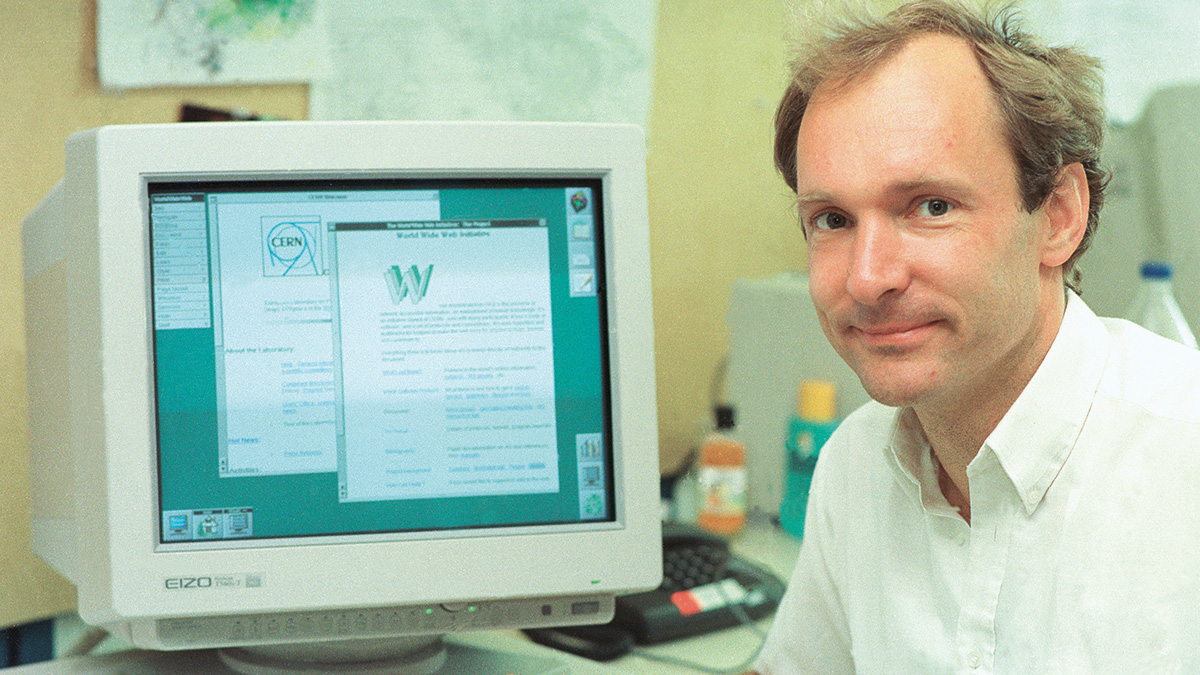
As the recent dramatic improvement in AI leads to its increasingly widespread adoption, many of us are left unsure how to respond. The narrative, particularly among digital natives, is that we are living through an experience without precedent. Of course, to some extent, we are – AI is a technology unlike anything that came before it. However, this does not mean history has nothing to teach us.
Tim Berners-Lee’s invention of the World Wide Web in 1989 went on to transform global communication, economics, and societies, leaving many scrambling to keep up. While his latest book does not attempt to comprehensively answer every question sparked by the rise of AI, it provides a useful reference for anyone grappling with them. This Is for Everyone delivers a detailed yet compact history of the web, accompanied by its inventor’s reflections on what it has and could become.
The book starts by describing Berners-Lee’s childhood in London, where – raised by parents who were both mathematicians and electronic engineers – he was constantly exposed to technology. Born in 1955, he discusses his cohort’s “magic-carpet ride through the wave of tech”, where computing was developing at a perfect pace for their education and career development.
The CERN years
His interest in technology eventually took him to CERN. The book contains a positive description of the Organization, set alongside a relatable caveat of how challenging it was to facilitate communication within its community. It was this challenge that he sought to address through inventing the web, supported by many CERN colleagues he describes with great affection.
The story of the web’s origin is relatively well known within the particle-physics community, but perhaps less so is what happened next. Depicted in detail in the book is the work of the World Wide Web Consortium (W3C), which brought together companies, non-profits, universities and governments to develop standards that would help preserve the web’s “universal” nature. The history of the governance of the web is set alongside Berners-Lee’s own memories of its increasingly widespread adoption. His joy in the many products of his creation leaps off the page, from the first online museum exhibitions of the nascent web to the later growth of Wikipedia and podcasts.
When describing some early side-effects of the web, Berners-Lee is sometimes too dismissive of their significance. He does not, however, shy away from describing how the negative impact of the web has grown with time, alongside his despair at modern social media. While the book regrettably does not thoroughly discuss what could have been done to prevent social media from reaching their current state, it does include some ideas on how to improve them. Berners-Lee believes that online lack of compassion is a design issue, not a human failing, and that the solution is mostly technical. He proposes a switch to algorithms trained for constructive engagement, similar to those used by music apps, which could be designed to give us more of the things we enjoy.

Berners-Lee also outlines his belief in the importance of data privacy and sovereignty, lamenting how web users have often become products for advertisers, as well as the web’s abuse by authoritarian governments. The book explains how this led him to develop the web decentralisation protocol Solid, which gives people ownership of their data through a “pod” they control, and his company Inrupt – a part of his career many may be unfamiliar with. Although Berners-Lee has an obvious vested interest in the protocol, it certainly appears to be an interesting approach to data sovereignty.
The book states Berners-Lee’s concern that the rise of AI risks exacerbating current problems with the web and broader digital landscape. Although he emphasises his excitement about AI’s potential to benefit the world, he also stresses the need to act quickly to mitigate “the risk that it turns into something darker, more coercive and exploitative, as happened with social media.” It is in this area that his experience spearheading a new technology provides some necessary weight to his often bold arguments. His rejection of the false dichotomy between AI “doomers” and “boomers”, and his push for a nuanced discussion of its development, reflect the careful approach of the W3C. His emphasis on the need to avoid monopolies and prioritise the rights of the end user for the AI-powered web is likewise a continuation of his original principles for the web. His belief in the importance of international collaboration, first sparked during his time at CERN, leads him to call for “a CERN-like institution for AI before something catastrophic happens.”
Although the book is not the most fluently written, it is generally easy to understand, even for readers with no expertise in web development or computing. The anecdotes included about the early web community will likely pique the interest of many Courier readers. As seems characteristic of its author, the book presents a very idealistic vision of the future of technology. Given the often toxic nature of debate in this area, however, such optimism is refreshing.
This Is for Everyone will leave you in no doubt that building an AI-powered web with humanity’s best interest at heart is one of the most significant global challenges today. Luckily, as Berners-Lee concludes, “There’s still time.”