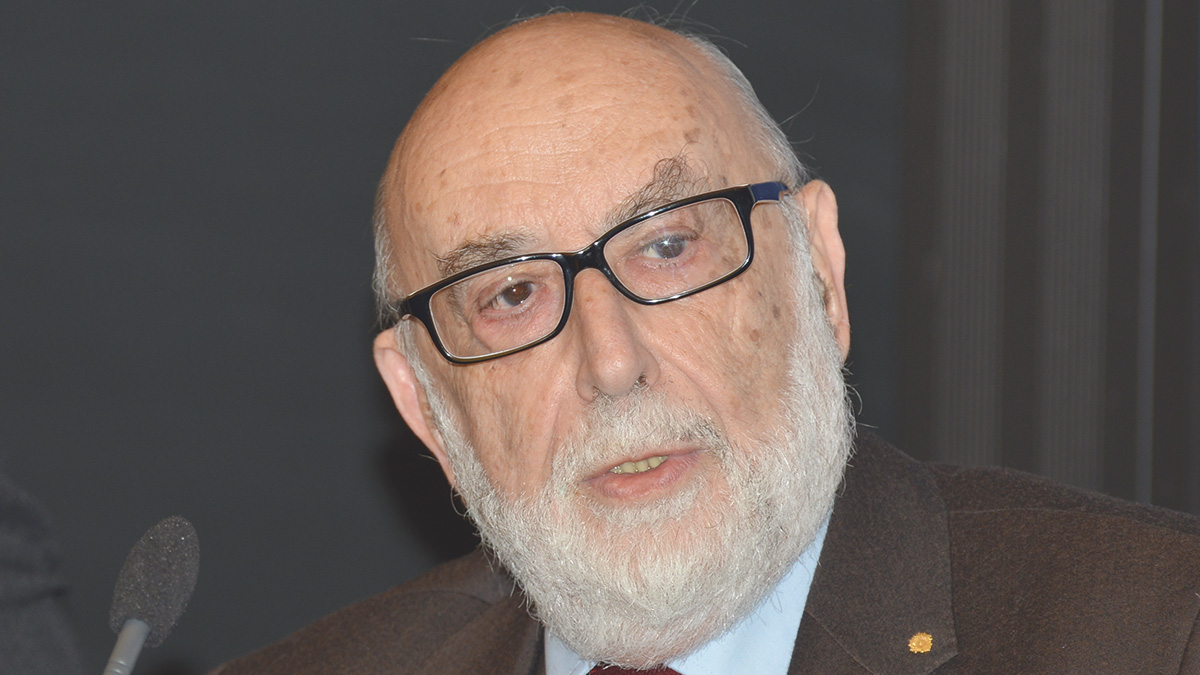
François Englert died on 18 June in Uccle, in the Brussels region, aged 93. Beyond his major contributions to fundamental physics, he had a profound, if discreet, influence on the Belgian scientific community.
He was born on 6 November 1932 in Etterbeek (Brussels), to a family of Jewish immigrants from Poland. During World War II, François and his older brother Marc became enfants cachés – hidden children – finding refuge in the countryside at great risk to those who sheltered them. For a child so young, it was a traumatic experience, which François long kept to himself. After the war, he enrolled at the Université Libre de Bruxelles (ULB) in the Faculty of Applied Sciences, a frequent choice at the time, as it guaranteed employment and claimed to offer the same training as a physics degree. After graduating in 1955 he switched to physics, quickly completing a licence in 1958 and a PhD, under the supervision of Jules Géhéniau, the following year.
A turning point in his career came with a postdoctoral stay at Cornell University, where Robert Brout, at first his adviser, became a lifelong colleague. He came back to ULB in 1961, as a lecturer in general physics, and Robert soon followed him. Only later, in 1980, would they formally found the Theoretical Physics group – a generic name chosen to avoid dissecting physics into separate specialities.
Open culture
From Cornell, they had brought back an informal culture: the door was always open to anyone who wanted to discuss physics. As students, we were completely immersed in the research, spending whole afternoons with the two leaders in a sort of musical-chairs brainstorming at the blackboard. They also made sure that a permanent position could be considered only after a postdoctoral stay abroad, an attitude that eventually spread to other departments, reversing a long tradition of internal recruitment.
In the early 1960s, François and Robert were looking for a way to formulate short-distance interactions in the formalism of quantum field theory (QFT). Gauge-invariant QFT was known to describe quantum electrodynamics, but dealt only with massless gauge bosons and hence long-distance interactions. The mechanism they found was submitted to Physical Review Letters in June 1964, in a paper that showed diagrammatically how gauge bosons could acquire mass. Independently, in July, Peter Higgs approached the problem focusing on the elimination of unwanted Goldstone bosons, and included the mass of the gauge bosons in a later paper.
That short paper by François and Robert was in fact remarkably complete: it included the basic spontaneous symmetry breaking by a fundamental scalar field, as is now standard, but also a dynamical approach assuming fermion condensates, and it covered the non-abelian case. The mechanism also opened the way to the proof of the renormalisability of the theory. At the time, both the strong and the weak interactions were candidates for such symmetry breaking, but a concrete realisation awaited a 1967 paper by Steven Weinberg. A different mechanism, confinement, was eventually shown to operate in strong interactions.
François and Robert soon turned their attention to cosmology, first joined by Edgard Gunzig, then by Philippe Spindel and eventually by the whole Brussels group – an exceptional case, as they had insisted that its members operate as independent individuals. One puzzle, in particular, drew them. In an expanding universe, regions thought never to have been in causal contact show almost the same temperature in the cosmic microwave background, the fossil radiation of the Big Bang. Their explanation relied on a fast initial expansion phase, a scenario they called the “causal universe”. Here, too, they were precursors. François’s curiosity extended to a wide variety of topics, with more interest in finding mechanisms than in a tedious zoology of nature. These ranged from generating the spacetime metric out of a fractal structure to the classification of monopoles and even the structure of viruses!
While François and Robert played a formative role in the Belgian physics community, François never mentioned his role in the student revolts at ULB in 1968, since the structures that emerged from them had fallen short of his hopes. In fact, he kept clear of institutional academic roles altogether. His influence was felt otherwise. Formal recognition, too, was long in coming. It began with the Gravity Research Foundation award (1978), followed by the Francqui Prize (1982), the European Physical Society Prize (1997), the Wolf Prize (2004) and the Sakurai Prize (2010). In 2013 came the Prince of Asturias Award and the Nobel Prize, awarded to François and Peter Higgs, Robert Brout having died in 2011. King Albert II made François a baron in the same year, and he was also appointed professor at Tel Aviv University.
A point of reference
It must be realised that, by the time of François’s and Robert’s seminal paper, QFT itself had fallen out of fashion. Despite its success in quantum electrodynamics, the framework could not be applied to short-distance interactions, and many preferred more holistic approaches, such as the unitary S-matrix. Interest returned progressively as spontaneous symmetry breaking gained acceptance, a shift that can be followed in the paper’s own citation curve, and François and Robert embarked on an inter-university series of lectures and seminars. Despite the philosophical and linguistic differences between the universities, this seeded or cemented the contacts between the theoretical physics groups of Brussels, Leuven and Louvain-la-Neuve. The effort made them a point of reference for Belgian physics.
Interestingly, this path had been trodden before them by Monsignor Georges Lemaître, father of the Big Bang, who visited ULB frequently. To celebrate these unifying efforts, the Belgian Senate, later joined by the Brussels Region, encouraged the formation of the Brout–Englert–Lemaître (BEL) Centre, common to ULB, the Vrije Universiteit Brussel (VUB), the Université Catholique de Louvain (UCLouvain) and the Katholieke Universiteit Leuven (KU Leuven).