A report from the ATLAS experiment.
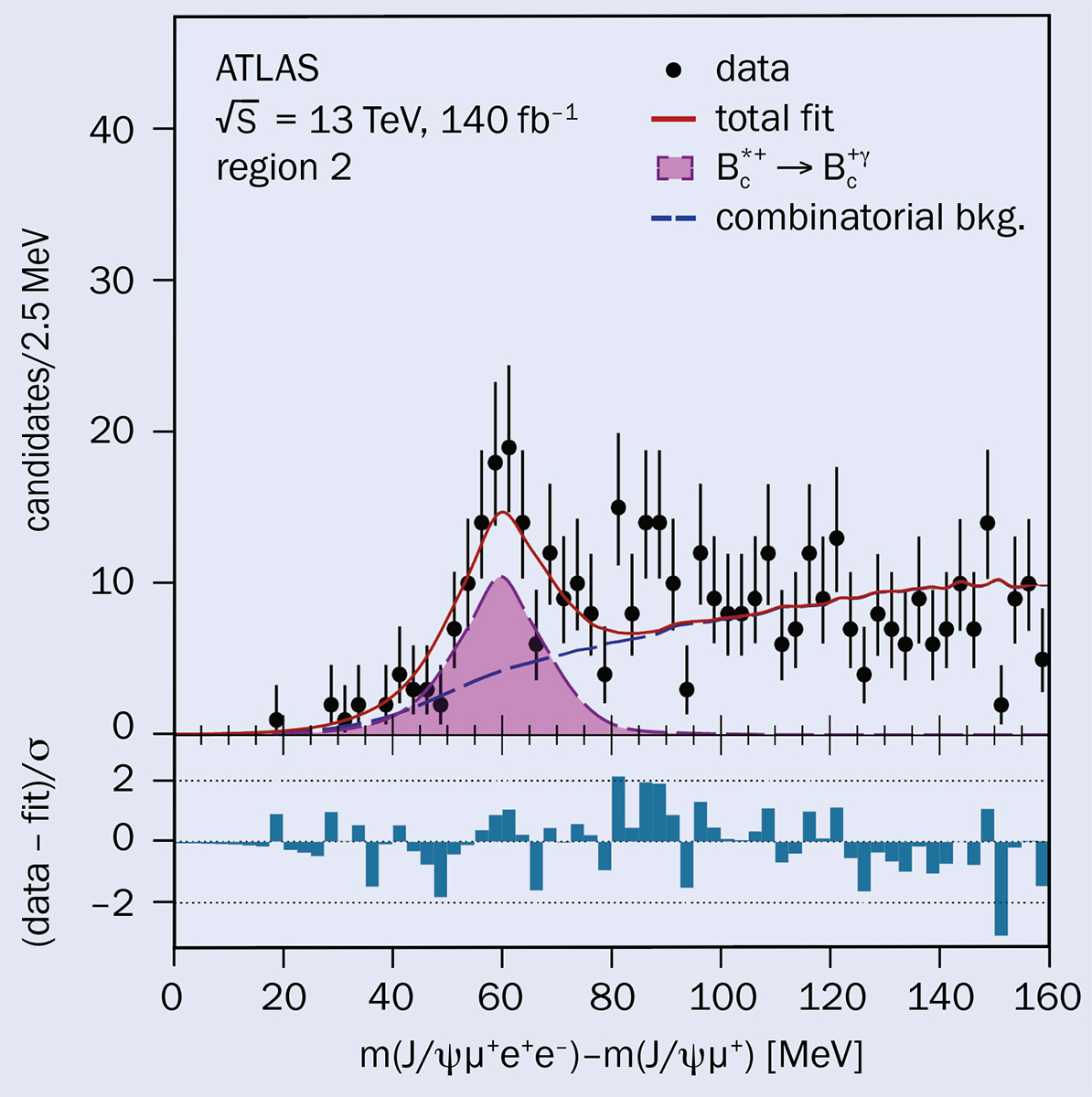
The B+c mesons are heavy bound states of a charm quark and a beauty antiquark, intermediate in mass between charmonium (cc) and bottomonium (bb). The ATLAS collaboration has now reported the first observation of the Bc*+ meson, the lightest excitation of the system, using the full 140 fb–1 of 13 TeV proton–proton collisions recorded during Run 2 of the LHC. The spectrum of this system is largely uncharted, and mapping it offers a powerful test of QCD.
The ground-state B+c meson was first observed by the CDF collaboration at the Tevatron in 1998 (CERN Courier Summer 1998 p22), but excited bc states have proved considerably more challenging to identify. In analogy with the hyperfine splitting of the hydrogen atom, the Bc*+ meson’s quark and antiquark spins are aligned in the same direction, whereas they are oppositely oriented in the ground-state B+c. The mass difference between the two states is therefore expected to be only a few tens of MeV, the smallest splitting among all known Bc excitations. The excited Bc*+ meson decays into the ground-state B+c meson by emitting a correspondingly low-energy photon, which is extremely difficult to measure.
The analysis identified the B+c mesons through their semileptonic decays to J/ψ(→μ+μ–)μ+νμX. Such modes are not typically used in hadron spectroscopy, because the missing neutrino prevents the full kinematics from being reconstructed. However, the branching fraction of this channel is about 20 times larger than that of the hadronic decay to J/ψπ+ used in earlier studies of excited bc states. This gain in statistics, along with a relatively low level of background, outweighs the complication of the partial final-state reconstruction.
The low-energy photons were identified using their conversions to electron–positron pairs in the material of the beampipe or of the innermost part of the ATLAS tracking detector. A conversion candidate is marked by a pair of oppositely charged tracks emerging from a common vertex, sufficiently displaced from the collision point. To increase the acceptance for the soft photons, a dedicated track reconstruction procedure was introduced with a transverse momentum threshold as low as 100 MeV, compared with the about 500 MeV typical of ATLAS track reconstruction. While running it on the entire dataset would be computationally impractical, the analysis benefited from a recent development in distributed data management that enabled individual raw events containing a B+c candidate to be “picked” from the tapes. This way, the dedicated tracking was executed only on several hundred thousand preselected events, instead of the billions in the full dataset.
Once the B+c decay and photon candidates are combined, the signal of the Bc*+ decay is identified using the distribution of the mass difference m(J/ψμ+γ) – m(J/ψμ+). The signal produces a distinct peak in this distribution, despite the missing neutrino from the B+c decay (see figure 1). The statistical significance of the observed signal exceeds eight standard deviations. The mass difference between the new particle and the ground-state B+c meson is measured to be 64.5 ± 1.4 (stat.)+1.0–1.4 (syst.) MeV. This value is within the range of the available theoretical expectations, although it lies slightly above the most recent precise lattice-QCD calculations, which predict values below 60 MeV.
This discovery fills a gap in the spectrum of experimentally observed states of the bc system and will help inform the development of theoretical models. It also demonstrates the potential of ATLAS for heavy-flavour hadron spectroscopy, a capability that will be further explored with Run-3 data and at the High-Luminosity LHC.
Further reading
ATLAS Collab. arXiv:2605.16228.