A report from the LHCb experiment.
Almost every particle decay process recorded to date involves at least a meson or a lepton. Only two feature nothing but baryons and antibaryons, and both include a charmed product. The LHCb collaboration has now observed a third, Λ0b → Λpp , this time with no final-state charm quarks, and the first to emerge from a dedicated search.
It is the intricate internal structure of baryons that makes purely baryonic decay processes so interesting. The two previously known cases, Λ0b → Σ0cpp and Λ0b → Σc*0pp , surfaced in 2018 from an LHCb analysis of Λ0b → Λ+c pp π–. In both these modes, as well as in the new one, the original three-quark baryon transforms into three other baryons and antibaryons containing nine valence quarks and antiquarks altogether. The transition must therefore create several quark–antiquark pairs. Measuring these processes can help clarify how the weak decay of a heavy quark is followed by the strong interactions that bind quarks into observable particles. Their spin structure also gives access to angular observables, including triple-product correlations, that are sensitive to CP-violating and time-reversal-odd effects.
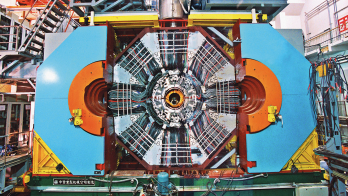
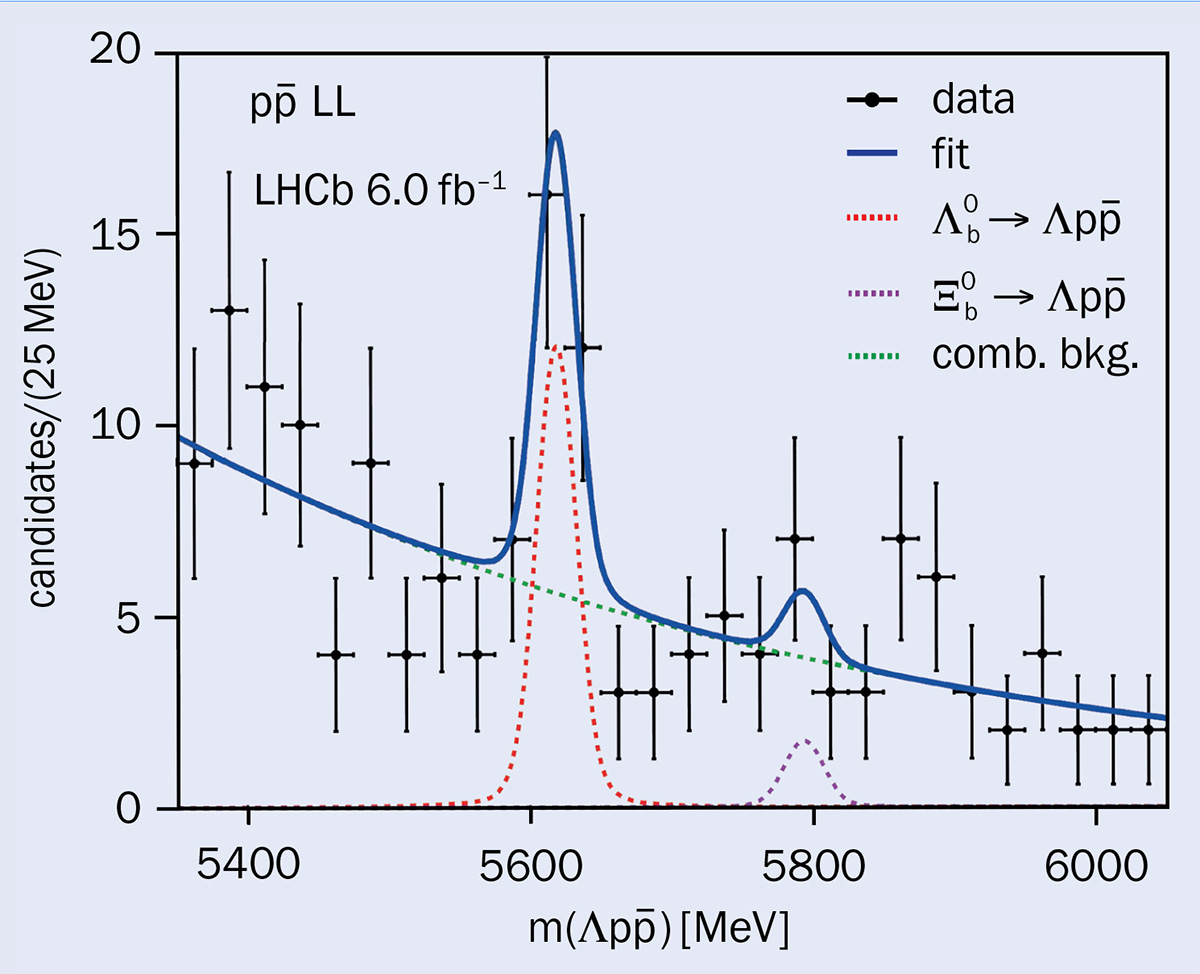
The recent search was conducted using 6.0 fb–1 of proton–proton collision data recorded by LHCb during Run 2 of the LHC, at a centre-of-mass energy of 13 TeV. The relatively long-lived Λ baryon was reconstructed through its decay into a proton and a pion. Since the Λ can travel an appreciable distance before decaying, the data are divided into two categories based on where the decay takes place inside the detector. In the “long–long” (LL) category, both decay products leave hits in the vertex detector near the collision point and in the tracking stations downstream, providing the best mass and vertex resolution (see figure 1). A complementary “downstream–downstream” (DD) category recovers Λ baryons that decay outside the vertex detector and contributes about half of the signal.
Larger Run-3 datasets will allow the dynamics of this decay to be explored in much greater detail
The candidates were separated from random combinations of particles using the displaced-decay topology, multivariate algorithms and LHCb’s particle-identification detectors. Backgrounds containing charm hadrons were removed, while decays through intermediate charmonium resonances were excluded by requiring the proton–antiproton invariant mass to be below 2.85 GeV. A simultaneous fit to both reconstruction categories yields 39 ± 10 decays with a significance of 5.1 standard deviations, including systematic uncertainties. The Λ0b → Λpp decay rate is measured relative to the similar Λ0b → ΛK+K–, giving a ratio of branching fractions of (5.1 ± 1.3 (stat.) ± 0.3 (syst.)) × 10–2. Since the measurement is restricted to this charmonium-free region for both decays, while the published branching fraction of the normalisation mode covers the full phase space, the ratio cannot yet be converted directly into an absolute branching fraction for Λ0b → Λpp .
Larger Run-3 datasets from the upgraded LHCb detector will allow the internal dynamics of this decay to be explored in much greater detail, including possible threshold enhancements and searches for CP-violating effects through spin-dependent observables. The related decay Ξ0b → Λpp , for which the Run-2 analysis found a modest 2.3 standard-deviation excess, will also be studied in finer detail.
Further reading
LHCb Collab. arXiv:2605.04348.