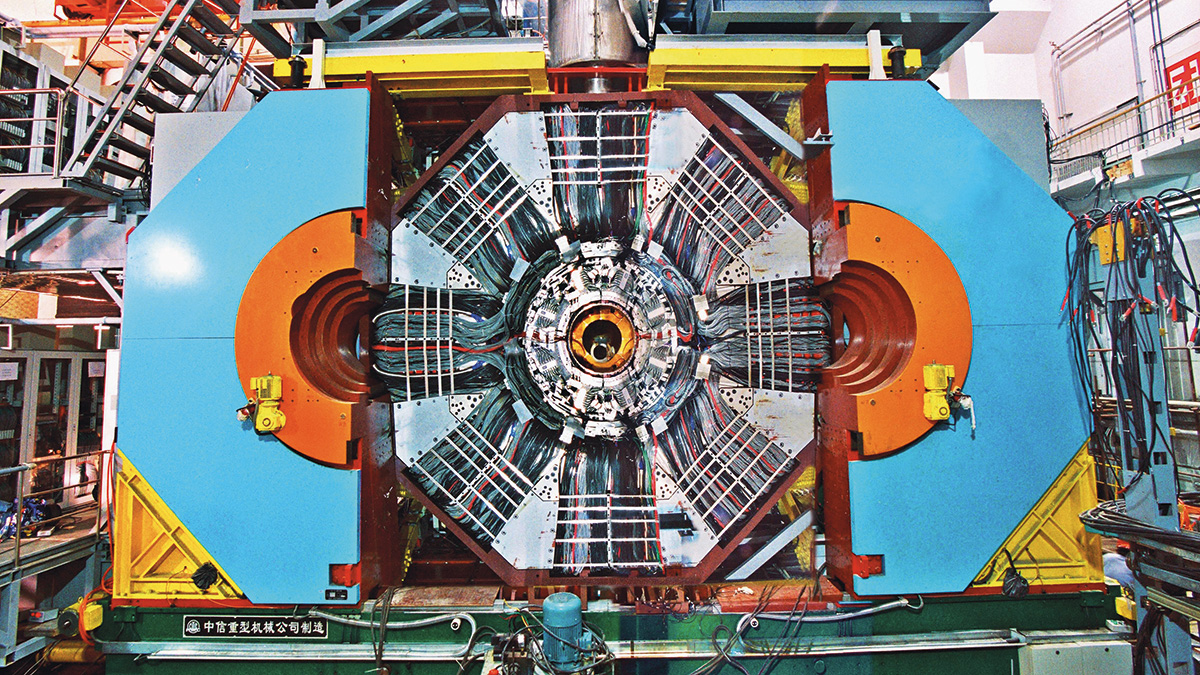
Every hadron catalogued so far consists of quarks bound by gluons. The BESIII collaboration has now reported evidence that the dominant constituent of the X(2370) resonance is a glueball – a long-conjectured hadron made of gluons alone. The analysis spans the state’s mass, quantum numbers, production rate and decay patterns, and rests on 10 billion J/ψ events recorded at the BEPCII collider in Beijing.
Gluons, unlike photons, are charged under the very interaction they mediate. As a consequence, they attract one another, and quantum chromodynamics (QCD) predicts them to bind into composite particles of their own. Calculations on a discretised spacetime lattice place the lightest such states, with scalar, tensor and pseudoscalar quantum numbers, between 1.3 and 3 GeV (see “How strong is the strong interaction?”). There, glueballs are notoriously hard to single out.
“Historically, there were many candidates, such as the f0(1710) and f0(1500), but none of them was ever established,” says Shan Jin of Nanjing University, who presented the results on 5 August at the International Conference on High Energy Physics in Natal, Brazil. “The difficulties mainly come from mixing with nearby mesons, and from other interpretations that are hard to exclude, such as multiquark and hybrid states.”
Pure force
The appeal of the search, for Jin, goes beyond expanding the taxonomy of hadrons. “Glueballs are a unique kind of matter, made of pure force rather than fermions,” he says. “And since gluons do not couple directly to the Higgs boson, an established glueball would directly probe how the strong interaction generates mass.”
The hunt has long centred on radiative J/ψ decays, in which the charm quark and its antiquark annihilate into a photon and two gluons. The pair, flavourless and even under charge conjugation, carries exactly the quantum numbers a glueball needs, and the recoiling photon tags the decay cleanly. A lattice calculation by Ying Chen of Beijing’s Institute of High Energy Physics and colleagues predicts around two in every ten thousand J/ψ decays to yield a pseudoscalar glueball, with mass 2395 ± 14 MeV.
An established glueball would directly probe how the strong interaction generates mass
BESIII first observed the X(2370) resonance in J/ψ → γπ+π–η′ decays in 2011, with a significance above 6.4σ, and later confirmed it in KKη′ final states. Pinning down its quantum numbers proved much more demanding. “It took us 13 years to determine the spin-parity of the X(2370),” says Jin. “Many processes containing the signal suffer from huge backgrounds of neutral pions, which are easily misidentified as photons. We finally found one, J/ψ → γKS0KS0η′, that is free of them.” The 2024 analysis gave JPC = 0–+ at a significance above 9.8σ and a mass of 2395 ± 11 (stat)+26–94 (syst) MeV, in agreement with the lattice prediction. The full J/ψ sample was essential. “With one billion events, the significance naively scales down by a factor of three, below 5σ,” notes Jin. “These studies would have been impossible.”
Over the past two years, three further decay modes, to KS0KS0π0, π0π0η and a0(980)π0, have been observed, each with a significance above 9σ. A combination across the new channels gives a mass of 2359+13–14 MeV and a width of 170+44–29 MeV. The measured product branching fractions alone sum to nearly 10–3, larger than expected for an unmixed glueball. In May, Chen and colleagues proposed that a small admixture of pseudoscalar charmonium could account for the enhanced production rate.
Suppressed decays
No single X(2370) decay mode is expected to dominate. The collaboration estimates that each S-wave quasi-two-body mode accounts for about one to ten percent of the total width, around 170 MeV. “These narrow partial widths are consistent with the glueball expectation, since its decays are suppressed by the Okubo–Zweig–Iizuka (OZI) rule,” explains Jin. “All other kinds of hadrons have quark–antiquark content, so their decays are OZI-allowed, with typical partial widths of the order of 100 MeV, much larger than what we observed.” The ω and φ mesons couple to light quark–antiquark pairs, so a state containing such pairs can decay readily to γω and γφ. The X(2370) → γω and γφ decays turned out to be strongly suppressed, Jin adds, showing that any light quark–antiquark content in the state must be very small.
Another indication comes from flavour. Gluons couple to all quark flavours equally, so a glueball must be a flavour singlet, and a pseudoscalar flavour singlet is expected not to decay to K*(892)K due to the conservation of generalised G-parity – a symmetry that combines charge conjugation with a flavour rotation. An η–η′ pseudoscalar excitation in this mass range would instead do so copiously, with a predicted partial width of about 15–200 MeV. BESIII searched for the mode in J/ψ → γKS0KS0π0 decays and found nothing, implying a partial width below about 2 MeV. According to the collaboration, the X(2370) is thus the first flavour-singlet light hadron observed above 1 GeV. “We do need the 0–+ glueball to have a natural and complete explanation of all the X(2370) properties, while all other interpretations can hardly explain all of them simultaneously,” says Jin.
The next step would be to determine the mixing angle
A note of caution comes from the theory side. “The only available first-principles prediction for the spectrum of glueballs in the continuum limit completely neglects the effect of quarks,” says Davide Vadacchino, a theorist at the University of Plymouth. While the spectrum is under numerical control in this approximation, known as quenching, full QCD is still far off. “The glueball in nature is not an asymptotic state, and it also mixes with other flavour singlets,” he explains. “Its decay rate and mixing angle are in principle very interesting quantities, but obtaining them on the lattice is challenging.” Calculations with dynamical quarks remain exploratory, limited by poor signal-to-noise ratios and still awaiting a continuum limit, so the agreement with the quenched mass should be read with care. “The case made at BESIII seems to be strong,” concludes Vadacchino nonetheless. “The next step would be to determine the mixing angle between the glue component of the X(2370) and its matter component,” he adds.
Other interpretations have been proposed. On 1 September, Di Ben, Li-Ke Yang and Bing-Song Zou of Tsinghua University and the Chinese Academy of Sciences argued that a state dominated by a ΣΣ molecular component can account for the observed properties. At BESIII, further decay modes of the X(2370) remain to be studied, and the search will extend to the scalar and tensor glueballs.
Further reading
BESIII Collab. 2026 arXiv:2607.20366.
BESIII Collab. 2026 arXiv:2605.26495.
Y Chen et al. 2026 arXiv:2605.01757.
BESIII Collab. 2024 Phys. Rev. Lett. 132 181901.
Ben D et al. 2026 arXiv:2609.01342.