A report from the ALICE experiment.
When lead nuclei collide at the LHC, they create tiny droplets of quark–gluon plasma, an extremely hot and dense state of matter in which quarks and gluons are no longer confined within protons and neutrons. Although these droplets exist for only a tiny fraction of a second, they expand collectively before cooling into the particles detected by the ALICE experiment. One of the clearest signatures of this collective motion is the elliptic flow, which quantifies how particles preferentially emerge along certain directions in the plane transverse to the collision axis.
ALICE has now measured, for the first time, the elliptic flow of the hypertriton (3ΛH) in lead–lead collisions at √sNN = 5.36 TeV, and compared the results with those of anti-3He, a more compact nucleus of similar mass (about 3 GeV). A bound state of a proton, a neutron and a Λ hyperon, the hypertriton is among the most weakly bound nuclei known. As a result, it is significantly larger than ordinary nuclei – while the radius of 3He is about 1.96 fm, the distance between the deuteron core and the Λ hyperon in the hypertriton is of the order of 10 fm. Measurements of the hypertriton flow thus provide a unique opportunity to test whether such a large and loosely bound nucleus follows the collective motion of the medium in the same way as more compact ones.
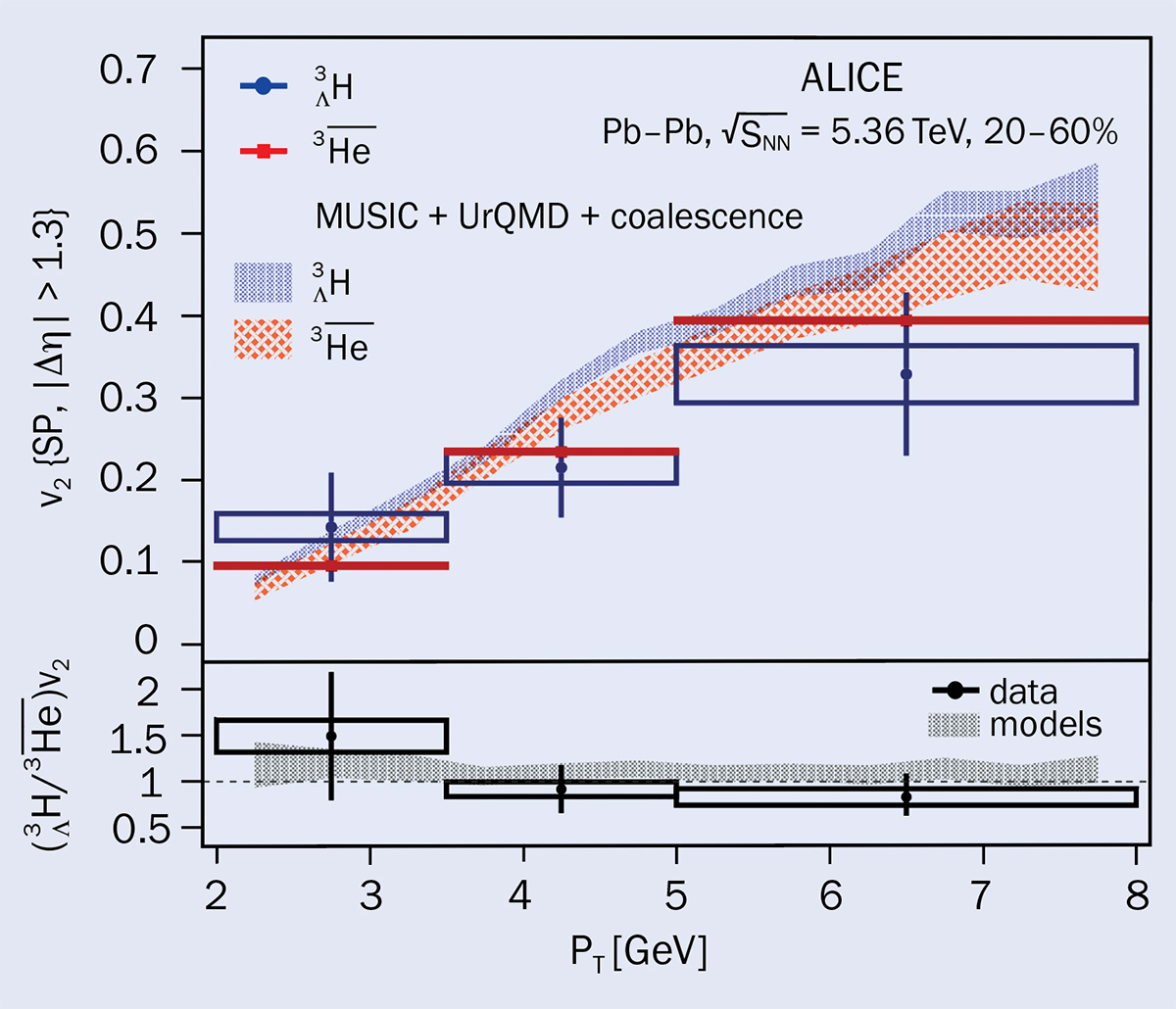
The analysis is based on approximately five billion lead–lead collisions recorded in 2023. 3He candidates are identified by measuring their specific energy loss in the ALICE Time-Projection Chamber, complemented by information from the Inner Tracking System. Hypertriton candidates are reconstructed through their decay into 3He and a charged pion. To distinguish the tiny signal from the much more abundant particles produced at the collision vertex, the analysis identifies a secondary vertex, displaced from the point of collision, where the hypertriton decay happened. Despite their very different sizes and binding energies, the measured elliptic flow of the hypertriton is found to be consistent with that of the 3He (see figure 1).
The 3He measurement reaches unprecedented precision and shows an increase in elliptic flow with transverse momentum, exceeding 0.5 at intermediate and high transverse momenta in the 40–60% centrality interval. Such large values suggest that larger azimuthal modulations contribute to the full angular pattern of 3He production. This behaviour arises naturally in coalescence models, in which light nuclei are formed near kinetic freeze-out by the coalescence of already formed nucleons. In this picture, their collective motion reflects the combined motion of their constituents. The combination of several flowing nucleons can then reshape the nucleus’s final azimuthal distribution, producing the large observed modulation.
Theoretical models reproduce the 3He flow only when a coalescence stage is included, providing strong evidence that light nuclei are not simply born as complete objects at hadronisation, but are assembled from nucleons at a later stage of the collision. Together, the new measurements provide a coherent picture of how composite objects emerge from the hot and dense medium created in high-energy nuclear collisions. Light nuclei appear to carry the collective motion of their constituents, and their elliptic flow is largely governed by the dynamics of the expanding medium. Even for the loosely bound hypertriton, the acquired flow remains insensitive to the large spatial size of the final nucleus. These results establish light nuclei as powerful probes of how and when composite matter forms in heavy-ion collisions.
Further reading
ALICE Collab 2026 arXiv:2603.19398.