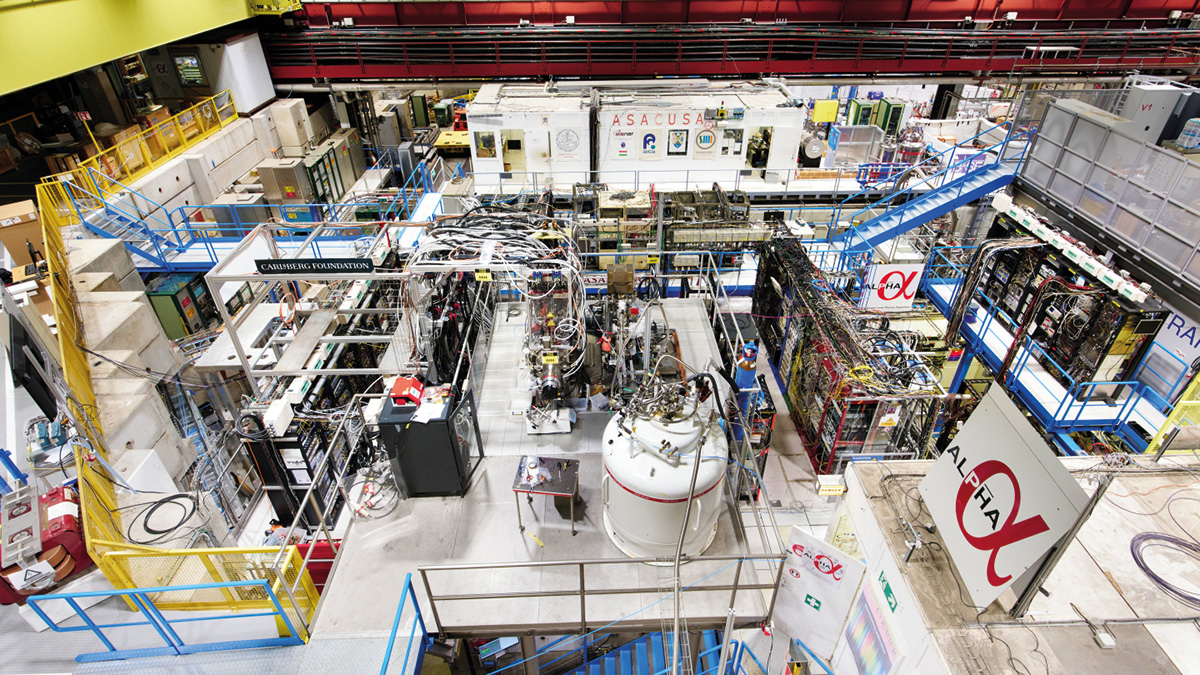
Hydrogen’s ground state is split into two closely spaced energy levels, the tiny gap set by the magnetic tug between its proton and electron. Antihydrogen should split by exactly the same amount. The ALPHA experiment at CERN’s Antimatter Factory has now found that it does, a hundred times more precisely than before. The new result, with an uncertainty of four parts per million, delivers one of the most stringent comparisons between matter and antimatter, and a potential probe of the antiproton’s internal structure.
ALPHA is designed to measure the spectrum of antihydrogen, compare it with hydrogen, and test the limits of CPT symmetry. This principle holds that physics is unchanged when charge, parity and time are reversed together. Matter and antimatter must then have the same masses and spectra – hydrogen and antihydrogen included. “The current measurement represents the culmination of many years of effort,” says Jeffrey Hangst, spokesperson of the ALPHA Collaboration. “We have been pursuing the precise determination of the hyperfine splitting of antihydrogen since we demonstrated how to trap antimatter atoms in 2010.”
Early evidence
Precision measurements of atomic hyperfine structures in the late 1940s provided early evidence for the electron’s anomalous magnetic moment, and, together with the discovery of the Lamb shift, contributed to the development of quantum electrodynamics. Today, the ground-state hyperfine splitting of hydrogen is known to better than one part in a trillion.
Measuring antihydrogen, however, is much more challenging. To do it, the ALPHA collaboration uses microwaves to drive spin-flip transitions in trapped antihydrogen atoms. Within the magnetic field of the trap, the ground-state hyperfine structure resolves into four sublevels, separated in energy by the Zeeman effect. Antihydrogen atoms in the two high-field-seeking states are ejected from the trap and annihilate, while those in the two low-field-seeking ones stay confined. Researchers determine the two transition frequencies by scanning the microwave frequency and observing when trapped atoms flip, leave the trap and annihilate. The splitting then follows from the difference between the two, through the Breit–Rabi formula.
We have made strong progress in the control, stabilisation and characterisation of the magnetic fields in the antihydrogen trap
The first demonstration of this approach came in 2012, and in 2017 the collaboration made the first quantitative measurement of the ground-state hyperfine splitting with a precision of 400 parts per million, in agreement with hydrogen. The precision was limited by the amount of antihydrogen available. “We have made strong progress in the control, stabilisation and characterisation of the magnetic fields in the antihydrogen trap,” explains Hangst. “Our new accumulation technique has also been a real game changer.”
The technique uses laser-cooled beryllium ions to cool positrons before mixing them with antiprotons, raising the trapping rate eightfold. The data behind the 2017 result came from 22 runs of 11 to 14 trapped atoms. The new measurement comprised instead 16 runs, eight at each of two magnetic-field settings, each accumulating roughly 1500 antihydrogen atoms. This improved the precision on the ground-state hyperfine splitting by two orders of magnitude, finding it consistent with the hydrogen value.
ALPHA now plans to study the nuclear magnetic resonance transition between the two trapped levels. This measurement is far less prone to systematics from the magnetic trap, and is expected to improve on the present result by a further two orders of magnitude. In the same Antimatter Factory, the ASACUSA collaboration is developing a complementary approach to measure the hyperfine splitting with a beam of antihydrogen in a field-free region.
Further reading
ALPHA Collab. 2017 Nature 548 66.
ALPHA Collab. 2025 Nat. Commun. 16 10106.
ALPHA Collab. 2026 Nature 653 1022.