How can Europe turn its world-leading capabilities in Big Science into industrial and societal impact? The conclusion of the Research and Technology Infrastructures (RTIs) Summit 2025 was clear: Europe has the skills, partners and ambition, but progress is slowed by fragmentation and lack of consistent funding.
Held in Copenhagen on 22–23 October 2025, and hosted under the Danish EU presidency, the RTI Summit brought together leaders from across Europe to shape the future of research and technology infrastructures and to discuss how to implement the new European strategy in this field, launched by the European Commission at the event.
A dedicated session on accelerators and superconducting magnets examined today’s best practices and the steps needed to build a reliable route from lab to market. Several European strengths are already visible. Pierre Vedrine (CEA Saclay) showed how open technology infrastructures, such as Synergium, accelerate innovation from materials and components to full systems, including superconducting MRI magnets. Clean rooms, assembly platforms and large-scale testing shorten development cycles and enable close collaboration between scientists, industry, and small and medium-sized enterprises (SMEs). Martina Bauer (GSI/FAIR) presented the Hi-Acts platform, which offers companies a single-entry point into Helmholtz competencies to find contacts, access beamtime and services, and obtain guidance on cooperation.
The I.FAST EU-funded project coordinated by CERN, presented by Maurizio Vretenar, provided another example of co-innovation: involving SMEs in R&D from the outset supports earlier adoption of industrial standards, faster prototype improvement and lower costs. I.FAST brings together 49 partners, including 17 companies as co-innovation partners to develop technologies common to many accelerator platforms, from high-efficiency klystrons and thin-film superconducting RF cavities to new beam-window materials and energy-efficiency strategies. Industry presentations confirmed the long-term payoff of Big Science engagement: Julio Lucas (Elytt Energy) showed how experience from ITER tooling translated to CERN magnet systems and FAIR dipoles, while Torben Ekvall (Mark & Wedell) described how one-off contracts opened doors to the private fusion market.
Despite this progress, familiar obstacles persist. Access rules, intellectual property (IP) practices and internal priorities still vary by country and facility. Funding and support mechanisms exist but are difficult to navigate across borders. Funding cycles are often too short for hardware-heavy, low-TRL (technology readiness level) development – four-year projects rarely suffice to reach robust prototypes and market adoption, keeping the so-called “valley of death” wide. At the same time, administrative procedures overwhelm smaller companies without dedicated grant management. Talent retention is another pressure point: SMEs struggle to match big-company salaries and maintain niche competencies during long project gaps.
The Big Science market also presents a challenging risk profile for SMEs. Long projects offer few invoicing milestones against unavoidable upfront spending on engineering, tooling, quality systems and certification. Specialised skills must be maintained through periods of low order volume, and key experts are hard to replace in tight labour markets. Markets are lumpy and project-based, with long gaps between tenders and highly customised solutions that do not always translate to other buyers. Cross-border collaboration adds further complexity. Strategically, firms often enter early-stage R&D without a clear view of the post-project market, and risk over-dependence on a single facility.
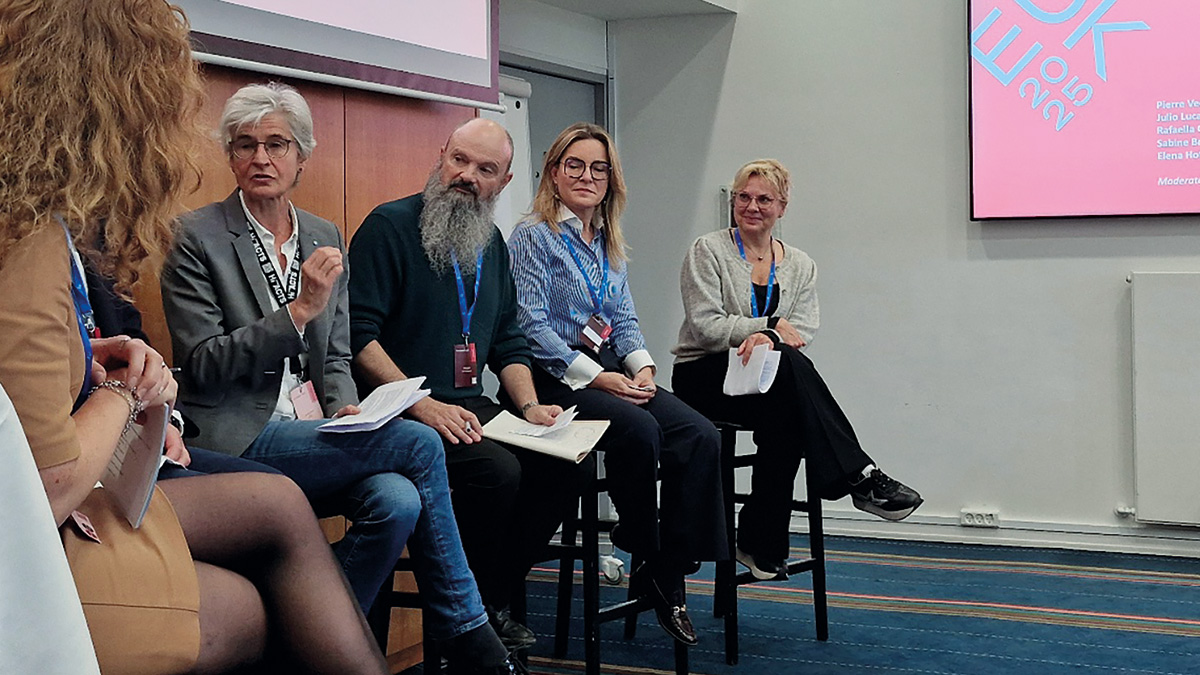
A panel discussion with Pierre Vedrine (CEA), Julio Lucas (Elytt Energy), Raffaella Geometrante (KYMA Undulators and co-chair of the Accelerator Science and Technology Industry Permanent Forum), Sabine Brock (Hi-Acts) and Elena Hoffert (French Ministry of Higher Education and Research) converged on a set of practical remedies.
First, early and structured co-innovation should become the norm. When SMEs participate from low-TRL levels, roles and milestones can be defined up front, risk shared more evenly, and manufacturability feedback integrated before costs escalate.
Second, Europe would benefit from a more coherent access and IP framework. Building on models such as Hi-Acts, Europe could connect companies to testbeds, services and expert brokers without forcing them to relearn procedures in each country. Harmonised IP principles would help: open, royalty-free academic research, clear commercialisation pathways for industry, and standard terms agreed upfront rather than under time pressure.
Longer, steadier funding is equally important, as hardware-centric deep-tech needs time. Extending funding horizons beyond four years would match development realities, while dedicated technology-transfer funds – combining public and private capital – could bridge feasibility, prototyping and first deployments. Targeted instruments such as vouchers or match funding can reduce the barrier to SME participation in pilot projects, test campaigns and certification.
Markets matter
Market signals matter too: if facilities publish procurement roadmaps and use framework agreements, SMEs can plan capacity and recover innovation costs by selling validated solutions to multiple sites. Standardised specifications and qualification across facilities would increase portability and reduce repeated rework.
People remain the backbone of deep-tech translation. Mobility programmes and joint appointments between RTIs, universities and SMEs can spread know-how and create shared cultures. Embedding training and student pipelines within projects turns RTIs into talent multipliers. Temporary support to retain key teams between projects can prevent hard-won competencies from dissipating during inevitable times of low market demand.
Administrative simplification and lasting coordination would further lower barriers. SME-friendly procedures, template agreements and faster feedback make participation less daunting. Permanent, lightly funded structures can maintain continuity and provide a platform for roadmapping and collaboration. Securing the industry perspective in long-term strategies is essential, with the AIPF Forum being one such initiative.
In the end, the session’s messages were well aligned. Europe has the infrastructure, excellence and entrepreneurial SMEs to lead globally in Big Science technologies. By turning its diversity into a strength, through coordinated standards, simpler access to facilities, more continuous funding and earlier industry engagement, it can move technology transfer from a by-product to a central objective. This will allow SMEs to recover development costs and invest in people and in durable collaboration structures that keep the know-how alive. Europe could then ultimately accelerate the translation of Big Science into societal and industrial impact.