A report from the LHCb experiment.
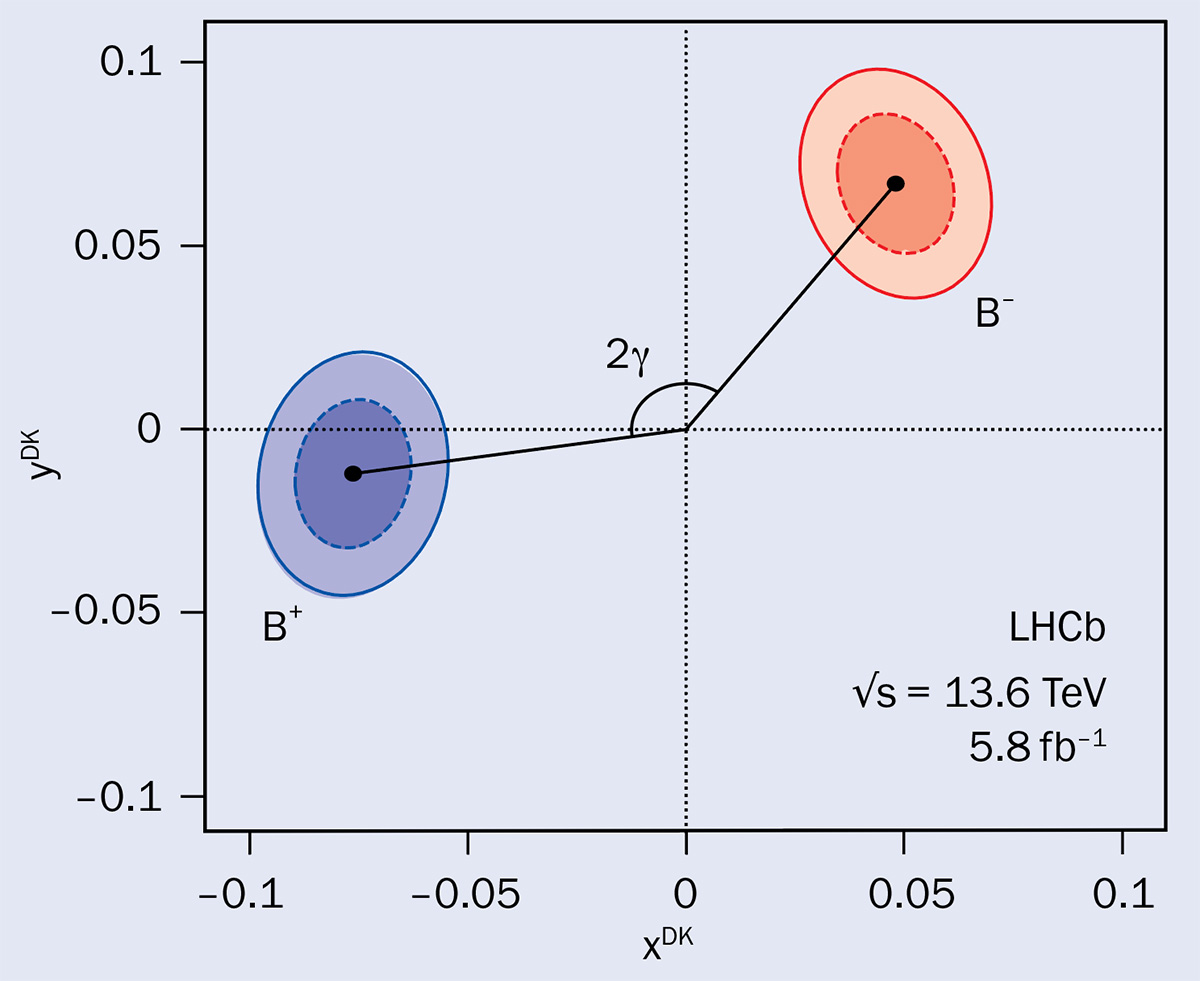
The LHCb collaboration has announced its first Run 3 measurement of the CKM angle γ, a key parameter describing CP violation in the quark sector. The measurement, consistent with previous results, yields γ = (68.1 ± 6.7)°, and will provide an important input to the world average.
The matter–antimatter asymmetry in the universe remains one of the central puzzles in physics, and violation of the combined charge–parity (CP) symmetry is a prerequisite for it. Within the Standard Model (SM), the only established source of CP violation is the complex phase in the Cabibbo–Kobayashi–Maskawa (CKM) matrix, which governs the weak transitions between quarks of different flavour. Precise experimental tests of the CKM framework thus play a central role in understanding CP violation and weak interactions.
Among the CKM parameters, the angle γ is central to testing the SM paradigm. Its direct determination through B → DK decays provides a clean theoretical environment and is largely insensitive to physics beyond the SM. Indirect determinations, obtained from global fits to other CKM observables under the assumption of CKM unitarity, currently achieve higher precision, but involve loop-level processes where new physics could enter, and are limited by challenging theoretical uncertainties. A precise direct determination of γ is therefore essential to compare the two approaches and provide a stringent test of the CKM picture.
LHCb is the best-positioned experiment to produce such a determination. Its highly efficient tracking system, excellent vertex resolution and powerful particle-identification capabilities allow it to reconstruct large samples of B → DK decays. As a result, LHCb measurements currently dominate the world average on γ, with a recent combination yielding γ = (62.8 ± 2.6)°. After a major upgrade of the detector from 2019 to 2022, the experiment now records data at five times the previous luminosity and operates with a highly-efficient, fully software-based trigger, significantly increasing its physics reach.
LHCb has now measured the CKM angle γ in the golden channel B± → DK±, with D → K0Sh+h–, using data collected by the upgraded LHCb detector between July and October 2024, corresponding to an integrated luminosity of 5.8 fb–1. The decay B± → Dπ± is included to help control detector-induced effects and reduce the dependence on simulation, leading to a high-precision measurement. About 16,000 B± → DK± and 240,000 B± → Dπ± signal candidates were observed by inspecting their invariant-mass spectra.
Despite using only four months of Run 3 data, corresponding to a lower integrated luminosity than the combined Run 1 and Run 2 dataset, the signal yield is 17% larger. This illustrates the substantial gain in performance from the upgraded detector and reoptimised software trigger system. CP-violating observables are extracted through a simultaneous analysis of data across the decay phase space (see figure 1). A clear signature of direct CP violation is visible as the opening angle between the B+ and B– vectors: the two differ by a relative rotation of 2γ, directly encoding the CP-violating phase. Interpreting these observables in terms of the underlying physics parameters yields γ = (68.1 ± 6.7)°.
Excellent precision has already been achieved with a small fraction of the LHCb Run 3 dataset. The full dataset, projected to increase the sample size by a factor of four, is expected to produce the most precise direct measurement of γ. The planned LHCb Upgrade II, with its much larger dataset and enhanced detector capabilities in the HL-LHC era, will further strengthen tests of the SM through increased sensitivity to CP violation.
Further reading
LHCb Collab. arXiv:2605.03501.