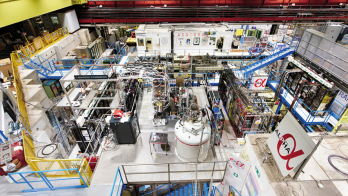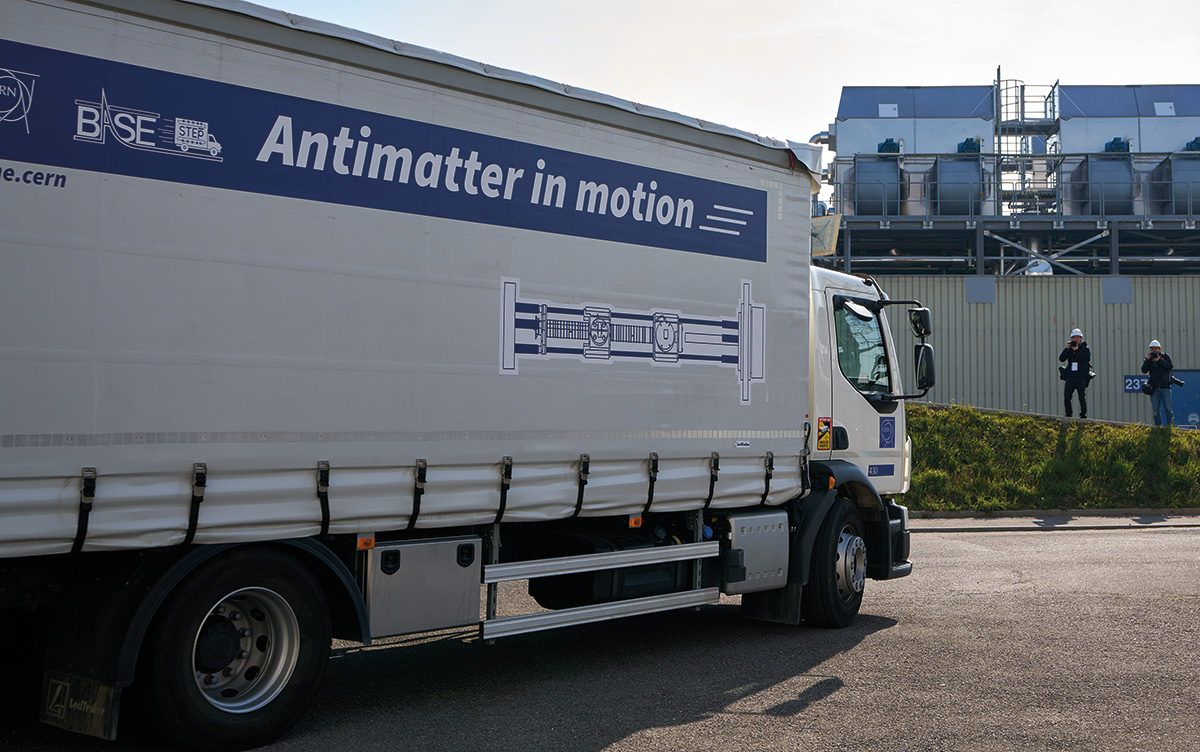
Take a bunch of antiprotons. To stop them annihilating, seal them inside a near-perfect vacuum, suspended in the bore of a superconducting magnet, and superimpose an electric field. Load them onto a truck, and drive off. On 24 March 2026, the BASE collaboration sent 92 antiprotons on a test loop around CERN’s Meyrin site, achieving the first controlled and reversible transport of antimatter. The trip is the culmination of years of work to move antimatter precision measurements out of CERN’s noisy Antimatter Factory, where BASE operates (CERN Courier January/February 2025 p6).
The collaboration’s main target is CPT symmetry. Charge conjugation (C), parity inversion (P) and time reversal (T), taken together, are expected to leave physics invariant. Matter and antimatter must therefore have identical masses and magnetic moments of equal magnitude, with charges of opposite sign. BASE tests CPT directly on protons and antiprotons, confined in electromagnetic traps, by measuring their cyclotron and spin-flip frequencies. “At low energies, measurements usually use only matter systems, on the assumption that antimatter behaves the same way without testing it,” says Christian Smorra, leader of the collaboration’s transportable-trap project BASE–STEP. “Antiprotons are the only stable antibaryons that can be produced and trapped at low energies, enabling precise frequency measurements.”
Noisy fields
So far, BASE results on proton and antiproton charge-to-mass ratios agree to 16 parts per trillion, and their magnetic moments to 1.5 parts per billion. The measured frequencies, however, scale linearly with the strong magnetic field that confines the particles, so any noise in it directly affects the result. The magnetic environment of CERN’s Antimatter Factory now limits how far precision can be pushed.
One natural solution is to move the antiprotons elsewhere. To survive the journey, they must remain in an extreme vacuum, below 10–14 mbar, since contact with a single gas molecule means annihilation. “At those pressures, the only way to test the vacuum is to trap antiprotons and see how long they survive,” explains Smorra. “We had no way to predict how much the pressure would rise in the room-temperature parts of the system during transport, so we had to rely on calculations and build the best possible setup to limit the gas flow into the trap.”
Calculations suggest that the trap could hold antiprotons for more than a year
The result is BASE-STEP: a one-tonne portable electromagnetic trap with up to four hours autonomous operation and a persistent superconducting magnet cooled by liquid helium. At those temperatures, the inner walls of the trap freeze out most gas molecules on contact, preserving the vacuum. Three further measures handle what the walls cannot manage alone. A 500 mm-long differential pumping section thins residual gas in the warm part of the system, a specialised valve – now in its third generation – seals the cold interior, and a dedicated pump captures any stray hydrogen.
The first injection of antiprotons, in December 2025, lasted three days. A subsequent run kept them trapped for more than a month, with cumulative experimental lifetimes now reaching two and a half. “Calculations suggest the trap could hold antiprotons for more than a year,” says Smorra. “The limit is set by gas slowly accumulating on the cold trap surfaces. Once a single layer has built up, they can no longer trap new molecules, and the vacuum starts to deteriorate.”
The 24 March test demonstrated that BASE-STEP could survive vibration and acceleration without losing its load. The team has now requested a low-magnetic-noise space at CERN to establish methods for transferring antiprotons between the transportable trap and a receiver experiment. Further afield, BASE–HHU at Heinrich Heine University Düsseldorf is being built to receive antiprotons from BASE-STEP and perform precision measurements. “We expect to need only one or two trips per measurement,” says Smorra. The Düsseldorf transport will take around 10 hours, longer than the trap can run on its own. A generator on the truck will power a cryocooler to keep the magnet superconducting throughout.
Beyond CPT tests, the approach may prove useful to other precision searches. “We are also studying exotic interactions of antiprotons,” comments Smorra, “such as antiproton–axion coupling or collision rates of millicharged particles with trapped antiprotons.”