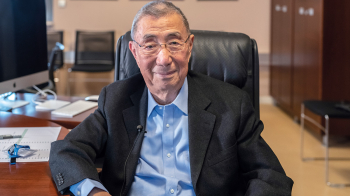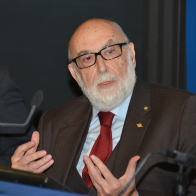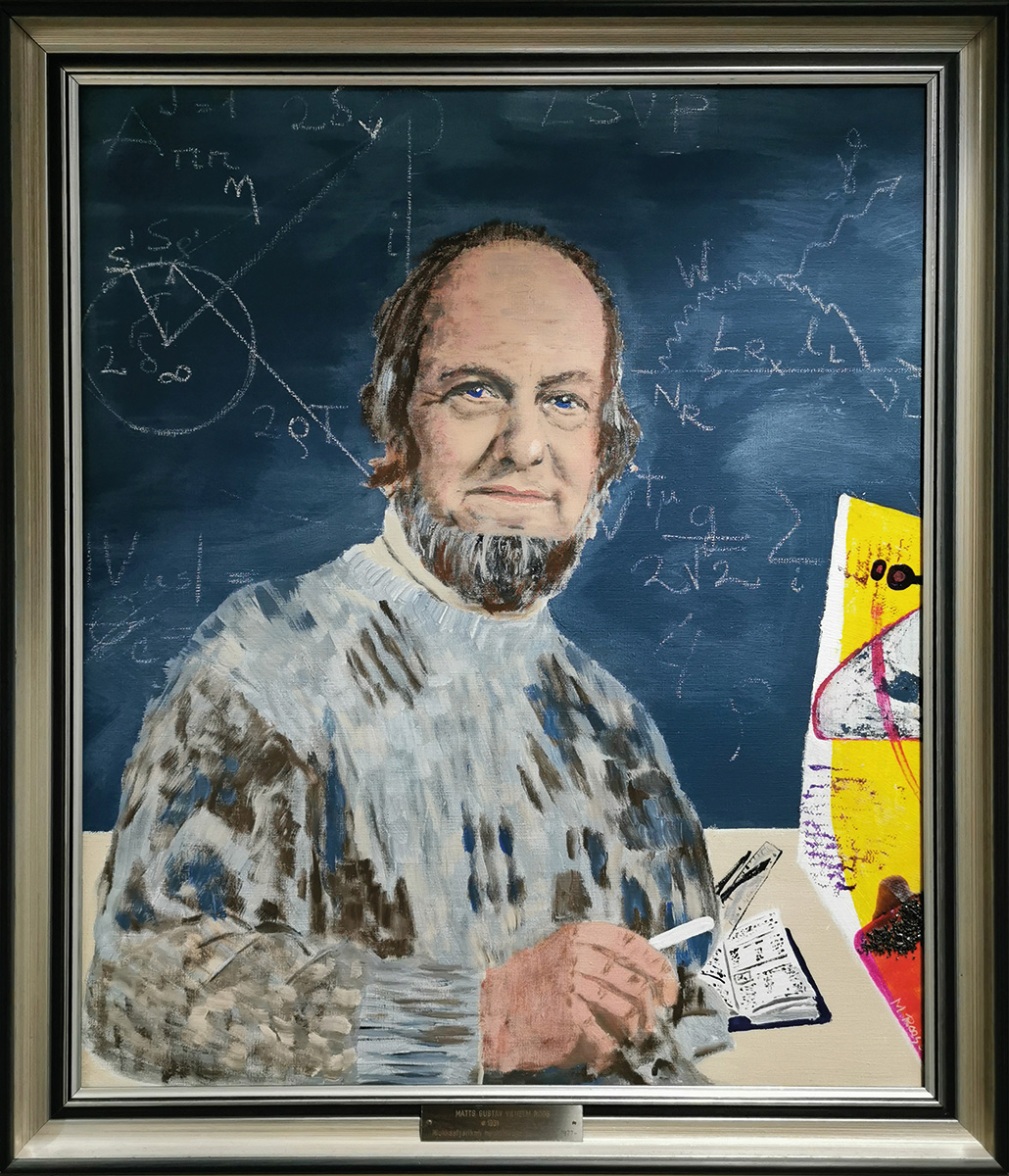
Matts Roos, who promoted the international standardisation of high-energy-physics data and developed the popular statistical minimisation system, passed away on 25 November 2025 in his hometown of Helsinki at the age of 94.
Roos was born on 28 October 1931. He completed an MSc degree in technical physics at the Helsinki University of Technology in 1956 and began his career in Stockholm at AB Atomenergi, where he investigated materials for radiation safety. However, he had basic science in his genes, or at least on his mind. Encouraged by his uncle, Ragnar Granit, who in 1967 was awarded the Nobel Prize in Physiology or Medicine, Roos became a research assistant in theoretical physics at the University of Stockholm, from where, a few years later, he continued to the Nordic Institute for Theoretical Physics and the Niels Bohr Institute in Copenhagen. In 1967, he defended his doctoral thesis on CP non-invariance in neutral-kaon decays.
Together with Arthur H Rosenfeld from Berkeley, Roos laid the foundations of the Particle Data Group (PDG). Rosenfeld published the first tables of particle data in 1957 and in 1963 Roos published his own particle tables. In 1964 these two tables were merged into what is now known as the Review of Particle Physics. Sixty years later, this highly cited opus has swollen to 1400 pages.
A particularly significant phase in Roos’ career were the five years he spent at CERN in Geneva, although Finland was not yet a member of CERN in 1965. Victor Weisskopf, the Director-General of CERN, invited Roos, on the basis of his work with the PDG, to apply for a temporary position in the Theory Division, then lead by Léon Van Hove. Motivated by the work on the validation of properties of by then discovered elementary particles, CERN then invited Roos to lecture on statistical methods. This course eventually crystallised into Statistical Methods in Experimental Physics, published in 1971 in collaboration with Fred James, Daniel Drijard, Bernard Sadoulet and William Eadie.
Roos’ international reputation is also based on another CERN-period achievement that greatly benefited the scientific community: the MINUIT software developed together with James. This is a versatile statistical tool that has been used in particle-physics research throughout the decades, with reference to the original publication still increasing today.
The years abroad brought the sociable and multilingual Roos a wide circle of friends and acquaintances among researchers and made him cosmopolitan. Roos returned to Finland in 1971 after the University of Helsinki appointed him as an associate professor in the field of elementary particle physics. From 1977 until his retirement, he served as a personal professor of particle physics. Later, Roos turned to cosmology in addition to elementary particles. He devoted himself to the field by writing a textbook, Introduction to Cosmology, which went through four editions between 1994 and 2015. Roos also served as a member of the International Neutrino Commission for decades. In 1996 he organised the 17th International Conference on Neutrino Physics and Astrophysics in Helsinki.
In his spare time, Roos began to pursue visual arts in the 1980s, developing over the years from an enthusiastic amateur to a professional painter. He stated that art provides a counterbalance to research work, because “science progresses logically and art illogically”. His interest in art must have been rooted in the family, as his father and brother were well-known photographers and filmmakers, and his sister was an architect.
Roos took an active part in the debates in society, supported colleagues behind the iron curtain with forbidden scientific litera-ture or Solzhenitsyn, and established a think tank on the civil use of nuclear power. He also helped introduce Transcendental Meditation into Finland, after having experienced it himself during a congress in California in the early 1960s.
After returning to Finland, Matts Roos settled in Helsinki with his Swiss-born wife Jacqueline, whom he met while participating in a choral music society, and with the family’s three children. In the summers, the family enjoyed their cottage in the Sipoo archipelago, where many colleagues also were invited.
We shall keep the memory of the Dear alive.