Si Einstein avait su, by Alain Aspect, Odile Jacob
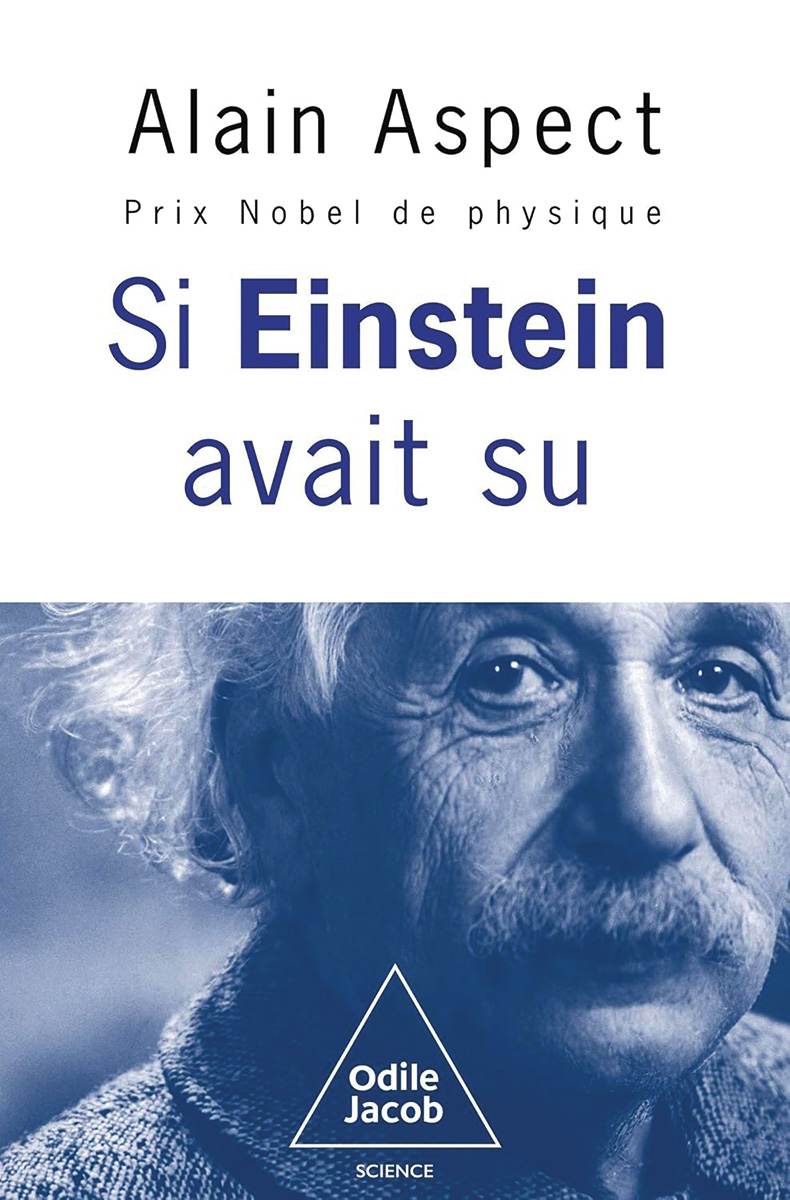
How would Einstein have reacted to Bell’s theorem and the experimental results derived from it? Alain Aspect’s new French-language book Si Einstein avait su (If Einstein had known) can be recommended to anybody interested in the Einstein–Bohr debates about quantum mechanics, how a CERN theorist, John Stewart Bell (1928–1990), weighed in in 1964, and how experimentalists converted Bell’s idea into ingenious physical experiments. Aspect shared the 2022 Nobel Prize in Physics with John F Clauser and Anton Zeilinger for this work.
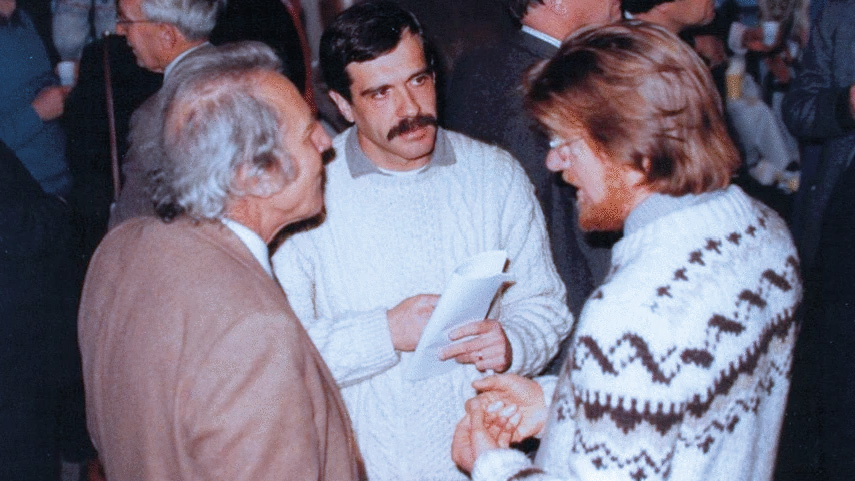
The core part of Aspect’s book covers his own contributions to the experimental test of Bell’s inequality spanning 1975 to 1985. He gives a very personal account of his involvement as an experimental physicist in this matter, starting soon after he visited Bell at CERN in spring 1975 for advice concerning his French Thèse d’État. With anecdotes that give the reader the impression of sitting next to the author and listening to his stories, Aspect recounts how, in 1975, captivated by Bell’s work, he set up experiments in underground rooms at the Institut d’Optique in Orsay to test hidden-variable theories. He explains his experiments in detail with diagrams and figures from his original publications as well as images of the apparatus used. By 1981 and for several years to come, it was Aspect’s experiments that came closest to Bell’s idea on how to test the inequality formulated in 1964. Aspect defended his thesis in 1983 in a packed auditorium with illustrious examiners such as J S Bell, C Cohen-Tannoudji and B d’Espagnat. Not long afterwards, Cohen-Tannoudji invited him to the Collège de France and the Paris ENS to work on the laser cooling and manipulation of atoms – a quite different subject. At that time, Aspect didn’t see any point in closing some of the remaining loopholes in his experiments.
To prepare the terrain for his story, Aspect first tells the history of quantum mechanics from 1900 to 1935. He begins with a discussion of Planck’s blackbody radiation (1900), Einstein’s description of the photoelectric effect (1905) and the heat capacity of solids (1907), the wave–particle duality of light, first Solvay Congress (1911), Bohr’s atomic model (1913) and matter–radiation interaction according to Einstein (1916). He then covers the Einstein–Bohr debates at the Solvay congresses of 1927 and 1930 on the interpretation of the probability aspects of quantum mechanics.
Aspect then turns to the Einstein, Podolsky, Rosen (EPR) paper of 1935, which discusses a gedankenexperiment involving two entangled quantum mechanical particles. Whereas the previous Einstein–Bohr debates ended with convincing arguments by Bohr refuting Einstein’s point of view, Bohr didn’t come up with a clear answer to Einstein’s objection of 1935, namely that he considered quantum mechanics to be incomplete. In 1935 and the following years, for most physicists the Einstein–Bohr debate had been considered uninteresting and purely philosophical. It had practically no influence on the success of the application of quantum mechanics. Between 1935 and 1964, the EPR subject was nearly dormant, apart from David Bohm’s interventions during the 1950s. In 1964 Bell took up the EPR paradox, which had been advanced as an argument that quantum mechanics should be supplemented by additional variables (CERN Courier July/August 2025 p21).
Aspect describes clearly and convincingly how Bell entered the scene and how the inequality with his name triggered experimentalists to get involved: experiments with polarisation-entangled photons and their correlations could decide whether Einstein or Bohr’s view of quantum mechanics was correct. Bell’s discovery transferred the Einstein–Bohr debate from epistemology to the realm of experimental physics. At the end of the 1960s the first experiments based on Bell’s inequality started to take form. Aspect describes how these analysed the polarisation correlation of the entangled photons at a separation of a few metres. He discusses their difficulties and limitations, starting with the experiments launched by Clauser et al.
In the final chapter, covering 1985 to the present, Aspect explains why he decided not to continue his research with entangled photons and to switch subject. His opinion was that the technology at the time wasn’t ripe enough to close some of the remaining loopholes in his experiments – loopholes of a type that Bell considered less important. Aspect was convinced that if quantum mechanics was faulty, one would have seen indications of that in his experiments. It took until 2015 for two of the loopholes left open by Aspect’s experiments (the locality and detection loophole) to be simultaneously closed. Yet no experiment, as ideal as it is, can be said to be totally loophole-free, as Aspect says. The final chapter also covers more philosophical aspects of quantum non-locality and speculations about how Einstein would have reacted to the violation of Bell’s inequalities. In complementary sections, Aspect speaks about the no-cloning theorem, technological applications of quantum optics like quantum cryptography according to Ekert, quantum teleportation and quantum random number generators.
Who will profit from reading this book? First one should say that it is not a quantum-mechanics or quantum-optics textbook. Most of the material is written in such a way that it will be accessible and enjoyable to the educated layperson. For the more curious reader, supplementary sections cover physical aspects in deeper detail, and the book cites more than 80 original references. Aspect’s long experience and honed pedagogical skills are evident throughout. It is an engaging and authoritative introduction to one of the most profound debates in modern physics.