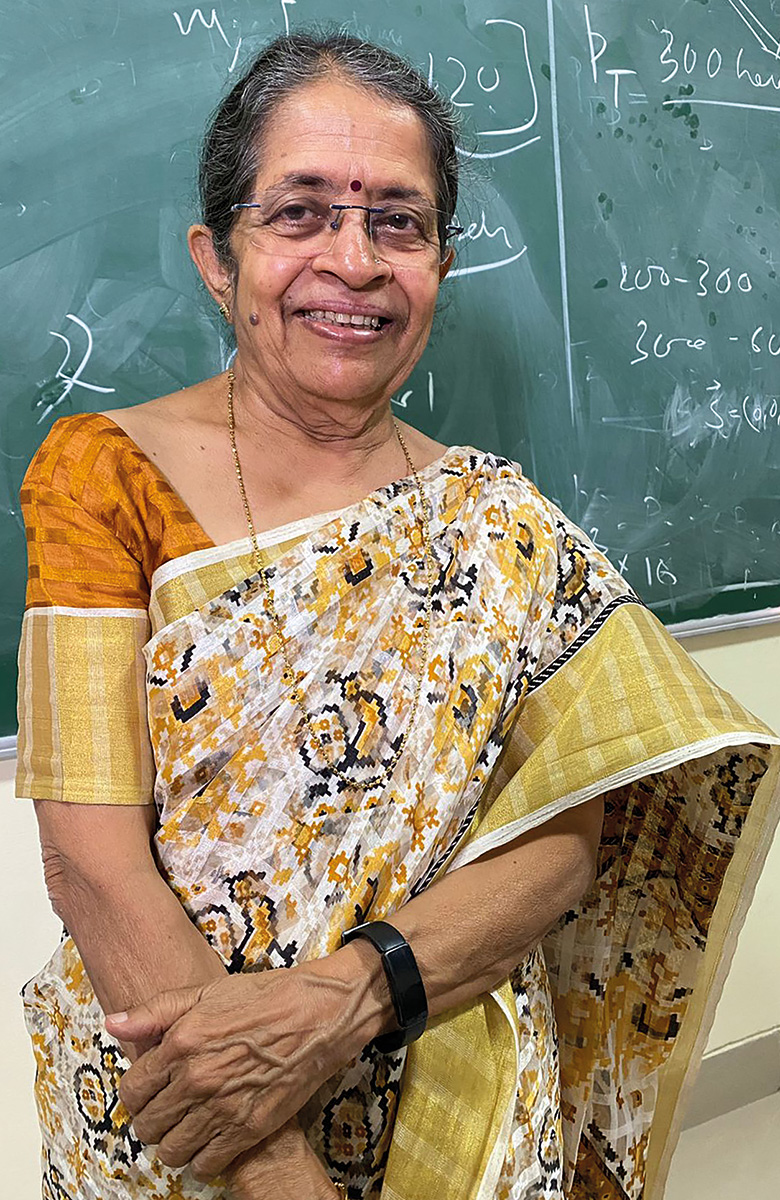
Rohini Madhusudan Godbole, one of India’s most influential particle physicists, passed away in her hometown of Pune on 25 October 2024.
Rohini was born on 12 November 1952 to Madhusudan and Malati Godbole. Theirs was a cultured and highly educated family, and she grew up in an atmosphere of intellectual freedom and progressive ideas. Educated at the best schools and colleges in Pune, she joined the Indian Institute of Technology at Bombay, from which she graduated in 1972. She then moved to Stony Brook, where she completed her PhD in particle physics with Jack Smith in 1979. Returning to India, she worked temporarily at the Tata Institute of Fundamental Research before joining the faculty at the University of Bombay (now Mumbai). There she remained until 1997, when she moved to the Centre for High Energy Physics at the Indian Institute of Science at Bangalore (now Bengaluru). She worked there for the rest of her life, continuing after her formal retirement as an emeritus professor. It was only a few months before the end that she moved back to her hometown, to be with her family in her last days.
Rohini was a prolific researcher. She will probably be best remembered pioneering the development, with Manuel Drees, of photon structure functions for use with photon beams at future colliders, but her contributions spanned vacuum polarisation, Higgs physics, top-quark physics with polarised beams, and beyond the Standard Model physics, especially low-energy supersymmetry. She authored a well-known textbook on the latter subject with Probir Roy and Drees.
Rohini was indefatigable in promoting the cause of women in science
Rohini’s broad understanding and warm character combined to make her the best-known face of elementary particle physics from India. She worked tirelessly to promote high-energy physics inside India, organising schools and workshops, and often represented the country in international forums, such as to monitor India’s participation in the LHC and other large international collaborative experiments. Rohini was a dedicated teacher and mentor to a long series of graduate students and postdocs, and a universal elder sister or aunt for the entire community of younger particle physicists in India.
No description of Rohini can be complete without mentioning her indefatigable efforts to promote the cause of women in science. Having herself faced gender discrimination in her younger days, she was determined to ensure that young women scientists received proper opportunities and recognition. She authored two books highlighting the work of Indian women scientists, thereby setting up role models to inspire the younger generation. Even more than these books, however, her own presence and encouragement left a mark on two generations of particle physicists, in India and abroad.
Rohini’s signal contributions were recognised by many awards and distinctions. The government of India awarded her the coveted Padma Shri in 2019, and the government of France awarded her the Ordre National du Mérite in 2021, mentioning her important role in furthering scientific collaboration between India and France. But her true memorial lies in the unique place she holds in the hearts of thousands of students, collaborators, friends and acquaintances. She was an extraordinary person who carved out a niche all by herself, with her scientific talents, her indefatigable energy, her universal amiability and her indomitable will. Her loss is sorely felt.