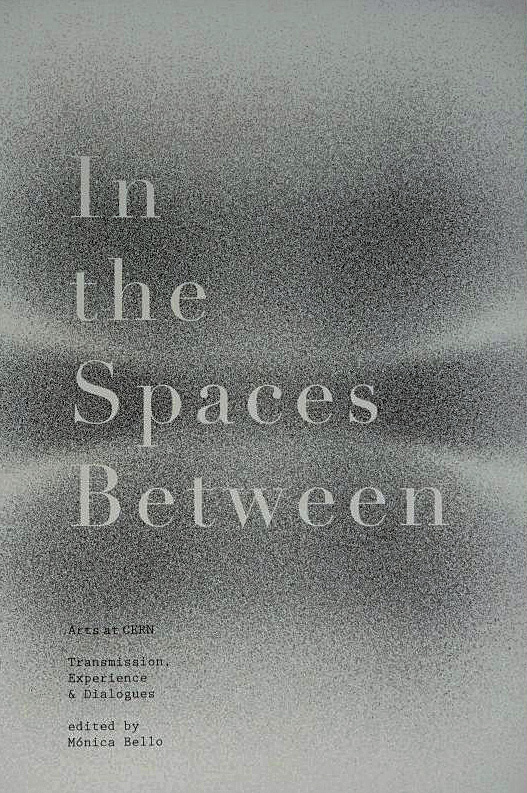
In the Spaces Between: Transmission, Experience & Dialogues, edited by Mónica Bello, dpr-barcelona
What happens when an artist enters a particle-physics laboratory, not to explain its discoveries or visualise its equations, but simply to remain, observe and respond? In the Spaces Between, a sustained reflection on the long-running Arts at CERN programme, argues that what emerges is not illustration or explanation, but a shared space of inquiry – one that works with uncertainty rather than resolving it, echoing the statistical, instrument-mediated nature of contemporary physics.
Both art and particle physics push at the edges of what can be known, imagined and expressed. Through its programmes, Arts at CERN hosts artists for extended residencies at the laboratory, where they meet physicists and engineers, attend seminars, visit experimental sites and engage directly with ongoing research. The artists are not tasked with illustrating experiments or communicating results. Instead, they develop independent works – installations, performances, films, sculptures – shaped by sustained dialogue with the scientific community.
Creating coalitions
Edited by Mónica Bello, former head of Arts at CERN (CERN Courier March/April 2025 p41), the book brings together essays, images and reflective texts by artists, scientists and collaborators involved in the artist residency programme. Rather than presenting a catalogue of finished works, it focuses on the conditions that make exchange possible: how artists encounter scientific infrastructures, and how meaning begins to form in spaces where neither discipline fully sets the rules.
The book is organised around four broad themes: “quantum”, cosmology, experimentation and the unknown. These function less as explanatory frameworks than as loose points of orientation, allowing contributions to remain fragmentary and open-ended. The structure mirrors the reality of interdisciplinary work, which rarely unfolds in clean, linear ways, but instead through moments of partial understanding, misalignment and return.
For readers trained in physics, this approach may feel unexpectedly familiar. Scientific knowledge rarely emerges fully formed; it develops through iteration, uncertainty and interpretation. In a similar spirit, the contributions resist tidy conclusions and treat concepts not as definitions to be settled, but as materials for creative reworking. What matters is less resolution than the act of thinking itself, an openness that mirrors the exploratory character of research. At times this displacement can feel destabilising, yet it is precisely this imaginative expansion that gives the book much of its intellectual force.
This sensibility is vividly captured in Rohini Devasher’s Beyond the Standard Model. Spread across a dark, planetary surface, words such as “uncertainty”, “duality”, “observer”, “wonder” and “serendipity” – form a dense, drifting constellation. Some terms carry clear scientific weight; others belong to the emotional and imaginative registers that accompany research but rarely appear in formal papers. For Devasher, the interest lies precisely in language. By placing these words on the same visual plane, the piece loosens disciplinary hierarchies and allows concepts to float, cluster and collide. As the artist notes, the words are intended to read as a web. Rather than explaining physics, it evokes the conceptual environment in which physics thinking takes place.
Places and perspectives
On another page, language again becomes material in Cecilia Vicuña’s Ceque. The work draws on the ceq’e system of the Inca civilisation: a network of conceptual and ceremonial lines radiating outward from the city of Cusco, that are used to organise ritual practice, social relations and cosmological understanding. Rather than functioning as fixed geometrical paths, ceq’es describe relationships between places, perspectives and moments in time.
The page opens with the line “The ceq’e is not a line, it is an instant, a gaze.” Around it, words tilt, scatter and spiral – “a thought, radiating”, “another meridian”, “seen from above or from below”. Reading becomes a spatial act rather than a linear one. Meaning is not extracted or fixed; it unfolds uneasily alongside the order, diagrammatic structures through which Western science typically organises knowledge. The book offers little explicit explanation of the concept, allowing the work instead to function as an alternative way of organising knowledge: relational, situated and resistant to a single point of view.
Visual thinking also surfaces in drawings from Suzanne Treister’s project The Holographic Universe Theory of Art History (THUTOAH), including Alessandra Gnecchi’s Holographic Universe Principle. The work resembles a hand-drawn cosmology sketched in coloured pencil: strings, branes and horizons coexist with handwritten annotations and looping arrows. The emphasis is not on polished representation, but on the labour of thinking – the scribbles, approximations and half-formed connections that precede formalisation. Theory appears not as a final statement, but as something constantly under construction.
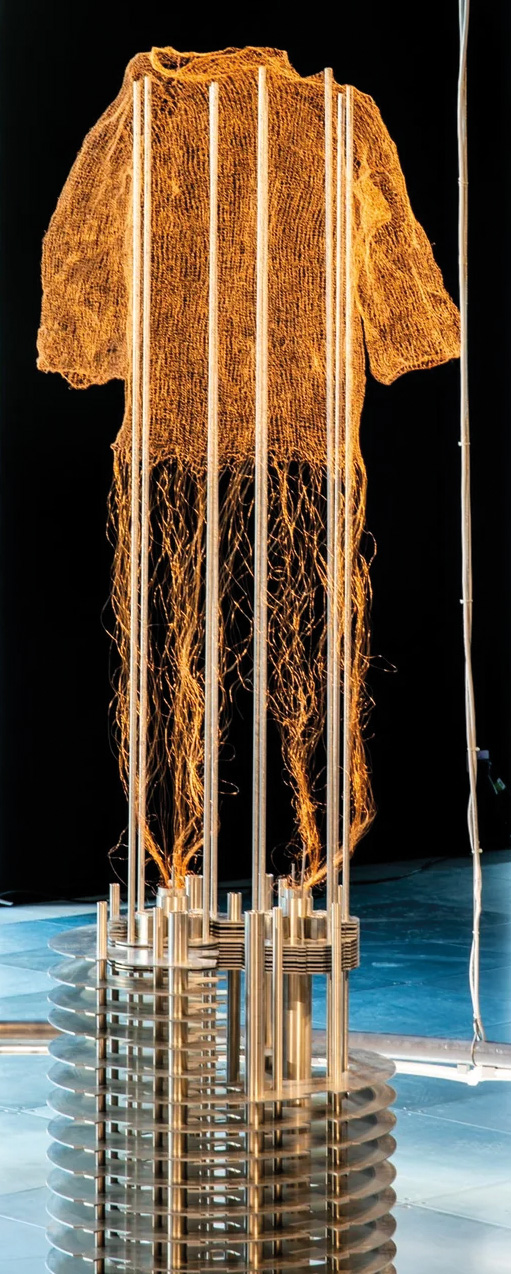
One of the more quietly striking works in the book is Julijonas Urbonas’s When Accelerators Turn into Sweaters: a translucent garment constructed from fine copper-stabilised superconducting fibres (see “Accelerator materiality” image). The title collapses the scale of accelerator infrastructure into a wearable object, shifting attention from machines as abstract systems to the materials from which they are built. As Urbonas puts it, the work aims to “bring a monumental, sealed infrastructure into the scale of the body, not just visually, but physically and imaginatively… a translation from the remote language of high-energy physics into something you can almost inhabit.”
In doing so, it foregrounds the material reality of high-energy physics – copper as thread and cable at once. Though made of copper, the sweater evokes the magnetic levitation of the Meissner effect, a reference to the cryogenic superconductivity of the LHC. As Urbonas observes, “the accelerator needs extreme cold to do its job, while a sweater’s whole purpose is warmth.” By keeping that gap open, the piece operates less as demonstration than as speculation: a domestic object positioned against an environment colder than outer space, inviting viewers to rethink how scientific infrastructure is imagined. Urbonas leaves the reader with a provocation: “What if physicists talked in the knitwork of the world instead?”
For accelerator physicists, this change of scale may register not simply as metaphor, but as a reminder that even the largest facilities depend on materials physically assembled, connected and maintained by hand. By reframing accelerator infrastructure at human scale, the piece foregrounds construction and material composition rather than the monumental image of the machine, aligning with the book’s broader emphasis on process over spectacle.
The contributions make clear that Arts at CERN is not a peripheral outreach activity, but a mature programme of sustained exchange
In the Spaces Between does not romanticise interdisciplinarity as a seamless merging of perspectives or a frictionless dialogue between equals. Several contributors openly acknowledge the asymmetries between artistic and scientific practice within a large research institution, where scientific priorities and infrastructures inevitably set the operating conditions. Rather than glossing over these tensions, the book treats them as productive constraints that actively shape how collaboration unfolds.
Taken together, the contributions make clear that Arts at CERN is a mature programme of sustained exchange. Its longevity has not led to conceptual closure; instead, the dialogue has deepened while remaining exploratory, evolving rather than resolving.
With its emphasis on process rather than outcomes, the book offers a rare window into how artistic inquiry operates inside a laboratory environment. It does not try to merge art and science, nor to reduce one to the language of the other. Instead, it traces the intellectual and imaginative terrain that lies between them, a space defined not by synthesis, but by ongoing negotiation.
Ultimately, In the Spaces Between suggests that experimentation runs deeply through both artistic and scientific practice, not only as a set of methods for testing ideas, but as a shared commitment to iteration, risk and revision. The sustained dialogue documented here does not aim at synthesis or resolution; rather, it creates conditions in which new forms of knowledge can emerge, forms that remain open-ended. The book will be of particular interest to those working at the intersections of art, science and research institutions, and to readers interested in what happens when disciplines meet without being forced into premature coherence.