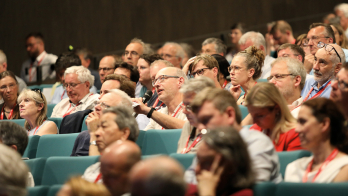
On 7 November 2025, the Austrian Academy of Sciences inaugurated the Marietta Blau Institute for Particle Physics (MBI). The new centre brings together the former Stefan Meyer Institute for Subatomic Physics and the Institute of High Energy Physics (HEPHY), creating Austria’s largest hub for particle-physics research. In total, about 130 researchers with broad expertise across the discipline now work under the MBI umbrella.
Marietta Blau was one of the first women to study physics at the University of Vienna. As recalled by Brigitte Strohmaier (University of Vienna), who summarised Blau’s biography, she became best known for her work at the Institute for Radium Research between 1923 and 1938, where she developed the nuclear-emulsion technique for detecting charged particles with micrometre-scale precision.
Together with Hertha Wambacher, Blau exposed nuclear emulsions to cosmic rays at Victor Hess’s observatory near Innsbruck, producing photographic evidence of the interactions between high-energy particles and matter.
Staying in Scandinavia when Nazi Germany annexed Austria in 1938, Blau could not return to Vienna. She secured a position at the Polytechnic Institute of Mexico City on the recommendation of Albert Einstein, but found herself isolated from colleagues. From 1944 on, she worked in the US before returning to Vienna in 1960, where she supervised the evaluation of photographic plates from CERN.
Her method of nuclear emulsions was further advanced by Cecil Powell in Bristol, who was awarded the Nobel Prize in Physics in 1950 for discoveries regarding mesons made with this method. On this and other occasions, Marietta Blau was also nominated, but never recognised for her groundbreaking research.
Joachim Kopp, chair of the Scientific Advisory Board of HEPHY, introduced the institute’s scientific outlook. He highlighted the breadth of MBI’s programme, which includes major contributions to CERN experiments such as CMS and ALICE at the LHC, and ASACUSA at the AD/ELENA facility, where antimatter is studied using low-energy antiprotons.
Groups at MBI are also involved in the Belle II experiment at KEK, as well as the dark-matter experiments CRESST and COSINUS at the LNGS underground lab. Neutrino physics, gravitational-wave studies at the Einstein Telescope, as well as tests of fundamental symmetries using ultra-cold hydrogen and deuterium beams, are also part of the research programme. The MBI also builds on the long tradition of detector development and construction for future experiments, complemented by a dedicated theory group.