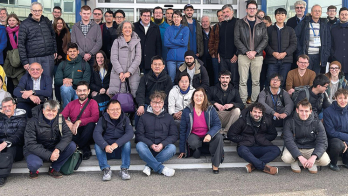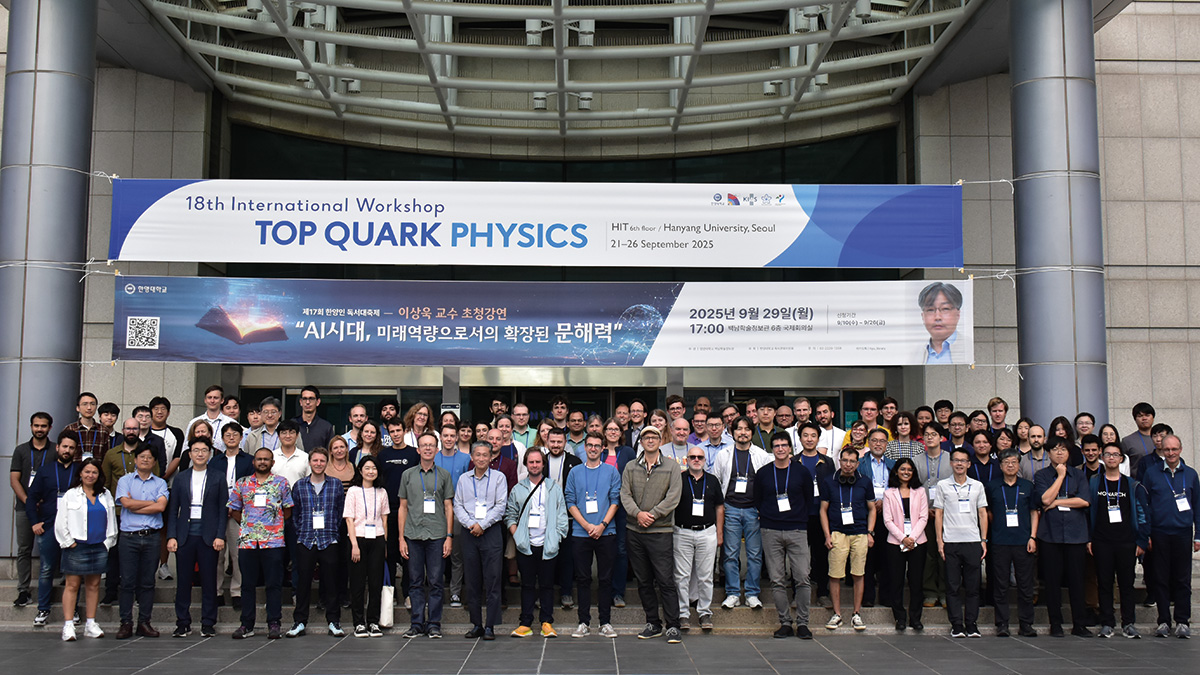
The 18th International Workshop on Top Quark Physics (TOP2025) brought the top-quark community to Seoul, South Korea, from 21 to 26 September 2025. Hosted at Hanyang University, the event offered 135 experimentalists and theorists a chance to exchange results, discuss open questions and explore the future of top-quark physics.
2025 marked the 30th anniversary of the top quark’s discovery by the DØ and CDF experiments at Fermilab. Three decades on, and despite ever-increasing experimental precision, the top quark’s properties remain only partially understood. While its mass is now known at the sub-GeV level and its production cross sections agree well with Standard Model predictions, questions persist about its electroweak couplings, its interactions with the Higgs boson, and the detailed structure of top–antitop production at high energies. Because of its large mass and correspondingly strong coupling to the electroweak sector, many in the community continue to view the top quark as a sensitive probe of physics beyond the Standard Model.
The conference opened with an inspiring keynote address by Juan Antonio Aguilar Saavedra (IFT Madrid), who explored the connections between top-quark physics and quantum science and technology. A notable example is the recent observation of quantum entanglement in top-quark pair production by the ATLAS and CMS experiments, which has opened a promising new line of research linking collider physics with concepts more familiar to quantum information researchers. Entanglement can be measured in the top–antitop system because top quarks decay before hadronisation takes place, allowing direct access to their spin correlations.
Top physics is currently enjoying a golden era. Last year, the CMS collaboration reported an excess near the top–antitop threshold (CERN Courier May/June 2025 p7), later confirmed by ATLAS with a significance of 7.7σ above the background predicted by perturbative quantum chromodynamics (CERN Courier September/October 2025 p9). This excess is consistent with expectations from non-relativistic quantum chromodynamics, an effective theory that describes the dynamics of heavy quark pairs near threshold and with simplified models involving a pseudoscalar “quasi-bound-state”, called toponium.
During a mini-workshop dedicated to toponium, Benjamin Fuks (LPTHE) presented an intriguing scenario in which the excess could be explained by two contributions: one from a top–antitop bound state and another from a beyond-the-Standard-Model signature, although the data are also compatible with Standard-Model-only components.
The next edition of the TOP conference will take place in Antalya, Turkey, from 5 to 9 October 2026.