Every new instrument needs its mysteries, and no discovery of the James Webb Space Telescope (JWST) has been more surprising than the “little red dots” it discovered in the early universe. Four years after their discovery, their nature is still an open question, with new papers purporting to solve the mystery on an almost daily basis.
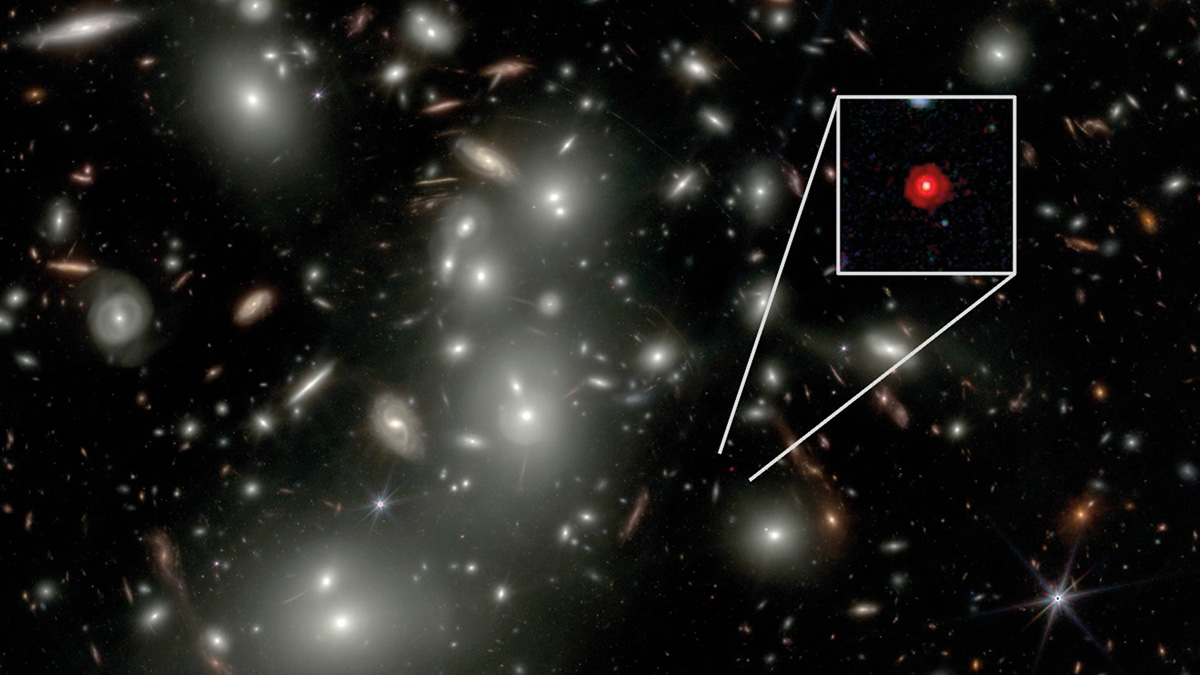
These unexpected objects came into view in JWST’s first data release in 2022 thanks to its sharp images and sensitivity in the near infrared. By summer of 2023, a number of discovery papers had been written about them, identifying three traits in common: they were compact in size, had unusual “V-shaped” spectra and they showed emission from high-velocity hydrogen gas. Due to their compact size and red colour in the rest frame, they were dubbed little red dots. A few appeared in every pointing of the JWST imaging camera NIRCam, accounting for a few percent of all known galaxies in the first billion years of cosmic time. The race was on to determine their nature.
Two options initially appeared possible, but both were extraordinary and required a very precise tuning of parameters to fit the observations: too-dense galaxies or too-massive supermassive black holes. In either case, the objects had to be enshrouded in a cocoon of dust.
Galaxies or black holes?
The first paper assumed they were very massive galaxies, with their stars all assembled less than a billion years after the Big Bang. In favour of the galactic hypothesis were the V-shaped spectra, which are difficult to model without invoking massive stars. The vertex of the V-shape resembles a “Balmer break”, which is produced by the absorption of hydrogen atoms in the n = 2 level. Longward of the break, the optical continuum rises steeply toward the red, which this model attributed to the reddening of these stars by dust, with the UV being produced by starlight that was scattered out of the dust screen. However, the very high masses and early-universe star formation rates required for these models were difficult to reconcile with our understanding of the rate at which galaxies and their dark-matter halos assemble.
The first paper assumed they were very massive galaxies, with their stars all assembled less than a billion years after the Big Bang
The black-hole hypothesis was supported by evidence for very dense gas clouds moving at thousands of kilometres per second in the potential of a massive black hole. In this picture, surrounding dust would preferentially absorb ultraviolet light and re-emit it at longer wavelengths, producing the observed red colour. Though this explanation promised to alleviate the tension arising from the implied galaxy masses, it quickly became clear that these objects were not typical growing black holes. They were not detected in X-rays, nor did they show the characteristic 1000 K dust signature that is ubiquitous in actively accreting black holes. However, the most concerning piece of the black-hole interpretation was the implied black-hole masses. Applying local calibrations to the observed motion of gas in the little red dots implied black-hole masses of ten million to a billion suns, compared with galaxy masses of the same order – a stark contrast with local black holes, which have masses roughly a thousandth of their host galaxies. These overly massive black holes are hard to grow so far in advance of the galaxies, and also overproduce the total amount of black-hole mass created at such an early time.
Explaining their redness
Two major breakthroughs occurred in 2024 that clarified the nature of the little red dots. All the aforementioned models invoked heavy amounts of dust to suppress ultraviolet emission and produce the observed red colours. The conservation of energy implies that all the absorbed radiation should be re-emitted by the dust. However, multiple studies of populations and of luminous individual sources turned up non-detections of dust emission. These stringent limits on the far-infrared energy output were enough to conclusively rule out these entire classes of models, invoking reddening by dust to explain the observed red colours.
At the same time, campaigns to observe the broad population of little red dots discovered a remarkable class of sources with very little ultraviolet emission and extreme Balmer breaks. These breaks could not be produced by anything resembling a stellar population we have observed before, and served as conclusive evidence that normal stars cannot be responsible for producing the optical emission in little red dots; the photoabsorption by hydrogen in the n = 2 energy state must nevertheless be a crucial physical aspect of the little red dots, even if it wasn’t happening in the atmospheres of massive stars.
Plausible scenarios
The challenge is therefore to explain the characteristic red colour of the little red dots without dust obscuration. Any successful model would also need a substantial reservoir of hydrogen around to cause the hydrogen absorption that looked like starlight, but wasn’t. One plausible scenario that could satisfy these requirements is very dense gas arranged quasi-spherically around the black hole. In this scenario, the black holes powering the little red dots could be significantly less massive than we had originally thought, when we had assumed that dust was obscuring most of the light from the growing black hole.
The task is to explain the characteristic red colour of the little red dots without dust obscuration
In this new picture, the little red dots are powered by black holes that are accreting at much higher rates than are typically seen at later times. A higher accretion rate implies greater luminosity for a given black-hole mass, and therefore we infer much lower black-hole masses, perhaps closer to a million suns, and much more aligned with the measured galaxy masses. As a side benefit, lower black-hole masses are much more natural for objects that are so prevalent, because the number of low-mass dark-matter halos and low-mass galaxies is much higher than the number of high-mass systems.
Astronomers are still arguing about how this dense gas is configured and accretes onto the black hole, and everyone has their favourite model. We do not know if the geometry of the system is completely spherical, or if we are seeing a mixed-phase medium where the viewing angle is an important parameter. These details matter, because if we can pin down the characteristic size and density of these gas envelopes, we may be able to infer more robust black-hole masses for the population. There has been some recent speculation that the little red dots may be marking the end stages of black-hole seed growth, in which case they could be a critical missing link in our understanding of the formation of the first black holes. However, without more concrete constraints on black-hole mass, we cannot know for sure. At the same time, we need a much better theoretical understanding of what makes little red dots so distinct from the more typical growing black holes we have studied for decades, and why that mode of growth becomes so much less common as the universe ages.
One thing we do know for sure: the more we learn about the little red dots, the more complex and unexpected they become. We are excited to see what new wrinkles arise as we enter our fifth year of JWST operations.