A report from the ALICE experiment.
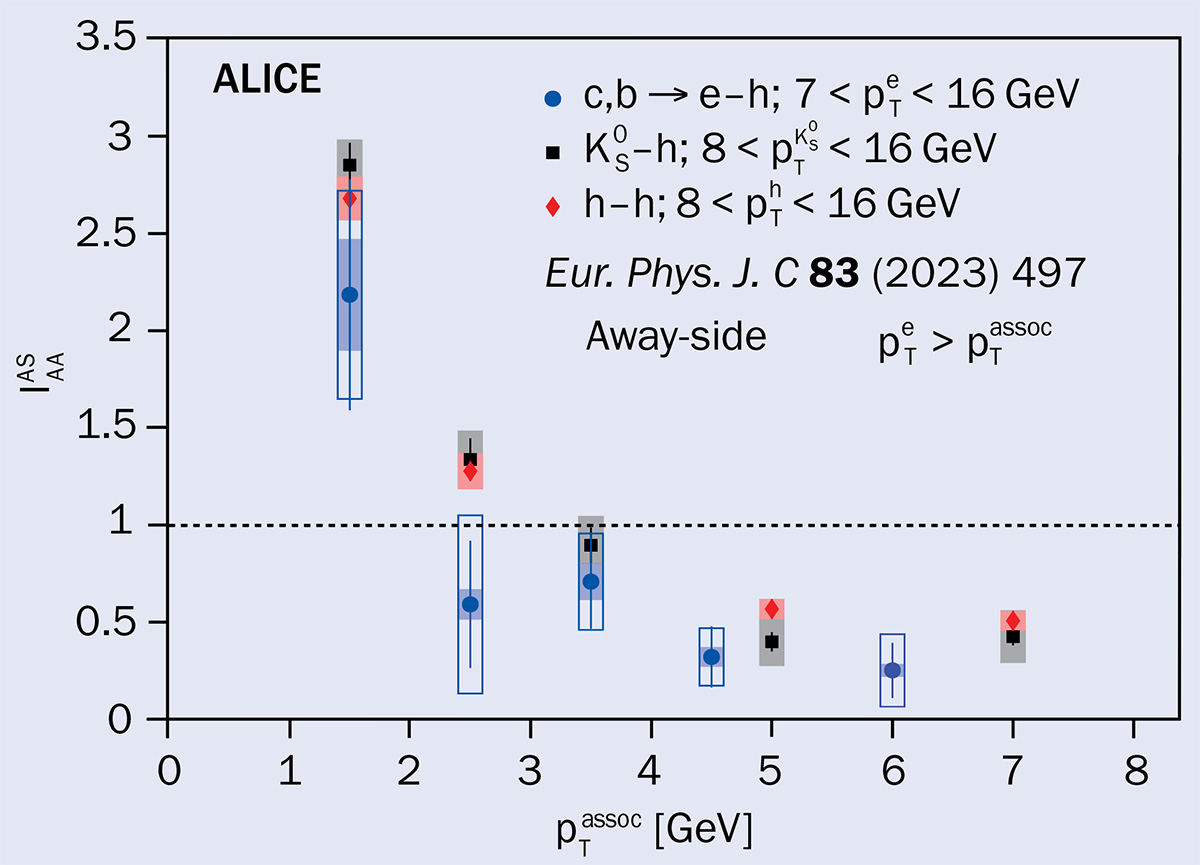
Partons produced in heavy-ion collisions at the LHC must push their way through a hot, dense quark–gluon plasma (QGP). In doing so, they experience medium-induced energy loss that depends on the parton’s mass. In a recent analysis, the ALICE collaboration compared the yields of charged particles associated with electrons from heavy-flavour hadron decays with those of the light hadrons. Both show a suppression of high-momentum particles emitted opposite to the tagged particle, with no significant difference between the two.
After a hard scattering, high-energy partons fragment into collimated sprays of hadrons known as jets. These are well described in proton–proton (pp) collisions, where their substructures provide stringent tests of perturbative QCD. In heavy-ion collisions, instead, they propagate through the QGP and emerge modified – a phenomenon known as jet quenching. Previous measurements (CERN Courier March/April 2025 p13) suggest that jets initiated by charm and beauty quarks lose less energy than those from light quarks and gluons, owing to their larger mass. This difference is commonly attributed to the dead-cone effect, which suppresses gluon emission by heavy quarks at small angles. Jet-quenching effects can be further characterised by measuring the transverse-momentum distribution of particles within jets, providing insight into the redistribution of the quenched energy.
To study this, the ALICE collaboration employs azimuthal-correlation measurements. This technique measures the angular correlation between a heavy-flavour hadron or its decay daughter (“trigger” particle) and other associated charged particles in the same event. The resulting distribution features two correlation peaks: a near-side peak from particles produced alongside the trigger and an away-side one from the recoiling jet, particularly sensitive to jet-medium interactions. Jet quenching is then quantified by the per-trigger nuclear modification factor IAA, which is the ratio of away-side charged-particle yield in heavy-ion collisions to pp collisions. Values of IAA deviating from unity indicate QGP-induced modifications of the jet.
The ALICE collaboration now reports the measurements of jet-like structures in the heavy-flavour sector of lead-lead collisions at a centre-of-mass energy of 5.02 TeV per nucleon pair. The analysis, based on LHC Run 2 data, uses electrons from semi-leptonic decays of charm and beauty hadrons as trigger particles. Electron identification relies on a combination of energy-loss measurements in the time-projection chamber, energy-momentum matching in the calorimeter and selection of shower shapes. Invariant-mass tagging techniques allowed for the subtraction of the large backgrounds from photon conversions and light-meson decays to electron-positron pairs.
The measurement is challenging due to the high multiplicity of lead-lead collisions and the need to extract jet-like correlations from large combinatorial and collective-motion backgrounds. A corresponding analysis of pp collisions at the same energy provides the reference needed to compare jet evolution in the presence of the QGP.
The away-side shows a suppression for associated particles with transverse momenta between 4 and 7 GeV/c (see figure 1), indicating relevant jet quenching with a 2.5σ significance. Conversely, a hint of an enhancement is observed below 2 GeV/c, possibly signalling the redistribution of lost energy into the medium and the subsequent formation of additional low-momentum particles.
These results are consistent with corresponding measurements using light-flavour triggers across all measured intervals. While this suggests that the QGP modifies jets consistently regardless of the initiating parton’s mass, important caveats remain. Variations in parton-to-hadron momentum scaling, as well as the fact that the heavy flavour is tagged via decay electrons, could introduce kinematic differences that complicate a direct comparison. Whether QCD predicts a deviation remains an open question for future modelling of mass-dependent parton-medium interactions.
LHC Run 3 will provide an order of magnitude more heavy-ion events. This increased luminosity will enable higher-precision analyses, offering a deeper understanding of how QGP modifies heavy- and light-flavour jets.
Further reading
ALICE Collab. 2025 arXiv:2507.13197.