The Best Science Stories and How They Work: A Collection with Commentary, edited by Siri Carpenter, University of Chicago Press
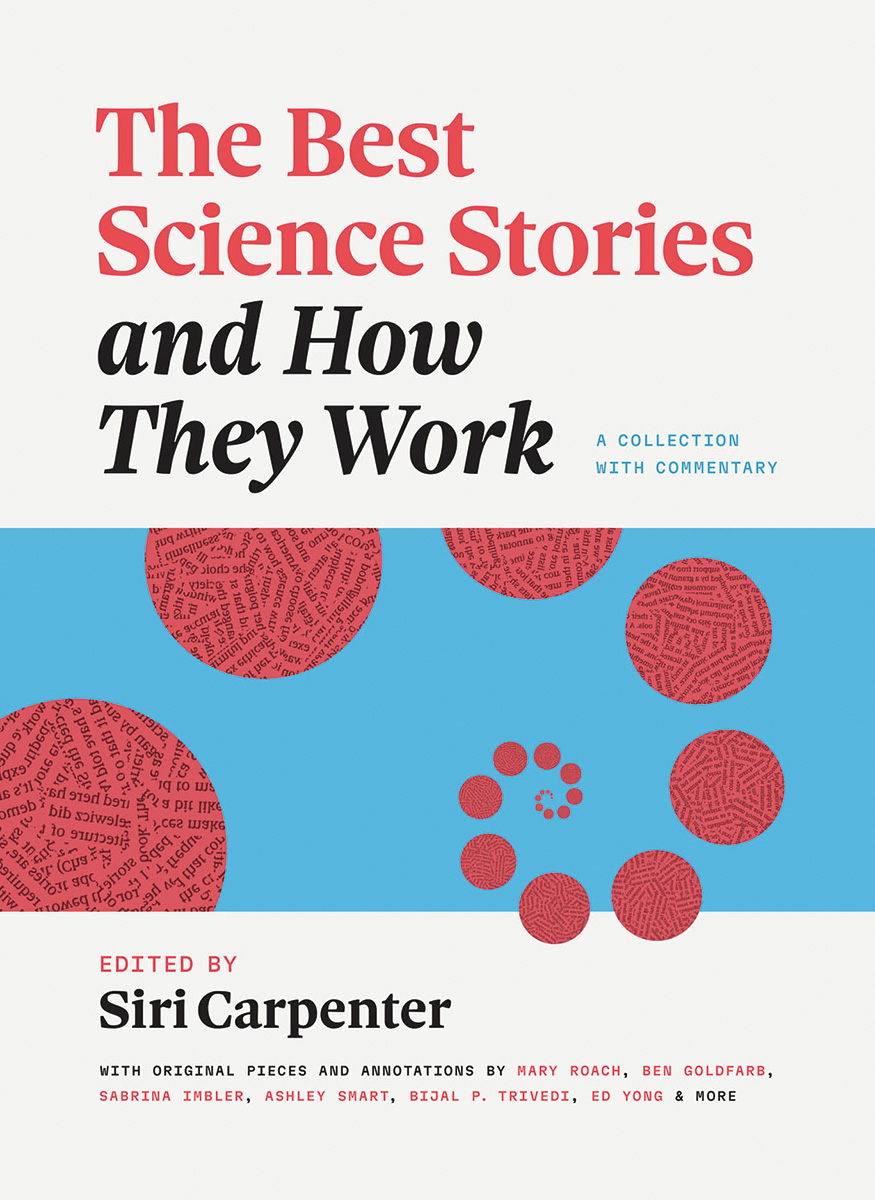
Science journalism has the difficult task of making complex ideas accessible without sacrificing the uncertainty, nuance and sometimes messiness that accompany scientific research. Yet when it succeeds, much of the work involved is invisible. Readers encounter the finished story, not the reporting decisions, discarded approaches, structural choices and conversations with sources that produced it. The Best Science Stories and How They Work turns its attention to this hidden process. Each of its 11 reprinted stories comes with an introduction and annotations by a fellow science journalist, followed by a conversation in which writer and annotator discuss how the piece came together. The result is both an anthology of contemporary science writing and an attempt to take that writing apart and see what makes it work.
A wide world of topics
The subjects are remarkably varied, encompassing medicine, climate change, genetics, conservation, mathematics and space exploration, and drawing on journalism originally published in outlets including Nature, Scientific American, The Atlantic, MIT Technology Review and The New York Times Magazine. Ed Yong’s “Fatigue can shatter a person”, for example, examines the debilitating experience of pathological fatigue, particularly in the context of long COVID, while Kendra Pierre-Louis investigates “How rising groundwater caused by climate change could devastate coastal communities”. Juxtaposing such different stories is crucial, as it shows how similar questions about evidence, explanation, narrative and human experience arise across scientific disciplines.
What makes the collection distinctive, however, is what happens around each article. Rather than asking readers simply to admire a successful piece of journalism, the annotations encourage them to notice its construction. Why does a story begin where it does? How is technical information introduced without interrupting the narrative? What makes a source compelling, and how should a journalist balance curiosity with scepticism? Such questions turn reading into a more active exercise. The conversations between writers and annotators add another layer by focusing attention on the decisions and challenges behind each piece.
A persuasive case for paying closer attention to how science stories are assembled
This emphasis on process makes the book relevant beyond aspiring science journalists. Communicating science is often described as a problem of translation: taking specialist knowledge and making it understandable to a non-specialist audience. The examples collected here suggest something much richer. Good communication also depends on judgement – what a reader needs to know, what can safely be omitted, where uncertainty matters and where explanation should give way to narrative. These decisions will be recognisable to any scientist who has tried to explain a result outside their immediate field.
There is inevitably a degree of artificiality in dismantling writing that was designed to be experienced as a whole. Not every reader will want to interrupt an engaging story to consider its underlying mechanics, and those looking primarily for physics or another particular discipline will find much of the collection removed from the subject of their interest. But that breadth is also one of the book’s strengths. Moving between very different flavours of science and storytelling, it resists the idea that successful science communication can be reduced to a single template. It offers instead something closer to a workshop built around examples: read the story, examine the choices behind it and consider what might be learnt.
The Best Science Stories and How They Work makes a persuasive case for paying closer attention to how science stories are assembled, as well as to what they say. To early-career journalists, it offers an opportunity to examine the working methods behind effective reporting. To scientists, it provides a reminder that making science understandable involves more than simplifying terminology.