James Robinson reflects on a journey from the ATLAS collaboration to the Environment and Sustainability programme at the Alan Turing Institute.
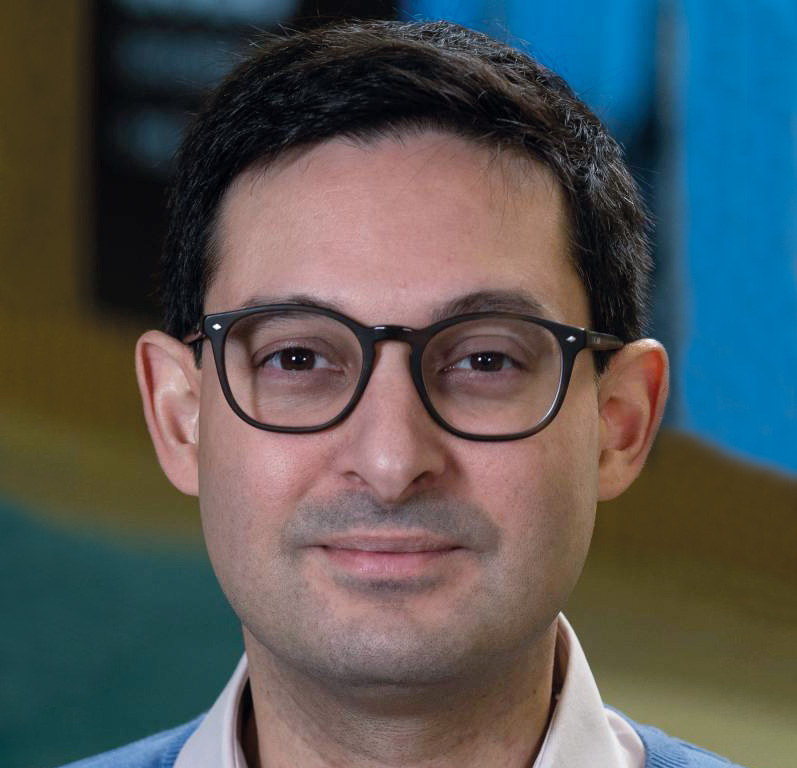
In physics, as in life, it’s important to persevere in the face of setbacks. When James Robinson joined the ATLAS experiment at CERN in 2008, the Large Hadron Collider had just sputtered into life. “I remember the excitement of the initial startup and the disappointment when data taking was delayed for a year,” recalls Robinson.” Over the next decade, Robinson built a career in experimental particle physics, analysing jets and soft-QCD events, convening subgroups, tuning Monte Carlo generators and helping measure luminosity.
By 2018, Robinson was beginning to ponder his professional priorities. “I didn’t really want to spend another three years writing grants and not having much time to do physics,” he says. Constant relocation was another strain. “It was really nice having the freedom to travel, but in your mid-thirties you start thinking maybe it’s time to settle in one location.”
Real-world research
That’s when he spotted an opening at the Alan Turing Institute, the UK’s national centre for data science and AI. The Institute is a research-led organisation who hire experts and academics to find solutions to real-world challenges and to advise UK public policy. The role Robinson initially applied for focused on advanced computing and AI strategy, one that would apply his academic skills, and help develop his practical ones. “The Institute has a lot in common with CERN,” he says. “But I applied because of its larger focus on applications of research, rather than pure blue-sky work.”
Today, Robinson is the software engineering research lead in the Turing’s Environment and Sustainability programme, where teams of researchers, data scientists and engineers tackle urgent global challenges. “Right now we’re working with the Met Office on using AI to get faster and better weather predictions in the UK,” he explains. “For other projects, we also partner with African countries to improve forecasts in the global South, and model changes in Arctic and Antarctic sea ice, which is useful for everything from animal migrations to navigation.”
One of Robinson’s first projects was to model London’s air quality to inform the mayor’s office on pollution hot spots. “Traffic turned out to be the most important factor,” he says. “We could point to areas where we thought air quality was bad but under-measured, and the mayor’s office deployed mobile sensors to check. During COVID we even repurposed the project to monitor how busy London was coming out of lockdown. It felt really nice to see a project pivot quickly and directly feed into policy.”
Although the Turing Institute engages with government and public-sector partners, it isn’t a commercial consultancy. Each team decides which areas they would like to work in, and the problems they focus on improving. Once they identify a problem, the next stage is to find the best partner who will allow their models to make the most impact. “We’re not here to build a slightly better algorithm for its own sake,” says Robinson. “We want to apply AI to make change in the real world.”
The Institute’s mission echoes the one that first drew Robinson to physics. “One of the big similarities with CERN is the sense that what you’re doing is worthwhile and good for the world,” he says. “It’s still research, but more applied. Improving the weather forecast that everyone sees on their phone – that’s easy to explain to your grandparents.”
Robinson, who had previously been part of decades-long, large-scale research projects at ATLAS, felt it extremely satisfying to see the direct impact of his work. “At CERN you contribute a tiny part to a huge experiment,” he says. “Here I get to see a project from start to finish, and sometimes adapted straight into real-world decision making.”
Transferable skills
But was high-energy physics a good preparation for Robinson’s current career?
The answer is a resounding yes. Having done a PhD and two post docs, he was used to flexible and adaptable timelines. “I was often handed a problem without a clear solution,” he recalls. “Sometimes we have to pivot quickly away from one idea or plan and dive straight into another. That ability to rethink and improve has transferred directly to Turing.”
A lack of formal technical qualifications also need not be a problem. “Many of us were self-taught programmers at CERN,” he says. “The fact you’ve done research, adapted and developed those skills is what matters.”
Collaboration is another common thread. “Like CERN, Turing is a meeting place for people from many different institutions,” he says. “No one can just order work to happen. You negotiate, you build consensus.”
But Robinson notes that applying for non-academic roles requires a shift in mindset. While academic CVs and cover letters are often long and detailed, applications for industry, consultancy or somewhere in between like the Institute, may look different.
“Don’t go into the specifics of your ATLAS analysis because it won’t be directly relevant in industry,” says Robinson. “Show your research experience, but focus on the skills: problem-solving, collaboration, adaptability.”
But most importantly, make sure the values of the company you’re applying to align with your own. For Robinson, the Turning Institute was an obvious choice.
“I’m taking the same mindset I had at CERN and using it to make a difference you can see,” says Robinson. “That’s the rewarding part: turning data into something that genuinely helps people.”