Physics is beautiful in its ideas and in the people who pursue them across borders. What better, then, than for 16 laboratories across Asia, Europe and North America to throw open their doors for a photography competition, allowing the aesthetically inclined to immortalise on film the wonders within. The votes are now in.
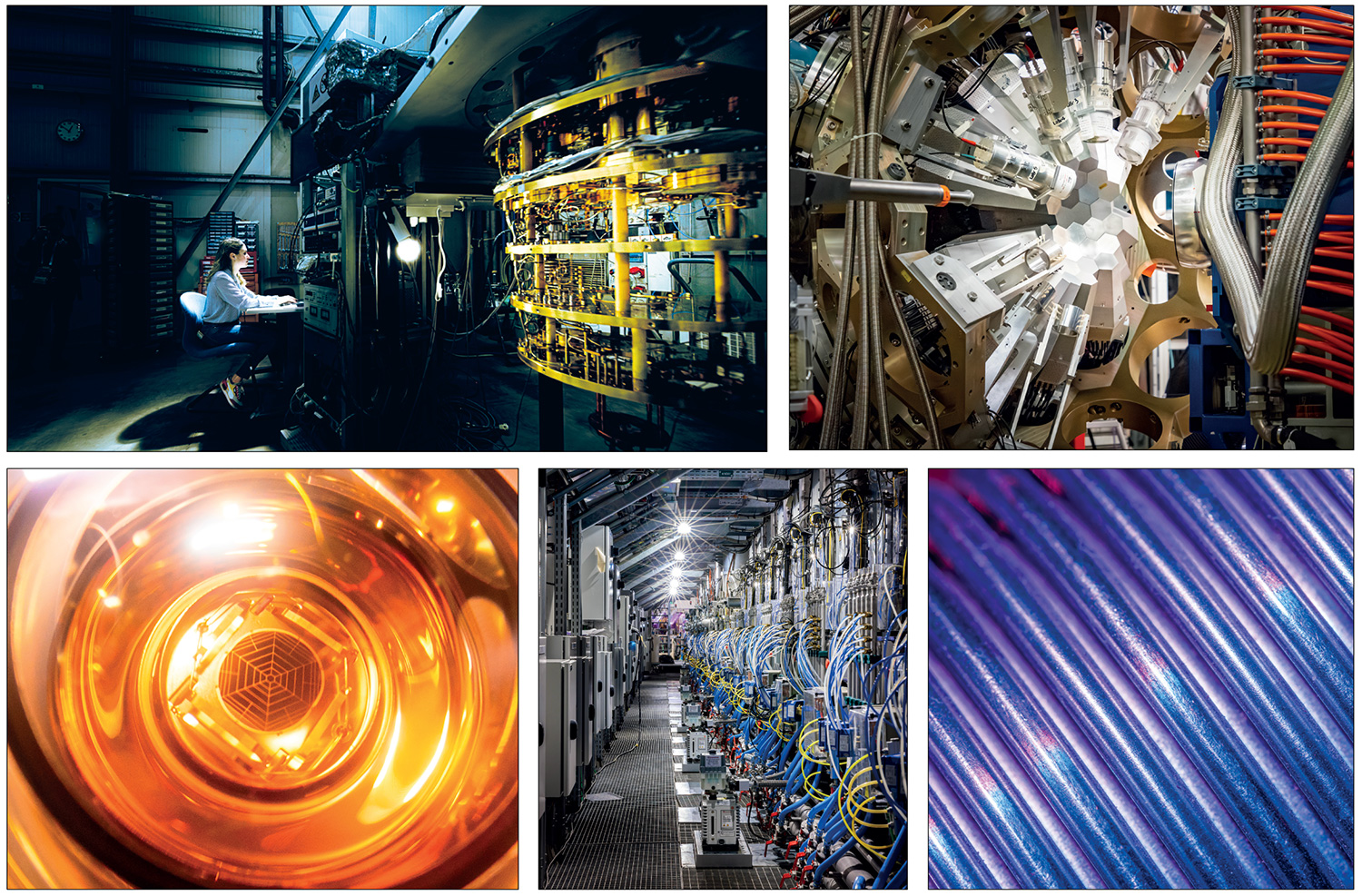
The winning image of the 2025 Global Physics Photowalk, by photographer Marco Donghia, shows INFN National Laboratories of Frascati researcher Raffaella Donghia seated beside an open cryostat during installation of an ultracold experiment at COLD, the CryOgenic Laboratory for Detectors (see “First place” image). The apparatus houses an axion haloscope – a cryogenic antenna consisting of a microwave cavity resonating at about 9 GHz, immersed in a powerful 9 tesla magnetic field and connected to an ultra-low-noise amplification system designed to search for ultralight dark-matter candidates such as axions or dark photons (CERN Courier January/February 2026 p21). If ultralight dark matter circulates in a galactic halo, it could excite the resonant cavity at a frequency corresponding to the particle’s mass, appearing as a minute increase in electromagnetic power at that frequency. Cooling the system to 10 mK suppresses thermal noise to the point that quantum noise dominates.
“The image stood out for its clear visual storytelling and masterful use of light, which leads the eye through the scene and emphasises the moment of discovery,” said judge Tabea Rauscher, then creative lead at the European Molecular Biology Laboratory. “The researcher appears small in relation to the cryostat, highlighting the scale of the technology while keeping the human presence at the centre. The lighting creates a quiet, almost cinematic atmosphere that captures both the intensity and the solitude of scientific work.”
The photographs move between abstraction and lived experience
Fellow judge Dmitri Denisov, deputy associate laboratory director for high-energy physics at Brookhaven National Laboratory in the US, noted that while the judges chose Donghia’s photograph for its ability to convey the “deep connection between the apparatuses used in particle physics and the human developing them,” the second- and third-place photographs were chosen for their “deep looks into the inner workings of experiments and impressive display of colours.”
The judges awarded second place to Matteo Monzali for his photograph of a nuclear-physics experiment at INFN National Laboratories of Legnaro in Italy (see “Runner up” image) and third place to Hugo Pardinilla for a close-up image of a photomultiplier from the KM3NeT/ORCA experiment, a neutrino telescope currently being installed in the Mediterranean Sea at a depth of 2500 metres off the coast of Provence, France (see “Third place” image). Members of the public awarded first and second place to Yannig Van De Wouwer’s photographs of GANIL, the heavy-ion accelerator in Caen, France, featuring pipes and cables serving the SPIRAL2 linear accelerator and iridescent patterns in a beam pipe (see “Public preference” image). The public’s third choice went to Monzali’s snap of the AGATA–PRISMA setup in INFN Legnaro.
Deeply human
“Serving as a judge for the 2025 Global Physics Photowalk, I was struck by the range and sensitivity of the submissions,” concludes judge Will Warasila, a freelance photographer for the New York Times. “The photographs move between abstraction and lived experience – finding form, rhythm and quiet beauty in scientific spaces, while foregrounding the people whose labour and curiosity make this work possible. Across geographies and institutions, these images show how photography can slow us down, make complex systems legible and remind us that science is not only technical, but deeply human.”
The Global Physics Photowalk is organised by the Interactions Collaboration (interactions.org), an international network of particle-physics institutions including CERN and over 20 partner laboratories and research infrastructures around the world.