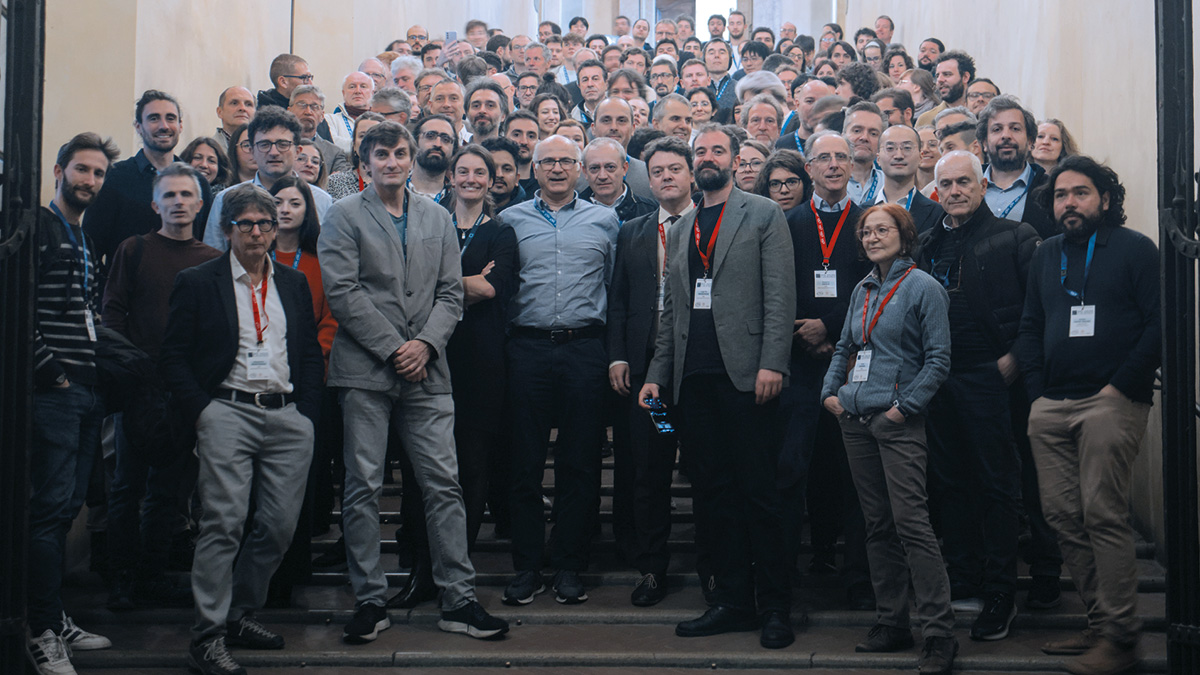
The 7th international workshop on new Photon-Detectors (PD2025) took place from 3 to 5 December 2025 at Bologna’s Palazzo d’Accursio, attracting more than 150 researchers working on the development and application of photon-detection technologies. The medieval city-hall library, with its transparent floor above archaeological remains spanning more than two millennia, provided a striking setting for three days of discussion on state-of-the-art detector technologies.
Photon detectors lie at the heart of modern experimental physics. Their ability to measure extremely faint light signals, down to the single photons, makes them indispensable in areas ranging from high-energy and nuclear physics to astroparticle physics, astronomy, medical imaging and emerging quantum technologies. In recent years, rapid progress in devices such as silicon photomultipliers (SiPMs), avalanche photodiodes (APDs) and microchannel-plate (MCP-PMT) detectors has delivered improvements in timing resolution, radiation tolerance and large-scale integration. PD2025 provided a timely snapshot of this evolving field, combining technology-driven discussions with reports from experiments already exploiting these advances.
A significant fraction of the invited talks focused on the latest developments in SiPM technology, which has become the workhorse photodetector for many contemporary experiments. Alberto Gola (FBK) and Edoardo Charbon (EPFL) highlighted progress in custom SiPM and digital SPAD devices, respectively, stressing their improvements in photon-detection efficiency and sub-100 ps timing performance, as well as ongoing efforts to mitigate correlated noise and radiation-induced degradation. These technological developments were complemented by reports from large-scale experiments – such as ALICE3, CMS, DARKSIDE, DUNE, ePIC and JUNO-TAO – in high-energy and astroparticle physics, outlining the status of ongoing developments and the anticipated role of SiPM-based systems in large-area calorimetry, precision timing and Cherenkov imaging in future detectors.
Equally prominent were contributions on vacuum photodetectors and on enabling technologies. Albert Lehmann (University of Erlangen-Nürnberg) reviewed the status and future prospects of microchannel-plate photomultiplier tubes (MCP-PMT), while Angelo Rivetti (INFN Torino) addressed the challenges of fast, low-power front-end electronics capable of handling the ever-increasing channel counts of modern detectors. Modelling of photon-detection devices was discussed by Werner Riegler (CERN), who introduced an analytic description of timing and efficiency in SPADs and SiPMs, clarifying their performance limits for single-photon and charged-particle detection.
Several contributions underlined the increasingly close relationship between academia and industry in photon-detector development, touching on technology transfer, production scalability and long-term reliability, issues that are becoming central as detectors transition from small-scale prototypes to systems comprising hundreds of thousands, or even millions, of channels, such as in the case of the use of digital SiPMs for physics experiments.
The next edition of the conference will take place in May 2027 in Beijing.