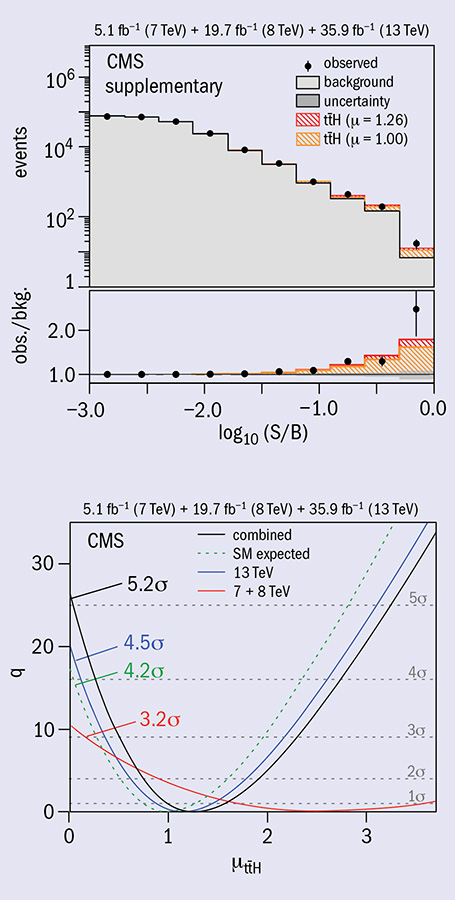
The CMS collaboration has published the first direct observation of the coupling between the Higgs boson and the top quark, offering an important probe of the consistency of the Standard Model (SM). In the SM, the Higgs boson interacts with fermions via a Yukawa coupling, the strength of which is proportional to the fermion mass. Since the top quark is the heaviest particle in the SM, its coupling to the Higgs boson is expected to be the largest and thus the dominant contribution to many loop processes, making it a sensitive probe of hypothetical new physics.
The associated production of a Higgs boson with a top quark–antiquark pair (ttH) is the best direct probe of the top-Higgs Yukawa coupling with minimal model dependence, and thus a crucial element to verify the SM nature of the Higgs boson. However, its small production rate – constituting only about 1% of the total Higgs production cross-section – makes the ttH measurement a considerable challenge.
The CMS and ATLAS collaborations reported first evidence for the process last year, based on LHC data collected at a centre-of-mass energy of 13 TeV (CERN Courier May 2017 p49 and December 2017 p12). The first observation, constituting statistical significance above five standard deviations, is based on an analysis of the full 2016 CMS dataset recorded at an energy of 13 TeV and by combining these results with those collected at lower energies.
The ttH process gives rise to a wide variety of final states, and the new CMS analysis combines results from a number of them. Top quarks decay almost exclusively to a bottom quark (b) and a W boson, the latter subsequently decaying either to a quark and an antiquark or to a charged lepton and its associated neutrino. The Higgs-boson decay channels include the decay to a bb quark pair, a τ+τ– lepton pair, a photon pair, and combinations of quarks and leptons from the decay of intermediate on- or off-shell W and Z bosons. These five Higgs-boson decay channels were analysed by CMS using sophisticated methods, such as multivariate techniques, to separate signal from background events. Each channel poses different experimental challenges: the bb channel has the largest rate but suffers from a large background of events containing a top-quark pair and jets, while the photon and Z-boson pair channels offer the highest signal-to-background ratio at a very small rate.
CMS observed an excess of events with respect to the background-only hypothesis at a significance of 5.2 standard deviations. The measured values of the signal strength in the considered channels are consistent with each other, and a combined value of 1.26 +0.31/–0.26 times the SM expectation is obtained (see figure). The measured production rate is thus consistent with the SM prediction within one standard deviation. The result establishes the direct Yukawa coupling of the Higgs boson to the top quark, marking an important milestone in our understanding of the properties of the Higgs boson.
The large centre-of-mass energy and luminosity of the LHC have made possible the first measurements of electroweak-boson production in ultrarelativistic heavy-ion collisions. The production cross sections for such processes in proton–proton (pp) collisions are known with high precision, and indeed have been suggested as “standard candles” for luminosity measurements at the LHC. Since the electroweak bosons and their leptonic decay products do not interact strongly with the hot and dense quark–gluon matter produced in heavy-ion collisions, they can also be used as a reference in this environment. Here, the production rates of W and Z bosons directly probe initial-state effects, such as the u- and d-quark density (isospin) and the difference between the parton density functions (PDFs) of nucleons that are bound in nuclei and those that are free. These effects are studied by comparing the measurements in lead–lead (PbPb) collisions to the results from pp collisions, taking their different collision-impact parameters into account.
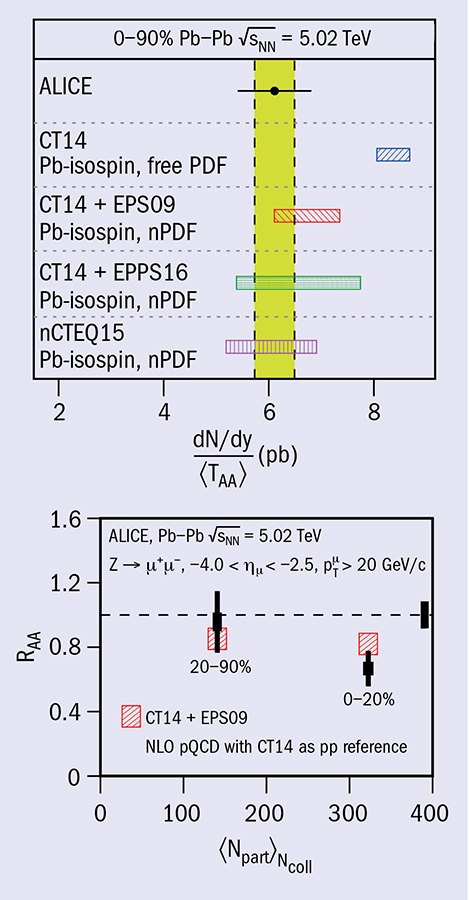
The ALICE experiment has measured, for the first time, Z-boson production at large rapidity in PbPb collisions at a centre-of-mass energy of 5.02 TeV per nucleon pair (figure, top). The measurement was compared with theoretical calculations at next-to-leading order, considering a combination of proton and neutron PDFs to account for the isospin of the lead nucleus. Those calculations that include a nuclear modification of the PDFs (through three different parameterisations) describe the data well, while the calculation using free proton and neutron PDFs overestimates the data by 2.3 standard deviations.
The Z production rate was studied as a function of rapidity and collision centrality. To study the radial dependence of the nuclear effects, the data sample was divided into two different centrality classes and the nuclear modification factor RAA was evaluated by dividing the normalised yields by the theoretical pp cross-section reference (figure, bottom). The measurements are well described by the calculations using an impact-parameter-dependent nuclear PDF, and the data point in the 0–20% most central collisions deviates from the predictions with free PDFs by three standard deviations.
The Z-boson measurements at large rapidity in PbPb collisions at LHC energies are well-described by calculations that include nuclear modifications of the PDFs. These have been inferred mostly from deep-inelastic scattering experiments at lower energies, while the predictions using free PDFs deviate from data. The data from the upcoming PbPb data-taking period in November will allow ALICE to improve the precision of the electroweak-boson measurements and provide more precise information on the modification of PDFs in nuclei.
Four years ago, LHCb measured the central exclusive production (CEP) of J/ψ and ψ(2S) mesons at a centre-of-mass energy of 7 TeV (CERN Courier March 2014 p7). In CEP, two incoming protons emerge intact from the collision, with a central system created by the fusion of two propagators that do not contain colour (e.g. photons or pomerons). This results in an unusual final state for hadron collisions with just a few particles detected: in the case of J/ψ and ψ(2S) mesons, it leads to the characteristic signature of two muons from the meson decay and no other observed activity in the event.
A major background to this process is due to collisions where the protons dissociate but the remnants travel close to the beamline and thus remain undetected. To address this, the LHCb collaboration designed and built a new detector called HeRSCheL, which was installed at the beginning of 2015 in the LHC tunnel. It consists of 20 square plastic scintillators approximately 30 cm wide placed just outside the vacuum pipe at distances up to 114 m from the interaction point. Whilst LHCb is fully instrumented in the pseudorapidity region 2 < η < 5, HeRSCheL significantly extends the sensitivity to 5 < | η | < 10 and therefore improves the precision with which the experiment can observe CEP processes.
LHCb has now taken advantage of the extra reach to measure J/ψ and ψ(2S) CEP in 13 TeV proton–proton collisions. By including HeRSCheL, backgrounds have been reduced by a factor of two compared to the measurement at 7 TeV. Furthermore, by comparing events with and without activity in HeRSCheL, a much better understanding of those backgrounds has been achieved, resulting in an improved precision.
The figure shows the derived photoproduction cross section for J/ψ mesons as a function of the proton–photon centre-of-mass energy for LHCb data at 7 and 13 TeV, with good agreement observed compared to theoretical predictions. Also shown are ALICE results in proton–lead collisions and HERA (H1 and Zeus) results at lower energies. The shaded band is a power-law extrapolation of the HERA data, which is seen to be inconsistent with the data at the highest energies.
Measurements of the CEP process can be used to test perturbative QCD predictions as well as to improve our understanding of the distribution of gluons inside the proton. This new measurement paves the way to future CEP analyses at LHCb and beyond, not only using proton–proton but also heavy-ion collisions.
The LHC is not only the highest-energy collider ever built, it also delivers proton–proton collisions at a much higher rate than any machine before. The LHC detectors measure each of these events in unprecedented detail, generating enormous volumes of data. To cope, the experiments apply tight online filters (triggers) that identify events of interest for subsequent analysis. Despite careful trigger design, however, it is inevitable that some potentially interesting events are discarded.
The LHC-experiment collaborations have devised strategies to get around this, allowing them to record much larger event samples for certain physics channels. One such strategy is the ATLAS trigger-object level analysis (TLA), which consists of a search for new particles with masses below the TeV scale decaying to a pair of quarks or gluons. The analysisuses selective readout to reduce the event size and therefore allow more events to be recorded, increasing the sensitivity to new physics in domains where rates of Standard Model (SM) backgroundprocesses are very large.
Dijet searches look for a resonance in the two-jet invariant mass spectrum. The strong-interaction multi-jet background is expected to be smoothly falling, thus a bump-like structure would be a clear sign of a deviation from the SM prediction. As the invariant mass decreases, the rate of multi-jet events increases steeply – to the point where, in the sub-TeV mass range, the data-taking system of ATLAS cannot handle the full rate due to limited data-storage resources. Instead, the ATLAS trigger system discards most of the events in this mass range, reducing the sensitivity to low-mass dijet resonances.
By recording only the final-state objects used to make the trigger decision, however, this limitation can be bypassed. For a dijet-resonance search, the only necessary ATLAS detector signals are the calorimeter information used to reconstruct the jets. This compact data format records far less information for each event, about 1% of the usual amount, allowing ATLAS to record dijet events at a rate 20 times larger than what is possible with standard data-taking (figure, left).
While the TLA technique gives access to physics at lower thresholds, the ATLAS detector information for these events is incomplete. Dedicated reconstruction and calibration techniques had to be developed to deal with the partial event information and, as a result, the invariant mass computed from TLA jets is comparable to that using jets reconstructed from the full detector readout within 0.05%.
The data recorded by ATLAS in 2015 and 2016 at a centre-of-mass energy of 13 TeV did not reveal any bump-like structure in the TLA dijet spectrum. The unprecedented statistical precision allowed ATLAS to set its strongest limits on resonances decaying to quarks in the mass range between 450 GeV and 1 TeV (figure, right). The analysis is sensitive to new particles that could mediate interactions between the SM particles and a dark sector, and to other new resonances at the electroweak scale. This analysis probes an important mass region that could not otherwise be explored in this final state with comparable sensitivity.
ATLAS joins CMS and LHCb with an analysis technique that requires fewer storage resources to collect more LHC data. The technique will be extended in the future, with upgraded trigger farms and detectors making tracking information available at early trigger levels. It will thus play an important role at LHC Run 3 and at the high-luminosity LHC upgrade.
For hundreds of years, discoveries in astronomy were all made in the visible part of the electromagnetic spectrum. This changed in the past century when new objects started being discovered at both longer wavelengths, such as radio, and shorter wavelengths, up to gamma-ray wavelengths corresponding to GeV energies. The 21st century then saw another extension of the range of astronomical observations with the birth of TeV astronomy.
The High Energy Stereoscopic System (HESS) – an array of five telescopes located in Namibia in operation since 2002 – was the first large ground-based telescope capable of measuring TeV photons (followed shortly afterwards by the MAGIC observatory in the Canary Islands and, later, VERITAS in Arizona). To celebrate its 15th anniversary, the HESS collaboration has published its largest set of scientific results to date in a special edition of Astronomy and Astrophysics. Among them is the detection of three new candidates for supernova remnants that, despite being almost the size of the full Moon on the sky, had thus far escaped detection.
Supernova remnants are what’s left after massive stars die. They are the prime suspect for producing the bulk of cosmic rays in the Milky Way and are the means by which chemical elements produced by supernovae are spread in the interstellar medium. They are therefore of great interest for different fields in astrophysics.
HESS observes the Milky Way in the energy range 0.03–100 TeV, but its telescopes do not directly detect TeV photons. Rather, they measure the Cherenkov radiation produced by showers of particles generated when these photons enter Earth’s atmosphere. The energy and direction of the primary TeV photons can then be determined from the shape and direction of the Cherenkov radiation.
Detections by HESS demonstrate the power of TeV astronomy to identify new objects
Using the characteristics of known TeV-emitting supernova remnants, such as their shell-like shape, the HESS search revealed three new objects at gamma-ray wavelengths, prompting the team to search for counterparts of these objects in other wavelengths. Only one, called HESS J1534-571 (figure, left), could be connected to a radio source and thus be classified as a supernova remnant. For the two other sources, HESS J1614-518 and HESS J1912+101, no clear counterparts were found. These objects thus remain candidates for supernova remnants.
The lack of an X-ray counterpart to these sources could have implications for cosmic-ray acceleration mechanisms. The cosmic rays thought to originate from supernova remnants should be directly connected to the production of high-energy photons. If the emission of TeV photons is a result of low-energy photons being scattered by high-energy cosmic-ray electrons originating from a supernova remnant (as described by leptonic emission models), soft X-rays would also be produced while such electrons travelled through magnetic fields around the remnant. The lack of detection of such X-rays could therefore indicate that the TeV photons are not linked to such scattering but are instead associated with the decay of high-energy cosmic-ray pions produced around the remnant, as described by hadronic emission models. Searches in the X-ray band with more sensitive instruments than those available today are required to confirm this possibility and bring deeper insight into the link between supernova remnants and cosmic rays.
The new supernova-remnant detections by HESS demonstrate the power of TeV astronomy to identify new objects. The latest findings increase the anticipation for a range of discoveries from the future Cherenkov Telescope Array (CTA). With more than 100 telescopes, CTA will be more sensitive to TeV photons than HESS, and it is expected to substantially increase the number of detected supernova remnants in the Milky Way.
It is almost six years since the CMS and ATLAS collaborations jointly announced the discovery of the Higgs boson, the last of the Standard Model particles predicted to exist. Yet deep questions in particle physics remain unsolved and precise measurements of the Higgs boson are one of many ways to search for answers that could point to new physics beyond the Standard Model. Experiments at higher energies than those available at the LHC could conclusively determine which, if any, of the many theories describing this new physics is realised and reveal the nature of the dark sector of the universe.
The Future Circular Collider (FCC) study, which was formally launched in 2014, would see a 100 km-circumference tunnel built at CERN to host post-LHC colliders. The goals of this international project include precision measurements of the Higgs self-interaction, whose structure is deeply related to the origin of mass and to the breaking of the electroweak symmetry. More generally, the FCC offers a leap into completely uncharted territory, from delivering mind-boggling statistics of 5 × 10¹² Z decays all the way up to proton–proton collisions at an energy of 100 TeV (CERN Courier May 2017 p34).
Deriving from proposals formulated as early as 2010, the FCC study has made rapid progress in R&D across the many domains of this mammoth technological effort, and attracted a growing international community. Scientists and engineers from around the world gathered in Amsterdam from 9–13 April for the 2018 FCC collaboration week to identify key objectives for the FCC’s Conceptual Design Report (CDR), which is due by the end of this year. Advances in theoretical studies and detector techniques presented during the conference demonstrated that the machines envisaged by the FCC study could investigate some of the most compelling issues of particle physics in the decades following the LHC, while at the same time driving a major training, technological and industrial programme.
As with other major proposals for post-LHC machines at CERN and elsewhere, the FCC is currently at the exploratory stage. Its predecessors, the Large Electron Positron collider (LEP) and the LHC were, and are, massive endeavours offering a fruitful physics programme spanning more than 60 years: from the first concept of LEP to the future full exploitation of the high-luminosity LHC upgrade. The timescales of high-energy physics are such that we need to start the process of designing, and understanding what would be required to build, the next generation of circular colliders now if they are to come into operation soon after the completion of the high-luminosity LHC’s research programme in the late 2030s.
Following earlier investigations and projects – such as the ELOISATRON in Italy and the Superconducting Super Collider and Very Large Lepton Collider (VLLC)/Very Large Hadron Collider (VLHC) in the US – the first studies in Europe for a future circular collider started in 2010 and 2011, respectively, for new high-energy proton and lepton colliders at CERN. The lepton collider had three variants: LEP3 (a new electron–positron collider in the LHC tunnel), DLEP (a new collider roughly double the size of LEP) and the 80 km circumference “TLEP” (triple the size of LEP). As was the case for LEP and LHC, and also proposed by the VLLC/VLHC study in around 2001, both the lepton and hadron machines could be housed successively in a new, large tunnel.
Amalgamation
In early 2014 the lepton- and proton-collider design efforts were formally combined under the umbrella of the FCC study. First civil engineering studies in 2012 and 2014 revealed that a tunnel of 80–100 km is geologically preferred in the Lake Geneva basin, and a circumference of about 100 km has become the FCC target. In 2013 the Institute for High-Energy Physics in Beijing initiated a similar design study for a Higgs factory in China (CEPC) that would be succeeded by a high-energy proton–proton collider called SppC (see China’s bid for a circular electron–positron collider). Initially a CEPC tunnel circumference of 54 km and a proton collider reaching collision energies of 70 TeV were being considered, but since 2017 the CEPC tunnel circumference has also been set at 100 km.
The FCC study envisages, as a potential first step, an electron–positron collider (FCC-ee) that could scrutinise the Higgs boson and the electroweak scale. The remarkable precision of LEP has been instrumental in confirming the Standard Model and in tightly constraining the masses of the top quark and of the Higgs Boson. The FCC-ee builds upon this tradition. Operating at four different energies for precision measurements of the Z, W and Higgs bosons and the top quark, FCC-ee represents a significant advance in terms of technology and design parameters. The total scientific programme could span a period of 14 years, the first eight dedicated to Z, W and Higgs measurements followed by a high-energy upgrade to a top-quark factory.
With produced samples of 5 × 10¹² Z bosons, 108 W pairs, 106 Higgs and top pairs, FCC-ee will allow searches for rare phenomena that can reveal new physics, while as an exploratory machine it would have sensitivity to new particles that might either be extremely heavy or that could interact too weakly with ordinary matter to be otherwise seen. The extraordinary precision of FCC-ee (1 ppm precision on the Z mass, 7 ppm precision on the W mass) backed up by unique measurements of additional inputs to the calculations (such as the top-quark mass) will allow typical sensitivity to particles as massive as 50 TeV or to couplings many orders of magnitude smaller than those of normal particles. While presenting considerable challenges, the design and technology for FCC-ee are solid and the machine could be built so as to start physics as soon as the LHC’s high-luminosity upgrade (HL-LHC) has completed its programme.
The mammoth proton–proton collider (FCC-hh) would operate at seven times the LHC energy, and deliver about 10 times more integrated luminosity. During its planned 25 years of data-taking, more than 1010 Higgs bosons will be created, which will be 100 times more than that achieved by the end of the (HL-)LHC operation. These additional statistics will enable the FCC-hh experiments to improve the separation of Higgs signals from the huge backgrounds that affect most LHC studies. The discovery reach for high-mass particles – such as Z′ and W′ gauge bosons corresponding to new fundamental forces, or particles like gluinos and squarks that appear in supersymmetric theories – will increase by a factor five or more, depending on the luminosity. The new energy regime will allow us to exclude many theories relying on weakly interacting massive particles, guaranteeing a discovery or excluding a vast portion of the parameter space, and explore fully the electroweak symmetry-breaking mechanism.
Operating the FCC-hh machine with heavy ions generates even more extreme collisions, leading to the creation of a quark–gluon plasma with larger initial density and temperature than those previously observed at RHIC and LHC. This system, in comparison to that produced at the LHC, represents the universe at an earlier, hotter stage of its evolution, allowing a better understanding of quantum chromodynamics and shedding light on the question of how quarks combine to form more stable particles. The FCC complex could also host a proton–electron mode (FCC-he) to explore the secrets of the structure of matter by means of an electron super microscope using deep-inelastic electron–proton (ep) scattering with unprecedented energies and luminosities. Finally, the FCC study also pursues the design of a 27 TeV proton–proton collider in the LHC tunnel (the so-called High Energy LHC, HE-LHC) based on the same 16 T superconducting niobium-tin magnet technology as intended for FCC.
New thinking required
Conceiving and designing an FCC-class accelerator poses tantalising challenges with respect to infrastructure and operations. Since the launch of the study, a major focus of the civil-engineering team has been locating the machine in the optimal position, as well as developing a design that could host the different collider modes in a combination of underground and surface structures.
The civil-engineering requirements for the FCC include approximately 115 km of tunnelling, of which 97.75 km is a 5.5 m-diameter machine tunnel, and the remainder is a combination of bypass, injection and dump tunnels. In addition, four experimental caverns and 12 service caverns are needed, while a total of 22 shafts will connect the underground facilities with the surface (figure 1). The current baseline position successfully fulfils many of the desired criteria, such as a reduction in the total shaft length, a maximum amount of tunnelling in the stable molasses rock, and a minimum amount of excavation in karstic limestone and moraines. Detailed underground surveys, as previously done for the LHC and HL-LHC, are needed to confirm the different soil types and identify potential problems before the proposed location can be firmly validated.
Significant progress has been made over the past year to assess and minimise environmental impact, opting for smart “green” solutions based on the development of new technologies. Among all proposed, future electron–positron colliders, FCC-ee offers by far the highest luminosity at the lowest electric input power up to the top quark threshold, partly thanks to more efficient superconducting radio-frequency cavities, new klystrons and novel designs for the dipole (figure 2) and quadrupole magnets. Similar considerations apply to the design of FCC-hh, which spans a wide range of proton collision energies yet should draw a total electric power similar to the FCC-ee.
FCC Week 2018 saw significant progress in the development of detector designs both for FCC-ee and FCC-hh. For the lepton collider, a detector inspired by the Compact Linear Collider (CLIC) with an all-silicon tracker and a 3D-imaging calorimeter, and an alternative novel detector approach (called International Detector for Electron-positron Accelerator, or IDEA) combine different philosophies with bold technologies. For IDEA, the vertex detector would be silicon-based using the Monolithic Active Pixel Sensor (MAPS) technology developed for the ALICE inner-tracker upgrade, while a large wire chamber inspired by DAFNE’s KLOE experiment would provide the central tracking. Perhaps the most innovative concept of IDEA is the dual-readout copper calorimeter. All in all, the basic detector components are based on proven techniques and work is in progress, including test beam sessions foreseen at CERN in the summer, to optimise their designs.
The increased energy of FCC-hh also has a huge impact on the design of the various detectors for tracking and calorimetry and their readout electronics, as well as the magnet system for bending charged particles and identifying their properties. The superconducting detector magnets of the FCC-hh experiments should provide a higher magnetic field over a larger tracking distance than currently achieved by the LHC experiments, and this poses a new challenge for magnet designers. The FCC-hh baseline design foresees a very large main solenoid (with a free bore of 10 m and a length of 20 m) providing a field of 4 T and forward solenoids at both ends. For FCC-ee, an ultra-thin 2 T magnet concept is being studied with a free bore of 4.4 m and a length of 6 m.
Core technology
Advanced superconducting technology is at the core of the FCC study. Two of the major technological challenges for an energy-frontier machine are the development of more powerful dipole magnets (16 T, which is around twice that of the LHC) and a new generation of superconductors able to meet the FCC requirements. CERN has launched a 16 T magnet programme, in coordination with a US programme targeting 15 T, and an ambitious FCC conductor development programme with research institutes and industry distributed around the world (CERN Courier May 2018 p40).
Niobium-tin (Nb3Sn) is the workhorse of the FCC magnet development programme. The first breakthrough results of this effort came in 2015, when a Nb3Sn magnet in Racetrack Model Coil (RMC) configuration reached a field of 16.2 T (CERN Courier November 2015 p8). The next goal is to create an enhanced RMC (ERMC) reaching a mid-plane field of 16 T with a 10% margin at a temperature of 4.2 K. The first ERMC coil was successfully wound at CERN in April this year (figure 2, left picture) and a demonstrator unit will be available by the end of the summer. The high-field magnets of the proposed FCC-hh collider would require 7000–9000 tonnes of Nb3Sn superconducting wire, with major implications for the superconductivity industry, while boosting the applications of this technology in domains outside high-energy physics.
The FCC conductor development programme aims, over an initial four-year period, to meet the challenging requirements of the FCC high-field magnets. The first results are very promising: within only one year, the Nb3Sn superconducting wires produced by various international partners have achieved the same performance as the HL-LHC wire (figure 3), and there are strong indicators that it will be feasible to meet the even more ambitious wire targets (in terms of performance and cost) for FCC. The FCC magnet development programme will require six tonnes of superconducting wire over the next five years for the construction of R&D and model magnets, representing a substantial opportunity for wire manufacturers in Europe and beyond. CERN has also launched a Marie-Curie training network called EASITrain to advance our knowledge on superconducting materials and take into account large-scale industrialisation (CERN Courier September 2017 p31).
Another key technology for FCC is advanced superconducting radio-frequency (RF) cavities. A series of cavity designs comprising single-cell, four-cell 400 MHz and five-cell 800 MHz cavities are being developed, in collaboration with LNL-INFN in Italy and JLAB in the US, to cover the different operation energies foreseen for FCC-ee (figure 4). Recent progress in superconducting RF cavities at CERN has been fascinating, and a concrete R&D programme is under way (CERN Courier April 2018 p26). The technology of superconducting niobium-coated copper cavities, already employed at LEP and LHC, is rapidly advancing, achieving, for FCC-ee, a performance at 4.5 K that is competitive to niobium radiofrequency cavities at 2 K.
Current results from niobium-copper cavities installed in HIE-ISOLDE demonstrate the outstanding performance of this technology, achieving peak surface fields of 60 MV/m. Another key development is the rapid shaping of cavities using novel hydro-hydraulic forming, a technique developed in collaboration with the France-headquartered firm Bmax, and promising results from sputtering tests with Nb3Sn films for even more efficient RF cavities. In addition, new klystron bunching technologies that can increase RF power production efficiency up to 90% (compared to the present average of 65%) are being developed in collaboration with the CLIC team. Finally, prototypes of the low-field low-power (and low-cost) twin-aperture dipole and quadrupole magnets for the FCC-ee arcs have been built and tested at CERN.
All in all, the new challenges of the FCC compared to the LHC and LEP call for a number of novel, special technologies that will allow a reliable and sustainable operation. New extraction systems, kickers and collimators to control the beam, powerful vacuum systems and novel approaches to deal with beam effects at the new regime of FCC, are but a few examples. These efforts have already resulted in a new beam-screen design (figure 5) to cope with the high synchrotron radiation of energetic proton beams, the first prototypes of which are currently under test at the Karlsruhe Research Accelerator (KARA) in Germany. Among other first pieces of hardware paving the way for FCC are the first prototypes of a superconducting shield septum magnet (figure 6) and an innovative method of laser surface treatment to suppress the electron clouds so easily induced by the intense FCC-hh beams, which is also under consideration for the HL-LHC.
Cooling the detector and accelerator magnets is another major challenge for a research infrastructure of this size, requiring huge cryogenic refrigeration capacity below 2 K. In collaboration with specialised industrial partners, significant studies of turbo compressors and also new mixtures of coolants have been carried out. A prototyping phase is to be launched after the completion of the forthcoming CDR.
A collider that significantly extends the energy reach of the LHC requires multi-year and multinational cooperation, given the daunting magnitude of the resources needed. The high and growing number of young participants during the annual FCC meetings is a positive indicator for the future of the study. Moreover, the participation of a large number of industries in the FCC study and the supporting Horizon 2020 projects is not a surprise. After all, many of these challenges are also opportunities for technological breakthroughs, as confirmed by past large-scale scientific projects.
The wealth of results presented during the FCC Week 2018 will help inform the update of the European Strategy for Particle Physics, written input for which is required by the end of the year (CERN Courier April 2018 p7). As CERN Director-General Fabiola Gianotti remarked during the opening session of the Amsterdam event, “I cannot see a more natural and better place than CERN to host future circular colliders of the complexity of the FCC, given CERN’s demonstrated expertise in building and operating high-energy accelerators, the existing powerful accelerator complex, and the available infrastructure that we continue to upgrade.” The laboratory’s long history and strong expertise in all the necessary technical domains, as well as its ability to foster international collaborations that amplify the impact of such large-scale projects, provide the ideal base from which to mount the post-LHC adventure.
Chinese accelerator-based research in high-energy physics is a relatively recent affair. It began in earnest in October 1984 with the construction of the 240 m-circumference Beijing Electron Positron Collider (BEPC) at the Institute of High Energy Physics. BEPC’s first collisions took place in 1988 at a centre-of-mass energy of 1.89 GeV. At the time, SLAC in the US and CERN in Europe were operating their more energetic PEP and LEP electron–positron colliders, respectively, while the lower-energy electron–positron machines ADONE (Frascati), DORIS (DESY) and VEPP-4 (BINP Novosibirsk) were also in operation.
Beginning in 2006, the BEPCII upgrade project saw the previous machine replaced with a double-ring scheme capable of colliding electrons and positrons at the same beam energy as that of BEPC but with a luminosity 100 times higher (1033 cm−2 s−1). BEPCII, whose collisions are recorded by the Beijing Spectrometer III (BES III) detector, switched on two years later and continues to produce results today, with a particular focus on the study of charm and light-hadron decays. China also undertakes non-accelerator-based research in high-energy physics via the Daya Bay neutrino experiment, which was approved in 2006 and announced the first observation of the neutrino mixing angle θ13 in March 2012.
The discovery of the Higgs boson at CERN’s Large Hadron Collider in July 2012 raises new opportunities for a large-scale accelerator. Thanks to the low mass of the Higgs, it is possible to produce it in the relatively clean environment of a circular electron–positron collider – in addition to linear electron–positron colliders such as the International Linear Collider (ILC) and the Compact Linear Collider (CLIC) – with reasonable luminosity, technology, cost and power consumption. The Higgs boson is the cornerstone of the Standard Model (SM), yet is also responsible for most of its mysteries: the naturalness problem, the mass-hierarchy problem and the vacuum-stability problem, among others. Therefore, precise measurements of the Higgs boson serve as excellent probes of the fundamental physics principles underlying the SM and of exploration beyond the SM.
In September 2012, Chinese scientists proposed a 50–70 km circumference 240 GeV Circular Electron Positron Collider (CEPC) in China, serving two large detectors for Higgs studies. The tunnel for such a machine could also host a Super Proton Proton Collider (SppC) to reach energies beyond the LHC (figure 1). CERN is also developing, via the Future Circular Collider (FCC) study, a proposal for a large (100 km circumference) tunnel, which could host high-energy electron–positron (FCC-ee), proton–proton (FCC-hh) or electron–proton (FCC-he) colliders (see CERN thinks bigger). Progress in both projects is proceeding fast, although many open questions remain – not least how to organise and fund these next great steps in our exploration of fundamental particles.
Precision leap
CEPC is a Higgs factory capable of producing one million clean Higgs bosons over a 10 year period. As a result, the couplings between the Higgs boson and other particles could be determined to an accuracy of 0.1–1% – roughly one order of magnitude better than that expected of the high-luminosity LHC upgrade and challenging the most advanced next-to-next-to-leading-order SM calculations (figure 2). By lowering the centre-of-mass energy to that of the Z pole at around 90 GeV, without the need to change hardware, CEPC could produce at least 10 billion Z bosons per year. As a super Z – and W – factory, CEPC would shed light on rare decays and heavy-flavour physics and mark a factor-10 leap in the precision of electroweak measurements.
The latest CEPC baseline design is a 100 km double ring (figure 3, left) with a single-beam synchrotron-radiation power of 30 MW at the Higgs pole, and with the same superconducting radio-frequency accelerator system for both electron and positron beams. CEPC could work both at Higgs- and Z-pole energies with a luminosity of 2 × 1034 cm–2 s–1 and 16 × 1034 cm–2 s–1, respectively. The alternative design of CEPC is based on a so-called advanced partial double-ring scheme (figure 3, right) with the aim of reducing the construction cost. Preliminary designs for the two CEPC detectors are shown in figure 4.
Concerning the SppC baseline, it has been decided to start with 12 T dipole magnets made from iron-based high-temperature superconductors to allow proton–proton collisions at a centre-of-mass energy of 75 TeV and a luminosity of 1035 cm–2 s–1. The SppC SC magnet design is different to the Nb3Sn-based magnets planned by the FCC-hh study, which are targeting a field of 16 T to allow protons to collide at a centre-of-mass energy of 100 TeV. The Chinese design also envisages an upgrade to 20 T magnets, which will take the SppC collision energy to beyond 100 TeV. Discovered just over a decade ago, iron-based superconductors have a much higher superconducting transition temperature than conventional superconductors, and therefore promise to reduce the cost of the magnets to an affordable level. To conduct the relevant R&D, a national network in China has been established and already more than 100 m of iron-based conductor cable has been fabricated.
The CEPC is designed as a facility where both machines can coexist in the same tunnel (figure 5). It will have a total of four detector experimental halls, each with a floor area of 2000 m2 – two for CEPC and another two for SppC experiments. The tunnel is around 6 m wide and 4.8 m high, hosting the CEPC main ring (comprising two beam pipes), the CEPC booster and SppC. The SppC will be positioned outside of CEPC to accommodate other collision modes, such as an electron–proton, in the far future. The FCC study, which is aiming to complete a Conceptual Design Report (CDR) by the end of the year, adopts a similar staged approach (see CERN thinks bigger).
Since the first CEPC proposal, momentum has grown. In June 2013, the 464th Fragrant Hill Meeting (a national meeting series started in 1994 for the long-term strategic development of China’s science and technology) was held in Beijing and devoted to developing China’s high-energy physics following the discovery of the Higgs boson. Two consensuses were reached: the first was to support the ILC and participate in its construction with in-kind contributions, with R&D funds to be requested from the Chinese government; the second was a recognition that a circular electron–positron Higgs factory – the next collider after BEPCII in China – and a Super proton–proton collider built afterwards in the same tunnel is an important historical opportunity for fundamental science.
In 2014, the International Committee for Future Accelerators (ICFA) released statements supporting studies of energy-frontier circular colliders and encouraged global coordination. ICFA continues to support international studies of circular colliders, in addition to support for linear machines, reflecting the strategic vision of the international high-energy community. In April 2016, during the AsiaHEP and Asian Committee for Future Accelerators (ACFA) meeting in Kyoto, positive statements were made regarding the ILC and a China-led effort on CEPC-SppC. In September that year, at a meeting of the Chinese Physics Society, it was concluded that CEPC is the first option for a future high-energy accelerator project in China, with the strategic aim of making it a large international scientific project. Pre-conceptual design reports (pre-CDRs) for CEPC-SppC were completed at the beginning of 2015 with an international review, based on a single ring-based “pretzel” orbit scheme. A CEPC International Advisory Committee (IAC) was established and, in 2016, the Chinese Ministry of Science and Technology (MOST) allocated 36 million RMB (€4.6 million) for the CEPC study, and in 2018 another 32 million RMB (€4.1 million) has been approved by MOST.
Ensuring that a large future circular collider maximises its luminosity is a major challenge. The CEPC project has studied the use of a crab-waist collision scheme, which is also being studied for FCC-ee. Each of the double-ring schemes for CEPC have been studied systematically with the aim of comparing the luminosity potentials. On 15 January last year, CEPC-SppC baseline and alternative designs for the CDR were decided, laying the ground for the completion of the CEPC CDR at the end of 2017. Following an international review in June, the CEPC CDR will be published in July 2018.
While technical R&D continues – both for the CEPC machine and its two large detectors – a crucial issue is how to pay for such a major international project. In addition to the initial funding from MOST, other potential channels include the National Science Foundation of China (NSFC), the Chinese Academy of Sciences (CAS) and local governments. For example, two years ago Beijing Municipal allocated more than 500 million RMB (€65 million) to the Institute of High Energy Physics for superconducting RF development, and in 2018 CAS plans to allocate 200 million RMB (€26 million) to study high-temperature superconductors for magnets, including studies in materials science, industry and projects such as SppC. While not specifically intended for CEPC-SppC, such investments will have strong synergies with high-energy physics and, in November 2017, the CEPC-SppC Industrial Promotion Consortium was established with the aim of supporting mutual efforts between CEPC-SppC and industry.
A five-year-long Technical Design Report (TDR) effort to optimise the CEPC-SppC design and technologies, and prepare for industrial production, started this year. Construction of CEPC could begin as early as 2022 and be completed by the end of the decade. CEPC would operate for about 10 years, while SppC is planned to start construction in around 2040 and be completed by the mid-2040s. The CEPC-SppC TDR phase after the CDR is critical, both for key-component R&D and industrialisation. R&D has already started towards high-Q, high-field 1.3 GHz and 650 MHz superconducting cavities; 650 MHz high-power high-efficiency klystrons; 12 kW cryogenic systems, 12 T iron-based high temperature superconducting dipoles, and other enabling technologies. Construction of a new 4500 m2 superconducting RF facility in Beijing called the Platform of Advanced Photon Source began in May 2017 to be completed in 2020, and could serve as a supporting facility for different projects.
International ambition
CEPC-SppC is a Chinese-proposed project to be built in China, but its nature is an international collaboration for the high-energy physics community worldwide. Following the creation of the CEPC-SppC IAC in 2015, more than 20 MoUs have been signed with many institutes and universities around the world, such as the Budker Institute of Nuclear Physics (BINP; Russia); National Research Nuclear University MEPhI (Moscow, Russia) and the University of Rostock (Germany).
In August 2017, ICFA endorsed an ILC operating at a centre-of-mass energy of 250 GeV (ILC250), with energy-upgrade possibilities in the future (CERN Courier January/February 2018 p7). Although CEPC and ILC250 start with the same energy to study the Higgs boson, the ultimate goals are totally different from each other: SppC is for a 100 TeV proton–proton collider and ILC is a 1 TeV (maximum) electron–positron collider. The existence of both, however, would offer a highly complementary physics programme operating for a period of decades. The specific feature of CEPC is its small-scale superconducting RF system, (and its relatively large AC power consumption (300 MW for CEPC compared to 110 MW for ILC250). As for the cost, CEPC in its first phase includes part of the cost of SppC for its long tunnel, whereas ILC would upgrade its energy by increasing tunnel length accordingly later.
Deciding where to site the CEPC-SppC involves numerous considerations. Technical criteria are roughly quantified as follows: earthquake intensity less than seven on the Richter scale; earthquake acceleration less than 0.1 g; ground surface-vibration amplitude less than 20 nm at 1–100 Hz; granite bedrock around 50–100 m deep, and others. The site-selection process started in February 2015, and so far six sites have been considered: Qinhuangdao in Hebei Province; Huangling county in Shanxi Province; Shenshan Special District in Guangdong Province; Baoding (Xiongan) in Heibei Province; Huzhou in Zhejiang Province and Changchun in Jilin Province, where the first three sites have been prospected underground (figure 6). More sites, such as Huzhou in Zhejiang Province, will be considered in the future before a final selection decision. According to Chinese civil construction companies involved in the siting process, a 100 km tunnel will take less than five years to dig using drill-and-blast methods, and around three years if a tunnel boring machine is employed.
2018 is a milestone year for Higgs factories in Asia. As CEPC completes its CDR, the global high-energy physics community is waiting for a potential positive declaration from the Japanese government, by the end of the year, on their intention to host ILC250 in Japan, upgradable to higher energies. It is also a key moment for high-energy physics in Europe. FCC will complete its CDR by the end of the year, while CLIC released an updated 380 GeV baseline-staging scenario (CERN Courier November 2016 p20), and the European Strategy for Particle Physics update process will get under way (CERN Courier April 2018 p7). Hopefully, both ILC250 and CEPC-SppC will be included in the update together with FCC, while with respect to the US strategy we are looking forward to the next “P5” meeting following the European update.
During the past five years, CEPC-SppC has kept to schedule both in design and R&D, together with strong team development and international collaboration. On 28 March this year, the Chinese government announced the “Implementation method to support China-initiated large international science projects and plans”, with the goal of identifying between three and five preparatory projects, one or two of which will be put to construction, by 2020. Hopefully, CEPC will be among those selected.
From freeze-dried foods to flat-panel displays and space simulation, vacuum technology is essential in many fields of research and industry. Globally, vacuum technologies represent a multi-billion-dollar, and growing, market. However, it is only when vacuum is applied to particle accelerators for high-energy physics that the technology displays its full complexity and multidisciplinary nature – which bears little resemblance to the common perception of vacuum as being just about pumps and valves.
Particle beams require extremely low pressure in the pipes in which they travel to ensure that their lifetime is not limited by interactions with residual gas molecules and to minimise backgrounds in the physics detectors. The peculiarity of particle accelerators is that the particle beam itself is the cause of the main source of gas: ions, protons and electrons interact with the wall of the vacuum vessels and extract gas molecules, either due to direct beam losses or mediated by photons (synchrotron radiation) and electrons (for example by “multipacting”).
Nowadays, vacuum technology for particle accelerators is focused on this key challenge: understand, simulate, control and mitigate the direct and indirect effects of particle beams on material surfaces. It is thanks to major advances made at CERN and elsewhere in this area that machines such as the LHC are able to achieve the high beam stability that they do.
Since it is in the few-nanometre-thick top slice of materials that vacuum technology concentrates most effort, CERN has merged in the same group: surface-physics specialists, thin-film coating experts and galvanic-treatment professionals, together with teams of designers and colleagues dedicated to the operation of large vacuum equipment. Bringing this expertise together “under one roof” makes CERN one of the world’s leading R&D centres for extreme vacuum technology, contributing to major existing and future accelerator projects at CERN and beyond.
Intersecting history
Vacuum technology for particle accelerators has been pioneered by CERN since its early days, with the Intersecting Storage Rings (ISR) bringing the most important breakthroughs. At the turn of the 1960s and 1970s, this technological marvel – the world’s first hadron collider – required proton beams of unprecedented intensity (of the order of 10 A) and extremely low vacuum pressures in the interaction areas (below 10–11 mbar). The former challenge stimulated studies about ion instabilities and led to innovative surface treatments – for instance glow-discharge cleaning – to mitigate the effects. The low-vacuum requirement, on the other hand, drove the development of materials and their treatments – both chemical and thermal – in addition to novel high-performance cryogenic pumps and vacuum gauges that are still in use today. The technological successes of the ISR also allowed a direct measurement in the laboratory of the lowest ever achieved pressure at room temperature, 2 × 10–14 mbar, a record that still stands today.
The Large Electron Positron collider (LEP) inspired the next chapter in CERN’s vacuum story. Even though LEP’s residual gas density and current intensities were less demanding than those of the ISR, the exceptional length and the intense synchrotron-light power distributed along its 27 km ring triggered the need for unconventional solutions at reasonable cost. Responding to this challenge, the LEP vacuum team developed extruded aluminium vacuum chambers and introduced, for the first time, linear pumping by non-evaporable getter (NEG) strips.
In parallel, LEP project leader Emilio Picasso launched another fruitful development that led to the production of the first superconducting radio-frequency (RF) cavities based on niobium thin-film coating on copper substrates. The ability to attain very low vacuum gained with the ISR, the acquired knowledge in film deposition, and the impressive results obtained in surface treatments of copper were the ingredients for success. The present accelerating RF cavities of the LHC and HIE-ISOLDE (figure 1) are essentially based on the expertise assimilated for LEP (CERN Courier May 2018 p26).
The coexistence in the same team of both NEG and thin-film expertise was the seed for another breakthrough in vacuum technology: NEG thin-film coatings, driven by the LHC project requirements and the vision of LHC project leader Lyn Evans. The NEG material, a micron-thick coating made of a mixture of titanium, zirconium and vanadium, is deposited onto the inner wall of vacuum chambers and, after activation by heating in the accelerator, provides pumping for most of the gas species present in accelerators. The Low Energy Ion Ring (LEIR) was the first CERN accelerator to implement extensive NEG coating in around 2006. For the LHC, one of the technology’s key benefits is its low secondary-electron emission, which suppresses the growth of electron clouds in the room-temperature part of the machine (figure 2).
Electron clouds had to be studied in depth for the LHC. CERN’s vacuum experts provided direct measurements of the effect in the Super Proton Synchrotron (SPS) with LHC beams, contributing to a deeper understanding of electron emission from technical surfaces over a large range of temperatures. New concepts for vacuum systems at cryogenic temperatures were invented, in particular the beam screen. Conceived at BINP (Russia) and further developed at CERN, this key technology is essential in keeping the gas density stable and to reduce the heat load to the 1.9 K cold-mass temperature of the magnets. This non-exhaustive series of advancements is another example of how CERN’s vacuum success is driven by the often daunting requirements of new projects to pursue fundamental research.
Preparing for the HL-LHC
As the LHC restarts this year for the final stage of Run 2 at a collision energy of 13 TeV, preparations for the high-luminosity LHC (HL-LHC) upgrade are getting under way. The more intense beams of HL-LHC will amplify the effect of electron clouds on both the beam stability and the thermal load to the cryogenic systems. While NEG coatings are very effective in eradicating electron multipacting, their application is limited for room-temperature beam pipes that needed to be heated (“bakeable” in vacuum jargon) to around 200 °C to activate them. Therefore, an alternative strategy has to be found for the parts of the accelerators that cannot be heated, for example those in the superconducting magnets of the LHC and the vacuum chambers in the SPS.
Thin-film coatings made from carbon offer a solution. The idea originated at CERN in 2006 following the observation that beam-scrubbed surfaces – those that have been cleared of trapped gas molecules which increase electron-cloud effects – are enriched in graphite-like carbon. During the past 10 years, this material has been the subject of intense study at CERN. Carbon’s characteristics at cryogenic temperatures are extremely interesting in terms of gas adsorption and electron emission, and the material has already been deposited on tens of SPS vacuum chambers within the LHC Injectors Upgrade project (CERN Courier October 2017 p32). By far, the HL-LHC project presents the most challenging activity in the coming years, namely the coating of the beam screens inserted in the triplet magnets to be situated on both sides of the four LHC experiments to squeeze the protons into tighter bunches. A dedicated sputtering source has been developed that allows alternate deposition of titanium, to improve adherence, and carbon. At the end of the process, the latter layer will be just 50 nm thick.
Another idea to fight electron clouds for the HL-LHC, originally proposed by researchers at the STFC Accelerator Science and Technology Centre (ASTeC) and the University of Dundee in the UK, involves laser-treating surfaces to make them more rough: secondary electrons are intercepted by the surrounding surfaces and cannot be accelerated by the beam. In collaboration with UK researchers and GE Inspection Robotics, CERN’s vacuum team has recently developed a miniature robot that can direct the laser onto the LHC beam screen (“Miniature robot” image). The possibility of in situ surface treatments by lasers opens new perspectives for vacuum technology in the next decades, including studies for future circular colliders.
An additional drawback of the HL-LHC’s intense beams is the higher rate of induced radioactivity in certain locations: the extremities of the detectors, owing to the higher flux of interaction debris, and the collimation areas due to the increased proton losses. To minimise the integrated radioactive dose received by personnel during interventions, it is necessary to properly design all components and define a layout that facilitates and accelerates all manual operations. Since a large fraction of the intervention time is taken up by connecting pieces of equipment, remote assembling and disassembling of flanges is a key area for potential improvements.
One interesting idea that is being developed by CERN’s vacuum team, in collaboration with the University of Calabria (Italy), concerns shape-memory alloys. Given appropriate thermomechanical pre-treatment, a ring of such materials delivers radial forces that tighten the connection between two metallic pipes: heating provokes the clamping, while cooling generates the unclamping. Both actions can be easily implemented remotely, reducing human intervention significantly. Although the invention was motivated by the HL-LHC, it has other applications that are not yet fully exploited, such as flanges for radioactive-beam accelerators and, more generally, the coupling of pipes made of different materials.
Synchrotron applications
Technology advancement sometimes verges off from its initial goals, and this phenomenon is clearly illustrated by one of our most recent innovations. In the main linac of the Compact Linear Collider (CLIC), which envisages a high-energy linear electron-positron collider, the quadrupole magnets need a beam pipe with a very small diameter (about 8 mm) and pressures in the ultra-high vacuum range. The vacuum requirement can be obtained by NEG-coating the vacuum vessel, but the coating process in such a high aspect-ratio geometry is not easy due to the very small space available for the material source and the plasma needed for its sputtering.
This troublesome issue has been solved by a complete change of the production process: the NEG material is no longer directly coated on the wall of the tiny pipe, but instead is coated on the external wall of a sacrificial mandrel made of high-purity aluminium (figure 3). On the top of the coated mandrel, the beam pipe is made by copper electroforming, a well-known electrolytic technique, and on the last production step the mandrel is dissolved chemically by a caustic soda solution. This production process has no limitations in the diameter of the coated beam pipe, and even non-cylindrical geometries can be conceived. The flanges can be assembled during electroforming so that welding or brazing is no longer necessary.
It turns out that the CLIC requirement is common with that of next-generation synchrotron-light sources. For these accelerators, future constraints for vacuum technology are quite clear: very compact magnets with magnetic poles as close as possible to the beam – to reduce costs and improve beam performance – call for very-small-diameter vacuum pipes (less than 5 mm in diameter and more than 2 m long). CERN has already produced prototypes that should fit with these requirements. Indeed, the collaboration between the CERN vacuum group and vacuum experts of light sources has a long history. It started with the need for photon beams for the study of vacuum chambers for LEP and beam screens for the LHC, and continued with NEG coating as an efficient choice for reducing residual gas density – a typical example is MAX IV, for which CERN was closely involved (CERN Courier September 2017 p38). The new way to produce small-diameter beam pipes represents another step in this fruitful collaboration.
Further technology transfer has come from the sophisticated simulations necessary for the HL-LHC and the Future Circular Collider study. A typical example is the integration of electromagnetic and thermomechanical phenomena during a magnet quench to assess the integrity of the vacuum vessel. Another example is the simulation of gas-density and photon-impingement profiles by Monte Carlo methods. These simulation codes have found a large variety of applications well beyond the accelerator field, from the coating of electronic devices to space simulation. For the latter, codes have been used to model the random motion and migration of any chemical species present on the surfaces of satellites at the time of their launch, which is a critical step for future missions to Mars looking for traces of organic compounds.
Of course, the main objective of the CERN vacuum group is the operation of CERN’s accelerators, in particular those in the LHC chain. Here, the relationship with industry is key because the vacuum industry across CERN’s Member and Associate Member states provides us with state-of-art components, valves, pumps, gauges and control equipment that have contributed to the high reliability of our vacuum systems. On the other hand, the LHC gives high visibility to industrial products that, in turn, can be beneficial for the image of our industrial partners. Collaborating with industry is a win–win situation.
The variety of projects and activities performed at CERN provide us with a continuous stimulation to improve and extend our competences in vacuum technology. The fervour of new collider concepts and experimental approaches in the physics community drives us towards innovation. Other typical examples are antimatter physics, which requires very low gas density (figure 4), and radioactive-beam physics that imposes severe controls on contamination and gas exhausting. New challenges are already visible at the horizon, for example physics with gas targets, higher-energy beams in the LHC, and coating beam pipes with high-temperature superconductors to reduce beam impedance.
An orthogonal driver of innovation is reducing the costs and operational downtime of CERN’s accelerators. In the long term, our dream is to avoid bakeout of vacuum systems so that very low pressure can be attained without the heavy operation of heating the vacuum vessels in situ, principally to remove water vapour. Such advances are possible only if the puzzling interaction between water molecules and technical materials is understood, where again only a very thin layer on top of material surfaces makes the difference. Achieving ultra-high vacuum in a matter of a few hours at a reduced cost would also have an impact well beyond the high-energy physics community. This and other challenges at CERN will guarantee that we continue to push the limits of vacuum technology well into the 21st century.
With each new high-energy accelerator, a question arises: is this the largest facility that we can conceive of being built? Although accelerator experts have never lost their astounding capacity for innovation when it comes to building the next collider, it is the necessary political will required to fund multi-billion-dollar science projects that remains the big unknown. Yet, giant facilities have succeeded in the past.
CERN’s Large Hadron Collider (LHC) was Europe’s answer to a long-standing transatlantic competition for the high-energy frontier. The US Superconducting Super Collider (SSC) had been designed to operate at 40 TeV – an enormous step – while the LHC was proposed at lower energy to fit into the existing LEP tunnel, compensating with higher luminosity. The cancellation of the SSC in 1993 ensured that the LHC would take up the high-energy mantle. Meanwhile, the 2 TeV Tevatron at Fermilab continued operations, giving the LHC real competition in the search for the Higgs boson.
Overcoming many challenges to the LHC’s construction, CERN wrestled back the energy frontier with magnificent success, crowned in 2012 by the Higgs-boson discovery. The machine and its approved high-luminosity upgrade will maintain Europe’s leadership into the 2030s. But what then?
The proposed Future Circular Collider (FCC) aims to keep CERN at the energy frontier via a 100 km-circumference ring capable of housing a 100 TeV proton collider (see CERN thinks bigger). It may well proceed via an intermediate 90–365 GeV electron–positron collider (FCC-ee), bringing incredible precision to measurements of the Higgs boson and backing up the discovery at the LHC in much the same way that LEP did after the discoveries of the Z and W bosons at the SppS.
Whilst CERN physicists and partners wish for continued leadership from their stable base, global competition is tilting towards Asia, where two major proposals are progressing towards approval: the 250 GeV International Linear Collider (ILC) in Japan, and the 250 GeV Circular Electron-Positron Collider (CEPC) in China (see China’s bid for a circular electron–positron collider). The ILC requires major international participation, whilst CEPC (which, like FCC, could proceed to a high-energy proton collider) will be largely nationally resourced.
In principle, FCC-ee and the CEPC are direct competitors. For that matter the ILC is too, and CERN is also developing the Compact Linear Collider (CLIC) with a much higher energy reach. All would produce a very large sample of Higgs bosons in a clean environment. Uniquely, linear machines can in principle be upgraded by extending their length or increasing the gradient of their accelerating cavities. Circular machines, with the radius fixed at construction, require stronger magnets and increased power to push up their energy.
The existence of the Chinese and CERN bids is reminiscent of the competitive LHC–SSC era. Again, while the physics potential of each machine is similar, their political, economic and social environments are quite different. This time it is the new economic power of China, with a government focussed on international leadership in a range of endeavours, that is impacting future planning in the field.
The ILC and CEPC have such different development pathways – and with China increasing the size of the international high-energy physics pie, not just re-slicing it – that both could be important. For a 100 TeV proton collider, perhaps the massive development and production of the necessary superconducting magnets can be limited to one facility, freeing up international resources to explore more compact and efficient acceleration techniques for the future. CERN clearly has the experience and leadership in high-energy proton colliders.
The lesson from the LHC–SSC story is the need for persistence, international collaboration and endorsement, stability, innovation and a long-term vision – characteristics that underpin CERN’s successes. In Asia too, where long-term vision is the cultural norm, effective decadal planning is expected and recognised as critical amongst high-energy physics leaders. Surely international resources can be optimised to ensure our field remains active and relevant in the decades to come.
This book is an excellent source for those interested in learning the basic features of the Standard Model (SM) of particle physics – also known as the Glashow–Weinberg–Salam (GSW) model – without many technical details. It is a remarkably accessible book that can be used for self learning by advanced undergraduates and beginning graduate students. All the basic building blocks are provided in a self-contained manner, so that the reader can acquire a good knowledge of quantum mechanics and electromagnetism before reaching the boundaries of the SM, which is the theory that best describes our knowledge of the fundamental interactions.
The topics that the book deals with include special relativity, basic quantum field theory and the action principle, continuous symmetries and Noether’s theorem, as well as basic group theory – in particular, the groups needed in the SM: U(1), SU(2) and SU(3). It also covers the relativistic treatment of fermions through the Dirac equation, the quantisation of the electromagnetic field and a first look at the theory of gauge transformations in a familiar context. This is followed by a reasonable account of quantum electrodynamics (QED), the most accurate theory tested so far. The quantisation rules are reviewed with clarity and a number of useful and classic computations are presented to familiarise the reader with the technical details associated with the computation of decay rates, scattering amplitudes, phase-space volumes and propagators. The book also provides an elementary description of how to construct and compute Feynman rules and diagrams, which are later applied to electron–electron scattering and electron–positron annihilation, and how the latter relates to Compton or electron–photon scattering. This lays the basic computational tools to be used later in the sections about electroweak and strong interactions.
At this point, before starting a description of the SM per se, the author briefly describes the historical Fermi model and then presents the main actors. The reader is introduced to the lepton doublet (including the electron, the muon, the tau and their neutrinos), the weak charged and neutral currents, and the vector bosons that carry the weak force (the Ws and the Z). This is followed by an analysis of electroweak unification and the introduction of the weak angle, indicating how the electromagnetic interaction sits inside the weak isospin and hypercharge. Then, the author deals with the quark doublets and the symmetry breaking pattern, using the Brout–Englert–Higgs mechanism, which gives mass to the vector bosons and permits the accommodation of masses for the quarks and leptons. We also learn about the Cabibbo–Kobayashi–Maskawa mixing matrix, neutrino oscillations, charge and parity (CP) violation, the solar neutrino problem, and so on. To conclude, the author presents the SU(3) gauge theory of the strong interactions and provides a description of some theories that go beyond the SM, as well as a short list of important open problems. All this is covered in just over 250 pages: a remarkable achievement. In addition, the book includes many interesting and useful computations.
This work is a very welcome addition to the modern literature in particle physics and I certainly recommend it, in particular for self study. I hope, though, that in the second edition the correct Weinberg is portrayed on p184… an extremely hilarious blunder.
To provide the best experiences, we use technologies like cookies to store and/or access device information. Consenting to these technologies will allow us to process data such as browsing behavior or unique IDs on this site. Not consenting or withdrawing consent, may adversely affect certain features and functions.
Functional
Always active
The technical storage or access is strictly necessary for the legitimate purpose of enabling the use of a specific service explicitly requested by the subscriber or user, or for the sole purpose of carrying out the transmission of a communication over an electronic communications network.
Preferences
The technical storage or access is necessary for the legitimate purpose of storing preferences that are not requested by the subscriber or user.
Statistics
The technical storage or access that is used exclusively for statistical purposes.The technical storage or access that is used exclusively for anonymous statistical purposes. Without a subpoena, voluntary compliance on the part of your Internet Service Provider, or additional records from a third party, information stored or retrieved for this purpose alone cannot usually be used to identify you.
Marketing
The technical storage or access is required to create user profiles to send advertising, or to track the user on a website or across several websites for similar marketing purposes.