Comsol -leaderboard other pages

Topics

European strategy enters next phase

European Strategy for Particle Physics

Physicists in Europe have published a 250-page “briefing book” to help map out the next major paths in fundamental exploration. Compiled by an expert physics-preparatory group set up by the CERN Council, the document is the result of an intense effort to capture the status and prospects for experiment, theory, accelerators, computing and other vital machinery of high-energy physics.

Last year, the European Strategy Group (ESG) — which includes scientific delegates from CERN’s member and associate-member states, directors and representatives of major European laboratories and organisations and invitees from outside Europe — was tasked with formulating the next update of the European strategy for particle physics. Following a call for input in September 2018, which attracted 160 submissions, an open symposium was held in Granada, Spain, on 13-16 May at which more than 600 delegates discussed the potential merits and challenges of the proposed research programmes. The ESG briefing book distills input from the working groups and the Granada symposium to provide an objective scientific summary.

“This document is the result of months of work by hundreds of people, and every effort has been made to objectively analyse the submitted inputs,” says ESG chair Halina Abramowicz of Tel Aviv University. “It does not take a position on the strategy process itself, or on individual projects, but rather is intended to represent the forward thinking of the community and be the main input to the drafting session in Germany in January.”

Collider considerations
An important element of the European strategy update is to consider which major collider should follow the LHC. The Granada symposium revealed there is clear support for an electron–positron collider to study the Higgs boson in greater detail, but four possible options at different stages of maturity exist: an International Linear Collider (ILC) in Japan, a Compact Linear Collider (CLIC) or Future Circular Collider (FCC-ee) at CERN, and a Circular Electron Positron Collider (CEPC) in China. The briefing book states that, in a global context, CLIC and FCC-ee are competing with the ILC and with CEPC. As Higgs factories, however, the report finds all four to have similar reach, albeit with different time schedules and with differing potentials for the study of physics topics at other energies.

Also considered in depth are design studies in Europe for colliders that push the energy frontier, including a 3 TeV CLIC and a 100 TeV circular hadron collider (FCC-hh). The briefing book details the estimated timescales to develop some of these technologies, observing that the development of 16 T dipole magnets for FCC-hh will take a comparable time (about 20 years) to that projected for novel acceleration technologies such as plasma-wakefield techniques to reach conceptual designs.

“The Granada symposium and the briefing book mention the urgent need for intensifying accelerator R&D, including that for muon colliders,” says Lenny Rivkin of Paul Scherrer Institut, who was co-convener of the chapter on accelerator science and technology. “Another important aspect of the strategy update is to recognize the potential impact of the development of accelerator and associated technology on the progress in other branches of science, such as astroparticle physics, cosmology and nuclear physics.”

The bulk of the briefing book details the current physics landscape and prospects for progress, with chapters devoted to electroweak physics, strong interactions, flavour physics, neutrinos, cosmic messengers, physics beyond the Standard Model, and dark-sector exploration. A preceding chapter about theory emphasises the importance of keeping theoretical research in fundamental physics “free and diverse” and “not only limited to the goals of ongoing experimental projects”. It points to historical success stories such as Peter Higgs’ celebrated 1964 paper, which had the purely theoretical aim to show that Gilbert’s theorem is invalid for gauge theories at a time when applications to electroweak interactions were well beyond the horizon.

“While an amazing amount of progress has been made in the past seven years since the Higgs boson discovery, our knowledge of the couplings of the Higgs-boson to the W and Z and to third-generation charged fermions is quite imprecise, and the couplings of the Higgs boson to the other charged fermions and to itself are unmeasured,” says Beate Heinemann of DESY, who co-convened the report’s electroweak chapter. “The imperative to study this unique particle further derives from its special properties and the special role it might play in resolving some of the current puzzles of the universe, for example dark matter, the matter-antimatter asymmetry or the hierarchy problem.”

Readers are reminded that the discovery of neutrino oscillations constitutes a “laboratory” proof of physics beyond the Standard Model. The briefing book also notes the significant role played by Europe, via CERN, in neutrino-experiment R&D since the last strategy update concluded in 2013. Flavour physics too should remain at the forefront of the European strategy, it argues, noting that the search for flavour and CP violation in the quark and lepton sectors at different energy frontiers “has a great potential to lead to new physics at moderate cost”. An independent determination of the proton structure is needed if present and future hadron colliders are to be turned into precision machines, reports the chapter on strong interactions, and a diverse global programme based on fixed-target experiments as well as dedicated electron-proton colliders is in place.

Europe also has the opportunity to play a leading role in the searches for dark matter “by fully exploiting the opportunities offered by the CERN facilities, such as the SPS, the potential Beam Dump Facility, and the LHC itself, and by supporting the programme of searches for axions to be hosted at other European institutions”. The briefing book notes the strong complementarity between accelerator and astrophysical searches for dark matter, and the demand for deeper technology sharing between particle and astroparticle physics.

Scientific diversity
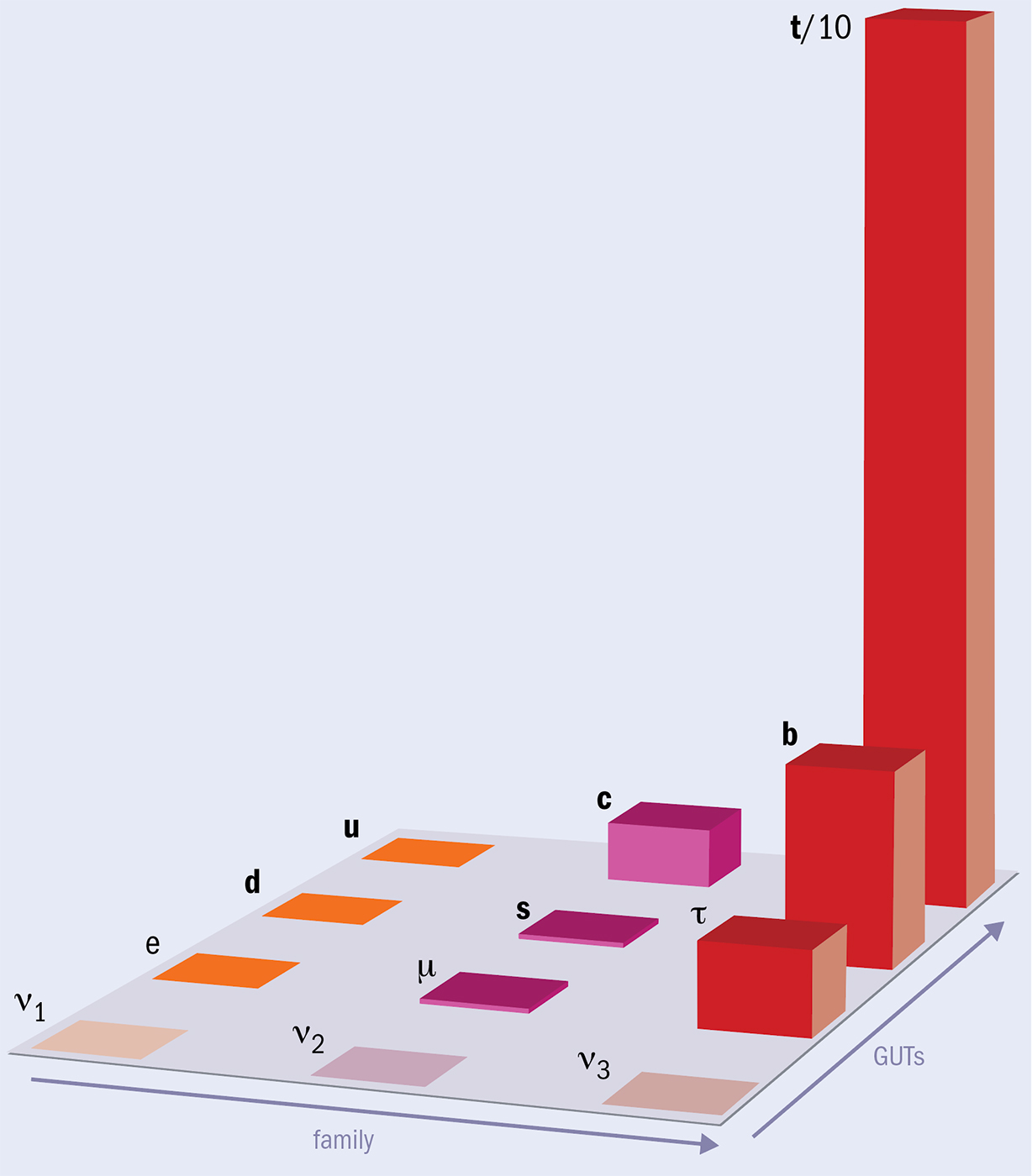
The diversity of the experimental physics programme is a strong feature of the strategy update. The briefing book lists outstanding puzzles that did not change in the post-Run 2 LHC era – such as the origin of electroweak symmetry breaking, the nature of the Higgs boson, the pattern of quark and lepton masses and the neutrino’s nature – that can also be investigated by smaller scale experiments at lower energies, as explored by CERN’s dedicated Physics Beyond Colliders initiative.

Finally, in addressing the vital roles of detector & accelerator development, computing and instrumentation, the report acknowledges both the growing importance of energy efficiency and the risks posed by “the limited amount of success in attracting, developing and retaining instrumentation and computing experts”, urging that such activities be recognized correctly as fundamental research activities. The strong support in computing and infrastructure is also key to the success of the high-luminosity LHC which, the report states, will see “a very dynamic programme occupying a large fraction of the community” during the next two decades – including a determination of the couplings between the Higgs boson and Standard Model particles “at the percent level”.

Following a drafting session to take place in Bad Honnef, Germany, on 20-24 January, the ESG is due to submit its recommendations for the approval of the CERN Council in May 2020 in Budapest, Hungary.

“Now comes the most challenging part of the strategy update process: how to turn the exciting and well-motivated scientific proposals of the community into a viable and coherent strategy which will ensure progress and a bright future for particle physics in Europe,” says Abramowicz. “Its importance cannot be overestimated, coming at a time when the field faces several crossroads and decisions about how best to maintain progress in fundamental exploration, potentially for generations to come.”

Hadron therapy to get heavier in Southeast Europe

Montenegro prime minister Duško Marković marks the start of the SEEIIST design phase on 18 September.

A state-of-the-art facility for hadron therapy in Southeast Europe has moved from its conceptual to design phase, following financial support from the European Commission. At a kick-off meeting held on Wednesday 18 September in Budva, Montenegro, more than 120 people met to discuss the future South East European International Institute for Sustainable Technologies (SEEIIST) – a facility for tumour therapy and biomedical research that follows the founding principles of CERN.

“This is a region that has no dilemma regarding its European affiliation, and which, I believe, will be part of a joint European competition for technological progress. Therefore, the International Institute for Sustainable Technologies is an urgent need of our region,” said Montenegro prime minister Duško Marković during the opening address. “I am confident that the political support for this project is obvious and indisputable. The memorandum of understanding was signed by six prime ministers in July this year in Poznan. I believe that other countries in the region will formally join the initiative.”

The idea for SEEIIST germinated three years ago at a meeting of trustees of the World Academy of Art and Science in Dubrovnik, Croatia. It is the brainchild of former CERN Director-General Herwig Schopper, and has benefitted from a political push from Montenegro minister of science Sanja Damjanović, who is also a physicist who works at CERN and GSI-FAIR in Darmstadt, Germany. SEEIIST aims to create a platform for internationally competitive research in the spirit of the CERN model “science for peace”, stimulating the education of young scientists, building scientific capacity and fostering greater cooperation and mobility in the region.

SEEIIST event

In January 2018, at a forum at the International Centre for Theoretical Physics in Italy held under the auspices of UNESCO, the International Atomic Energy Agency and the European Physical Society, two possibilities for a large international institute were presented: a synchrotron X-ray facility and a hadron-therapy centre. Soon afterwards, the 10 participating parties of SEEIIST’s newly formed intergovernmental steering committee chose the latter.

Europe has played a major role in the development of hadron therapy, with numerous centres currently offering proton therapy and four facilities offering proton and more advanced carbon-ion treatment. But currently no such facility exists in Southeast Europe despite a growing number of tumours being diagnosed there. SEEIIST will follow the  idea of the “PIMMS” accelerator design started at CERN two decades ago, profiting from the experience at the dual proton–ion centres CNAO in Italy and MedAustron in Austria, and also centres at GSI and in Heidelberg. It will be a unique facility that splits its beam time 50:50 between treating patients and performing research with a wide range of different ions for radiobiology, imaging and treatment planning. The latter will include studies into the feasibility of heavier ions such as oxygen, making SEEIIST distinct in this rapidly growing field.

The next steps are to prepare a definite technical design for the facility, to propose a structure and business plan and to define the conditions for the site selection. To carry out these tasks, several working groups are being established in close collaboration with CERN and GSI-FAIR. “This great event was a culmination of the continuous efforts invested since 2017 into the project,” says Damjanović. “If all goes well, construction is expected to start in 2023, with first patient treatment in 2028.”

KATRIN sets first limit on neutrino mass

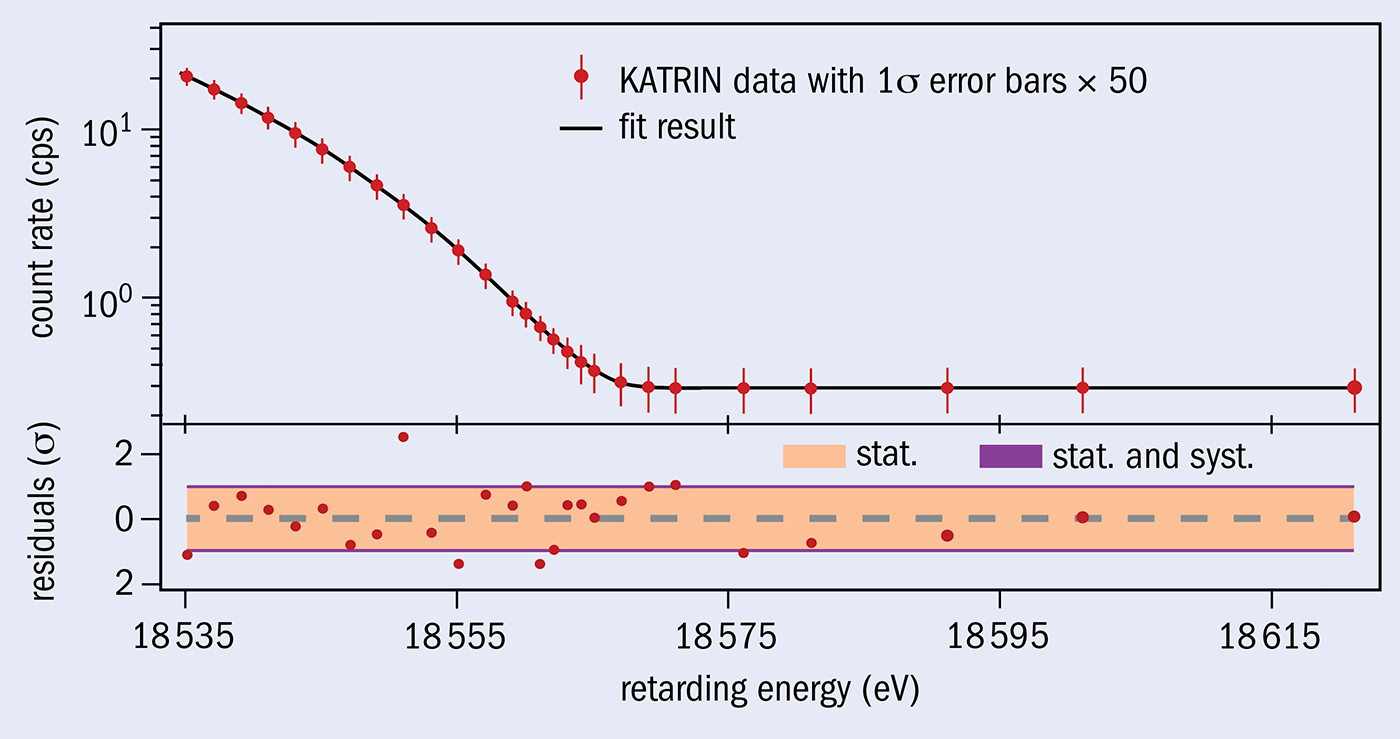
Based on just four weeks of running, researchers at the Karlsruhe Tritium Neutrino (KATRIN) experiment in Germany have set a new model-independent bound on the mass of the neutrino. At a colloquium today, the collaboration reported an upper limit of 1.1 eV at 90% confidence, almost halving the previous bound.

Neutrinos are among the least well understood particles in the Standard Model. Their three known mass eigenstates do not match up with the better-known flavour eigenstates, but mix according to the PMNS matrix, resulting in the flavour transmutations seen by neutrino-oscillation experiments. Despite their success in constraining neutrino mixing, such experiments are sensitive only to squared mass differences between the eigenstates, and not to the neutrino masses themselves.

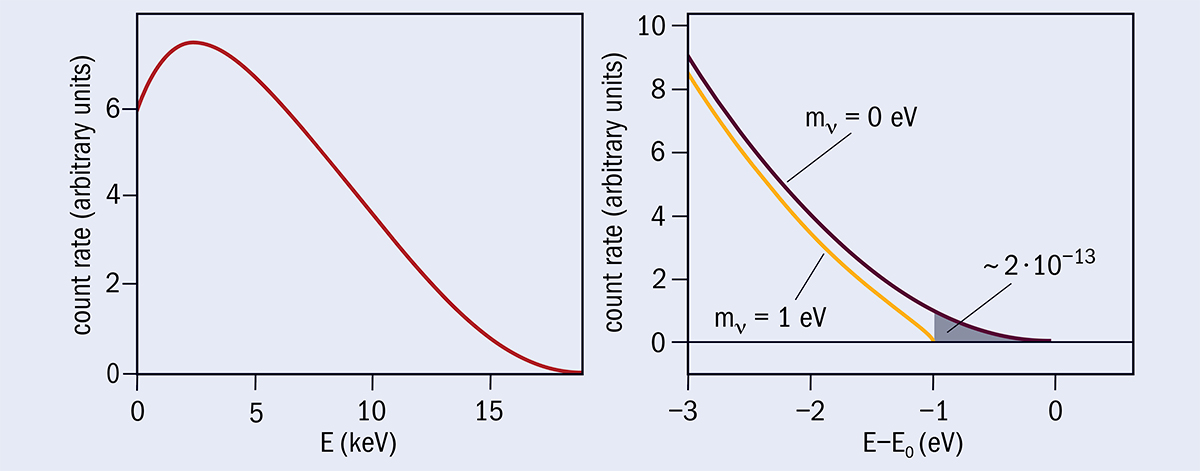
Physicists have pursued direct mass measurements since Reines and Cowan observed electron antineutrinos in inverse beta decays in 1956. The direct mass measurement method hinges on precisely measuring the energy spectrum of beta-decay electrons, and is considered model independent as the extracted neutrino mass depends only on the kinematics of the decay. KATRIN is now the most precise experiment of this kind. It builds on the invention of gaseous molecular tritium sources and spectrometers based on the principle of magnetic adiabatic collimation with electrostatic filtering. The combination of these methods culminated in the previous best limits of 2.3 eV at 95% confidence in 2005, and 2.05 eV at 95% confidence in 2011, by physicists working in Mainz, Germany and Troitsk, Russia, respectively. The KATRIN analysis improves on these experimental results, with systematic uncertainties reduced by a factor of six and statistical uncertainties reduced by a factor of two.

These are exciting times for the collaboration

Guido Drexlin

“These are exciting times for the collaboration,” said KATRIN co-spokesperson Guido Drexlin. “The first KATRIN result is based on a measurement campaign of only four weeks at reduced source activity, equivalent to five days at nominal activity.” To reach its final sensitivity, KATRIN will collect data for 1000 days, and systematic errors will be reduced. “This will allow us to probe neutrino masses down to 0.2 eV,” continued Drexlin, “as well as many other interesting searches for beyond-the-Standard-Model physics, such as for admixtures of sterile neutrinos from the eV up to the keV scale.”

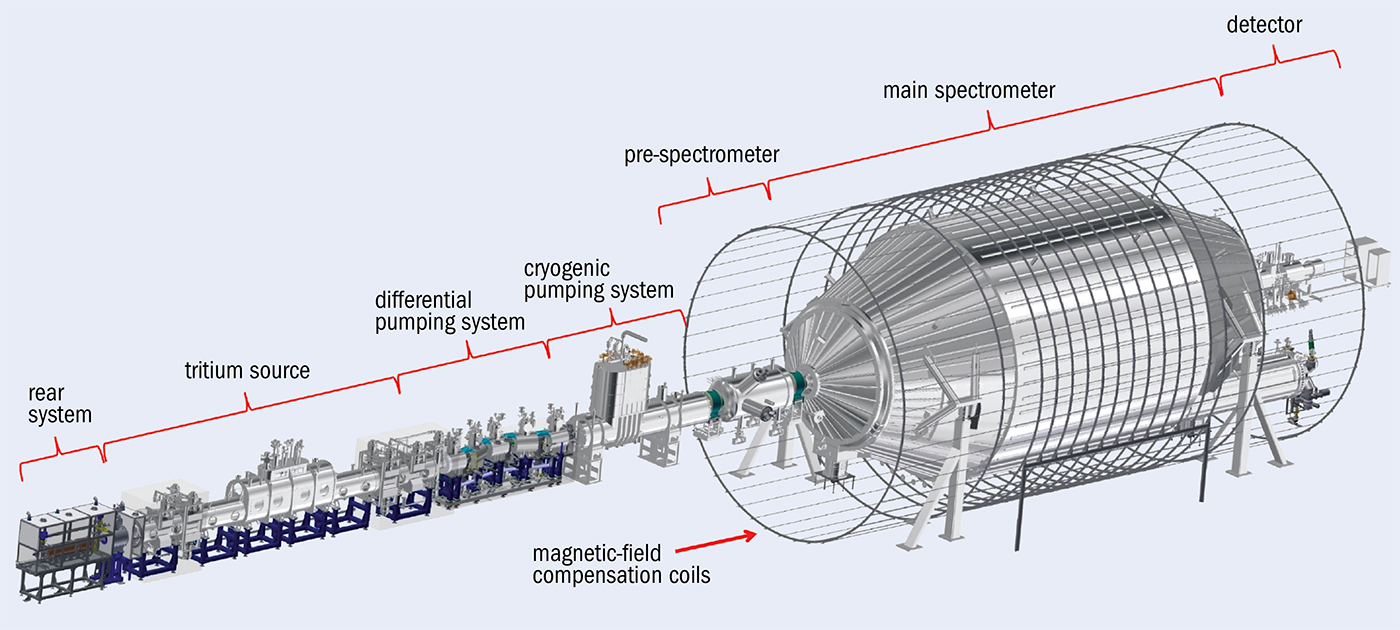
The KATRIN beamline

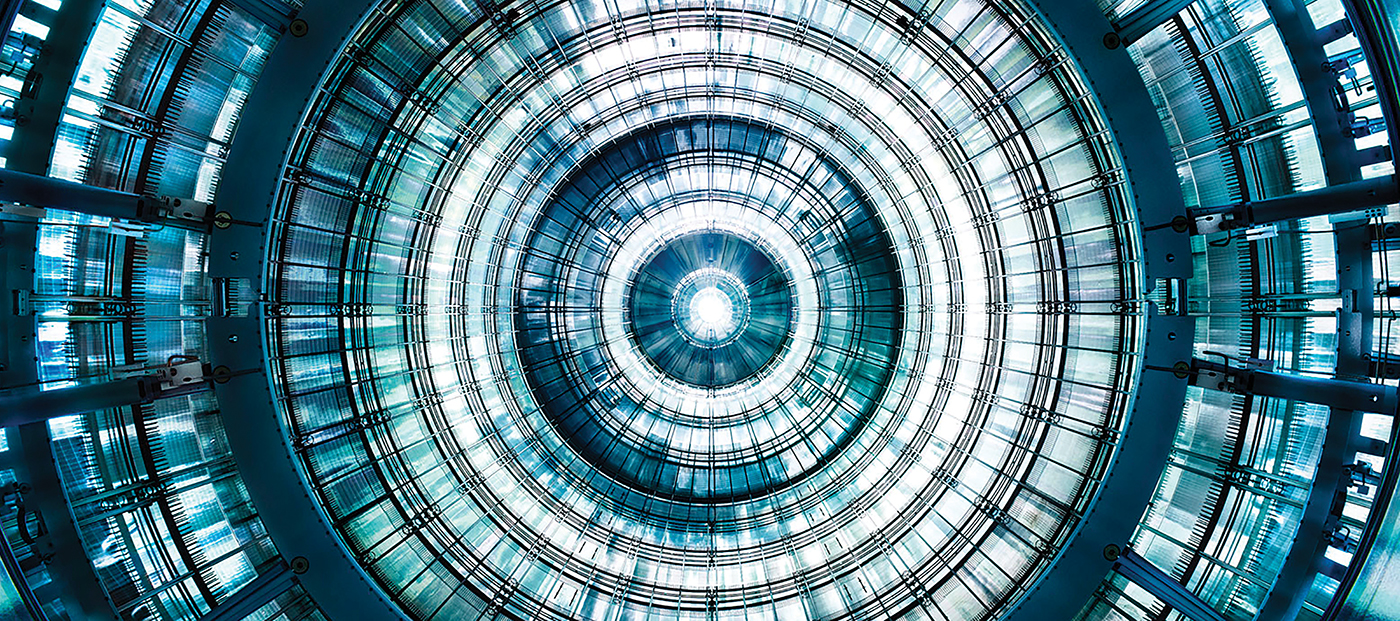
Conceived almost two decades ago, KATRIN operates using a high-resolution, large-acceptance and low-background measurement of the decay spectrum of tritium 3H → 3He e ν̄e. Electrons are transported to the spectrometer via a beamline that was completed in autumn 2016, allowing experimenters to search for distortions in the tail of the electron energy distribution that depend on the absolute mass of the neutrino. KATRIN collaborators are now looking forward to a two-month measurement campaign, which will start in a few days. It will feature a signal-to-background ratio that is expected to be about one order of magnitude better than the initial measurements, due to an increase in source activity, and a decrease in background due to hardware upgrades. The goal is to achieve an activity of 1011 beta-decay electrons per second, while reducing the current background level by about a factor of two.

Direct measurements are not the only handle on neutrino masses available to physicists, though they are certainly the most model independent. Experiments searching for neutrinoless double beta-decay offer a complementary limit, but must assume that the neutrino is a Majorana fermion.

The tightest limit on neutrino masses comes from cosmology. Comparing data from the Planck satellite with simulations of the development of structure in the early universe yields an upper limit on the sum of all three neutrino masses of 0.17 eV at 95% confidence.

The Planck limit is fairly robust, and one would have to go to great lengths to avoid it

Joachim Kopp

“The Planck limit is fairly robust, and one would have to go to great lengths to avoid it – but it’s not impossible to do so,” says CERN theorist Joachim Kopp. For example, it would be invalidated by a scenario where as-yet-undiscovered right-handed neutrinos couple to a new scalar field with a vacuum expectation value that evolves over cosmological timescales. “Planck data tell us what neutrinos were like in the early universe,” says Kopp. “The value of KATRIN lies in testing neutrinos now.”

Black-hole snap scoops 2020 Breakthrough Prize in Fundamental Physics

The first direct image of a black hole, obtained by the Event Horizon Telescope (EHT) collaboration earlier this year, has been recognized by the 2020 Breakthrough Prize in Fundamental Physics. The $3 million prize will be shared equally between 347 researchers who were co-authors of the six papers published by the EHT collaboration on 10 April.

The EHT is a network of eight radio dishes in Antarctica, Chile, Mexico, Hawaii, Arizona and Spain that creates an Earth-sized interferometer. Its ultra-high angular resolution images of radio emission from a supermassive black hole at the heart of galaxy M87* opened a new window on black holes and other phenomena. Recently, a team at Brookhaven National Laboratory used the EHT image to disfavour “fuzzy” models of ultra-light boson dark matter.

Also announced were six New Horizons Prizes worth $100,000 each, which recognize early-career achievements in physics and mathematics. In physics, Jo Dunkley (Princeton); Samaya Nissanke (University of Amsterdam) and Kendrick Smith (Perimeter Institute) were awarded for the development of novel techniques to extract fundamental physics from astronomical data. Simon Caron-Huot (McGill University) and Pedro Vieira (Perimeter Institute) were recognized for their “profound contributions to the understanding of quantum field theory”.

The Breakthrough Prize was founded in 2012 by former physicist and entrepreneur Yuri Milner, with sponsors including Google’s Sergey Brin and Facebook’s Mark Zuckerberg. In August, a Special Breakthrough Prize in Fundamental physics was awarded to Sergio Ferrara, Daniel Freedman and Peter van Nieuwenhuizen for the discovery of supergravity.

All prize recipients, along winners in mathematics and biology, will receive their awards at a ceremony in California on 3 November.

Black-hole image constrains ultra-light dark matter

EHT black hole

Hooman Davoudiasl and Peter Denton of Brookhaven National Laboratory have used the recent Event Horizon Telescope image of supermassive black hole M87* to disfavour “fuzzy” models of ultra-light boson dark matter with masses of the order of a few 10-21 eV (Phys. Rev. Lett. 123 021102). The inferred mass, spin and age of the black hole are incompatible with the existence of such fuzzy dark matter given the principle of superradiance, whereby quantum fluctuations deplete the angular momentum of a rotating black hole by populating a cloud of bosons around it. The effect depends only on the bosons’ mass, and does not presuppose any non-gravitational interactions. Future measurements of M87* and other spinning supermassive black holes have the potential to exclude the entire parameter space for fuzzy dark matter.

An intriguing alternative to cold dark matter, fuzzy dark matter could address the “core-cusp problem”, wherein observations of an approximately constant dark matter density in the inner parts of galaxies conflict with the steep power-law-like behaviour of cosmological simulations. The particles’ long de Broglie wavelengths, of the order of a kiloparsec, would suppress structure at this scale.

A new centre for astroparticle theory

Gian Giudice, Teresa Montaruli, Eckhard Elsen and Job de Kleuver

On 10 July, CERN and the Astroparticle Physics European Consortium (APPEC) founded a new research centre for astroparticle physics theory called EuCAPT. Led by an international steering committee comprising 12 theorists from institutes in France, Portugal, Spain, Sweden, Germany, the Netherlands, Italy, Switzerland and the UK, and from CERN, EuCAPT aims to coordinate and promote theoretical physics in the fields of astroparticle physics and cosmology in Europe.

Astroparticle physics is undergoing a phase of profound transformation, explains inaugural EuCAPT director Gianfranco Bertone, who is spokesperson of the Centre for Gravitation and Astroparticle Physics at the University of Amsterdam. “We have recently obtained extraordinary results such as the discovery of high-energy cosmic neutrinos with IceCube, the direct detection of gravitational waves with LIGO and Virgo, and we have witnessed the birth of multi-messenger astrophysics. Yet we have formidable challenges ahead of us: understanding the nature of dark matter and dark energy, elucidating the origin of cosmic rays, understanding the matter-antimatter asymmetry problem, and so on. These are highly interdisciplinary problems that have ramifications in cosmology, particle, and astroparticle physics, and that are best addressed by a strong and diverse community of scientists.”

The construction of experimental astroparticle facilities is coordinated by APPEC, but until now there was no Europe-wide coordination of theoretical activities, says Bertone. “We want to be open and inclusive, and we hope that all interested scientists will feel welcome to join this new initiative.” On a practical level, EuCAPT aims to coordinate scientific and training activities, help researchers attract adequate resources for their projects, and promote a stimulating and open environment in which young scientists can thrive. CERN will act as the central hub of the consortium for the first five years.

It is not a coincidence that CERN has been chosen as the central hub of EuCAPT, says Gian Giudice, head of CERN’s theory department. “The research that we are doing at CERN-TH is an exploration of the possible links between physics at the smallest and largest scales. Creating a collaborative network among European research centres in astroparticle physics and cosmology will boost activities in these fields and foster dialogue with particle physics,” he says. “Dark matter, dark energy, inflation and the origin of large-scale structures are big questions regarding the universe. But there are good hints that suggest that their explanation has to be looked for in the domain of particle physics.”

CERN and ESA join forces in harsh environments

The effects of radiation on electronics for the JUICE mission

Strengthening connections between particle physics and related disciplines, CERN signed a collaboration agreement with the European Space Agency (ESA) on 11 July to address the challenges of operating equipment in harsh radiation environments. Such environments are found in both particle-physics facilities and outer space, and the agreement identifies several high-priority projects, including: high-energy electron tests; high-penetration heavy-ion tests; assessment of commercial components and modules; radiation-hard and radiation-tolerant components and modules; radiation detectors, monitors and dosimeters; and simulation tools for radiation effects. Important preliminary results have already been achieved in some areas, including high-energy electron tests of electronics for the Jupiter Icy Moons Explorer (JUICE) mission performed at CERN’s CLEAR/VESPER facility.

CMS revisits rare and beautiful decays

Two muons emerge from a Bs → μμ decay candidate

The Bs meson is a bound state of a strange quark and a beauty antiquark – as such it possesses both beauty and strangeness. For many years the search for its extremely rare decay to a μ+μ pair was a holy grail of particle physics, because of its sensitivity to theories that extend the Standard Model (SM). The SM predicts the decay rate for Bsμ+μ to be only about 3.6 parts per billion (ppb). Its lighter cousin, the B0, which is made from a down quark and a beauty antiquark, has an even lower predicted branching fraction for decays to a μ+μ pair of 0.1 ppb. If beyond-the-SM particles exist, however, the predictions could be modified by their presence, giving the decays sensitivity to new physics that rivals and might even exceed that of direct searches.

It took more than a quarter of a century of extensive effort to establish Bsμ+μ, and the first observation was presented in 2013, in a joint publication by the CMS and LHCb collaborations based on LHC Run 1 data. The same paper reported evidence for B0μ+μ with a significance of three standard deviations, however, this signal has not subsequently been confirmed by CMS, LHCb or ATLAS analyses. A new CMS Run 2 analysis now looks set to bolster interest in these intriguing decays.

Diagram of probability contours

The CMS collaboration has updated its 2013 analysis with higher centre-of-mass-energy Run 2 data from 2016, permitting an observation of Bsμ+μ with a significance of 5.6 standard deviations (figure 1). The results are consistent with the latest results from ATLAS and LHCb, and while no significant deviation from the SM is observed by any of the experiments, all three decay rates are found to lie slightly below the SM prediction. The slight deficit is not significant, but the trend is intriguing because it could be related to so-called flavour anomalies recently observed by the LHCb experiment in other rare decays of B mesons (CERN Courier May/June p9). This makes the new CMS measurement even more exciting. The new analysis showed no sign of B0μ+μ, and a stringent 95% confidence limit of less than 0.36 ppb was set on its rate.

CMS also managed to measure the effective lifetime of the Bs meson using the several dozen Bsμ+μ decay events that were observed. The interest in measuring this lifetime is that, just as for the branching fraction, new physics might alter its value from the SM expectation. This measurement yielded a lifetime of about 1.7 ps, consistent with the SM. The measured CMS value is also consistent with the only other such lifetime measurement, performed by LHCb.

With three times more Run 2 data yet to be analysed by CMS, the next update – based on the full Run 1 and Run 2 datasets – may shed more light on this fascinating corner of physics, and move us closer to the ultimate goal, which is the observation of the B0μ+μ decays.

Run 2 data set pins down Higgs-boson properties

Diagram of the distribution of the invariant mass of four leptons

The LHC completed its Run 2 operations in December 2018, delivering a large dataset of proton–proton collisions at a centre-of-mass energy of 13 TeV. The ATLAS detector maintained a high level of readiness and performance throughout Run 2, resulting in 139 fb–1 of data for physics analyses.

An increasingly consistent picture of the properties of the Higgs boson is being drawn in light of the Run 2 data. This is thanks to a wide range of measurements, and particularly through the establishment of its couplings with third-generation quarks following the observation of the H → bb decay and associated ttH production.

The H → γγ and H → ZZ* → 4ℓ final states, where 4ℓ denotes 4e, 2e2μ or 4μ, provide clean experimental signatures that played a leading role in the discovery of the Higgs boson, and are ideal for precision measurements that could reveal subtle effects from new physics. ATLAS presented updated results for these two channels using the full Run 2 dataset at the 2019 summer conferences.

Using improved identification and energy calibration of leptons, photons and jets, and new analysis techniques, a sample of about 210 H → ZZ* → 4ℓ signal events (figure 1) and 6550 H → γγ signal events were selected to perform a series of measurements. The properties of the Higgs boson are investigated by measuring inclusive, differential and per-production-mode cross sections that are sensitive to different modelling aspects.

In the 4ℓ channel, differential cross-section measurements are performed as a function of the transverse momentum of the Higgs boson and the number of jets produced in association with it. The different production mechanisms of the Higgs boson are measured inclusively and in various regions of kinematic phase space, which are cleanly separated by neural networks.

In the high-statistics γγ channel, differential cross sections are measured for a set of variables related to the Higgs boson kinematics, as well as the kinematics and multiplicity of jets produced in association with the Higgs boson. The measured distributions are used to constrain modified interactions of the Higgs boson with SM particles.

Diagram of the differential cross section for the transverse momentum of the Higgs boson

The measurements in both channels are found to be well described by the SM predictions. Their combination yields a total Higgs-production cross section of 55.4 ± 4.3 pb, in agreement with the SM prediction of 55.6 ± 2.5 pb. The combined measurement of the transverse-momentum differential cross section (figure 2) has significantly improved in precision compared to earlier results. It is sensitive to the virtual processes governing the dominant Higgs-boson production through gluon fusion and to direct contributions from new physics.

Achieving 8% precision on the Higgs cross section is a significant step towards studying the electroweak symmetry breaking mechanism. Numerous additional measurements are being pursued by ATLAS in the Higgs-boson sector with the full Run 2 dataset to perform detailed tests of SM predictions and hunt for new phenomena.

Particle physics meets gravity in the Austrian Alps

Humboldt Kolleg participants

The Humboldt Kolleg conference Discoveries and Open Puzzles in Particle Physics and Gravitation took place at Kitzbühel in the Austrian Alps from 24 to 28 June, bringing Humboldt prize winners, professors and research-fellow alumni together with prospective future fellows. The meeting was sponsored by the Humboldt Foundation, based in Bonn, whose mission is to promote cooperation between scientists in Germany and elsewhere. The programme focused on connections between particle physics and the large-scale cosmological structure of the universe.

The most recent LHC experimental results were presented by Karl Jakobs (Freiburg and ATLAS spokesperson), confirming the status of the Standard Model (SM). A key discussion topic raised by Fred Jegerlehner (DESY-Zeuthen) is whether the SM’s symmetries might be “emergent” at the relatively low energies of current experiments: in contrast to unification models that exhibit maximal symmetry at the highest energies, the gauge symmetries could emerge in the infrared, but “dissolve” in the extreme ultraviolet. Consider the analogy of a carpet: it looks flat and invariant under translations when viewed from a distance, but this smoothness dissolves when we look at it close up, e.g. as perceived by an ant crawling on it. A critical system close to the Planck scale – the scale where quantum-gravity effects should be important – could behave similarly: the only modes that can exist as long-range correlations, e.g. light-mass particles, self-organise into multiplets with a small number of particles, just as they do in the SM. The vector modes become the gauge bosons of U(1), SU(2) and SU(3); low-energy symmetries such as baryon- and lepton-number conservation would all be violated close to the Planck scale.

Ideas connecting particle physics and quantum computing were also discussed by Peter Zoller (Innsbruck) and Erez Zohar (MPQ, Munich). Here, one takes a lattice field theory that is theoretically difficult to solve and maps it onto a fully controllable quantum system such as an optical lattice that can be programmed in experiments to do calculations – a quantum simulator. First promising results with up to 20 qubits have been obtained for the Schwinger model (QED in 1+1 dimensions). This model exhibits dynamical mass generation and is a first prototype before looking at more complicated theories like QCD.

The cosmological constant is related to the vacuum energy density, which is in turn connected to possible phase transitions in the early universe.

A key puzzle concerns the hierarchies of scales: the small ratio of the Higgs-boson mass to the Planck scale plus the very small cosmological constant that drives the accelerating expansion of the universe. Might these be related? The cosmological constant is related to the vacuum energy density, which is in turn connected to possible phase transitions in the early universe. Future gravitational-wave experiments with LISA were discussed by Stefano Vitale (Trento) and are expected to be sensitive to the effects of these phase transitions.

A main purpose of Humboldt Kolleg is the promotion of young scientists from the central European region. Student poster prizes sponsored by the Kitzbühel mayor Klaus Winkler were awarded to Janina Krzysiak (IFJ PAN, Krakow) and Jui-Lin Kuo (HEPHY, Vienna).

bright-rec iop pub iop-science physcis connect