Bluefors – leaderboard other pages

Topics

Crystals put spin on particle beam action

cernnews12_9-01

New investigations being made into the behaviour of charged particle beams as they pass through crystals suggest that the very high electric fields inside these crystals could be used to orient (polarize) the spins of the particles.

The spin of an electron can be imagined as equivalent to a tiny current-carrying coil. This coil will induce a neighbouring magnetic field, which will interact with any other electromagnetic field.

In the early 1960s it was seen that the interaction of this intrinsic electron magnetism with the magnetic field in a circular accelerator could be used to polarize circulating electrons. This is now routinely used to polarize beams of electrons in storage rings. However, this polarization takes hours to achieve because the fields are very weak.

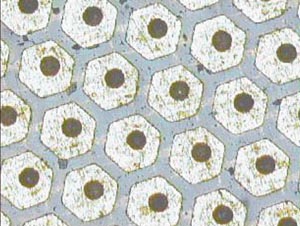
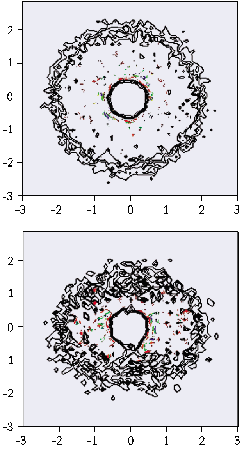
During the 1990s the NA43 collaboration at CERN made an in-depth study of what happens when a high-energy beam passes through various crystal structures. When such a beam penetrates a crystal, it “sees” a strong coherent electric field due to the nuclear constituents. Moreover, if the charged particles are moving at relativistic speeds, the apparent fields are even higher, attainingthe so-called critical field, 1016V/cm. Under these conditions, the electrons align their spin in the field in about the same time as it takes to traverse the crystal, 1 ps, instead of several hours.

Under these conditions the photons emitted in the individual electron spin-flips can also be studied. Such effects could be of interest for planned high-energy linear electron-positron colliders, such as CERN’s CLIC, and they are probably also found at the surface of neutron stars, where the fields are of a strength comparable to the critical field.

Another well-known crystal-beam effect is “channelling”, which is when the charged particle beam is steered through the crystal by its interior electromagnetic fields. Using a bent crystal provides a more economical way of steering a beam than conventional large magnets. Channelling in bent crystals is routinely used in experiments, notably the NA48 CP-violation study at CERN.

Proposed SPL machine could help provide neutrino beams

cernnews2_6-01

The imaginations of physicists all over the world have been fired by the quest for new schemes for making intense beams of neutrinos. Attention is now turning to the proton machines that may be able to provide these synthetic particles. At established laboratories like CERN, developing such proton drivers would offer new possibilities for boosting existing beam networks, as well as benefiting future ones.

The new idea involves muon storage rings. The first step is to use high-energy protons to produce pions, which decay to give muons. These are then quickly accelerated (their lifetime at rest is only 2 µs) and passed to a storage ring, where they decay. The key requirement is for a very intense proton accelerator that can deliver several megawatts of beam power.

At CERN, this has generated increased interest in the idea of a Superconducting Proton Linac (SPL), which had already been proposed as a new injector for the 28 GeV Proton Synchrotron (PS). The PS is CERN’s oldest machine, but it remains the heart of the laboratory’s unique particle beam system.

To deliver its 2.23 GeV protons, the SPL, operating at 352 MHz, would use radiofrequency equipment salvaged from CERN’s LEP electron-positron collider, which was closed at the end of last year. The SPL would in fact handle negative hydrogen ions (two electrons orbiting each proton), the classic medium for eventually supplying high-energy protons.

All 44 of the klystrons that previously powered LEP’s accelerating structures would be reused. They would operate in pulsed mode with a 30% duty cycle. Over the 800 m of the proposed linac design, the last 360 m (above a kinetic energy of 1085 MeV) would be equipped with 108 unmodified LEP-2 radiofrequency cavities. Between 390 and 1085 MeV, 12 LEP cryostats would also be employed, refurbished with new five-cell cavities. Suitable resonators would have to be developed for the lowest energy range.

Upstream, room temperature structures would be used, namely radiofrequency quadrupoles to supply the initial energy kick up to 7 MeV, and drift tube linacs up to 120 MeV. The linac would inject into an accumulator ring and then a bunch compressor ring before the tailored beam reaches the pion production target.

Such a high-power machine brings special design considerations. Electrical power increases with the repetition rate of the machine, and a compromise value of 75 Hz has been selected. Short proton bunches are needed to maximize the density of the muons, and the requisite 1 ns levels are difficult to achieve. However, deleterious effects are minimized by limiting the number of protons per bunch to 3.3 x 10⁸, using 140 bunches spaced by 23 ns.

The SPL would supply beams to the PS, and thence to the SPS and the LHC. Higher-performance beams could be delivered by the PS, thanks to the increased injection energy and higher density of the injected beam. This would have knock-on benefits for all of CERN’s machines, including the neutron time-of-flight facility and the antiproton decelerator.

Another happy SPL client would be the ISOLDE on-line isotope separator, especially in view of the ambitious plans of this physics community, which is looking for such a proton accelerator to drive the next-generation facility in Europe.

Neutron Time of Flight facility takes off smoothly at CERN

cernnews3_6-01

There was a new arrival among CERN’s family of particle beams when the laboratory’s first intense beam of neutrons was produced at the new neutron Time Of Flight (nTOF) facility. The nTOF opens the door to many corridors of research, ranging from fundamental science to new forms of energy generation, and it is complementary to CERN’s existing ISOLDE radioactive-beam facility.

The goal of the nTOF is to provide unprecedented precision in neutron kinetic energy determination, which will in turn bring much-needed precision in neutron-induced cross-section measurements. Such measurements are vital for a range of studies in fields as diverse as nuclear technology, astrophysics and fundamental nuclear physics. The nTOF will provide neutron rates some three orders of magnitude higher than existing facilities, allowing measurements to be made more precisely and more rapidly than in the past.

The lineage of the nTOF can be traced back to work that was carried out by CERN’s 1984 Nobel prizewinner Carlo Rubbia on a new, safe and clean way of extracting energy from the atomic nucleus. Rubbia’s Energy Amplifier is an example of an Accelerator Driven System (ADS) in which the thorium cycle would be put to work. Since thorium fission does not release sufficient neutrons to sustain a chain reaction, an accelerator would be used to produce the neutrons that drive the reactions.

In 1994, in a European Union-backed experiment at CERN, Rubbia’s team showed that the energy produced by fission is about 30 times that injected by the accelerated particle beam, giving a strong impetus to the Energy Amplifier concept. Then, in 1997, the Transmutation by the Adiabatic Resonance Crossing experiment used lead moderated neutrons to induce the transmutation of long-lived fission fragments from conventional reactors, and of elements yielding isotopes useful in nuclear medicine.

These early experiments demonstrated the viability of the Energy Amplifier concept and showed that ADS technology could have an impact on society that involved much more than energy generation. Experiments at the nTOF, which is financially supported by the European Union’s EURATOM programme, will now turn to the more technological issues of an ADS, measuring neutron cross-sections on structural and coolant materials as well as on fuel and fission products. In line with one of EURATOM’s main goals, special emphasis will be placed on the elimination of nuclear waste.

The nTOF collaboration, which consists of almost 150 scientists from 40 institutes, began its scientific programme by precisely calibrating the neutron spectrum. From there, the collaboration moved on to its first approved experiments, both of which are in the domain of astrophysics. One will provide neutron capture data needed for computing stellar reaction rates – data that will help to improve calculations of the age of the universe. The other will measure cross-sections important for understanding nucleosynthesis by slow neutron-capture, or the s-process, which is important for generating elements heavier than iron. For the future, a rich and varied range of proposals has been submitted to CERN’s ISOLDE and nTOF committee, promising an intense hive of scientific activity for many years to come.

ISOLDE tests the Standard Model

cernnews4_6-01

Tests of the Standard Model of particle physics are largely the domain of high-energy particle accelerators. However, a research programme recently inaugurated at CERN’s ISOLDE on-line isotope facility is demonstrating that low-energy experiments also have something to say – testing the Standard Model today, and looking for physics beyond it tomorrow.

Nuclear beta decay is nature’s way of redressing any uncomfortable imbalance between the number of protons and neutrons in a nucleus when either becomes excessive. It is a manifestation of the weak interaction, which acts over distances that are small compared with nuclear dimensions. That means that the nucleus can be used as a microlaboratory for investigating the weak interaction, thus putting the Standard Model to the test. ISOLDE is an ideal place for such research, because it is an abundant source of many isotopes with an uncomfortable mixture of protons and neutrons.

The nuclide chosen for ISOLDE’s Standard Model investigation is rubidium-74, which has equal numbers of protons and neutrons – an uncomfortable mixture in a heavy nucleus due to electrostatic repulsion – and is particularly suitable for the task. It decays with a half-life of around 65 ms to krypton-74 via a so-called super allowed Fermi beta transition in which only the vector component of the weak interaction is at work.

Nuclear beta decay, in which a neutron changes into a proton, is described in quark terms as the transition of a “down” quark to an “up” quark. The Cabibbo-Kobayashi-Maskawa matrix has three rows and three columns, which describe all possible quark transitions. Super-allowed beta decays give access to the up-down quark element, Vud, of the matrix. Combining Vud with the other elements, Vus and Vub, allows an important test (unitarity) of a Standard Model containing six quarks arranged pairwise in three generations.

Several experiments on relatively light isotopes have already given a very precise measurement. Curiously, these experiments are proving to be consistently at odds with the Standard Model, differing by more than two standard deviations.

The most precisely known of the three elements, Vud, also carries the most weight and, as such, is still the greatest source of uncertainty. This is due to the fact that the beta decay takes place in the nuclear medium, requiring theoretical corrections that must be constrained.

The precision expected from the latest ISOLDE experiments will allow the discrepancy observed in lighter nuclei, if confirmed, to be measured with greater significance and could therefore expose a small chink in the much vaunted Standard Model’s armour. The choice of rubidium-74 will also allow some important nuclear model distinctions to be made, because the heavier the nucleus, the more significant model-dependent Coulomb corrections become.

The ISOLDE experiments will explore three quantities involved in the decay of rubdium-74: the half-life and branching ratio of its super-allowed beta decay, and the mass difference between the parent and daughter nuclei – the Q-value of the decay. Experiments began in November 2000 using three different experimental facilities: the low-energy electron spectrometer ELLI, and the mass spectrometers ISOLTRAP and MISTRAL.

While MISTRAL was conceived specially for short-lived nuclei, the 65 ms half-life of rubidium-74 would normally have been far too short to be successfully measured by the tandem Penning trap spectrometer ISOLTRAP. However, recently developed ion-cooling techniques have allowed ISOLTRAP to extend its lower reach, thereby giving two independent measurements. In the game of high-precision mass determination, measurements by different instruments in the same regime of precision are important for cross-checking any hint of systematic error. ISOLTRAP has also succeeded in improving the measurement of mass of krypton-74, which further constrains the Q-value.

The new ISOLDE data are currently being analysed, with early indications suggesting small but significant deviations from previous mass values. The half-life of rubidium-74 is also the subject of similar studies at the Canadian TRIUMF laboratory’s new ISAC facility (March 2001 p10), the initial results of which have recently been published. The new ISOLDE spectroscopy results are in agreement with those of the ISAC facility, adding the equally important branching ratio measurement.

For the future, the ISOLDE programme aims to go one step further. Whereas ISOLDE today tests the Standard Model with rubidium-74, one of the first experiments scheduled for the REX-TRAP facility will use the nuclear microlaboratory to look for physics beyond the Standard Model. The WITCH experiment (Weak Interaction Studies Using an Electromagnetic Ion Trap), which is scheduled to run in 2002, will look for scalar and tensor components of the weak interaction – physics “forbidden” by the Standard Model.

Plasma-gas refraction improves on crystals

Experiments using a high-energy electron beam at the Stanford Linear Accelerator Center (SLAC) have shown the way in which such a beam can be bent as it crosses the boundary between a plasma and a gas.

Electrons in the gas are expelled by the electrostatic pressure at the head of the high-energy electron beam,  leaving a positively charged channel that steers the remainder of the beam. This force is asymmetric at the plasma boundary, there deflecting the beam in the same way that light is refracted.

These results confirm earlier simulations. According to the authors of the report, the results together show that “it is possible to refract and even reflect a particle beam from a dilute plasma gas. Remarkably, for a 28.5 GeV beam that can bore through several millimetres of steel, the collective effects of a plasma are strong enough to ‘bounce’ the beam off an interface that is one million times less dense than air.”

According to the SLAC-Southern California-UCLA team, the effects also suggest that beam refraction could lead to the replacement of bulky magnetic kickers in particle accelerators by fast optical kickers, or even the use of plasma fibre optics to make storage rings without magnets.

Particles can also be channelled by the arrangement of atoms in crystals, and specially bent crystals are already used in accelerator laboratories to steer high-energy beams. For example, a bent crystal is used at CERN’s SPS synchrotron to split off a small fraction of protons to generate neutral kaons for the NA48 CP violation experiment. The small crystal, which is only a few centimetres long, bends 450 GeV protons through 7.2 mrad, which would otherwise require a magnet 5 m long.

The deflection angles achieved by gas refraction are comparable to those provided by channelling in crystals. Unlike in crystal channelling, however, there are no losses from surface transmission. In addition the plasma, being much more dilute than a crystal, does not suffer from the same degree of loss due to scattering. Channelling expert Soeren Pape Moeller of Aarhus, Denmark, said: “The only serious difficulty is that it is without doubt a complicated device, 1.4 m long. Whether it can be turned into more modest and practical device, only time can show. But I think both the idea and the demonstration deserve attention.”

Fermilab launches Run II of Tevatron

Chris Tully made his first visit to Fermilab in 1988 as a high school student, representing the state of Virginia in the US Department of Energy’s national high school honours programme. He learned to string wires for the muon chambers at the D0 detector.

cernfer1_6-01

He returned 12 years later, on 13 December 2000, as a Fermilab Colloquium presenter, Princeton University physicist and CERN experimenter. This time he was reporting on the “tantalizing hints” for the Higgs mechanism that had shown up at CERN’s Large Electron-Positron (LEP) collider before the 8 November shutdown (seE Season of Higgs and melodrama).

Tully’s presentation echoed the global state of anticipation over the beginning of Collider Run II of the Tevatron – and the search for the origin of mass. “For eager Higgs hunters,” said Tully, “the immediate focus will be on the Run II results from Fermilab as the next possible source for direct evidence for the Higgs mechanism. Now that evidence suggests a low-mass Higgs, it might mean that Fermilab is in exactly the right place to observe a wealth of new physics.”

The whole world is watching, and the Higgs is far from being the only attraction as Fermilab opens Collider Run II of the Tevatron. In fact, Higgs candidates might not make an appearance for quite some time. CDF experiment co-spokesperson Franco Bedeschi estimates that five years of Run II would produce about 3000 Higgs candidates (out of 5 x 10¹⁴ proton-antiproton collisions) in the mass range of 115 GeV that is suggested by LEP results and other data.

cernfer2_6-01

So what else is new? Almost everything: new particles; new dimensions; new top quark measurements and production channels; and new CP violation results in B physics. “There is the possibility of finding something definitive early on,” said theorist Chris Hill. “For example, it’s possible that we will uncover a new layer of physics with new strong dynamics. That could show up in the first inverse femtobarn.”

Near the top of the Run II wish list is the top quark. Discovered at the Tevatron in 1995, the top is due for a step up in precision and a new production mode. Called single top production, the process starts with an up quark annihilating against a down quark (within the Tevatron’s proton-antiproton collisions). Out pops a “virtual” W boson, which quickly decays into a top and an antibottom.

“Single top production has never been observed before,” said Hill. He described it as a “new window into the top”, offering a view of how the top couples to the W boson. It also provides tests of the Standard Model and background for Higgs production.

Precision measurements of the masses of the top quark and the W also serve as constraints on the Higgs mass. “These precision electroweak tests use the top mass and the W mass in combination with other measurements to predict the Higgs mass,” Hill continued. “You then have the potential to define precisely where the Higgs ought to be, and check it with a discovery.”

In Run I, Fermilab produced a grand total of 150 top quarks. Run II, however, will yield thousands. The top is also a route into supersymmetry – the theory that all Standard Model particles have “superpartners.” But it’s a route with a twist.

“It seems to work in reverse,” Hill explained. “Because the top is heavy, many people expect its superpartner – the ‘stop’ – to be light. The production of a ‘top’ and an ‘antistop’ are possibilities, although the decay modes are very model-dependent: you have to determine what they’re decaying into. There are many possible channels, but ‘stop’ production is something people might expect in Run II.”

cernfer3_6-01

Fermilab discovered the fifth – “bottom” – quark in 1977. The field of B physics measures the behaviour of particles containing bottom quarks, known as B mesons. The decays of B mesons and their antimatter counterparts produce subtle differences that could go a long way towards explaining the universe’s preferential treatment of matter over antimatter, leading to life as we know it.

Here, the key quantity differentiating the decays is sinß, and the goal is to measure that quantity as accurately as possible. Fermilab’s Collider Detector Facility (CDF) collaboration set a new standard in sin2ß measurement with data from Collider Run I, establishing a value of 0.79 ± 0.4, which is consistent with Standard Model predictions of a large positive CP-violating asymmetry in this decay mode – in other words, a big gap between the behaviour of matter and antimatter.

Then along came the BaBar experiment at PEP-II, the electron-positron collider at the Stanford Linear Accelerator Center (SLAC) and the Belle experiment at the KEKB collider in Japan, which have recently reported more accurate results. “CDF will be very competitive,” said Hill. “When CDF is back up to speed, they’ll be able to address CP violation in the B system.”

Fermilab has a long history of offering up something extra, and this may be a bonus for Run II. Hope springs from luminosity, a measure of the number of collisions that the Tevatron can produce to light up the field with new discoveries, Higgs and otherwise.

“The big question is: can we get the integrated luminosity?” said veteran CDF experimenter Henry Frisch of Chicago. “If we make enough Higgs candidates, the newly upgraded detectors will definitely be capable of seeing them.”

Tevatron

The issue of making enough candidates applies to the entire range of Run II science. That puts the focus on Fermilab’s Beams Division, which performs the intricate task of creating antiprotons, “cooling” them into intense beams and colliding them with proton beams.

The Beams Division has a long and distinguished history of exceeding its goals. For example, the original design goal for the Tevatron collider luminosity was 1030/cm2/s, which corresponds to about 50 000 proton-antiproton collisions per second witnessed at each detector.

The Beams Division took that goal and exceeded it by a factor of about 16. It got to 1.6 * 1031, which corresponds to a collision rate of about 800 000/s. “Now we’re talking about something in the order of 10 to 20 times that number – as many as 10 to 15 million collisions per second,” Frisch stressed.

Luminosity holds the key to discoveries – specifically, integrated luminosity, or the number of total collisions over the course of the run. Frisch explained that the Higgs has an extremely small cross-section – physics-speak for the probability that a proton would actually produce a Higgs particle, or any specific particle under investigation. The equation in question is simple: (luminosity) x (cross-section) = collision rate, or number of events per second. Thus a small cross-section requires lots of luminosity to produce a significant number of observable events.

cernfer5_6-01

“The people in the Beams Division have always had wonderful ideas to get the luminosity up,” Frisch said. “We’re not yet running up against a ‘brick-wall’ limit set by physical law. Clever ideas, new techniques and a lot of hard work may well get us what we need.”

All this is happening against a background of pushing forward with the MINOS and MiniBooNE neutrino experiments; and of the lab’s continuing support for CERN’s LHC and its Compact Muon Solenoid detector.

“Looking from the outside,” said Chris Tully, perhaps wistfully, “the prospects for Run II at Fermilab are very promising if new physics is sitting just beyond what LEP was able to explore.”

*FermiNews is a biweekly magazine published by Fermilab’s Office of Public Affairs.

Isotope source hits target

cernisac1_6-01

The Isotope Separator and Accelerator (ISAC) at TRIUMF uses the on-line isotope separation technique that was developed at CERN to produce relatively intense beams of short-lived exotic nuclei for experiments in nuclear astrophysics and nuclear and condensed-matter physics. A 500 MeV beam of protons from the TRIUMF cyclotron is used to create the rare isotopes in a thick heated target, from which they effuse and are then ionized, extracted as a beam, separated by mass and accelerated. The first stage, ISAC-I, passed a major milestone on schedule last December when a 4He+ beam was accelerated through the continuous-wave radiofrequency quadrupole (RFQ) and drift-tube linacs to the design energy of 1.5 MeV nucleon.

Users have been running experiments with radioactive ion beams with an atomic mass of less than 30 at up to 60 keV since November 1998, and they have now begun taking data at full energy. The 20 µA proton beams used until now make this the highest-power ISOL source. The current is being raised to 40 µA, and a target has been tested to the full 100 µA design capability.

The importance of studying the properties of exotic nuclear isotopes has been increasingly recognized by physicists and astronomers in recent years (see OECD Megascience Forum report or Echoes of a report), and almost a dozen radioactive ion beam projects are now under way around the world. Research at ISAC-I focuses on the nuclear processes occurring in stars – where the high densities and huge numbers involved can lend importance to even short-lived isotopes – and on precision tests of the Standard Model of particle physics.

The ISAC ion source and target system is suspended at the bottom of a 2 m long iron shield block that can be lifted out of its vacuum enclosure and transported, as a unit for servicing, to a hot cell by a remotely operated crane. This system was designed to increase the useful target lifetime and decrease the exposure of personnel to radiation during servicing. In fact, the shielding permits the operation of thick uranium targets with up to 50 kW of proton beam.

cernisac2_6-01

Although the initial range of isotopes is limited by the use of a surface ion source to provide isotopes that can easily be thermally ionized, the list of available nuclei will expand considerably in 2002, when a 2.45 GHz electron-cyclotron resonance ion source (ECRIS) is scheduled to begin operation. Any isotope with an atomic mass of less than 240 and an energy of up to 60 keV can be transported, with the aid of electrostatic optics, through a magnetic mass analyser (mass resolution one part in 10 000), either to one of several low-energy experimental stations, or to the low-frequency (35 MHz) continuous-wave RFQ linac.

The 8 m long RFQ, which has a four-rod split-ring design, accelerates ions with a mass:charge ratio of less than 30 from 2-150 keV per nucleon. An 11.7 MHz pseudo-sawtooth prebuncher in the injection line is used to fill every third radiofrequency bucket in the RFQ, forming beam bunches at 87 ns intervals. The accelerated beam is then bunched again, stripped by a carbon foil to a higher charge state, rebunched and accelerated in a five-tank drift-tube linac (DTL) operating continuous wave at 105 MHz.

The DTL has a completely separated-function design, with the interdigital H-mode accelerating cavities separated by magnetic quadrupole triplets for transverse and three-gap split-ring bunchers for longitudinal focusing (the latter having been developed for ISAC by INR Moscow). The final beam energy, for selected ions with a mass:charge ratio of less than 6, is continuously variable at 0.15-1.5 MeV/nucleon.

The higher-energy experimental facilities reflect the emphasis on nuclear astrophysics. A large-acceptance recoil spectrometer system (DRAGON) is being commissioned to study the radiative capture reactions involved in explosive events like novae, supernovae and X- and gamma-ray bursts. To complement it, a large-acceptance scattering facility (TUDA) has been developed to locate resonances of interest in the corresponding compound nuclei.

The programme will focus on proton and alpha radiative-capture reactions in the low-mass (A<30) region. The first scheduled experiment will try to establish the rate for the 21Na(p, g22Mg reaction, which determines the production of sodium-22 in nova explosions of O-Ne-Mg-rich white dwarfs. With a 2.6 year half-life and a 1.275 MeV decay gamma ray, sodium-22 is the prime candidate for nova sightings in the next round of satellite-based gamma-ray searches, such as the ESA INTEGRAL mission.

cernisac3_6-01

The low-energy beams (up to 60 keV) are used in a broad programme covering fundamental symmetry tests, nuclear structure studies in exotic nuclei and condensed matter studies using light-polarized ions. Precision measurements of pure-Fermi beta-decay lifetimes, branching ratios and Q values (currently under way on rubidium-74) will improve the testing of the weak interaction theory and the determination of up-down quark mixing, while correlation studies in beta decay with trapped atoms (the TRINAT programme with metastable potassium-38 and polarized potassium-37) are placing constraints on extensions of the Standard Model.

A low-temperature nuclear orientation refrigerator (LTNO) for on-line nuclear magnetic resonance and perturbed angular correlation studies, and a large germanium gamma-ray detector array (the former Chalk River 8- spectrometer) are to be used in studies of nuclear deformation in transitional regions (mass band 80-100 and near 180).

Novel facility

A novel facility for beta-NMR (nuclear magnetic resonance) studies of condensed (especially superconducting) materials is being commissioned. Light polarized ions (currently lithium-8) are produced via collinear polarized laser beam excitation, while the spectrometer sits at an adjustable high voltage. The range of the ions can be adjusted so that they stop on the surface of the sample or at a prescribed depth, allowing studies of magnetism on surfaces, in thin layered materials and at interfaces.

With ISAC-I coming into full operation, TRIUMF is now turning to the construction of ISAC-II, funding for which was approved by the Canadian government last year for completion in 2005. This will involve adding a 6.5 MeV/nucleon superconducting linac and a new experimental hall, and will not only increase the ion energies but also allow the mass range to be extended to atomic masses of around 150. This will enable the electrostatic barrier to be overcome for all target nuclei, opening up a range of nuclear structure physics with proton- or neutron-rich projectiles – particularly studies of nuclei near the limits of stability, although a strong focus on nuclear astrophysics will remain.

Super Proton Synchrotron marks its 25th birthday

cernsps1_6-01

On the afternoon of 17 June 1976, CERN executive director-general John Adams addressed the CERN governing body, Council. After he had reported on the operation status of CERN’s various accelerators, he turned to its newest addition, the Super Proton Synchrotron (SPS), and announced that the machine had just accelerated protons to 300 GeV – the energy specified in the programme previously approved by Council.

With the dignified aplomb that characterizes the making of CERN’s major decisions, Adams then politely consulted Council about increasing the energy of the machine to 400 GeV, a possibility that had been formally discussed three years earlier. The motion was duly approved at 1530 h. Five minutes later, as Council continued its formal business, Adams was able to inform the meeting that the SPS had duly delivered 400 GeV protons.

Adams had always had a fine sense of occasion when announcing the successful operation of his new machines. Some 17 years earlier, in November 1959, he had displayed an empty bottle of vodka during his announcement to CERN staff that the Proton Synchrotron (PS) had reached its design energy of 25 GeV. He had been given the full bottle several months earlier on a trip to Dubna in the Soviet Union, with strict instructions that it should be drunk immediately after the PS had surpassed the world record energy of 10 GeV, then held by Dubna’s synchrophasotron.

However, the 400 GeV achieved by the SPS on 17 June 1976 was not a world record. In the US, Fermilab’s Main Ring, the 6.4 km circumference of which was comparable to that of the SPS, had already been in operation for several years. On 14 May 1976, a matter of days after the SPS had achieved an initial circulating proton beam (with no accelerating radiofrequency power) on 3 May, Fermilab took its protons all the way to 500 GeV. This achievement provided the opportunity to introduce a new energy scale, the teraelectronvolt (TeV), equal to 1000 GeV. The Fermilab Main Ring had become a 0.5 TeV machine.

A proud moment for Europe in June 1976 had, therefore, already been upstaged by Fermilab. CERN had lost the multihundred giga-electronvolt synchrotron race, and the European community gritted its teeth and prepared for the next round.

On the table this time was Carlo Rubbia’s proposal to convert a multihundred GeV synchrotron like Fermilab’s Main Ring or CERN’s SPS into a proton-antiproton collider. Fermilab left this imaginative proposal where it was, having initially preferred to build a second ring, this time superconducting, to merit the title of Tevatron. In this way Fermilab pioneered a cryogenic route to large proton synchrotrons.

cernsps2_6-01

CERN, though, picked up the proton-antiproton collider challenge and resolutely sprinted with it all the way to the finish line. The new CERN proton-antiproton complex provided its first collisions in 1981, and two years later it was the scene of the epic discovery of the W and Z boson carriers of the weak interactions.

Since it was commissioned in 1976, the SPS has learned how to accelerate antiprotons (for the SPS proton-antiproton collider), electrons and positrons (the SPS was the injector for CERN’s LEP electron-positron collider) and heavy ions (for a new research programme that began in the mid-1980s). The proton-antiproton collider is no more, and nor is LEP, but the veteran SPS is still having to learn many more new tricks to supply high-intensity proton beams to CERN’s LHC collider, which is scheduled to begin operations in 2006. The SPS will also be supplying the particles that will generate the neutrinos to be sent to the Italian Gran Sasso laboratory 730 km away. This year, to celebrate its 25th birthday, the SPS is supplying proton beams for a major physics run.

It is a tribute to John Adams and the team that designed and built the SPS that their machine has met all of the challenges of the past 25 years, and will surely continue this tradition in the future. The precision of the SPS survey and construction work, the sheer perfection of its magnets, its computer-driven control system and its robust power supplies have all contributed to this success. Foresight has been the key.

In addition, the SPS was CERN’s first machine to straddle an international frontier, breaking new ground in diplomacy and administration as well as in science and technology. The SPS supplied (and continues to supply) beams to two distinct experimental areas – one on the main CERN Meyrin site and the other on the Prévessin site, several kilometres away.

A second CERN

The initial proposal had been that the SPS would be built on an entirely new “greenfield” site somewhere else in Europe: a second CERN. Countries vied with one another to host the new machine, and political wrangling delayed a final decision. It took the Solomonic wisdom of John Adams to convince everybody of the advantages of building a new machine next to CERN’s existing site and using the Proton Synchrotron as the injector.

The idea was accepted, but the second CERN still went ahead. While the SPS was being constructed in the early 1970s, these two sites were known as CERN I (the original site based on Swiss territory) and CERN II (in France), and each site was run by its own director-general. Despite the obvious advantages of inherited proton infrastructure, grafting a CERN site in France onto one based in Switzerland had called for some imaginative administration. The two sites also looked very different, with the CERN II buildings harmonizing with their verdant surroundings in stark contrast with the postwar utility concrete of the original CERN site.

In 1975, CERN Council voted to merge the two laboratories, but a vestigial duality was to remain for another five years, with two director-generals heading the laboratory: John Adams as executive director-general of the united laboratory and Leon Van Hove as its research director-general. It was not until 1981 that the larger CERN came under a single director-general, Herwig Schopper.

Preparing for the future

cernsps3_6-01

The SPS will be the final pre-injector for the LHC, accelerating 26 GeV protons from the PS to 450 GeV before extraction via two specially built links connecting the SPS and the LHC ring tunnels (figure 2). Many changes to the existing SPS will be necessary before it can deliver the high-brightness proton beams required by the LHC.

To accomplish this, the main hardware modifications and additions will include an upgrade to the existing 200 MHz travelling wave radiofrequency system; the construction of a new extraction channel and modification to the existing ones; upgrades to the beam instrumentation, the transverse damper, the transfer lines, and the injection and extraction kickers; the development of a fast beam scraper; and an upgrade to the internal beam dump. Measures to reduce the impedance will also be taken.

This programme is already well under way, and work last year had to be conducted in such a way that LEP operations were not disturbed. During the past seven-month shutdown, the SPS has received a major facelift. In addition to the work already mentioned, the civil engineering required to connect the new transfer tunnels to the LHC ring tunnel has been carried out and major changes to the infrastructure and services for the machine have been made.

Reducing the impedance of the machine has involved clearing out all of the equipment previously used to provide beams to the LEP and the installation of shields to smooth the transitions in the vacuum chambers around the machine. This last activity alone involved removing and reinstalling half of the main magnets of the machine (some 400 in total) and most of the auxiliary magnets, requiring the displacement of around 8000 tonnes of material.

Work on upgrading the SPS will continue during the next two annual shutdowns, by which time all of the elements will be in place to allow commissioning of the new extraction channel in time for the first LHC injection tests, planned for 2004. One year later, the same extraction channel will be used to send a high-intensity proton beam towards a target for the CERN-Gran Sasso project for long-distance neutrino experiments. From 2006, the SPS will have to deliver a 450 GeV proton beam to the LHC on demand, as well as beams for Gran Sasso neutrinos and for the current experimental areas. During 2007, high-brightness heavy-ion (initially lead) beams for the LHC at 177 GeV per nucleon will be added to its repertoire. Plans for intermediate ions for LHC in later years are already under way.

The future of the SPS is assured for a long time to come.

Lasers make light work

cernart1_6-01

When CERN started working in collaboration with the London Institute on the Signatures of the Invisible project, I was nominated to work with UK artist Ken McMullen, who needed me to fabricate a scaled metallic model of his paper creation “Crumpled Theory”.

At CERN I make items according to detailed specifications from physicists and engineers. Although the project with Ken was very different, I was surprised to find quite a few parallels between it and my normal work. In both cases time was a constraint, and the goal was the transformation of a requirement or idea into hard reality. However, whereas the pieces I make for CERN have to meet criteria dictated by their functionality, the success of this work was measured by aesthetics and non-functionality.

Light was going to play an important part in the finished work. Ken was going to present the result in the gallery using different lighting effects, which would ultimately determine how it would be perceived. Taking this into consideration, I decided to use lasers during the manufacturing process wherever possible. Lasers are the ultimate sources of light, and their concentrated beams generate intense heat.

I had some initial discussions with Ken to see whether building this scaled piece of art would actually be feasible. Following this early exploration, I proposed how we could make the piece and, after some fine-tuning, we finalized the fabrication method.

The idea was to represent Ken’s “Crumpled Theory” using five baseplates, each mechanically machined with 20 grooves, along with 100 profiled segments, each of which would be fixed into a groove in the appropriate lateral (x) position.

The first stage was to scan the crumpled piece of paper. This was done in CERN’s metrology department using a helium-neon laser. The surface scans were represented by x and z co-ordinates. A total of 100 scans were made for every 3 mm of the paper, covering its whole length. These co-ordinates were then manipulated and scaled up by a factor of four in both the x and z directions, using a specially written computer program.

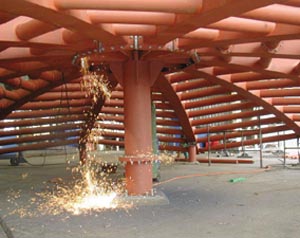
After we had written the required numerical control programs, the 100 stainless steel segments were laser cut. A high-power Nd:YAG laser burned through the stainless steel using oxygen as an assist gas to increase cutting efficiency. The resulting 100 profiled segments would be laser welded to the five baseplates produced in CERN’s mechanical workshops by conventional machining methods.

cernart2_6-01

Once the baseplates had been made, the assembly process could get under way. We made calculations to ensure that each segment was correctly positioned before it was attached. All 100 segments were subjected to the trauma of laser-welding, a violent procedure in which the materials are heated up in a fraction of a second, fuse together and then cool quickly, which causes some localized internal stresses. A series of spot welds gave the effect of the segments being stitched to the baseplate.

The finished piece was simply presented on the workshop floor, with sunlight streaming through the blinds. Ken was at CERN just at the right time to get a glimpse of it before it was shipped to England, and he was delighted. His enthusiasm was a most unusual experience for me. Normally on completion of a job at CERN a perfunctory “thank you” is the only response.

I found the whole project, as well as Ken’s reaction on its completion, very rewarding and motivating. Ken’s interest in and passion for the project meant that I thoroughly enjoyed the experience of working with him, and our thought-provoking conversations.

Neutrinos get their grand OPERA

cernnews1_5-01

The 2000 tonne OPERA (Oscillation Project with Emulsion Tracking Apparatus) experiment has been approved for construction and operation in the CERN Neutrino Beam to Gran Sasso project. The experiment involves 33 research institutes in 12 countries, including CERN, China and Japan.

The CERN Neutrino Beam to Gran Sasso project, now under construction, will send a beam of high-energy neutrinos from CERN to the Italian underground Gran Sasso laboratory, a distance of 730 km, where the OPERA detector will be assembled. The first neutrinos are expected to be sent in 2005.

Classically, neutrinos come in three varieties – electron, muon and tau, depending on their partner particles. These neutrino varieties are supposed to be immutable, so that a neutrino born alongside a muon should remain a muon neutrino for ever.

However, major experiments monitoring the arrival of neutrinos produced in the atmosphere by cosmic rays provide strong indications that neutrinos are not immutable (see How long until the next supernova?). To explain this observed behaviour, some neutrinos that start off muon-like could transform en route into tau-like neutrinos.

To maximize the chances of seeing such neutrino “oscillations”, the experiment needs a long “baseline”, in this case the 730 km between CERN and the Gran Sasso laboratory. Because of these oscillations, a neutrino beam starting off muon-like as it left CERN would contain tau-neutrinos on arrival at Gran Sasso. When they interact, these tau-neutrinos can produce highly unstable tau leptons, which decay within 1 mm of the neutrino interaction point. Recognizing these tiny decay kinks is the main goal of the OPERA experiment.

To do so it must use a detector with excellent spatial resolution over its whole 2000 tonne mass. The technique chosen is that of the Emulsion Cloud Chamber (ECC), with sheets of passive absorber (lead) material interspersed with emulsion layers to reveal the tracks left by neutrino interactions. The basic OPERA unit is a cell made of a 1 mm thick lead plate followed by a thin film, made of a pair of 50 µm emulsion layers on either side of a 200 µm plastic base (figure 1). Cells will be arranged in turn in removable “bricks”, and the bricks used to build “walls”, modules and supermodules. Downstream of the ECC lattice will be a muon spectrometer.

cernnews2_5-01

Each removable brick, weighing 8.3 kg, will have dimensions of 10.2 x 12.7 cm transverse to the beam and 7.5 cm along the beam, and will be made up of 56 individual cells. A wall will be built of 3264 bricks and, with two planes of electronic trackers (plastic scintillator read out by wavelength-shifting fibres), will make up a module. Each target supermodule will consist of 24 modules, and the whole detector, with a cross-section of about 6 x 7 m perpendicular to the beam, will contain three supermodules, representing a total of 235 000 bricks.

The effectiveness of the ECC technique was shown last year through its use in the first observation of explicit tau neutrino signals by the DONUT (Direct Observation of the NU Tau) experiment at Fermilab (see DONUT comes to neutrino town ). DONUT monitored the neutrino outcome after slamming a high-energy proton beam into a compact “beam dump”, thus generating a small number of tau-like neutrinos directly, rather than through oscillations.

Because of its natural divergence, by the time the neutrino beam reaches Gran Sasso it will have spread out across an area of about 800 m. This means that OPERA, mighty as it is, will only see a small slice of the arriving beam.

To build the detector, an assembly line at Gran Sasso will stack lead plates and emulsion films into bricks at the rate of about two per minute. Computer-controlled robots will arrange the bricks in their allocated positions. It will take about a year to fill the detector with bricks.

cernnews3_5-01

Emulsion films have a long history in particle physics experiments, one milestone having been the discovery of the pion in 1947 cosmic-ray studies. Automatic emulsion scanning by computerized microscopes was pioneered by the Nagoya group, starting in the late 1970s. Japanese emulsions were used for the CHORUS neutrino experiment at CERN and for DONUT at Fermilab. However, OPERA will need a much greater amount of emulsion than any of its predecessors, and new industrial techniques are being perfected in a collaboration between Nagoya and Fuji Film.

While the experiment is running, the complete detector will be continuously monitored by its own electronic detectors. These electronic trackers, located downstream of each wall, will also be used to identify the brick where a neutrino interaction occurs. These bricks (about 30 per day) will be removed outside the underground hall for calibration. They will then be taken apart and the emulsion plates developed.

Faster scanning procedures than those used for the CHORUS and DONUT experiments will be needed to locate the neutrino interactions. These are now being developed. Further scanning will search for a tell-tale millimetre track followed by a kink, the characteristic fingerprint of a tau decay and therefore of a tau-neutrino interaction.

At the neutrino oscillation rate suggested by experiments to date, OPERA should see about 15 tau-neutrino interactions in five years of running with the nominal performance of the neutrino beam from CERN to Gran Sasso. If so, it will have proved that the disappearance of muon-like neutrinos observed in atmospheric neutrino experiments is indeed due to oscillations into tau-like neutrinos.

bright-rec iop pub iop-science physcis connect