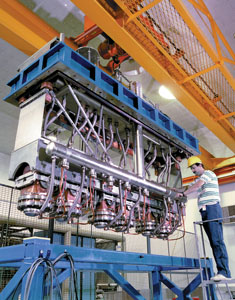
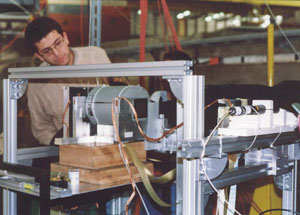
The LHC will use some 1248 superconducting dipole magnets to keep its proton beams on course. Generating an operating field of up to 8.33 Tesla, these are among the most technologically challenging of LHC components. An intensive prototyping exercise concluded in 2000, when an order was placed for 30 magnets each from three potential suppliers. The collared coils of these magnets have since been arriving at CERN for assembly into cold masses. The first cold masses from each supplier were assembled, welded and finished at CERN’s magnet assembly facility while the following ones were assembled and welded at CERN and then returned to the suppliers for finishing. Personnel from industry have been stationed at CERN to be trained in this task.
CERN has developed a unique automatic process for welding the two 15 m long half-cylinders of each magnet’s cold mass. This will ensure the quality, precision and uniformity required. To date, a single hydraulic press at CERN has been used. Now the technique has been perfected, however, and the laboratory has invested in three more presses, one for each of the suppliers building the magnets. The first press to become operational is at the French Alstom-Jeumont consortium, where a magnet was assembled, fully welded and finished at the end of 2001. The others began operation at Noell in Germany and Ansaldo in Italy earlier this year.
Following approval of the dipole magnet contract by CERN Council last December (CERN Courier January/February p4), the definitive production schedule is now under discussion with the supplying companies.
On a cold, clear night last May the shutters rolled away from the aperture window. The Pierre Auger Observatory’s newly completed air-fluorescence telescope was now overlooking a vast expanse of Argentine desert. Experimenters switched on the photomultiplier tubes and moments later they watched as the first cosmic-ray air shower appeared on the event display. The beautiful, nearly noise-free images represented an important milestone for the Auger collaboration in its study of the mysteries of the highest-energy cosmic rays.
Seven months later an even more dramatic event demonstrated the unique strength of the Auger Observatory. By then the first particle detectors of an extensive surface array were in operation. In the early hours of 8 December, the fluorescence detector and the surface array recorded a single shower as it cascaded through the air and splashed into the array below. This shower, captured by two quite different but complementary techniques, was transmitted to collaborators around the world. It demonstrated beyond doubt that the detectors, trigger, timing, data communications and data acquisition systems were working as designed.
However, there could only be a brief moment of celebration. Ahead lay the daunting task of deploying 1600 surface detector stations over 3000 sq. km of desert, and a total of 30 fluorescence telescopes to overlook this array. The observatory needs such a large aperture to gather enough of the very-high-energy cosmic-ray events to probe their origin. At such energies, cosmic-ray particles are extremely rare. Above 1019 eV there is just one cosmic-ray particle per square kilometre, per steradian, per year. Above 1020 eV there is only one per square kilometre, per steradian, per century.
The quest for the source of the highest-energy cosmic rays is one of the most interesting problems in astrophysics. Following the discovery of the cosmic microwave background in 1965, Greisen and, independently, Zatsepin and Kuzmin realized that this background radiation would make space opaque to cosmic rays of very high energy. Nevertheless, over the past 30 years, several tens of events have been recorded with energies of more than the Greisen, Zatsepin, Kuzmin (GZK) cut-off, which starts at about 5 x 10¹⁹ eV, including a number above 1020 eV. The cosmic acceleration mechanism for achieving these energies is not known. Because of the GZK cut-off, these particles must come from nearby – less than about 50 megaparsecs. Yet even though particles of these energies are only slightly deflected by galactic and extragalactic magnetic fields, none clearly points to a source sufficiently violent to be a candidate.
The two common detection techniques for cosmic rays both use the Earth’s atmosphere, a remarkably effective calorimeter for capturing the great energy of these particles. The traditional means is an array of particle detectors that measure ionizing radiation in a plastic scintillator, or Cerenkov light in a water tank. The other technique was developed in the 1980s by a University of Utah-led group. They used a set of stationary telescopes in their “fly’s eye” to record the development of showers by gathering the faint fluorescence produced as the shower passes through the atmosphere. Each of these techniques has its own strengths and limitations. The surface detector array depends on a comparison of the shower density distribution to simulations to obtain the energy scale. On the other hand, the surface array has a well defined aperture and can measure several features of the shower. The shower density, the electromagnetic and muon components, the shape of the shower front and the time structure are all useful in obtaining the composition of the primary particles. The fluorescence detector records the development of the shower and can make a more nearly calorimetric measurement of the energy. It can only be used on dark nights, however, and it depends on very careful calibration and an understanding of the attenuation of light in the atmosphere. The Auger Observatory combines the strengths of both techniques.
Two cosmic-ray air shower detectors are currently active. The AGASA surface array near Akeno, Japan, has been taking data for about 20 years. The other detector is the High Resolution Fly’s Eye fluorescence detector in Utah, US. Although the data from the two experiments seem to agree in many respects, recent results show significant differences in the shape of the high end of the energy spectrum. In the next few years the Auger Observatory should be able to resolve these differences using the power of the hybrid detector system to collect a large number of events around the GZK cut-off.
The Auger Observatory has other new and important features. The fluorescence telescope uses Schmidt optics, which, with their aperture stop and corrector lens, allow greater light collection and reduced coma aberration with a spherical mirror. This aperture is sealed with a window that is also an ultraviolet filter for selecting the nitrogen fluorescence lines. As a result, the camera, mirror and all of the electronics are contained in a clean, controlled environment.
The surface detector stations are 10,000-litre water Cerenkov detectors, each equipped with three 220 mm hemispherical photomultipliers. Each is self-contained, with its own data processing unit, radio transceiver and solar power system. Event triggers indicate the possibility that a large air shower has struck the array. These move by radio to the central data acquisition system, which examines them for interesting events.
The central data acquisition system is on the Auger campus, located at the edge of the array in the town of Malargue. The campus also contains the detector assembly building with electronics shops, mechanical shops and a water purification plant. Besides the data acquisition system, the handsome new Auger centre building contains offices for staff and Auger collaborators, and a visitors’ centre. For the scientists and engineers from 50 institutions in 18 countries working at the observatory, Malargue has begun to feel like home. At the inauguration of the new office building, the provincial governor, the mayor and a thousand townspeople came to hear speeches and tour the buildings.
In late October, an international review committee chaired by Werner Hoffman of the Max Planck Institute, Heidelberg, Germany, assembled at the Auger Observatory to evaluate progress. Its report was then received by the Auger Project Finance Board in Washington, which voted to proceed to completion. The collaboration hopes to finish the observatory by the end of 2004.
The growth of international collaboration in science was underlined last December by the award of a contract to Dutch telecoms provider KPNQuest for a new transatlantic high-speed data link at 622 Mbps, to replace the existing two 155 Mbps links.
Connecting CERN to StarLightTM, the optical component of the STAR TAPTM Internet exchange in Chicago, the new link will be funded by a consortium of the French particle and nuclear physics institute (IN2P3), the US Department of Energy and National Science Foundation, the Canadian high-energy physics community, the World Health Organization and CERN. Research users of transatlantic networking should start to notice the benefits from April 2002.
A second very-high-performance data link operating at 2.5 Gbps, also connecting CERN to StarLightTM, is expected to be ordered soon. This is part of the European Union-funded DataTAG (research & technological development for a transatlantic Grid) project, in collaboration with the Department of Energy and National Science Foundation. It will form an important part of the network for the Large Hadron Collider computing Grid.
Optical cables at Chicago’s StarLightTM Internet exchange. StarLight is the emerging optical component of the National Science Foundation-funded STAR TAPTM international interconnection point for advanced research and education networks. (Electronic Visualization Laboratory, University of Illinois, Chicago.)
Though physicists have probed the subatomic world for many decades, it is easy to forget that our understanding of the atomic nucleus is largely limited to studies with stable isotopes. An innovative, exotic-beam facility now under consideration – the Rare Isotope Accelerator (RIA) – could extend the horizons of nuclear physics greatly. RIA will enable broader-based research with high-quality energetic beams of short-lived isotopes.
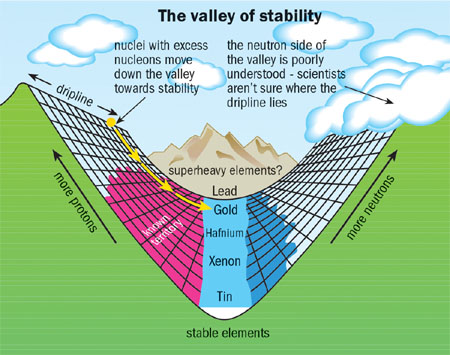
Of the thousands of known nuclear species, only about 300 are stable, that is they exist along the so-called “valley of stability”. The unstable species forming the valley “walls” – those with an overabundance of protons or neutrons – tend to decay quickly, sometimes within milliseconds.
The Organization for Economic Cooperation and Development’s Megascience Forum has recognized that beams of exotic radioactive isotopes have the potential to open up important, untapped opportunities for fundamental research, because studies of such ephemeral nuclear species by other means has been at best difficult and in most cases impossible.
Responding to these scientific opportunities, the US Nuclear Science Advisory Committee is recommending RIA as the highest priority for major new construction in its 2001 long-range plan for nuclear science. RIA will provide physicists with a powerful tool to complement the long-standing investigations of unstable nuclei at CERN’s ISOLDE and other laboratories. It will augment these other facilities not only by creating, but also by accelerating a range of short-lived nuclei that will provide a panoramic view from atop the “walls”, overlooking the “valley of stability”. Fundamental research in several fields would be addressed at RIA, including:
•The nature of nucleonic matter RIA will allow the close examination of the many nuclei that are very far from stability and about which little is known. Such studies will provide fundamental insights into nuclear structure and interactions that are not manifest in species near stability.
•The origin of the elements Nearly all of the chemical elements in the universe are forged in the interiors of stars, but the chain of events and even the astrophysical sites that produce them are still poorly understood. RIA will permit researchers to investigate the metamorphoses that nuclei undergo in these cosmic cauldrons.
•The Standard Model While high-energy accelerators are needed in direct searches for undiscovered particles like the Higgs boson, physicists will use RIA to explore with greater precision the known subatomic particles and the forces that act on them.
•Nuclear medicine A third of all patients hospitalized in the US undergo a nuclear medicine procedure. All such procedures require isotopes that are produced in reactors or small accelerators. RIA will bring a new level of technology for the rapid production and exploration of medical isotopes that have specific physical and chemical properties.
Building RIA will require innovations based on current accelerator technology, and researchers at several US institutions are already working to bridge this gap.
Limitations of current technology
There are currently two methods designed for probing unstable isotopes, each of which is limited in its scope. In the first – isotope separation on line (ISOL) – a driver beam of stable ions strikes a heated target. By means of either fission or spallation, the impact produces unstable nuclei at low energy. This “stopped beam” technique has proved useful in recent investigations into the Standard Model at CERN’s ISOLDE. This is a slow process, so many isotopes, especially those of refractory and chemically active elements, decay before they can be reaccelerated for study.
The second method of probing unstable isotopes solves some of the problems but creates others. A driver beam of heavy ions strikes a thinner target of light material, which makes the energetic ions fragment like shrapnel from a fast-moving projectile. These high-energy fragments do not require such time-consuming reacceleration but there is greater beam divergence and energy variation than in beams produced by ISOL. The two methods are considered complementary but, even when both are used, researchers are limited in their ability to produce high-quality beams of rare nuclear species.
RIA will allow physicists to have the best of both worlds, providing them with energetic, high-quality beams of essentially any isotope. An innovation based on the new “fast gas-catcher” technology will be necessary to overcome the limitations of the ISOL and in-flight projectile fragmentation methods. This technology was recently developed and put to use for research at Argonne’s ATLAS facility.
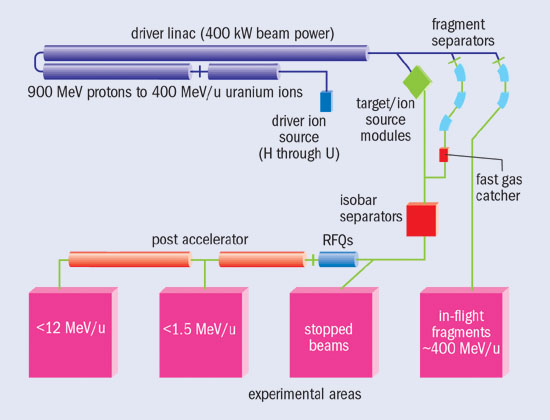
The technique magnetically separates exotic ions produced in thin targets and brings them to rest in a fast gas-catcher that is filled with pressurized helium. Normally these ions, which are positively charged, would neutralize themselves by capturing electrons from surrounding atoms. However, helium electrons are the most tightly bound of any element and the stopped ions remain positively charged. They are then extracted and reaccelerated so that all of the ions have uniform energy and small divergence.
The whole process – from target to gas cell to post accelerator – occurs in a matter of milliseconds. This new separation technology, in combination with the powerful new driver and efficient post accelerators, will give physicists high-quality beams of exotic isotopes of all elements from lithium to uranium.
Innovations in accelerator and target technology
Along with an increase in flexibility will come an increase in power – RIA will be able to produce beams of exotic nuclei that are far more intense than any that are available now. One of the secrets of producing this intensity will be the acceleration of more than one “charge state” of ions at a time.
Isotopes are typically stripped of many electrons before they are accelerated into a beam, turning them into positively charged ions. Ordinarily, accelerators have worked best with ions of one specific charge, but many nuclei come out of the ion source and strippers with a greater or smaller number of electrons than desired. Usually a single “charge state” is selected from the mixture – a process that severely limits the available heavy-ion beam intensities.
Argonne scientists have demonstrated that the driver linac can be configured to accelerate several charge states simultaneously. Experiments at ATLAS have confirmed that RIA’s beam intensity can be increased eight times by capturing and accelerating multiple charge states after the strippers. Plans have also been worked out to accelerate two charge states directly from the ion source. In combination, this would boost the power of RIA’s driver beam by a factor of 16 for the heaviest ions.
Such intense beams would quickly destroy a traditional solid target, so Argonne designers are developing a liquid target that can withstand the beam. Adapting an idea that was originally proposed for removing heat from a fusion reactor, the beam will shine on a stream of liquid lithium, which flows in a closed loop through a heat exchanger to dissipate the high beam power.
At this time, Argonne and Michigan State University are working together to develop a cost-effective plan for the construction of RIA. A workshop on potential applications of the accelerator was jointly sponsored by Los Alamos and Lawrence Livermore National laboratories in September 2000. Currently, seven US laboratories are participating in RIA research and a national committee is coordinating the ongoing research and development effort. This technical progress will ensure that RIA can achieve the promising scientific goals of the nuclear community.
Further Information
Traditional radioactive beam facilities
The ISOL method for producing, separating and studying the decays of radioactive isotopes has been in use since a pioneering experiment in Copenhagen in 1951. ISOL work has been carried out vigorously at the CERN ISOLDE facility for more than 30 years. Innovative work at Louvain-la-Neuve in Belgium made post-accelerated radioactive beams available.
At TRIUMF in Vancouver a powerful new ISOL-type facility – ISAC – was recently commissioned. It now delivers post-accelerated beams for research. A post-accelerator was also recently commissioned at CERN’s ISOLDE as part of the REX-ISOLDE experiment. Planning and R&D for an advanced ISOL-type radioactive beam facility for Europe is currently in progress.
The fragmentation method for the in-flight separation of short-lived rare isotopes was pioneered at the Berkeley Bevalac facility in the late 1970s. One advanced facility – based on the heavy-ion fragmentation method – is under construction at RIKEN in Japan and another is being proposed for GSI in Germany. Both of these new fragmentation facilities plan to use storage rings to expand the types of research that can be done with the rare isotopes. Other fragmentation facilities include those recently upgraded at Michigan State University in the US and GANIL in Caen, France.
RIA brings together a range of technologies to produce intense and high-quality beams of short-lived radionuclides of all of the chemical elements – from the lightest to the heaviest. The short-lived, rare isotopes are produced by a continuous-wave, superconducting 1.4 GV driver linac that will deliver 400 kW beams of any mass from 900 MeV protons to 400 MeV per nucleon uranium. The schematic layout is shown in figure 2.
The main production mechanisms are spallation and fission of heavy targets by light ions, and in-flight fragmentation or fission of heavy-ion beams.
RIA will provide facilities for research with rare isotopes in four energy regimes (stopped beams; ~1 MeV/nucleon reaccelerated beams; ~10 MeV nucleon reaccelerated beams; ~400 MeV/nucleon secondary beams of in-flight fragments). This flexibility will make RIA a valuable addition to existing exotic beam facilities. RIA is also a potential source of both ultracold neutrons and continuous-wave, high-energy neutron beams for a variety of basic and applied research programmes.
Moscow’s Institute for Theoretical and Experimental Physics recently celebrated the 40th anniversary of the commissioning of its U10 proton synchrotron.
Originally a 7 GeV machine, the proton synchrotron was constructed at the institute (ITEP) as a prototype for the 70 GeV Protvino machine – then the most powerful in the world – which was commissioned in 1967.
The ITEP machine was, along with the CERN Proton Synchrotron and Brookhaven’s Alternating Gradient Synchrotron – one of the first three synchrotrons constructed using the alternating gradient focusing principle. In 1973 its output energy was upgraded to 10 GeV. In 1980 the maximum intensity – 1.5 x10¹² protons per pulse – was reached.
The ITEP U10 accelerator is used for experimental physics, proton therapy, material irradiation, and testing fast electronics and new detectors.
The ITEP proton synchrotron contributed greatly to particle and relativistic nuclear physics. Experiments were performed with different bubble chambers, including the world’s largest helium and xenon chambers, and magnet spectrometers with wire chambers.
Many important results have been obtained on light meson spectroscopy and CP-violation parameters in neutral kaon decay, and on non-strange baryon spectroscopy via precise measurements of pion-nucleon elastic scattering on unpolarized and polarized targets. A comprehensive study of few nucleon systems has been made using beams of light nuclei and in pion-deuteron interactions.
The ITEP TWAC TeraWatt Accumulator Project takes the U10 ring into a new era. Complementing the proton programme, it will be used as a heavy-ion accumulator for high-energy density experiments. This work should begin this year.
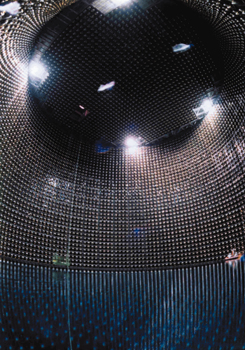
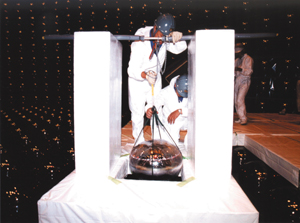
On 12 November, as reported briefly in CERN Courier, several thousand large photomultiplier tubes imploded in the huge Super-Kamiokande underground neutrino detector in Japan. The extent of the damage suggested some kind of chain reaction in the tubes, with one implosion setting off the next. It happened as the detector was being refilled with water after routine maintenance.
The detector began physics operation in 1996 and had produced important results, monitoring particles from the Sun, from cosmic-ray interactions in the atmosphere and from the Japanese KEK laboratory 250 km away. Recent results showed that synthetic muon-type neutrinos from KEK do not always show up as expected. The detector also provided key benchmarks for solar neutrinos. These results had been a major influence on physics thinking, and researchers were eagerly looking towards more.
A Japan-Korea-US collaboration, the Super-Kamiokande detector uses 50,000 tonnes of pure water as a neutrino target 1000 m below ground. The water target is 40 m high and monitored by 11,200, 50 cm diameter Hamamatsu R3600 photomultiplier tubes, and it is divided into a 32,000 tonne inner detector where the events are logged, and an 18,000 tonne outer volume to screen off unwanted effects. Most of the photomultipliers are deployed in the inner detector to pick up the flashes of light created when neutrinos interact with the water.
Apparently, a tube, probably near the bottom of the detector, imploded and set off a chain reaction, destroying much of the detector to a depth of about 2 m below the water level. The instrumentation at the top of the detector survived. The chain implosion caused around 8000 tubes to be destroyed, and it also wreaked havoc with the detector infrastructure.
The Hamamatsu R3600 photomultiplier tubes were first used in Kamiokande, the current detector’s predecessor, which was built in the same underground mine in the early 1980s. The initial goal of that experiment was to search for signs of proton decay (the “-nde” suffix is short for “nucleon decay experiment”). This detector used 1000 photomultipliers and a 300 tonne water target. Kamiokande’s observations of the 1987 supernova marked the beginning of a new science – neutrino astronomy – and Super-Kamiokande was set to follow this tradition.
The technical systems for CERN’s forthcoming Large Hadron Collider (LHC) reached an important milestone earlier this year with the successful commissioning of String 2 – a chain of prototype LHC magnets complete with all of the necessary powering, control and protection systems. String 2 is the final testbed for validating LHC systems before the new accelerator is installed in its tunnel ready for its start-up in 2006.
When the LHC starts up in five years’ time, it will be the world’s largest superconducting installation of any kind. Nearly all of its main magnets, some 2000 in total, will be bathed in superfluid helium at 1.9 K. Such a low temperature is required to keep the magnets superconducting, but maintaining it presents many challenges. The cold mass of each magnet is installed inside a vacuum vessel and rests on high-tech composite feet that are actively cooled from room temperature to 1.9 K over 25 cm. A similar active cooling scheme is used for the cables that monitor the magnets.
String 2 is the first LHC systems testbed to be built to the LHC’s final design and it is the last chance for LHC engineers to validate their design choices before the installation of the new accelerator underground. In its current configuration, String 2 consists of three prototype dipole magnets, two quadrupoles, and a full-scale prototype distribution line for the cryogenic fluids that cool the magnets. Three more dipoles are scheduled to be added, which will turn String 2 into a full cell of the LHC accelerator. Completing the String 2 set-up are 15 electrical powering circuits with final-design power converters, and a digital current regulation system capable of measuring magnet currents to a few parts per million.
String 2 was cooled down to 1.9 K in mid-September for systems validation tests. The LHC’s superconducting magnets are sensitive devices. If any part of their cable winding heats up, it provokes what is known as a quench – the magnet ceases to superconduct and the energy stored inside it has to be dissipated. Testing the systems that detect quenches and protect the magnets was the first part of the validation programme and was carried out before the magnets were ramped up to nominal current of 11 850 A on 27 September. A full programme of system validation tests in which the entire String is being put through its paces is now under way. All systems are being tested in normal running conditions, during the ramping up and down of the magnet currents, and during provoked quenches.
On 12 November, thousands of photomultipliers imploded in the huge Superkamiokande detector in Japan, which has produced important results on neutrino physics.
The detector uses 50 000 tonnes of pure water, 1000 m below ground, and it is monitored by 11 200 large (50 cm diameter) photomultiplier tubes. Most of these tubes were destroyed, also wreaking havoc with the detector infrastructure.
Superkamiokande director Yoji Totsuka vowed: “We will rebuild the detector.”
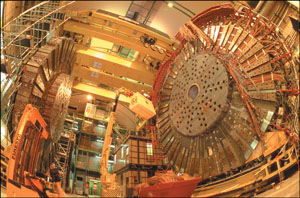
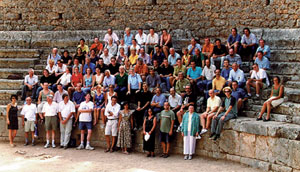
Although CERN’s LEP electron-positron collider finished operating in November 2000, analysis of the enormous amount of data it produced will continue for some time. On 19-25 September the collaboration of the DELPHI experiment held a meeting in Delphi, on the slopes of Mount Parnassus in Greece, to discuss recent results.
The name DELPHI is an acronym (DEtector with Lepton, Photon and Hadron Identification), but the collaboration includes several groups from Greece. When the name was chosen, in 1982, these groups immediately invited the collaboration to hold a meeting in Delphi. This took place in June 1983, at the start of DELPHI construction.
The return to Delphi in 2001 was therefore something of a sentimental journey. However, only eight people participated in both meetings. An impressive number of young people now working on DELPHI analysis were only in high school at the start of the experiment.
The meeting was organized by DELPHI’s three Greek groups (National Technical University, University of Athens and Demokritos) under the chairmanship of Theodora Papadopoulou of NTUA.
The opening session was addressed by NTUA rector Themistoclis Xanthopoulos. Although himself an engineer, Xanthopoulos stressed the need for supporting fundamental research and he expressed concern that, with the increasing emphasis on the market economy in university education, funding for basic research would come under great pressure.
Talks concentrated on the progress towards the finalization of the precision measurements of the parameters of the W and Z bosons; their couplings; testing the Standard Model at the highest energies yet obtainable; and the searches for new particles.
The searches for the particles predicted by supersymmetry seem to have drawn a clear blank throughout the entire LEP2 energy range, already ruling out most versions of the model. On the other hand, the search for the elusive Higgs boson – the origin of electroweak symmetry breaking and the boson responsible for particle masses – ended on an ambiguous note, with some suggestion that LEP had been on the verge of a major discovery (Season of Higgs and melodrama). A session called “Elementary particle physics – theory and experiment” was attended by 60 physics teachers from local high schools.
The opinion of all of the participants was that the meeting was a worthy successor to the 1983 meeting. It was remarkable to witness how LEP and DELPHI, together with all of the other experiments, had surpassed the design expectations formulated some 20 years ago.
The meeting highlighted the important contributions being made by Greek high-energy physicists and hopefully will contribute to assuring support for this significant work.
Transition radiation is playing an increasingly important role in the armoury of detection techniques for particle physics. A recent specialist workshop at Bari surveyed progress in this area.
When a fast-charged particle crosses the boundary between two media with different dielectric constants, the abrupt change in the electric field triggers the emission of electromagnetic radiation. If the particle energy is very high, the emitted photons are soft X-rays that can be collected easily.
Transition radiation was first predicted by V L Ginzburg and I M Frank in 1944, and in 1957 G M Garibian showed the feasibility of functional transition radiation detectors (TRDs). Since then TRDs have been successfully used in a number of experiments, mainly in high-energy particle physics and astrophysics.
Transition radiation has three major features that influence the design of these detectors:
* the total radiation energy emitted at the boundary is proportional to the particle’s Lorentz factor – the ratio of its total energy to its rest mass energy;
* the average number of photons emitted per boundary is rather small – about 1/137;
* the emitted photons travel in practically the same direction as the charged particle.
The first feature suggests two major applications – either to discriminate between particles with different masses and the same momentum or to measure the energy of a known particle.
The second feature means that, in order to have a significant number of photons, many boundaries are required. This can be achieved either by means of “regular radiators” built with many evenly spaced foils or with “irregular radiators” made of foams or fibres.
The third feature is something of a drawback, because the charged particle, if not deflected, releases energy by ionization in the same region as where the emitted photons must be detected: this effect requires careful design of the radiation detector and adequate data analysis techniques.
The Bari workshop examined the latest results and evaluated the future evolution of these detectors. The main subjects covered were the use of TRDs in currently operating experiments; the development of new concepts for radiators and radiation-detection devices; and the progress in engineering and electronics, mainly in view of high-rate accelerator experiments and high-performance set-ups to be operated on satellites.
After an overview by C Fabjan (CERN) on the renaissance of particle identification, K Ispiryan (Yerevan) gave a historical review of the pioneering theoretical and experimental steps in the field and later discussed the feasibility of a ring TRD, which is conceptually similar to a ring imaging Cherenkov detector.
M Cherry (Louisiana) gave a survey of applications in cosmic-ray and high-energy physics, and B Dolgoshein (Moscow) introduced new concepts for particle identification by TRDs. The installation and performance of a TRD in the future experiment AMS02 on the International Space Station was described by T Kirn (Aachen), while E O’Brien (Brookhaven), A Romaniouk (Moscow) and J Wessels (Heidelberg) presented, respectively, PHENIX, ATLAS and ALICE – the detectors to be included in large accelerator experiments.
A crucial TRD element is the X-ray detection device. F Gargano and M N Mazziotta (Bari) examined the possibility of using silicon detectors instead of the traditional gas chambers, while V Tikhomirov (Moscow) discussed the feasibility of a radiator/detector combination based on a two-component scintillator. D Cambiaghi (Brescia) talked about the mechanical design of instruments for a space environment.
The workshop paid attention to the process of the design, development and testing of TRDs, illustrated by several examples: from the GEANT simulations by P Nevski (CERN) to the design considerations for the transition radiation tracker (TRT) in ATLAS by H Danielsson (CERN) and the study of xenon-based gas mixtures by V Sosnovtsev (Moscow). The physics goals, trigger architecture and prototype tests of the TRD for the ALICE experiment were described by A Andronic (GSI-Darmstadt), B Vulpescu and V Angelov (Heidelberg).
TRDs also have valuable applications in cosmic-ray physics. F Loparco (Bari) presented the muon energy measurement performed by the TRD of the MACRO underground experiment, while F Cafagna and P Spinelli (Bari) showed the particle identification features of the TRD of the PAMELA satellite experiment.
The next workshop in the series is tentatively planned for May 2003.
The workshop was organized with the support of the Italian Institute for Particle Physics (INFN), the Italian Space Agency (ASI) and the physics department of Bari University and Polytechnic. The proceedings will be published by INFN-LNF SIS-Pubblicazioni.
To provide the best experiences, we use technologies like cookies to store and/or access device information. Consenting to these technologies will allow us to process data such as browsing behavior or unique IDs on this site. Not consenting or withdrawing consent, may adversely affect certain features and functions.
Functional
Always active
The technical storage or access is strictly necessary for the legitimate purpose of enabling the use of a specific service explicitly requested by the subscriber or user, or for the sole purpose of carrying out the transmission of a communication over an electronic communications network.
Preferences
The technical storage or access is necessary for the legitimate purpose of storing preferences that are not requested by the subscriber or user.
Statistics
The technical storage or access that is used exclusively for statistical purposes.The technical storage or access that is used exclusively for anonymous statistical purposes. Without a subpoena, voluntary compliance on the part of your Internet Service Provider, or additional records from a third party, information stored or retrieved for this purpose alone cannot usually be used to identify you.
Marketing
The technical storage or access is required to create user profiles to send advertising, or to track the user on a website or across several websites for similar marketing purposes.