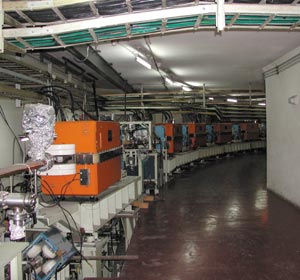
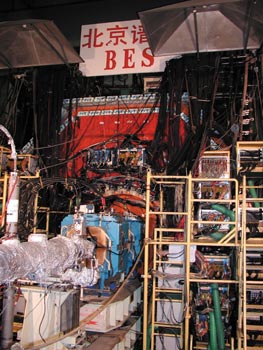
On 10 February, the Chinese government approved the Beijing Electron-Positron Collider Upgrading Program (BEPCII), finally making the long expectation of the Chinese high-energy physics community a reality. When complete in 2006, BEPCII will add a new “factory class” particle collider to the world scene, adding new momentum to research on tau-charm physics. China hopes that the physics potential will attract groups from other countries to join and help the Chinese physicists meet the technical challenge and share the cost of increasing detector performance to ensure first-class results.
The existing Beijing Electron-Positron Collider (BEPC), with a beam energy in the 1-2.5 GeV range, was constructed between 1984 and 1988. The Beijing Spectrometer (BES) is the only detector on this machine, and the research programmes that started in 1989 have concentrated on tau-charm physics. The luminosity of BEPC can reach 1 x 1031 cm-2 s-1 at a beam energy of 1.89 GeV, and over the past 10 years BES has obtained many important experimental results. For example, the precision of the tau mass measurement made in 1992 was 10 times higher than previous measurements, and played an essential role in testing lepton universality. Moreover, since its start-up BES has accumulated about 66 million J/Ψ events and 18 million Ψ′ events – the largest data samples in this energy range.
The main physics aims for the future at BEPC are precision measurements of charm physics and the search for new particles and new phenomena, mainly in the energy region of the J/Ψ and Ψ′. However, this requires both a major upgrade of BEPC to increase its luminosity by two orders of magnitude, and a major upgrade of BES to reduce its systematic errors and to adapt to the high event rates and small bunch spacing in BEPCII.
With the construction of an additional ring, BEPCII will be a double-ring collider that approaches most of the specifications of a particle factory. It will have superconducting micro-beta magnets, a 500 MHz RF system with superconducting cavities and a low impedance vacuum system. The second ring will be accommodated in the existing tunnel of BEPC, with a large horizontal crossing angle of 11 milliradians at the southern interaction region. There will be 93 bunches per ring with a total current of 910 mA per ring. The peak luminosity of BEPCII will be 1033 cm-2 s_1 at a beam energy of 1.89 GeV, which is about 100 times higher than that of BEPC. The upgrade of the linac will provide injection at energies up to 1.89 GeV for “top-up” injection. The positron injection rate will rise from the current 5 mA per minute to 50 mA per minute.
BESII, the current detector at BEPC, will be upgraded to BESIII. Most of the detector components will be rebuilt with up-to-date techniques to include a main drift chamber with small cells, aluminium field wires and helium-based gas; an electromagnetic calorimeter of caesium-iodide crystals of 15 radiation lengths (28 cm); plastic scintillators for time-of-flight; a 1 Tesla superconducting solenoid magnet; and nine layers of RPCs interleaved with the iron plates of the return yoke for muon identification.
Most of the existing utilities at BEPC will be used for BEPCII, after some upgrading. A cryogenics system at 4.2 K will be installed for three types of superconducting devices. The special design of BEPCII will keep the electron beam in the outer ring running during dedicated synchrotron radiation, so there will be no changes to the synchrotron radiation beam lines and the experimental stations, although the beam current will be increased from 140 mA at 2.2 GeV to 250 mA at 2.5 GeV.
The total estimated budget for BEPCII is around 640 million Chinese Yuan (about €70 m). The Chinese government will provide funding to cover the costs of the machine and the major part of the detector, while remaining detector costs are expected to come from international collaboration. There is international co-operation to help the Institute for High Energy Physics (IHEP) in Beijing with the design and R&D of BEPCII, as well as to produce some key devices. For example, the Brookhaven National Laboratory in the US is helping with the superconducting micro-beta magnets, and KEK in Japan is assisting with the superconducting RF cavities and the superconducting solenoid magnet. In May 2002, SLAC hosted a review on the design report of BEPCII, and detailed design is now underway. The construction of BEPCII should begin soon and is expected to finish by the end of 2006, with physics running scheduled for the beginning of 2007.
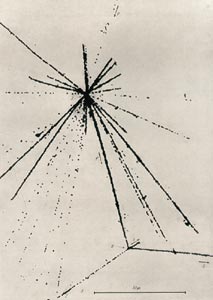
In 1953 Marian Danysz and Jerzy Pniewski, two Polish physicists studying cosmic radiation, observed the first hypernucleus. The interaction of a high-energy proton with a nucleus in the emulsions they were using as a detector produced a hyperfragment – a nucleus containing a Λ particle. This pioneering observation initiated a new field of fundamental research – hypernuclear physics. The hypernucleus itself provides a unique laboratory suitable not only for studying nuclear structure in the presence of a strange quark, but also for probing weak interactions between baryons.
During the past 50 years, hypernuclei have been copiously produced at CERN (during the 1960s and 1970s), BNL (1970s-80s) and KEK (1980s-90s), first using extracted beams of negative kaons, and subsequently employing much more intense beams of positive pions. Now, in the year of the 50th anniversary of hypernuclear physics, the INFN’s Frascati National Laboratory in Italy is about to start an intense and innovative programme of hypernuclear studies.
The DAFNE φ-factory
The Frascati laboratory is home to DAFNE (Double Annular ring for Nice Experiments), an electron-positron collider dedicated to the production of large numbers of the φ resonance. DAFNE con-sists of two almost circular rings, one for the electrons and the other for the positrons, which overlap in two straight sections where the beams collide head-on. The energy of each beam is set to 510 MeV/c2 in order to produce the φ(1020) particle.
DAFNE is currently the only running φ-factory in the world, and was designed with the main aim of exploring rare physical phenomena with very high accuracy. The interest in the φ resonance arises from the fact that it decays mainly to a kaon-antikaon pair – particles that showed such unexpected features, right from their discovery in 1947, that a new physical entity called “strangeness” was introduced to explain their characteristics. Now DAFNE is producing φ particles at the rate of 12 million per day, and further improvements are predicted. The φ-factory is a clean and abundant source of low-energy neutral and charged kaons (~16 MeV/c2 kinetic energy) suitable for exploring the open problems related to the strange flavour degree of freedom.
The study of neutral kaons led to the discovery in 1964 of a unique phenomenon: the violation of CP symmetry by the weak interaction. Detailed measurement of the fundamental parameters of this violation is still one of the most challenging open problems of modern physics. The KLOE (K Long Experiment) apparatus, located in the first DAFNE interaction region, is devoted mainly to these studies.
Charged kaons, on the other hand, can be used to insert strangeness inside a nucleus, as a probe to investigate the strong force that “glues” matter together. The DEAR (DAFNE Exotic Atoms Research) experiment is using negative kaons from DAFNE to produce kaonic atoms and study their properties. The goal is the precise measurement of the strong interaction shifts and the widths of the Kα line of kaonic hydrogen. After a test period with nitrogen, the DEAR collaboration has completed data-taking with hydrogen.
However, the main user of charged kaons – more precisely negative kaons – will be the FINUDA experiment (FIsica NUcleare a DAfne). When a K– interacts with a neutron in a nucleus, it can transform it into a Λ hyperon, turning the nucleus into a hypernucleus. The FINUDA experiment, located in the second interaction region of the Frascati machine, is starting data-taking this year to explore the physics of hypernuclei in a completely new way.
Before explaining more about FINUDA, it should be mentioned that the high currents (more than 1 A) circulating inside the DAFNE machine produce high fluxes of synchrotron radiation in the UV and soft X-ray wavelength region. This radiation is used to perform high-quality studies of solid-state and biological physics. Photons in the soft X-ray energy range (1-7 keV) are extracted from the DAFNE wiggler with a horizontal collection angle of 15 mrad; the beam is then split into two separate lines. A third beamline, SINBAD (Synchrotron Infrared Beamline at DAFNE), operates in the infrared range. Here the photons are extracted from one of the DAFNE bending magnets with a vertical acceptance angle of about 40 mrad.
The FINUDA experiment
The highly innovative FINUDA experiment is the first hypernuclear physics experiment to take place at a collider, and has prompted a new era in this field of research. The specific aim of FINUDA is to produce hypernuclei by stopping the negative kaons originating from φ decay in a nuclear target. The reaction involved is: K– + AZ → AΛZ + π–. By precisely measuring the momentum of the outgoing π–, it is possible to determine the energy level of the hypernucleus AΛZ produced. This approach has some advantages when compared with other experimental techniques using extracted K– beams on a fixed target. The low kinetic energy of the DAFNE kaons allows them to be stopped in a very thin target (~0.1 g/cm2 compared with some g/cm2 for fixed-target experiments). Therefore, the energy straggling of the π– that tags the hypernucleus formation is strongly reduced, and so high-resolution spectroscopic studies are possible. Moreover, kaons at DAFNE are emitted isotropically, and the detector acceptance can therefore be quite large. This feature, combined with a good machine luminosity, provides high hypernuclear counting rates: with L = 1032 cm-2s-1, more than 100 hypernuclear events per hour are expected.
FINUDA will investigate a wide programme of high-statistics studies on different hypernuclei. This is possible because the target station of the apparatus is segmented, and up to eight different solid-state targets can be mounted into the detector at the same time. The FINUDA apparatus itself is a complex magnetic spectrometer designed to detect both the π– emitted in hypernucleus formation, and the products of hypernuclei decay. This is a unique feature in the panorama of studies in hypernuclear physics, which will enable simultaneous exploration of hypernuclear spectroscopy and hypernuclei decay modes.
The Λ particle is the lightest hyperon, so it is stable from the point of view of the strong interaction, and allows the formation of stable nuclear systems. Its lifetime in free space is typically 260 ps, before it decays through a weak interaction, emitting a nucleon and a pion. Nevertheless, since the momentum of the outgoing nucleon is below the Fermi momentum, when the Λ particle is embedded in nuclear matter, the Pauli principle inhibits this decay process. Therefore, when a Λ hyperon is attached to a nucleus, it experiences new decays – the so-called “non-mesonic decays” – for which few data are available. These processes are essentially weak interactions between the Λ particle and a nucleon, resulting in a pair of nucleons of high momentum (Λ + N → N + N). These reactions are extremely interesting because they allow us to explore the four-fermion, strangeness-changing, baryon-baryon weak interaction. This is a good way to study the ΛN interaction, as it is very difficult to produce hyperon beams.
Another important aspect of non-mesonic Λ decays is related to the ΔI = 1/2 empirical rule. The weak decay of hyperons may occur, in principle, with isospin change ΔI = 1/2 or 3/2. However, the values of the experimental decay branching ratios imply a dominance of a factor 20 of ΔI = 1/2 over ΔI = 3/2. Nevertheless, experimental analysis of some non-mesonic decay channels seems to suggest a strong violation of this rule. The latest measurements of the ratio between neutron- and proton-induced decay modes performed at KEK on 28ΛSi and 12ΛC give results close to 1 or greater, while theoretical calculations, imposing the ΔI = 1/2 rule, predict values well below unity. Precise measurements of the relative branching ratios of the non-mesonic decays could therefore provide new information about the relative importance of the ΔI = 1/2 and ΔI = 3/2 amplitudes of the weak Hamiltonian.
Charged particles emitted following hypernucleus production and/or decay are detected in the FINUDA cylindrical magnetic volume (1.1 T, 1 m radius, 2 m length) by four different detectors, each one optimized for a different task. Silicon microstrips detect the hypernuclear vertex, drift chambers and straw tubes reconstruct charged-particle trajectories, and plastic scintillators produce the trigger signal and detect neutrons.
Each element of the FINUDA apparatus is a small gem of mechanics and electronics. As low-energy particles are involved, only light materials have been used for the construction to minimize disturbance of the particle properties. For the same reasons, the whole detector is embedded in a helium atmosphere. In fact, if air is left inside the apparatus, the momentum resolution Δp/p would be worsened from 0.3% to 1.5%. A momentum resolution of 0.3% will provide an energy resolution for hypernuclear levels of about 750 keV/c2, the best ever achieved with a magnetic spectrometer.
The design, assembly and installation of the FINUDA detector, which began in 1997, has involved around 50 physicists, mainly Italians, together with a dozen engineers and technicians. This January the detector rolled into the DAFNE beamline, and data collection will begin soon. This year’s data-taking will be performed with the following target set: two 6Li, one 7Li, three 12C, one 27Al and one 58V. Three targets of carbon are necessary to produce 12ΛC, the most studied hypernucleus, in order to calibrate the spectrometer and measure, with high statistics, the non-mesonic decay channels. With 250 pb-1, the non-mesonic decays (Λ + p → p + n; Λ + n → n + n) will be measured with a statistical accuracy better than 10%, a world record for this kind of measurement. On the other hand, with 6Li targets, some light hypernuclear systems (6ΛHe, 5ΛHe, 4ΛHe, 4ΛH) will be produced and studied, while heavier targets have been chosen to start a complete survey of hypernuclei with different atomic numbers.
Despite its age, hypernuclear physics is seeing a renaissance. Large new projects are planned or are starting at the Jefferson Laboratory in the US, the Japanese Hadron Facility at Tokai, and the new European Hadron Facility under study at GSI. In all of these laboratories, which exploit different production techniques, hypernuclei will be used to shed new light on the non-perturbative QCD sector and on fundamental symmetries in the low-energy domain. To fulfil this programme, detailed spectroscopic studies will be performed on hypernuclei with single or even multiple strangeness content, together with high-resolution researches on spin observables of the ΛN potential. FINUDA, with its present programme, and with future upgrades oriented towards γ-ray hypernuclear spectroscopy, is the first step into this new era.
They came from 15 different institutes and three private companies. Their purpose: to discuss recent progress in induction accelerators and the key technologies that are common to the different communities of heavy-ion inertial fusion and high-energy accelerators. The workshop focused on four topics:
• A review of developments in induction acceleration since the first demonstration by Nicholas Christofilos, applications, and up-to-date activities in energy research and high-energy physics.
• New concepts and ideas using induction acceleration.
• Key technologies, such as magnetic materials and solid-state modulators, which are indispensable for the realization of high-gradient accelerating fields and low-loss, high rep-rate operation.
• Beam dynamics specific to extremely high-intensity beam linacs, circular induction accelerators and hadron colliders employing a so-called super-bunch.
In his welcome address, Hirotaka Sugawara, director-general of KEK, stressed the importance of investment in accelerator R&D when he talked of the recent activities of ICFA as well as the status of ongoing and future projects at KEK.
The review of the history of induction accelerators ranged from the late 1960s with the first machine, ASTRON, to the recent Advanced Test Accelerator and Experimental Test Accelerator at the Lawrence Livermore National Laboratory (LLNL). A large variety of applications were also reviewed, from early applications to electron ring acceleration and high-power microwave generation. More recently, electron induction linacs have successfully demonstrated their capability as high-intensity electron beam drivers for free-electron lasers (at LLNL, KEK, the Japan Atomic Energy Research Institute (JAERI) and CESTA in France), as a relativistic klystron at LLNL/LBNL, and as a backward wave oscillator at JAERI.
The Virtual National Laboratory (VNL) in the US has recently focused on R&D work for a heavy-ion inertial fusion driver, using 4 GeV bismuth beams, with a 2 kA/beam and a 10 ns pulse length. The workshop heard about the US Heavy Ion Fusion Accelerator Program, which is concentrating on three areas: source/injector development, low energy transport, and neutralization in ballistic focusing. The goals and key issues of an Integrated Beam Experiment, which is planned to verify the concept, were also discussed. A complementary simulation study at Tokyo Institute of Technology has shown that halo formation during the last bunch-compression stage is a big concern. Details of the solid-state power modulator (1 MHz burst frequency), developed for precise waveform control in this programme, were presented at the workshop and extensive results from measurements on the magnetic properties of possible core materials were reported. The latter will serve as a database for future applications.
In X-ray radiography the DARHT-2 accelerator (20 MeV, 2 kA, 2 µs duration) at LLNL has succeeded the earlier generation of electron induction linacs. A novel technology for a high-frequency induction kicker system was reported and the importance of beam-plasma interactions near an X-ray target was discussed – both topics are of particular importance in X-ray radiography.
Moving on from linear machines, the concept of an induction synchrotron – a circular induction accelerator proposed by Ken Takayama and Junichi Kishiro in 1999 – was discussed. By using super-bunches, such a machine is capable of accelerating a beam of two to four times higher intensity than in a conventional RF synchrotron. An outline of the POP experiment in the KEK 12 GeV PS was given. In addition, the current status of R&D work on the 1 MHz rep-rate modulator and 2.5 kV/unit accelerating cavity for the POP experiment were reported.
The concept of a super-bunch hadron collider is regarded as a natural extension to the concept of an induction synchrotron and is expected to provide a luminosity 10 times higher. A typical example was reviewed and specific beam physics issues, such as parasitic beam-beam effects in the super-bunch collisions and the head-tail instability of a super-bunch, were discussed. A super-bunch option for the LHC upgrade plans triggered some interesting arguments at the workshop, where the figure of merit for employing a super-bunch was extensively discussed. Regarding barrier bucket beam handling, which should play a crucial role in super-bunch acceleration, an experimental result using an RF barrier bucket in the Fermilab Recycler Ring and a novel stacking technique were reported.
Four hot topics in current high-energy physics experiments were presented at the workshop: Tevatron Run II, K2K, MiniBoone and NuMI/MINOS, and the LHC. It was stated that most current hadron collider detector components could not survive a 10-fold increase in luminosity, so the possibility of such high luminosity is now challenging experimentalists. In the meantime, an increase of a factor of three to four in beam intensity should have a big impact on future neutrino oscillation experiments.
Details of a newly developed magnetic material, FINEMET, which is regarded as one of the core materials suitable for an induction accelerating device, were reported by the manufacturer, who pointed out its relatively large swing width, low core-loss, high Curie temperature and small dependence of µQf on flux density. Various applications using FINEMET include an induction cavity, a high-gradient and low-Q RF cavity (magnetic alloy loaded cavity), and an accelerating device for a beam chopper. The characteristics and basic performance of the semi-conducting switching elements of the MOSFET and the Static Induction (SI) Thyristor were also reviewed, together with the capability and future of the SiC-MOSFET, which is under development and promises a high breakdown voltage and lower on-resistance. It was reported that a solid-state power modulator is reliable in many applications, including a fast kicker pulser for an electron induction accelerator (MOSFET, ±18 kV, 10 ns rise/fall times, 16-200 ns pulse widths, multi-pulse burst) or for proton/electron ring accelerators (50 kV, 5 MHz burst, 73 ns flat-top), and a klystron modulator for the Next Linear Collider (IGBT, 500 kV, 3 µs, 120 Hz), KEKB injector (SI Thyristor, 45 kV, 6 µs, 50 Hz) or the Japan Linear Collider (IGBT, 500 kV, 1.6 µs, 150 Hz).
Overall the discussions on modern induction accelerators revealed two distinct trends: high-gradient and low rep-rate induction acceleration, and low-gradient and high rep-rate induction acceleration. The former is used in heavy-ion inertial fusion drivers, while the latter should be indispensable in a circular machine such as an induction synchrotron or super-bunch hadron collider. Because devices independently developed in the two different communities are based on common technologies, the mutual exchange of information will become more and more important if each community is to realize its dreams.
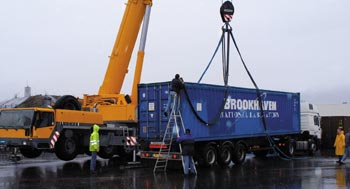
The new year at CERN has seen good news for two types of magnet that will be essential to focusing beams in the Large Hadron Collider (LHC). One of them, the first US-built magnet, came 6000 km by land and sea from the Brookhaven National Laboratory in New York. The other, a matching quadrupole magnet (MQM), built by UK firm Tesla Engineering, is showing exceptional performance levels.
The Brookhaven-built magnet, which arrived at CERN on 21 January, is a 10 m long, 4.7 tonne single-aperture dipole. Magnets of this type will be installed on either side of the ALICE and LHCb experiments to deviate the beams in order to make them interact and then to separate them. This first example, manufactured over a period of nine months by Brookhaven, is one of 20 magnets that the US laboratory is supplying for the “insertion regions” (where beams are deviated for various reasons), and includes four of the same type as the new arrival at CERN. The magnets are based on a technology developed by Brookhaven for its own RHIC accelerator.
LHC project leader Lyn Evans said: “Our Brookhaven colleagues have done a fantastic job in completing the USA’s first superconducting magnet for the LHC to specification and on schedule. It’s a great step forward for international collaboration in the construction and operation of large-scale installations for particle physics research.” Indeed, Brookhaven is not the only American partner in the LHC project, to which the US is contributing a total of $531 million (€490 million). Fermilab is building 18 “low-beta” quadrupole magnets, and the Lawrence Berkeley National Laboratory is working on the superconducting cable and feed boxes for the same quadrupoles.
The MQMs from the UK are also destined for the LHC’s eight insertion zones. The first 3.5 m long superconducting MQM has been undergoing stringent operating tests at CERN, reaching a magnetic field gradient of 215 T/m from the very first time it was powered up – under normal operating conditions it will only be required to reach 200 T/m, and the ramping took place without a single quench. This excellent result validates the choice of design and the industrial techniques, so series production can now begin.
The nominal parameters for the compact linear collider (CLIC) foresee acceleration of the electron and positron bunches to an energy of 1.5 TeV by 30 GHz normal-conducting accelerating structures operating at an average gradient of 150 MV/m. Such a high gradient is desirable to limit the length, and in consequence the cost of the linacs, but it is very ambitious when compared with present-day accelerators, which run typically at gradients of around 25 MV/m. The confidence that such high gradients could be achieved was shaken three years ago, when substantial damage of the copper surfaces of prototype 30 GHz accelerating structures was discovered after operating them in the CLIC Test Facility (CTF2) at gradients of only 70 MV/m for pulse lengths of only 15 ns – the CLIC nominal pulse length is 130 ns and the achievable gradient is expected to decrease with pulse length.
Following this disturbing discovery, a vigorous programme of R&D began, which aimed to understand the origin of the problem, and if possible propose and implement solutions. Three years later, the hard work has paid off. At the end of May, a novel 30-cell test structure reached an average accelerating gradient of 125 MV/m with a peak gradient in the first cell of 150 MV/m when powered with 15 ns pulses. On inspection, the structure was found to be undamaged.
The novel features that led to the dramatically higher gradient of this structure were three-fold. First, tungsten was used to make the parts of the structure where the surface electric field is highest, and where damage was observed in copper structures. Tungsten was chosen for its high melting point and low vapour pressure, and because it is renowned for its resistance to damage from arcing.
Second, a new type of power coupler – a so-called mode launcher coupler – was used for the first time to bring in and take out the power. Third, the geometry of the structure was revised to reduce the peak surface electric fields where breakdown occurs. News of this CLIC success was announced at EPAC2002, where it was very well received.
In November, a similar structure, but this time with molybdenum, did even better and achieved a peak accelerating gradient of 195 MV/m in the first cell, and an average accelerating field of 150 MV/m – this is the nominal CLIC loaded gradient. Again, on inspection the structure was found to be undamaged.
These are very important steps forward for the CLIC team and indeed for the whole linear collider field, although it is not yet the end of the road, because the gradient must be demonstrated at the CLIC nominal pulse length of 130 ns. Still, this latest CLIC high-gradient test result is a fitting way to end the very successful CTF2 programme. CTF2 was closed definitively at the end of 2002 to make way for CTF3. The next step in the high-gradient development programme will be the testing of an 11 GHz tungsten or molybdenum iris structure in the NLCTA at SLAC next June with 200 ns long pulses. From 2004, CTF3 will be used to make high-gradient testing at 30 GHz possible again at CERN with 130 ns long pulses.
Particle identification is a fundamental requirement for experiments such as LHCb that are dedicated to the study of B physics. Meaningful CP violation measurements will be possible only if hadron identification is available to reconstruct specific final states with high purity, and to tag the flavour of the b-hadron with high efficiency for the many B decay modes that can exhibit CP violating asymmetries. Now a team working in Novosibirsk, Russia, is successfully making highly transparent aerogel for the LHCb RICH (Rich Imaging Cerenkov) detector, which will play a key role in particle identification.
An important optical requirement of a Cerenkov radiator is not to scatter the produced photons. Any angular dispersion caused by the radiator medium will reduce the precision on the Cerenkov emission angle. In the momentum region of 2-10 GeV/c, an aerogel radiator having an index of refraction around n = 1.030 provides a good solution. Aerogel is a very-low-density material (0.1 g/cm3), essentially made of SiO2, and the dominant cause of image degradation is due to Rayleigh scattering.
The feasibility of a RICH detector with aerogel as a Cerenkov light radiator was demonstrated only a few years ago, in 1997, and relies on the excellent quality of aerogel available today. Aerogel produced by the Matsushita company in Japan is currently used in the RICH detector in the HERMES experiment at DESY.
The typical transverse dimensions of aerogel tiles are 10 x 10 cm2, and the typical thickness is 1 or 2 cm. It is technically very difficult to increase the thickness while maintaining the optical quality with the level of clarity needed. However, in order to achieve the required performance, the LHCb RICH detector needs a highly transparent aerogel radiator with a thickness of 4-6 cm.
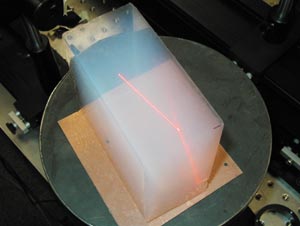
The aerogel block shown in the picture has been produced in Novosibirsk by a collaboration of the Boreskov Institute of Catalysis and the Budker Institute of Nuclear Physics, with support from a CERN-INTAS grant. It has dimensions of 10 x 10 x 5.5 cm3 and a refractive index of 1.03. Its effective scattering length for Cerenkov light at a wavelength of 400 nm is 43 mm, only 15% less than for the best thin aerogel samples.
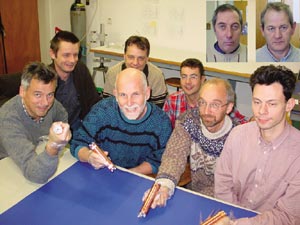
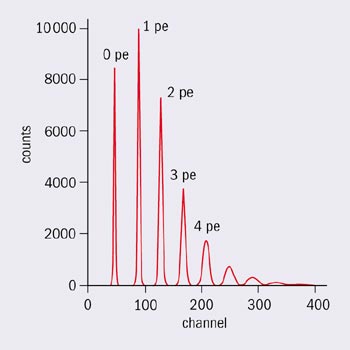
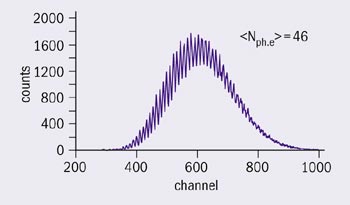
A team from the Moscow Engineering and Physics Institute together with Pulsar Enterprise in Moscow have developed a silicon photomultiplier (SiPM), which promises a wide range of applications. The device is basically a large number (103/mm2) of microphoton counters, which are located on a common silicon substrate and have a common output load. Each photon counter is a small (20-30 µm square) pixel with a depletion region of 2 µm. They are decoupled by polysilicon resistors and operate in a limited Geiger mode with a gain of 106. This means that the SiPM is sensitive to a single photoelectron, with a very low noise level of less than 0.1 photoelectron. Although each SiPM pixel operates digitally as a binary device, as a whole the SiPM is an analogue detector that can measure light intensity within a dynamic range of about 103/mm2 and has excellent photon capability.
The photon detection efficiency of the SiPM is at the level of photomultiplier tubes (PMTs) in the blue region (20%), and is higher in the yellow-green region. The device has very good timing resolution (50 ps r.m.s. for one photoelectron) and shows very good temperature stability. It is also insensitive to magnetic fields. These characteristics mean that the SiPM can compete with other known photodetectors (e.g. PMT, APD, HPD, VLPC) and may prove useful for many applications, from very low light intensity detection in particle physics and astrophysics, through fast luminescence and fluorescence studies with low photon numbers in chemistry, biology and material science, to fast communication links.
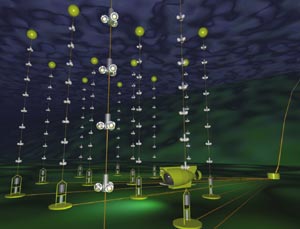
Late 2004 will see the implementation in the Mediterranean Sea of 12 detection lines carrying more than 1000 photomultipliers at depths from 2300 to 1950 m. These underwater eyes will form the ANTARES telescope, which will observe the Cerenkov emissions of up-going muons from the conversion of high-energy neutrinos in the deep water and seabed. Such neutrinos arrive undeviated from a variety of sources of astrophysical interest, and may also be produced in the annihilation of dark-matter neutralinos. In the closing weeks of 2002, the ANTARES collaboration passed two important milestones in the preparation for the final array.
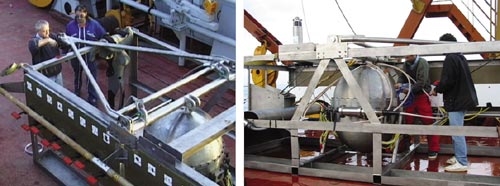
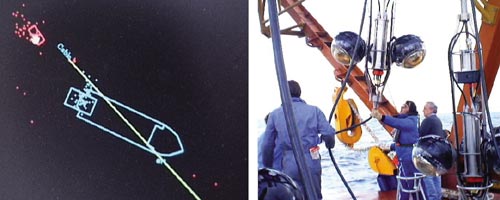
At 12.10 a.m. on 9 December 2002, the underwater electro-optical junction box – the nerve centre of the future array – touched down on the seabed south of l’Ile de Porquerolles near Toulon, France. Twelve days later, a 60 m detection line carrying photomultipliers and prototype readout electronics was successfully anchored nearby. The deployment of the junction box, which involved a 36 h boat mission, was a trickier operation, requiring the dredging and lifting of 2.5 km of the 40 km undersea electro-optical cable that had been laid to the ANTARES shore base more than a year previously.
The operations had begun in calm conditions at 8.30 p.m. on 7 December, when the GPS dynamical positioning ship Castor 02 set out from the Foselev Marine quay at La Seyne for the 3 h trip to the ANTARES site. Aboard were a CNRS film crew, two divers and eight ANTARES personnel with their test and underwater acoustic navigation equipment.
In the early hours of the following morning, an acoustic transponder deployed over Castor’s side received a response from acoustic beacons attached to the undersea cable. Taking position fixes from a net of acoustic transponders on the seabed, Castor manoeuvred a metre at a time on a pre-planned course perpendicular to the lay of the cable, dragging a chain grapple across the seabed nearly 2.5 km below. At about 9.00 a.m., the movement of a beacon showed that the 400 m “dredging tail” extension to the cable had been successfully snagged on the first pass, and cable lifting could begin. Steadily winching at 30 m per minute, Castor slowly reversed 3 km along the cable lay. A little before lunchtime, the end of the cable was landed on Castor’s deck.
Throughout the cable lift, the ANTARES shore station team regularly checked the attenuation in each of its 48 optical fibres. With the cable on Castor’s deck, the optical parameters were still acceptable, so the boat team set to work connecting the cable to the junction box’s titanium pressure sphere. Some 3 h later, the optical attenuations through the 16 junction box outputs had been checked and signed off. The insulation resistance of each of the 16 galvanically-isolated secondaries of the internal transformer had passed the acceptance criteria, and telemetry data were arriving back at the shore station through the undersea cable for the first time.
However, sea conditions had worsened, with torrential rain and waves lashing Castor’s deck. The test gear was sheeted down. Rain clouds cut short the daylight, so the remaining operations would be carried out under Castor’s powerful arc lamps. By 6.00 p.m., the swell exceeded 2 m. It was too dangerous to power the underwater cable to its full operating voltage with the junction box on deck, but Ohm’s law and a little resourcefulness with a car battery verified the continuity and resistance of the 40 km cable.
An hour later, the junction box was hanging far out over the fantail on Castor’s 25 tonne crane. On shore, the telemetry from the junction box inclinometers attested to the pounding, but with 2.5 km of cable now hanging from the junction box, the deployment had to continue. The divers donned lifelines. Some 20 m below the surface chop they would detach the kevlar slings from the crane, leaving the junction box suspended from a transfer cable spooled on Castor’s deep-sea winch. The crane block was paid out, and the junction box was lowered into the swell, breaking the surface twice before disappearing into the calmer water below trough level. So far so good; telemetry data was still coming in.
With the junction box 400 m below the surface, the descent was paused. An acoustic beacon and anchor weight were fitted to the transfer cable, which would become the dredging tail should the junction box need to be raised in the future. A duplex acoustic release was fitted to the winch cable. From here on up, all the cable would be respooled onto Castor’s winch once a coded acoustic signal had triggered the release shackles. Descent continued steadily until 11.30 p.m. By then, communications with the seabed transponder net were difficult due to the excessive noise from the sea swell and the efforts of Castor’s positioning motors, working flat out to keep her on the precalculated cable re-laying track. Suddenly, with the junction box around 400 m above the seabed, the indicated cable tension dropped by 2 tonnes – the weight of the junction box, its dredging tail and anchor. Had the cable parted, precipitating the junction box to the seabed?
Satellite phone calls to the shore station revealed that telemetry was still arriving. Pitch and roll were nominal. The swell decreased a little and the junction box acoustic beacon revealed that it was close to its correct descent position above the seabed; the fault was in the tensiometer and not the rigging. The last 400 m were carefully paid out, and the junction box was placed on the seabed within a few metres of the planned position. Not bad for acoustic manoeuvres in the dark! The dredging tail was aligned. The undersea cable was energized to 3700 V, and the correct current measured through the junction box transformer. The acoustic release was triggered and the deep-sea cable winched back to the surface, leaving the junction box in communication with the shore.
A rare window of good weather allowed the subsequent deployment of the 60 m test line to proceed smoothly. Following procedures developed during a rehearsal using “triplets” of empty pressure spheres, the test line deployment concluded at around 3.00 p.m. on 21 December, with the line anchor acoustic beacon revealing it at the correct touch-down location on the seabed, about 200 m from the junction box.
No further deployments were possible in the last few days of 2002. An instrumentation line carrying monitors for underwater environmental parameters including water transparency, undersea current profile and seabed seismic activity is awaiting good weather for deployment. The hook-up operations to the junction box plug board, using cables with underwater-mateable electro-optical connectors, must await the return of the Nautile submersible of France’s IFREMER oceanographic research agency from its capping operation on the wreck of the oil tanker Prestige off the Spanish coast. The collaboration hopes to make these hook-ups some time in March, allowing the instrumentation to be fully tested under real conditions.
Like all experimental groups around the world, the Belle collaboration at Japan’s KEK laboratory is always pushing for higher luminosity, and for the past couple of years the KEKB accelerator team has responded with successive improvements both in hardware and in beam tuning. The latest achievement came in October 2002, when Belle had accumulated an integrated luminosity of 100 fb-1 – a tally that no single collider experiment has previously achieved.
At the same time, KEKB notched up several milestones itself, with a beam current in the high-energy (electron) ring of 1006 mA, a peak luminosity of 82.56 ¥ 1032 cm-2 s-1, and integrated luminosities of 149.1 pb-1 in an 8 h shift and 433.7 pb-1 in a day. These numbers show that KEKB is still steadily progressing towards its design luminosity of 1034 cm-2 s-1.
The teams from KEKB and Belle, together with many others, celebrated these achievements on 28 October, and were toasted by two Nobel prize winners – Professor Masatoshi Koshiba, who shared last year’s Nobel Prize for Physics, and Professor Burton Richter, who won the prize in 1976 and was visiting KEK.
At the Jefferson Laboratory (JLab) in Virginia, US, a multilaboratory team using beams of relativistic electrons has generated broadband terahertz radiation at nearly 20 W average power, several orders of magnitude higher than any other source. The terahertz band – at the far-infrared interface between electronics and photonics – has drawn increasing attention in the past decade, despite the lack of high-average-power sources. The team reported its demonstration of high power in the 14 November edition of Nature.
The terahertz work is a spin-off from the superconducting radiofrequency (SRF) electron accelerator central to JLab’s mission of probing the quark structure of nuclei. In a news commentary accompanying the Nature report, Mark Sherwin of the Center for Terahertz Science and Technology at the University of California, Santa Barbara, wrote that the high-power demonstration has “opened the door to new investigations and applications in a wide range of disciplines”.
Terahertz imaging could reveal interesting features of the many materials with distinct absorptive and dispersive properties in this spectral range, which corresponds revealingly with biomolecular vibrations. The demonstration source would allow full-field, real-time imaging of the distribution of specific proteins or water in tissue, or buried metal layers in semiconductors. High-peak and average-power terahertz sources are also critical for driving new nonlinear phenomena, and for pump-probe studies of dynamical properties of materials.
Non-ionizing terahertz radiation can pass through clothing, paper, cardboard, wood, masonry, plastic and ceramics. It can penetrate fog and clouds. Since the light cannot penetrate metal or water, it cannot be used to inspect seagoing cargo containers or diagnose conditions deep inside the human body. However, eventual applications could include better detection of concealed weapons, hidden explosives and land mines; improved medical imaging and more productive study of cell dynamics and genes; real-time “fingerprinting” of chemical and biological terrorist materials in envelopes, packages or air; better characterization of semiconductors; and widening the frequency bands available for wireless communication.
Whichever applications may ultimately materialize, many will require high-average-power broadband terahertz light. Free-electron lasers (FELs) and fast diodes can produce useful quantities of narrow-band light. Thermal sources and tabletop laser-driven sources can produce broadband terahertz at low average power. The JLab experimenters produced high-average-power broadband emission from subpicosecond electron bunches in the JLab FEL’s unique SRF “driver” accelerator – a small, energy-recovering, high-current cousin of the 6 GeV CEBAF, the SRF accelerator that serves JLab’s nuclear and particle physics users.
Unlike most linear accelerators (linacs), the JLab FEL’s driver linac operates at a very high repetition rate – up to 75 MHz – using SRF cavities and recovering the energy of the spent electron bunches, so that the average current is orders of magnitude higher than in conventional linacs. This energy-recovery linac (ERL) runs with beam current up to 5 mA, compared with only 200 mA in CEBAF. The linac typifies the widening transdisciplinary applicability of smaller accelerators. In 1999, it provided the first substantial proof of the ERL principle, which is now being incorporated in or envisioned for machines worldwide.
JLab’s Gwyn Williams conceived and led the high-power terahertz demonstration experiment, which took place during late 2001 and involved researchers from JLab, Brookhaven National Laboratory and Lawrence Berkeley National Laboratory. They generated the light as synchrotron radiation from very short electron bunches (500 fs) that were accelerated to the relativistic energy of 40 MeV and then transversely accelerated by a magnetic field. Because the electron bunch dimensions are small – in particular, the bunch length is less than the wavelength of observation – the experimenters obtained multiparticle coherent enhancement.
Their demonstration of high-power terahertz radiation (also called T-rays, T-light or T-lux) adds a new dimension to Science magazine’s 16 August report, in an article called “Revealing the Invisible”, that “much research is being directed toward the development of T-ray sources and detectors.” Tochigi Nikon Corporation and Teraview (a Cambridge, UK, start-up associated with Toshiba) have begun commercializing low-power terahertz systems. A few hospitals are testing comparatively dim terahertz light for detecting skin cancer. Daniel M Mittleman of Rice University says that for low-power terahertz light, “perhaps the most promising applications lie in the area of quality control of packaged goods.” He illustrates by showing how the light can check the raisin count in boxes of raisin bran. Dr Xi-Cheng Zhang, a terahertz expert at Rensselaer Polytechnic Institute, predicts that “the future ‘killer application’…will be in biomedicine.”
These developments, statements and predictions were made when terahertz average power was still measured in milliwatts, not the tens of watts now demonstrated, or the still higher power that is expected. Nevertheless, the terahertz region still constitutes a gap in the science and technology of light – a region of the electromagnetic spectrum remaining to be better understood, and much better exploited. With commissioning of the 10 kW JLab FEL upgrade under way, Williams and his colleagues are planning an even higher-power terahertz beamline for further attempts to contribute toward those ends.
To provide the best experiences, we use technologies like cookies to store and/or access device information. Consenting to these technologies will allow us to process data such as browsing behavior or unique IDs on this site. Not consenting or withdrawing consent, may adversely affect certain features and functions.
Functional
Always active
The technical storage or access is strictly necessary for the legitimate purpose of enabling the use of a specific service explicitly requested by the subscriber or user, or for the sole purpose of carrying out the transmission of a communication over an electronic communications network.
Preferences
The technical storage or access is necessary for the legitimate purpose of storing preferences that are not requested by the subscriber or user.
Statistics
The technical storage or access that is used exclusively for statistical purposes.The technical storage or access that is used exclusively for anonymous statistical purposes. Without a subpoena, voluntary compliance on the part of your Internet Service Provider, or additional records from a third party, information stored or retrieved for this purpose alone cannot usually be used to identify you.
Marketing
The technical storage or access is required to create user profiles to send advertising, or to track the user on a website or across several websites for similar marketing purposes.