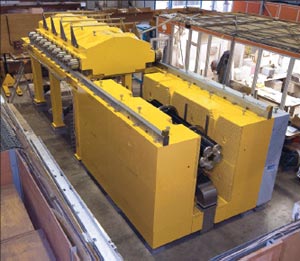
The CERN Neutrinos to Gran Sasso project (CNGS) has reached an important milestone with the successful first assembly of the target in a laboratory on the surface. Now the target is being dismantled prior to installation in its final location in the underground chamber.
On schedule for start-up in May 2006, CNGS will send a beam of neutrinos through the Earth to the Gran Sasso laboratory 730 km away in Italy, north-east of Rome, in a bid to unravel the mysteries of these elusive particles. To create the beam, a 400 GeV/c proton beam will be extracted from CERN’s Super Proton Synchrotron and directed towards the CNGS target, which consists of a series of graphite rods installed in a sealed container filled with helium. Positively charged pions and kaons produced by the proton interactions in the target will then be focused into a parallel beam by a system of two pulsed magnetic lenses – the horn and the reflector.
A 1 km-long evacuated decay pipe allows the pions and kaons to decay, in particular into muon-neutrinos and muons. The remaining hadrons (protons, pions and kaons) are absorbed in an iron beam dump with a graphite core. The muons will be monitored in two sets of detectors downstream of the dump, and then absorbed further downstream in the rock, while the neutrinos continue on towards Gran Sasso.
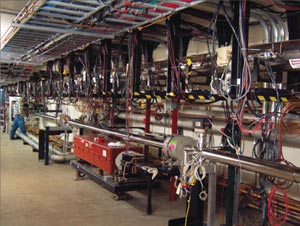
The target itself consists of 13 graphite rods, each 10 cm long and 4 or 5 mm in diameter. The first nine rods are interspaced by 9 cm of air, while the last four rods have no air-space between them; the 13 rods are together installed in a target unit. The CNGS target station contains five units – one active with four spares – in a rotatable target magazine. Together with a novel beam-position monitor (an electromagnetic coupler operated in air), the target magazine is installed on an alignment table. The four jacks to adjust the position of this table are fixed on a base table, and the entire assembly is installed inside an array of massive iron shielding blocks.
The neutrino beam will be completely installed by the end of 2005, and the first beam of neutrinos should head off next May.
Scintillation counters, with their simplicity and fast response, have been the quintessential tool for triggering in particle physics since they were first coupled with photomultiplier tubes (PMTs) some 60 years ago. However, the bulky, fragile, high-voltage-driven PMT looks set to be replaced by a much simpler and smaller silicon device. Thanks to the rapid development of semiconductor technologies during the past decade, the detection of light produced by ionizing particles in scintillating plastic can now be performed efficiently by inexpensive miniature photodiodes.
Taking advantage of this technique, physicists from the Institute for Theoretical and Experimental Physics (ITEP) in Moscow, who are part of the ALICE collaboration at CERN, have developed a scintillation counter in which the light is read out by high-gain avalanche photodiodes, embedded directly inside the scintillating plastic. The metal/resistive-layer/silicon (MRS) avalanche photodiodes (APDs) have a sensitive surface of 1 mm2, and when operated in the so-called “Geiger” mode provide a million-fold amplification of initial photo-ionization. This makes them sensitive even to single photons in the green region of the visible light spectrum. In contrast with standard PMTs, MRS APDs are biased at a low voltage of 30-50 V, consume little power and are not influenced by magnetic fields. Moreover, their current price is significantly lower than that of PMTs.
The team has developed a detector they call START, for Scintillation Tile with MRS APD Light Readout, which consists of a scintillating plastic plate, a piece of wavelength-shifting optical fibre installed in a circular groove inside the plate, two MRS APDs working in coincidence, an opaque wrapper and a front-end card mounted directly on the detector. Various versions of START have been thoroughly tested using cosmic rays and have shown operational consistency, excellent detection efficiency and good homogeneity.
An area of almost 4 m2 comprising 170 START tiles, each 15 × 15 ×1 cm3, has been assembled as part of the Time-of-Flight (TOF) project for the ALICE detector, which is under construction for the Large Hadron Collider. They will be used as cosmic-ray triggers in a larger system of STARTs for regularly testing the ALICE TOF system components.
With the push of a button, on 3 August German Federal Chancellor Gerhard Schröder handed DESY’s new vacuum-ultraviolet free-electron laser, VUV-FEL, over to the scientists. The VUV-FEL is the world’s first free-electron laser for generating the short-wavelength range of ultraviolet radiation, and will open up new insights into fields such as cluster physics, solid-state physics, surface physics, plasma research and molecular biology.
The VUV-FEL makes use of new technology developed at DESY from 1992 to 2004 by the international TESLA Collaboration. In a first step, electrons are brought to high energies by a superconducting linear accelerator. They then race through an undulator, a periodic arrangement of magnets that forces them to follow a slalom course and radiate. Thanks to the novel principle of self-amplified spontaneous emission (SASE), this radiation finally emerges in the form of short-wavelength, intense flashes of laser light.
The VUV-FEL produces coherent radiation with a wavelength tunable in the range 6-30 nm and a peak brilliance that surpasses that of modern synchrotron radiation sources by a factor of 10 million. Its very intense radiation pulses last only 10-50 fs, allowing researchers to observe directly the formation of chemical bonds, for example, or the processes that occur during magnetic data storage. In addition, operation of the VUV-FEL will provide important insights for the 3.4 km-long European X-ray laser (XFEL) that is being planned in Hamburg. The XFEL will generate even shorter wavelengths down to 0.085 nm and should begin operation in 2012.
As a user facility, the VUV-FEL will offer five experimental stations at which different instruments can be operated alternately. At present, 29 research projects are planned at the VUV-FEL. These will be carried out by around 200 scientists from 60 institutes in 11 countries. The project’s total cost is 7117 million, financed 90% by Germany and 10% by international partners.
The Relativistic Heavy Ion Collider (RHIC) at Brookhaven National Laboratory is unique. In addition to accelerating heavy ions, it also accelerates spin-polarized protons to high energies and enables the study of collisions between polarized protons with centre-of-mass energies up to 500 GeV.
Collisions between high-energy polarized protons are a powerful way of finding out what is spinning inside, technically known as the “spin structure functions” of the proton. The long-held assumption that the proton’s spin is simply the sum of the spins of the three quarks inside the proton has been laid to rest by experiments at SLAC, CERN and DESY. These have shown that less than 30% of the proton’s spin is accounted for by the spin of the quarks. Besides quarks, the proton (and neutron) contains gluons – the particles that explain the strong force that binds protons and neutrons in the atomic nucleus. Finding out what contribution gluons make to the spin of the proton and neutron is central to our understanding of nuclear matter.
Several large efforts are under way to study this question. The Common Muon and Proton Apparatus for Structure and Spectroscopy (COMPASS) collaboration at CERN and the HERMES collaboration at DESY bombard polarized protons (protons with their spin axes aligned in the same direction) with energetic muons or electrons. However, these experiments use electromagnetic probes, so the gluons are seen only indirectly.
Collisions between polarized energetic protons at RHIC should offer a more direct view of the gluon spin contribution. For this purpose, bunches of polarized protons are loaded into the RHIC accelerator, with the “blue” beam orbiting clockwise and the “yellow” beam orbiting counter-clockwise. (The beams are named after the coloured stripes on the collider’s two rings of magnets.) The two beams meet head-on at several different collision regions of the ring and the resulting secondary particles are observed by four detectors: BRAHMS, PHENIX, PHOBOS and STAR. The polarized protons originate from a special ion source that produces polarized negative hydrogen ions. These then pass in turn through a series of accelerators before being injected into RHIC.
This process is more difficult than it sounds. The polarized protons have a magnetic moment associated with their spin (they act like small compass needles). This raises the likelihood that the spin direction may be lost during the millions of times the protons orbit the ring, on each turn passing through the hundreds of magnets that are needed to deflect and focus the proton beam. Accelerator physicists avoid this depolarization by using spin precessors known as Siberian Snakes, but the question remains: how do we know the exact degree of polarization (the fraction of particles with spin up versus spin down) after the beam has been accelerated to full energy?
Measuring polarization
The polarization of a beam of protons is measured by inserting a thin target (an analyser) into the beam and observing the number of scattered particles at equal angles to the left and the right of the beam. The left:right intensity ratio depends on how much the beam is polarized (the beam polarization, P) and on how sensitive the scattering process is to the spin direction of the beam particles (the analysing power, A). The problem is that at very high energies there are no scattering processes for which the analysing power is known with sufficient accuracy. At lower energies than those achieved at RHIC, for example at the Proton Synchrotron at CERN and the Alternating Gradient Synchrotron at Brookhaven, moderate-angle elastic proton-proton scattering has been used, based on measurements of the analysing power using polarized hydrogen targets. The analysing power was observed to fall with energy, and the effectiveness of this method is exhausted by around 30 GeV.
However, for small scattering angles, the interference of the electromagnetic and strong interactions is expected to provide a significant analysing power for elastic proton-proton (and proton-nucleus) scattering. This analysing power, which is the basis of the RHIC high-energy polarimeters, derives from the same electromagnetic amplitude that generates the proton’s anomalous magnetic moment. Experiment E704 at Fermilab used 200 GeV/c polarized protons from hyperon decay to detect the asymmetry in scattering from a hydrogen target (Akchurin 1993). The largest analysing power, AN, was about 0.04 but the statistical errors were large. A calculation of the analysing power agreed with these measurements, but they are subject to uncertainties in the strong interaction amplitudes. Hence, an accurate calibration of the reaction is required.
The idea for the beam-polarization calibration at RHIC is simple in principle. Let the high-energy beam cross a jet of polarized hydrogen atoms of known nuclear polarization, and measure the left:right ratio in the number of scattered particles; then reverse the sign of the target polarization periodically to cancel asymmetries caused by differences in detector geometry or efficiency in the left and right directions. This gives the target asymmetry εtgt = PtgtAN. Now measure the corresponding asymmetry but with the polarization of the beam particles reversed, to give εbeam = PbeamAN. Since in proton-proton elastic scattering the analysing power AN, which is a measure of the polarization-sensitivity of the scattering process, is the same no matter which proton is polarized, the ratio of beam asymmetry to target asymmetry, εbeam⁄εtgt, multiplied by the known target polarization, Ptgt, gives an absolute measurement of the beam polarization, Pbeam.
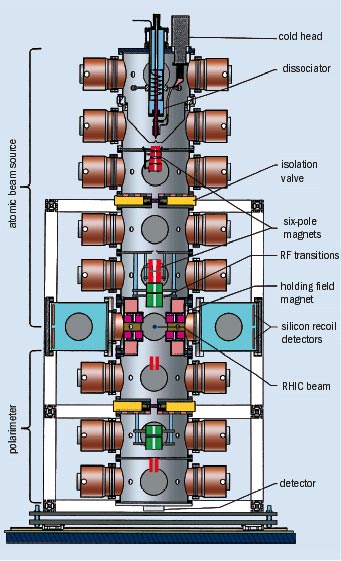
The trick is to make a jet of known polarization and of sufficient density to achieve reasonable count rates. The Brookhaven polarized-hydrogen jet is produced by an atomic beam source (ABS) in which molecular hydrogen is dissociated by a radio-frequency (RF) discharge, and the resulting atomic hydrogen beam is spin-separated and focused according to electron spin by sets of six-pole magnets (figure 1). The spin of the resulting particles is manipulated by RF transitions, which flip the spin to produce either up or down proton polarization. The principle is not new. Equipment of this type was originally developed for ion sources that produced polarized protons. Work on an ABS for use as an internal target of polarized hydrogen in the Super Proton Synchrotron at CERN was carried out some 30 years ago (Dick et al. 1981 and 1986), but was eventually abandoned because the target density (a few times 1011 H/cm3) was insufficient. To get around the low jet density, most recent experiments with polarized hydrogen gas targets use long “storage cells” into which hydrogen atoms from an ABS are injected (Steffens and Haeberli 2004). These storage cells increase the target thickness by a factor of about 100, but at RHIC the need to know the scattering angle of the very-low-energy recoil protons precludes the use of an extended target.
The polarized atomic hydrogen jet constructed for RHIC has achieved a beam intensity of 1.2 × 10¹⁷ H/s, which is the highest intensity recorded to date. At the point of interaction with the RHIC beams, the hydrogen beam profile is nearly gaussian and has a full width at half-maximum of 6.5 mm. The areal density of the hydrogen target is (1.3 ± 0.2) × 1012 H/cm2.
Hydrogen atoms formed by dissociating molecular hydrogen in an RF discharge emerge through a 2 mm-diameter cooled nozzle (optimum temperature 65 K) and enter a set of tapered six-pole magnets that are made of high-flux rare-earth permanent magnets (these have a pole-tip field of 1.5 T and a maximum gradient of 2.5 T/cm). The magnets are divided into sections to improve pumping. They were designed by elaborate optimization using empirical data on dissociator output versus gas flow and temperature, as well as attenuation by gas scattering in the beam-forming region and in the six-pole magnets. The atomic beam diverges in the first set of magnets, passes a long drift space, and converges in the second set of magnets towards the target region.
Near the point where the RHIC beam intersects the atomic hydrogen beam, a “holding field” provides a very uniform vertical magnetic field. The strength of the field (0.12 T) was chosen to avoid depolarization of the atoms by the periodic electromagnetic field that is produced by the beam bunches. Stringent conditions had to be met by the fringe fields of the guide field magnet to assure a slow adiabatic field change between the six-pole field, the RF transitions and the guide field.
The target polarization is reversed periodically by turning on one or other of two RF coils, which induces spin-flips in the hydrogen atoms. A second set of six-pole magnets and RF coils placed after the interaction point serve to measure the proton polarization at the target. The efficiency of the spin-flip transitions is found to be above 99%. In the finite holding field there is a residual coupling of the proton spin to the electron spin, which results in a net proton polarization of 0.96. The largest uncertainty in the target polarization arises from the uncertainty in the measured contamination of the atomic hydrogen beam by molecular hydrogen, which is unpolarized. Taking into account this dilution, the target polarization is Ptgt = 0.924 ± 0.018.
Results at RHIC
With a target of pure hydrogen atoms, proton-proton scattering with low momentum transfer can be uniquely identified by detecting the recoil proton near 90° with respect to the high-energy beam. The Fermilab experiment E704 showed significant spin-dependence in proton-proton scattering for momentum transfer in the range |t| = 0.001-0.03 (GeV/c)2. This corresponds to recoil protons of a few hundred kilo-electron-volts to several mega-electron-volts.
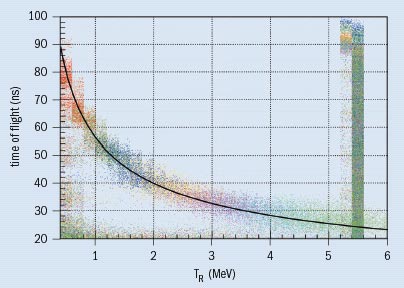
Recoils are detected in silicon-strip detectors placed 80 cm from the hydrogen jet (figure 2). Recoil protons from proton-proton elastic scattering are identified by their time-of-flight and energy-angle correlation (figure 3). The figure illustrates the clear identification of protons, with the solid curve showing the predicted relationship between proton energy and time of flight. Events from different detector strips are distinguished by colour, and it is this correlation between scattering angle and energy that demonstrates that the scattering is elastic.
The average of Ptgt(εbeam/εtgt), taken over all energy bins of the recoil detector, determines the beam polarization Pbeam. In fact, etgt and ebeam are measured at the same time by loading into the ring bunches of opposite polarization and reversing the target polarization every few minutes. The results of measurements on the blue beam during early 2004 show (εbeam/εtgt) = 0.43 ± 0.02, where the error is purely statistical. Assuming a target polarization of 0.924 ± 0.018, the RHIC beam polarization was 0.392 ± 0.026. For the measurements in 2005, the detectors were displaced along the RHIC beam direction to allow detection of recoils from both blue and yellow beams. Preliminary results indicate that, compared with 2004, the beam polarization has improved by about 15%, which is an important accomplishment. These results can be used to determine the t-dependence of the analysing power AN = Ptgt/εtgt for proton-proton elastic scattering at 100 GeV. The results, which are shown in figure 4, agree closely with calculations based on Coulomb nuclear interference without any hadronic spin-flip.
The polarized hydrogen jet makes it possible to determine the polarization of high-energy protons to an accuracy of a few per cent, without using a model. Theory predicts that the method will be successful over the entire energy range that is accessible by RHIC.
The polarized hydrogen jet does not interfere with the operation of the ring. Despite the small target density and without the use of coincidence detection, it has proved possible to cleanly identify proton-proton elastic events with minimal background.
The major drawback of the polarized hydrogen jet is that the low count rate precludes rapid monitoring of the beam polarization – for example, during beam tuning. For this reason, a proton-carbon (pC) polarimeter is used. This permits relative beam polarization to be measured in less than a minute. The polarized hydrogen jet enables the pC polarimeters to be calibrated to an accuracy better than 6%. Thus the polarized-hydrogen target and the carbon target serve complementary roles.
• The development and operation of the polarized hydrogen jet target was a collaboration between BNL (C-AD, Instrumentation and Physics), ITEP (Moscow), IUCF, Kyoto University, Riken BNL Research Center, University of Wisconsin-Madison and Yale University.
In the early 1980s, CERN initiated the pbar p Collider Workshop series with the aim of communicating and synthesizing the latest results from hadron collider experiments – most recently the Collider Detector at Fermilab (CDF), and the D0 experiment at the Tevatron at Fermilab. This year, with the projected commissioning of CERN’s Large Hadron Collider (LHC) in 2007 and the subsequent transfer of physics activities, the series was merged with the LHC Symposium that is devoted to preparing LHC experiments, and renamed the Hadron Collider Physics (HCP) Symposium. HCP2005 was organized by CERN and the Swiss Institute for Particle Physics (CHIPP), and was held in Les Diablerets, Switzerland, on 4-9 July. About 150 participants attended from the Tevatron and LHC experiments.
Ralph Eichler, the director of the Paul Scherrer Institute, gave a welcoming address. This was followed by Georg Weiglein from the Institute for Particle Physics Phenomenology, Durham, who presented an introductory theoretical overview of the role of hadron colliders in studying the Higgs sector of the Standard Model. The first major session was then devoted to machine and experimental studies at the Tevatron and LHC. David McGinnis of Fermilab described current and prospective operations at the Tevatron, where the CDF and D0 experiments are operating well and an integrated luminosity exceeding 1 fb-1 has already been delivered to each experiment. CERN’s Lyn Evans outlined the progress made in building the LHC, and representatives from each of the LHC experiments described the advanced construction status of the detectors, as well as the new phase of detector integration and commissioning.
Directions for physics
With the goal of maximizing the shared experience of the Tevatron and LHC communities, the symposium was then organized around the key physics directions of hadron-collider research. Each of the physics sessions was introduced by a theorist, who gave an overview of the subject, followed by speakers from the Tevatron and LHC experiments. Sessions were also held on experimental issues such as particle identification, or tracking and b-tagging, in which experts from both communities could present their solutions and exchange ideas.
The first physics session was on the subject of quantum chromodynamics (QCD). It opened with a talk by Keith Ellis from Fermilab on the status and limitations of next-to-leading-order (NLO) and next-to-next-to-leading-order (NNLO) theoretical calculations, together with calculations planned to match experimental “wish lists”. The experimental talks described the wealth of data that is becoming available from CDF and D0. There were also several talks about identifying and calibrating jets at the Tevatron and in future at the LHC.
A complementary session dealt with electroweak physics, a field in which some surprises may emerge. Ulrich Baur of the State University of New York presented the status of Standard Model fits and available calculations. This was followed by talks on production measurements of single-vector bosons and vector boson pairs.
The LHC is expected to open new frontiers beyond the Standard Model, so a major session was devoted to existing and future direct searches for new physics. This could be supersymmetry or something more exotic, and might even appear in small deviations in rare B-meson decays measured at the LHCb experiment. No hints of new physics have been found at the Tevatron. However, Anna Goussiou from the University of Notre Dame showed that even with reduced luminosity expectations for the final Run II data sample, the CDF and D0 experiments maintain a non-negligible potential for finding “evidence” of a Higgs boson in the low-mass range, where identification is most difficult for the LHC experiments.
Not so long ago, precision b-quark physics was considered to be almost impossible at hadron colliders. However, thanks to dedicated triggers and excellent tracking capabilities, the Tevatron experiments have world-class results that are in many cases comparable to those from the b-factories. Furthermore, CDF and D0 have a monopoly in studies of the BS sector. An important request from the theoretical community, which was emphasized in the talk by Luca Silvestrini from INFN/Roma, is for measurements of BS mixing, in particular the parameters ΓS and ΔmS. Guillelmo Gomez-Ceballos of the Instituto de Fisica de Cantabria presented results from the CDF effort on that topic. There is no quantitative measurement so far, but, with all of the analysis machinery in place, the whole region of ΔmS that is predicted by the mixing triangle can be covered as soon as sufficient data are available. If surprises arise and the value is larger than expected, the LHCb experiment will discover and/or measure with extreme precision this missing piece of the Cabibbo-Kobayashi-Maskawa puzzle.
The results from the Relativistic Heavy Ion Collider (RHIC) at Brookhaven and expectations from the ALICE experiment at the LHC dominated the session on heavy-ion physics. However, talks about CMS and ATLAS, the two general-purpose detectors at the LHC, showed that they will have a vital role in many aspects of heavy-ion physics; for example, in measuring high-pT jet production.
Top quark results
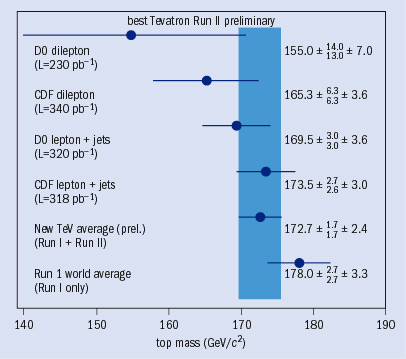
The last major physics session was dedicated to the top quark. CERN’s Fabio Maltoni highlighted the improved experimental conditions that are available at the LHC compared with the Tevatron, and stressed the importance of measuring the properties of the top quark to try to explain its large mass. Tomonobu Tomura of Tsukuba presented the latest mass measurements from CDF and D0 (figure 1), including CDF’s new measurement of 174.5+2.7-2.6 (stat.) ± 3.0 (sys.) GeV, based on a two-dimensional template method. While the preliminary Tevatron average for the top mass is 174.3 ± 2.0 (stat.) ± 2.8 (sys.) GeV, by the end of Run II the Tevatron experiments are expected to measure the mass with a precision better than ±2 GeV. The search for single-top production, as well as preliminary measurements of the ttbar production cross-section, were also described. Arnulf Quadt of Bonn presented the measurements of some t-quark decay properties (for example, the W-helicity) and searches for rare t-quark decay modes. Presentations by the CMS and ATLAS collaborations underlined the rich experimental programme that is expected in the future.
The physics sessions were interrupted by two sessions about preparations for the LHC. A key issue will be lepton identification. One session was devoted to the results and pitfalls from the Tevatron experience, and ended with status talks on the hardware and reconstruction aspects of the LHC experiments. The results seem encouraging, even if experience shows that the real answer only comes under running conditions. A natural follow-up to the b-physics session was a discussion on tracking and b-tagging. The lesson from the Tevatron has been positive and the LHC collaborations seem to be aware of that. The overall computing strategy and preparations for analysing the LHC experiments were widely presented and discussed at the end of the session.
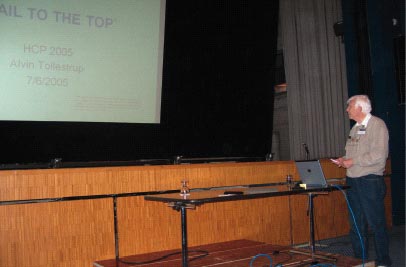
A special guest at the symposium was Fermilab’s Alvin Tollestrup. Tollestrup played a crucial role in the machine, detector and analysis activities that led to the discovery 10 years ago of the top quark by the CDF and D0 experiments. In an inspiring presentation, he talked about “the trail to the top”, leading to the discovery of the top quark and the ideas that were behind it. Many saw this talk as Tollestrup’s way of passing the baton to a younger generation. He also reminisced about a time when particle physics was on a smaller scale, and he stressed the evolution of experimental techniques in particle physics and their consequences.
The theoretical and experimental summaries of the symposium were given by Pierre Binétruy of the Laboratoire d’Astroparticule et Cosmologie (APC) in Paris, and John Womersley of Fermilab and the US Department of Energy. Binétruy stressed the important role of the LHC programme during the coming years. Womersley placed the results presented at the conference in the context of the rapidly evolving jigsaw puzzle of the Standard Model of electroweak and strong interactions, with its extensions and future possible surprises.
Holding the conference in a remote alpine location was a challenge. However, the organizing committee from CERN and CHIPP, the secretaries from CMS and ATLAS (Nadejda Bogolioubova and
Jodie Hallman) and the hotel staff made it a success. The only unpredictable factor, the weather, played foul. Although luck held during the welcome drink and an Alpine horn concert, it was mostly raining, and a dinner at 3000 m altitude in the glacier restaurant was immersed in cloud. Only those participants who remained an extra day discovered the beauty of Les Diablerets in brilliant sunshine.
The next meeting of the series will be hosted by Duke University in May 2006, and in summer 2007 the meeting will be hosted by INFN Pisa in or near the town of Pisa.
After 10 years of preparation, a team at Fermilab has achieved electron cooling at high energy. On 9 July, on the first attempt, the Electron Cooling Group observed the interaction between an 8 GeV antiproton beam and an electron beam travelling at the same speed. Although commissioning will take another couple of months, accelerator experts have already begun to use the electron-cooling system to reduce the size of antiproton beams prior to their injection into the Tevatron proton-antiproton collider. Ultimately, they hope that electron cooling will increase the collider’s luminosity by 50-100%.
Electron cooling, first proposed by Gersh Budker in 1966, is a proven method at low energies, but Fermilab, funded by the Office of Science of the US Department of Energy, is the first laboratory to extend the method to relativistic beam energies. The higher-energy system has been developed at Fermilab under the leadership of Sergei Nagaitsev, who joined the laboratory in 1995. Installation of the system in the Recycler storage ring, which stores and cools antiprotons, began in August 2004.
Constructed in the late 1990s, the Recycler is 3.3 km in circumference and uses permanent magnets to store antiprotons at 8 GeV. The new electron-cooling system mainly reduces the longitudinal emittance of the beam by “mixing” the antiprotons with a continuous 4.3 MeV beam of electrons, which are provided by a Pelletron accelerator adjacent to the ring. The electron beam, with a current of up to 0.5 A and power of up to 2 MW, travels for approximately 20 m along the same path as the antiprotons, and is then sent back to the Pelletron for recirculation. The electrons interact with the antiprotons, cooling the beam and reducing the spread in longitudinal momentum: antiprotons travelling too fast are slowed down as they bump into electrons, and slow antiprotons are sped up as they are hit by faster electrons.
A stochastic-cooling system, based on the principle invented by Simon van der Meer at CERN in 1972, already reduces the transverse emittance of the Recycler’s antiproton beam. With the start-up of the electron-cooling system, it is the first time that two beam-cooling systems have been used concurrently, according to Nagaitsev, and that electron cooling has been used to improve beams for a collider.
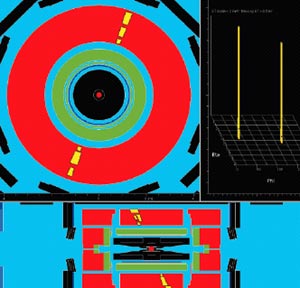
On the evening of 21 June, the ATLAS detector, now being installed in the underground experimental hall UX15 at CERN, reached an important psychological milestone: the first cosmic-ray events were recorded by the barrel hadronic tile calorimeter in situ. Although only four of the 64 calorimeter slices were included in the trigger, beautiful muon tracks were seen traversing the detector. The purpose-made trigger box selected cosmic rays passing close to the interaction region, thus giving the impression of “back-to-back” tracks.
An estimated 1 million cosmic muons enter the ATLAS cavern every 3 min, and the ATLAS team decided to use of some of them for the commissioning of the detector. For two weeks, experts of different disciplines from CERN and the experiment (cooling, high-voltage, front-end electronics, data acquisition, offline) worked underground in USA15, the counting room next to the main ATLAS cavern. Their goal was the commissioning of hardware and software systems, monitoring long-term stability and checking module uniformity and performance. The test used final components for the whole signal chain up to the counting room and provided valuable experience for the whole tile calorimeter system.
This is just the first stage of a long ATLAS commissioning programme, which will gradually see more subdetectors taking part. In autumn with a portion of the muon spectrometer already installed in the pit will begin commissioning, and will be joined in spring 2006 by the electromagnetic liquid argon calorimeter after it has been cooled. A complete “slice” of the ATLAS detector ran in a test beam during 2004, but this is the first time that events have been recorded underground.
The 2005 Particle Accelerator Conference (PAC05) took place on 16-20 May, at the Knoxville Convention Center in Knoxville, Tennessee. The conference was jointly hosted by the Oak Ridge National Laboratory Spallation Neutron Source (SNS) – the largest accelerator construction project in the US – and the Thomas Jefferson National Accelerator Facility (JLab), Newport News, Virginia. As usual, the conference covered new developments in all aspects of the science, technology and use of particle accelerators. Unique to PAC05, however, was the special theme of the World Year of Physics, as declared by the United Nations in honour of the centenary of Albert Einstein’s annus mirabilis, when he published his three papers on light quanta, Brownian motion and the special theory of relativity. These discoveries had a remarkable impact on science which continues to this day.
With its exciting programme, the conference attracted more than 1400 accelerator specialists to Knoxville during the week, making it the second largest PAC ever. Geographically, 59% of the attendees were from the US, 25% from Europe, 15% from Asia and 1% from the Middle East, South America and as far away as Australia. Nearly 1400 papers were processed during the conference and will soon be published on the Joint Accelerator Conferences Website, located at www.JACoW.org.
Accelerators present and future
Phil Bredesen, governor of Tennessee and a physicist with a background in accelerators from his student years, welcomed delegates to the conference. The governor talked about the significance of science as a driver of economy and wealth, as well as the importance of continuously supporting education. He was followed by Cecilia Jarlskog from Lund, whose colourful presentation included information about Einstein, the Nobel prize and accelerators. Barry Barish, chair of the International Technology Recommendation Panel for the proposed International Linear Collider (ILC), then explained the technology choice made last year for the machine and outlined his role as the new director of the ILC Global Design Effort to design the accelerator while involving all regions of the world.
The Monday morning plenary session included highlights from other accelerators, such as the luminosity records of the Tevatron at Fermilab, achieving more than 1 × 1032 cm-2 s-1; the outstanding performance of Brookhaven’s Relativistic Heavy Ion Collider, with its polarized beams; and the race between the B-factories (KEKB in Japan and PEP II at SLAC in the US). The closing plenary session on Friday afternoon included talks on nuclear-physics topics such as the Rare Isotope Accelerator proposed in the US and the Facility of Antiproton and Ion Research (FAIR) project at GSI, as well as accelerator-based materials-science research, and neutrino and high-energy physics. The talks focused on projects that have paved the way for the accelerators that need to be built to address today’s pressing questions in all areas of science, and they demonstrated yet again how accelerators have become crucial research tools over the past 50 years.
Synchrotron light sources of all sizes and flavours once again dominated the papers presented at the conference, demonstrating how quickly the field is still growing, especially in energy-recovery linacs and short-pulse coherent light sources, i.e. X-ray free-electron lasers (FELs) including the use of self-amplification of spontaneous emission (SASE). Sixteen oral presentations and more than 100 papers were presented on these facilities alone. Vibrant research and planning for new projects are ongoing, with the Linac Coherent Light Source under construction at SLAC and the EUROFEL moving from planning to construction at DESY, as well as the Spring-8 Compact SASE Source in Japan.
Einstein was ever-present throughout PAC05, with the conference website incorporating an Einstein quotation on every page, and several special activities during the week. These events began with a violin and piano concert by Jack Liebeck and Inon Barnatan on the Tuesday evening, which recognized Einstein’s love of the violin and was introduced by Brian Foster from Oxford University. Then on Wednesday afternoon, the US, Asian and European PAC series joined forces in a special session, “Einstein and the World Year of Physics”, organized by Swapan Chattopadhyay from JLab. The session was chaired by Bill Madia of Battelle and included four presentations relating present-day research to Einstein’s legacy, by Michael Turner from the National Science Foundation (NSF), Makoto Kobayashi of KEK, Yoichiro Suzuki of Tokyo and Carlo Rubbia from ENEA/CERN.
Einstein in the City
To draw the public’s attention to the World Year of Physics, an “Einstein in the City” festival followed the session. Organized with the City of Knoxville, the festival drew conference participants and several hundred others to the World’s Fair Park, outside the convention centre. Part of the festival was a science fair for local high-school students, with cash prizes of between $200 and $5000 awarded to projects judged by a team of conference participants. A special panel of four physicists, moderated by Madia, answered science-related questions from the public for about an hour. Questions covered everything from “Why is science useful?” to “How many stars are in the universe?” to “What does an accelerator do?”. Other activities included an appearance by “Einstein the Bird” – a talking parrot from the local zoo – and bluegrass music from a local band, as well as plenty of good food and drink.
Another highlight of the conference was the now customary prize session, in which the winners of several accelerator prizes are recognized and have the opportunity to report on their research. The session chair, Nan Phinney of SLAC, congratulated recipients individually and presented some of the awards. Among them was Keith Symon of the University of Wisconsin-Madison, winner of the American Physical Society’s prestigious Robert R Wilson Prize “for fundamental contributions to accelerator science, including the FFAG concept and the invention of the RF phase-manipulation technique that was essential to the success of the ISR and all subsequent hadron colliders”. The other APS prize was for an outstanding doctoral thesis by Eduard Pozdeyev from JLab, who performed his doctoral work at Michigan State University. Ron Davidson of Princeton and Tom Roser of Brookhaven National Lab were awarded the Particle Accelerator Science and Technology Award from the Nuclear and Plasma Science Society of the Institute of Electrical and Electronics Engineers. Wim Leemans of the Lawrence Berkeley National Laboratory (LBNL) and Anton Piwinski of DESY were presented with the US Particle Accelerator School Prize for Achievement in Accelerator Physics and Technology.
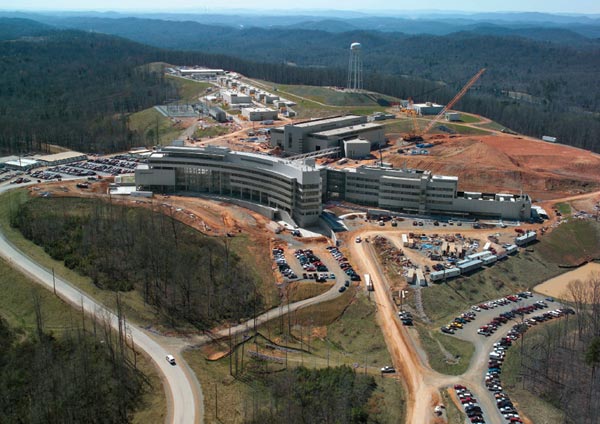
While PAC05 ended officially on Friday afternoon, about 400 participants extended their stay by a day to visit the SNS site at Oak Ridge. The SNS is entering its last year before the first beam is scheduled to hit the mercury target and the first neutrons channelled to instruments. So far the beam has been commissioned to the end of the normal conducting linac, up to 157 MeV, and soon the superconducting linac will be turned on to boost the energy to 1 GeV. Later this year the compressor will be commissioned in preparation for user operation, to begin next summer. Tour participants were therefore among the last people to get a glimpse of what has been going on at the site over the past five years, before much of the facility is closed to visitors.
A team at the Advanced Light Source (ALS) of the Lawrence Berkeley National Laboratory (LBNL) has proposed the construction of a ring-based photon source optimized for generating coherent synchrotron radiation (CSR) at terahertz frequencies. The Coherent Infrared Center (CIRCE) will exploit all the CSR production mechanisms currently available for achieving top-level performance, including a photon flux exceeding by more than nine orders of magnitude that of existing conventional broadband terahertz sources.
Interest in the scientific use of radiation at terahertz frequencies is rapidly increasing: the fields that would benefit range from solid-state physics (semiconductors, metals, superconductors, strongly correlated materials, etc) through chemistry and biology to applications in medical science and security. However, a major problem is that generating radiation of significant intensity in this frequency range, which lies between microwaves and infrared, is not straightforward. Owing to the lack of sources, this region is often referred to as the “terahertz gap”, but storage-ring-based CSR sources are very promising candidates for addressing this situation.
CSR occurs when the synchrotron emission from the relativistic electrons in a beam bunch is in phase. This happens when the length of an electron bunch is comparable to, or shorter than, the wavelength of the radiation being emitted. At 1 THz, this is about 300 μm. In the coherent regime, the radiation intensity is proportional to the square of the number of particles per bunch, in contrast with the linear dependence of conventional incoherent synchrotron radiation. Considering that the number of electrons per bunch in a storage ring is typically very large (106-1011), the potential intensity gain for a CSR source is huge. However, achievable bunch lengths and the shielding effect of the conductive vacuum chamber in storage rings mean CSR can only be generated in the terahertz frequency range (from about 100 μm to a few millimetres).
Although CSR was predicted to occur in high-energy storage rings over half a century ago, it has only been observed in the past few years. Intense bursts of CSR with a stochastic character have been measured in the terahertz frequency range in storage rings at several synchrotron light sources. Work carried out by groups at the Stanford Linear Accelerator Center (SLAC), LBNL and the Berliner Elektronenspeicherring-Gesellschaft für Synchrotron Strahlung (BESSY) showed that this bursting emission of CSR is associated with a single bunch instability (G Shipakov et al. 2002, M Venturini et al. 2002, J M Byrd et al. 2002, M Abo-Bakr et al. 2003a). This “microbunching instability” (MBI) is driven by the fields of the synchrotron radiation emitted by the bunch itself. Although interesting in terms of accelerator physics, these bursts of CSR are not very useful as a terahertz source, because they are intrinsically unstable and stochastic.
However, CSR emission with remarkably different characteristics was observed at BESSY when the storage ring was tuned to a special mode for short bunches (M Abo-Bakr et al. 2002 and 2003b). The emitted radiation was not the quasi-random bursting previously observed but a powerful and stable flux of broadband CSR in the terahertz range – exactly what is required for a source that is useful for scientific experiments. The LBNL, SLAC and BESSY groups together drew up a model that reproduces the observations and can be used for designing a ring-based source optimized for generating stable terahertz CSR (F Sannibale et al. 2004a and 2004b).
Terahertz CSR in storage rings
An interesting feature of the CSR spectra measured at BESSY is that they extend to significantly shorter wavelengths than those expected from a Gaussian longitudinal distribution of the bunch. The model developed showed that the synchrotron radiation fields can potentially produce a stable distortion of the bunch distribution from Gaussian towards a sawtooth-like shape with a sharp leading edge. This was ultimately responsible for the observed extension of the CSR spectra towards shorter wavelengths in BESSY. We will refer to this configuration as the “ultra-stable” mode of operation.
Another development in CSR in storage rings, first demonstrated at the ALS and more recently at BESSY, was obtained by exploiting parasitically the “femtoslicing” technique used for producing femtosecond X-ray pulses. In the femtoslicing scheme, the co-propagation in a wiggler of a femtosecond optical laser pulse with a much longer electron bunch generates a modulation of the electron energy in a femtosecond slice of the bunch. When the bunch propagates in a dispersive region, the energy-modulated particles are transversely displaced. Properly masking the synchrotron radiation can remove the part emitted by the core of the bunch while allowing the transmission of the part emitted by the displaced electrons. In this way, femtosecond X-ray pulses are obtained.
At the same time, because of the longitudinal dispersion in the ring, the modulation in energy induces a density variation in the longitudinal distribution as the bunch propagates along the ring. The characteristic length of these longitudinal structures starts from tens of micrometres (a few tens of femtoseconds duration) immediately after the laser-beam interaction region in the wiggler. It quickly increases to the order of a millimetre, before finally disappearing in a few ring turns. These structures radiate intense CSR in the terahertz range with appealing characteristics: very short CSR pulses (of the same order as the laser pulse length), which extend the CSR spectrum towards shorter wavelengths (to about 10 μm or about 30 THz) than those in the ultra-stable mode; high energies per terahertz pulse (tens of micro-joules); and terahertz CSR pulses intrinsically synchronous with the femtosecond laser and X-ray pulses (allowing for a variety of pump-probe experiments and/or electro-optic sampling techniques). The main limitation is the relatively low repetition rate (a few kilohertz), which is imposed by present laser technology.
Designing CIRCE
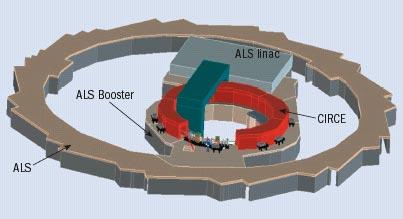
In designing the CIRCE ring, the team has provided for optimized versions of all the techniques for generating terahertz CSR as described. Figure 1 shows a 3D layout of the ring inside the ALS facility. The ring, 66 m in circumference and operating at 600 MeV, is designed to be located on top of the ALS Booster Ring shielding and will share the injector with the ALS Storage Ring.
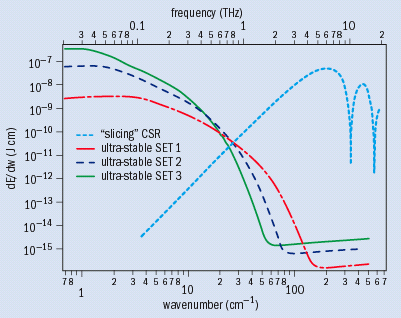
Figure 2 shows the impressive flux of CIRCE, calculated for three settings of the ultra-stable mode of operation. The gain of many orders of magnitude in the terahertz frequency range over the existing conventional source is clearly visible. Figure 3 shows how the femtoslicing mode complements the ultra-stable mode of operation in CIRCE. The calculated spectra for the two modes together cover the entire terahertz range from wavelengths of about 10 μm (30 THz) to about 10 mm (0.03 THz). The energy per terahertz pulse in the example used for the femtoslicing case is about 8.5 μJ, which when focused onto a sample would provide an electric field of about 106 V/cm. Current laser technology should allow repetition rates as high as 10-100 kHz.
The vacuum chambers in the dipole magnets and the first in-vacuum mirror have been designed for the efficient collection of terahertz synchrotron radiation. The design calls for three ports with 100 mrad horizontal by 140 mrad vertical acceptance for each of the 12 dipole magnets, giving a potential total of 36 dipole beam lines in CIRCE. The layout of the ring also includes six 3.5 m straight sections that can be used for insertion devices for possible future sources (as for the case of the wiggler in the femtoslicing scheme).
The CIRCE team has completed a detailed feasibility study that includes electron-beam linear and nonlinear dynamics studies, the design of all the magnets, the design of the special high-acceptance dipole vacuum chamber, and evaluating the compatibility of CIRCE with the ALS facility. Also, the team has experimentally investigated resonating modes that could be excited by the electron beam in the high-acceptance dipole vacuum chamber.
These modes, potentially dangerous for the electron-beam stability, have been measured and characterized by means of radio-frequency measurements in a prototype dipole chamber. No “show-stoppers” have been identified and CIRCE is part of the current five-year strategic plan for the ALS.
A potentially cost-saving and performance-enhancing new approach to fabricating superconducting radiofrequency (SRF) accelerating cavities has been demonstrated by the Institute for Superconducting Radiofrequency Science & Technology (ISRFST) at Jefferson Lab in Newport News, Virginia.
Several single-cell niobium cavities were made from material sliced from large-grain niobium ingots – rather than fine-grain material melted from ingots and formed into sheets by the traditional process of forging, annealing, rolling and chemical etching.
In tests carried out by ISRFST, these cavities performed extremely well. If multi-cell cavities are also successful, the method could have a substantial impact on the economics of high-performance RF superconductivity.
The work aimed to provide a deeper understanding of the influence of grain boundaries on the often-observed drop in Q (the cavity-performance quality factor) at accelerating gradients above 20 MV/m.
“Q-drop” is not well understood, but it may be linked to contaminants and grain boundaries in the niobium.
The researchers used single-crystal niobium sheets for forming into half-cells, omitting expensive processing steps and producing cavities with few or no grain boundaries. Reference Metals Company Inc of Bridgeville, Pennsylvania, provided the niobium in a research collaboration with JLab.
This proof-of-principle work could have wide repercussions. Most notably, it could lead to more reliable production and reduced costs.
The research also has important implications for the forthcoming International Linear Collider (ILC), a 500 GeV machine that will need some 17,000 SRF cavities performing above 28 MV/m. Using a scaled version of a low-loss design proposed for the ILC, a test cavity supported an accelerating gradient of 45 MV/m. This figure is very close to both Cornell’s current world record and the theoretical limit.
To provide the best experiences, we use technologies like cookies to store and/or access device information. Consenting to these technologies will allow us to process data such as browsing behavior or unique IDs on this site. Not consenting or withdrawing consent, may adversely affect certain features and functions.
Functional
Always active
The technical storage or access is strictly necessary for the legitimate purpose of enabling the use of a specific service explicitly requested by the subscriber or user, or for the sole purpose of carrying out the transmission of a communication over an electronic communications network.
Preferences
The technical storage or access is necessary for the legitimate purpose of storing preferences that are not requested by the subscriber or user.
Statistics
The technical storage or access that is used exclusively for statistical purposes.The technical storage or access that is used exclusively for anonymous statistical purposes. Without a subpoena, voluntary compliance on the part of your Internet Service Provider, or additional records from a third party, information stored or retrieved for this purpose alone cannot usually be used to identify you.
Marketing
The technical storage or access is required to create user profiles to send advertising, or to track the user on a website or across several websites for similar marketing purposes.