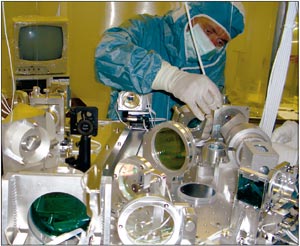
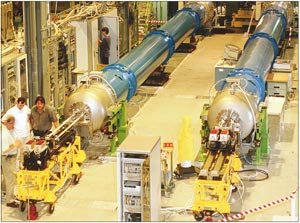
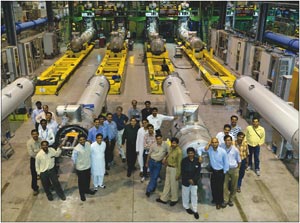
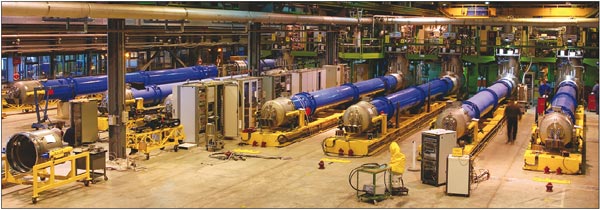
On 13 July, an inner triplet assembly of quadrupole magnets successfully completed a pressure test in the LHC tunnel, after installation of metal cartridges to reinforce internal support structures that broke in an assembly during an earlier pressure test in March. The triplet, which included three quadrupole magnets and the associated cryogenic and power distribution box (DFBX), met all test specifications at the requisite pressure of 25 atm for one hour.
The triplets will focus particle beams prior to particle collisions at the four interaction regions in the LHC. The pressure test is designed to verify the accelerator components in conditions that will occur during LHC operations. To withstand the asymmetrical forces generated, the Q1 and Q3 magnets at either end of the triplet assembly had each been fitted with a set of four metal cartridges to limit movement of the magnets inside their cryostats. The cartridges have a compound design consisting of an aluminium-alloy tube and an Invar rod to allow them to function over a broad range of temperatures.
To address design flaws that emerged during the March pressure test, a team from CERN, Fermilab, KEK and the Lawrence Berkeley National Laboratory also made changes to the DFBXs and the attachment of the triplet to the tunnel floor. These changes passed the test on 13 July.
Fermilab, in collaboration with CERN and KEK, supplied eight sets of triplets – one for either side of each of the interaction regions, plus one spare set. About half of the quadrupole magnets were repaired by the end of July, with the remaining repairs estimated to take six weeks to complete. This will be followed by the installation of assemblies and interconnections between quadrupole magnets, DFBXs and the rest of the accelerator. The inner triplets will then become part of the different sectors of the LHC and will be tested as part of the pressure tests of all sectors.
In the meantime, electrical tests have continued on the first sector to be commissioned (sector 7-8), which was initially cooled down in April. On 25 May, the dipole circuits were successfully powered up to several thousand amps, followed by the quadrupole circuits on 20 June. This was still below the nominal values. Depending on the type of superconducting magnet, the nominal current of the electrical circuits varies between 60 A and 12 kA. During the tests, however, some circuits were powered up to the nominal current and quenches triggered deliberately to test the protection system as well as the system for extracting the stored energy in the magnets.
These power tests were the culmination of several weeks of electrical tests on sector 7-8. More than 100 electrical circuits for the superconducting magnets were checked one by one. An overall test, where all of the circuits were powered up overnight, also took place to ensure that they perform correctly over a prolonged period. Finally, a power cut was simulated at point 8 for the teams to verify that all of the systems were being supplied with power from the scheduled source – whether the normal or back-up power supply. Sector 7-8 will now be warmed up so that the triplet magnets to the left of point 8 can be connected up and some consolidation work can take place.
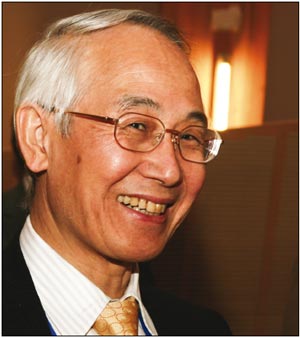
Hirohiko Tsujii is director of the Research Center for Charged Particle Therapy, at the National Institute of Radiological Sciences (NIRS), in Chiba, Japan. He is known internationally for his work on treating cancer with carbon ions and is the first doctor to have treated patients using hadron therapy in a clinical environment. Japan is the first country to have a heavy-ion accelerator for medical purposes, built as part of a national 10-year strategy for cancer control. Since the Heavy Ion Medical Accelerator in Chiba (HIMAC) opened in 1994, the facility has provided treatment for more than 3000 patients with various cancers and has resulted in a significant increase in the number of survivors after treatment. Recently, the Committee of Senior Officials for Scientific and Technical Research (COST) and the European Network for Research in Light-Ion Hadron Therapy (ENLIGHT) invited Tsujii as guest of honour at the COST-ENLIGHT workshop on hadron therapy, held at CERN on 3–4 May.
Tsujii has three decades of experience in developing hadron therapy as a novel treatment for cancer. The deposited radiation dose for charged hadrons (protons and heavier ions) rises to a peak near the end of the particle’s range. The aim with hadron therapy is to use this effect to irradiate tumours, while sparing healthy tissue better than with X-rays. “Before working at NIRS, I was involved with proton-beam therapy at Tsukuba University,” he says. Tsujii also worked on research for pion treatment in the US, where the use of pions in cancer therapy was pioneered at Los Alamos in co-operation with New Mexico University. “The biological effect was not as high as expected and it was also claimed that pions could produce a very nice distribution in the human body,” he explains. “However, compared with hadron therapy, such as with protons or carbon ions, the distribution was not that good. Eventually it was decided to stop the study that used pions.”
Japan is a major pioneer of hadron therapy. Each year, 650,000 people in the country are diagnosed with cancer and the number is expected to increase to 840,000 by 2020. Deep-seated tumours are the most challenging type of cancer and Tsujii has developed a special interest in treating them. Tumours found in the lungs, cervix, head and neck, liver, prostate, or bone and soft tissue, for example, are often treated with hadron therapy as they can be difficult to operate on and conventional radiotherapy is not always as effective.
“The reason we at NIRS decided to use carbon ions rather than protons is that it is the most balanced particle. It has the property of providing a constant treatment to the tumour and also has a higher biological effect on the tumour,” explains Tsujii. This means that the carbon-ion beam can be more focused on the tumour, resulting in the greatest cell damage to the tumour with less injury to the surrounding healthy tissue. “Of course, as the mass of the particle increases there is a higher relative biological effectiveness (RBE). But the ratio of RBE between the peak to plateau [before the peak] gets worse when using a particle with a higher mass. Therefore, when considering the biological effect, the carbon ion is the most balanced.”
After treating more than 3000 patients, Tsujii feels that it has been a good decision to use carbon ions in cancer treatment. “There was a lot of discussion in deciding what particle would be best. We decided to choose carbon ions and, for the time being, I am satisfied with this decision.” It took several years before coming to the optimum level of treatment with carbon ions. The local control for almost all types of tumours is 80–90%, and after choosing the optimal level of treatment the local control is expected to be more than 90%.
“Another point that I want to focus on is the use of ‘hypofractionated’ radiotherapy,” says Tsujii. A patient treated with photons – X-ray treatment – will, on average, require about 30–40 fractions (doses) over 6–7 weeks. With carbon ions, the treatment can be given in a single day (just one dose or fraction) for stage I lung cancer while cervical and prostrate cancer or other large tumours require only 16–20 fractions against around 40 fractions using conventional treatment. “It is important to note that there is a minimal toxicity to healthy cells. At the beginning we had some severe toxicity, but we analysed the treatment and techniques, and completely overcame the problem we had when we initially started the studies.”
As chair of the Particle Therapy Co-operative Group, an international group that coordinates all hadron therapy (such as protons and carbon ions), Tsujii sees the future development of carbon-ion therapy as the more popular choice for oncologists. Even the name of this group suggests the changes taking place. Once the Society for Proton Beam Therapy, the name now reflects increased development in high-energy radiation with carbon ions.
“I believe that many parts of radiotherapy will be replaced by carbon therapy – it is just simpler in terms of smaller fractions to apply to the patient, compared with photons. It is a rather complicated procedure with carbon ions, but as each part of the procedure is established, once it is decided, the necessary technique is fixed. This means that we can apply the more reliable technique to the patient’s treatment,” says Tsujii.
For small tumours, the results with carbon ions or photons May be similar, such as in early-stage lung cancer, where the tumour is smaller than 3 cm in diameter. If the tumour is larger, then carbon ions prove to be the better treatment. “We are especially interested in the treatment of tumours in the pelvis or spinal area, which are often difficult to treat with surgery, and we have focused on treating bone and soft-tissue sarcoma – large tumours of 10–15 cm diameter – and we are very satisfied with the improved local control and longer survival rates,” says Tsujii.
Tsujii has not seen a single case of radiation-induced cancer among the patients treated since starting the carbon-ion treatment for cancer 13 years ago. There is a possibility of some cancer being induced by carbon-ion irradiation, but the distribution close to the target area is much better than in traditional treatment. However, the risks of developing radiation-induced cancer are probably similar for both treatments.
The cost of building these kinds of facilities is something that many governments are considering, including Germany and Italy (CERN Courier December 2006 p17). Japan has started a new carbon-ion therapy facility and two proton therapy facilities at a cost of around €100 m, while In Germany and Italy, new facilities with dual capabilities for using carbon ions and protons are expected to open in 2008, at a cost of €90 m each. Tsjuii’s pioneering work seems certain to be expanded to other parts of the world.
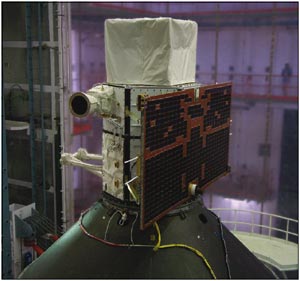
On 23 April, the Indian Polar Satellite Launch Vehicle (PSLV) launched the Italian astronomical satellite, AGILE, into orbit from the Sriharikota base in Chennai-Madras. AGILE (Astrorivelatore Gamma a lmmagini Leggero) is a 350 kg satellite dedicated to high-energy astrophysics. Its main goal is the simultaneous detection of hard X-ray and gamma-ray cosmic radiation in the energy bands 15–60 keV and 30 MeV – 50 GeV, with optimal imaging and timing.
Ten days after launch, on 4 May, the instruments on board the satellite – the tracker, the mini-calorimeter, and the X-ray detector – were switched on and the first data transmitted back to Earth. All proved to work well, and commissioning proceeded according to schedule until the end of June. The tracker, the main scientific instrument on AGILE, is based on state-of-the-art, reliable technology of solid-state silicon detectors developed by INFN laboratories.
The AGILE Mission is funded and managed by the Italian Space Agency (ASI), with co-participation from the Italian Institute of Astrophysics, the Italian Institute of Nuclear Physics, and several universities and research centres – including the National Research Council, the National Agency for New Technologies, Energy and the Environment, and the Consorzio Interuniversitario per la Fisica Spaziale. The industrial contractors involved are Carlo Gavazzi Space, Oerlikon-Contraves, Alcatel-Alenia Space Italia-LABEN, Telespazio, Galileo Avionica, Intecs and Mipot.
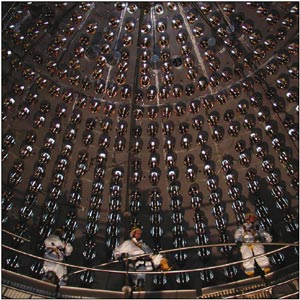
The Borexino detector is now fully operational at the Laboratori Nazionali del Gran Sasso. This milestone comes after several years of technical developments that have led to the lowest background levels ever achieved, followed by construction and commissioning. In addition, problems at the underground laboratory and with local authorities – owing mainly to environmental concerns – caused four years of delay.
Borexino’s main goal is the measurement of the monoenergetic (862 keV) neutrinos from the decay of 7Be formed in a branch of the proton–proton (pp) fusion chain in the Sun. Previous experiments indicate a severe suppression of these neutrinos, which are important in understanding solar neutrinos and neutrino oscillations.
The experiment will detect neutrino–electron scattering in real time in its central volume of 300 tonnes of ultrapure liquid scintillator (100 tonnes of fiducial mass). This is shielded by 1000 tonnes of ultrapure quenched pseudocumene (1-2-4 trimethylbenzene) and 2400 tonnes of purified water. A stainless-steel sphere contains the pseudocumene and also supports 2200 photomultipliers to detect the light produced by neutrino interactions, while 200 phototubes facing into the shielding water provide a veto for muons.
Borexino will cast light on the low mixing-angle solution for neutrino oscillation, which is still to be confirmed at low energies, and should provide information on the electron–neutrino survival probability in the transition region (0.7–4.0 MeV) between vacuum and matter oscillations. With its very low threshold – well below 1 MeV – the experiment also has the potential to explore other solar neutrino signals for the first time, and to test the astrophysical model of the Sun at the level of a few per cent. In addition, Gran Sasso provides the ideal location for the study of geoneutrinos, thanks to the low level of backgrounds from nuclear reactors.
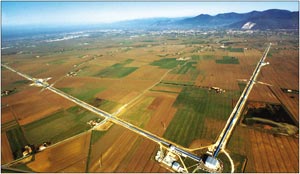
On 18 May, the Virgo laser interferometer for the detection of gravitational waves started its first science run at the European Gravitational Observatory, Pisa, marking a step forward towards a new astronomy. If Virgo and its counterparts, LIGO in the US and GEO600 in Germany, succeed in detecting gravitational waves, they will reveal new information about the universe.
Until now, astronomy has been based on photons – electromagnetic waves – originating from the accelerated motion of electric charges, as in a burning star. Gravitational waves originate instead in matter’s most intrinsic characteristic, its mass. A direct consequence of general relativity, gravitational waves are perturbations of the gravitational fields that are produced by the accelerated motion of masses, as in star collisions. According to general relativity, gravitational fields distort space–time and the passage of gravitational waves produces ripples, like on the surface of a pond. A light beam travelling through this perturbed space–time should be subject to tiny oscillations in the time it takes to bounce between two widely spaced mirrors.
Laser interferometers, such as Virgo, are ideal instruments to detect these phenomena. They can compare with enormous accuracy the times that light takes to go back and forth along two perpendicular arms, 3–4 km long. Miniscule changes in these times caused by gravitational waves will appear as microscopic changes in the interference fringes.
Having reached a sensitivity close to the design value, and comparable to that of the LIGO interferometers, Virgo has now begun scientific operation. The data collected will complement data from other detectors, and improve the overall statistical significance.
In an important step that greatly increases the value of the data collected in Europe and the US, Virgo and the LIGO Science Collaboration have agreed to share their data. The constitution of a worldwide network of detectors, the data for which are analysed coherently, has several basic advantages. The coincidence between weak signals sensed in widely separated locations allows the rejection of spurious events from local noise. The arrival-time difference of a gravitational-wave signal of various detectors enables reconstruction by triangulation of the position of the source in the sky and measuring the wave-front at several points allows the determination of all of the parameters characterizing gravitational waves.
With the instruments close to their design sensitivities, researchers could detect gravitational waves in the coming four months of common data-taking, although the “discovery” probability is estimated to be only about 1%, even for binary neutron-star coalescence – one of the better known sources. To increase this probability, the researchers have set up a coordinated, two-stage improvement campaign. This will bring the overall detection probability into the range of one event a year for 2009–2010, and a few tens of events a year for 2013–2014. If attained, it will mark the birth of gravitational-wave astronomy.
• Virgo is funded on an equal basis by the Centre National de la Recherche Scientifique and the Istituto Nazionale di Fisica Nucleare.
Speaking at the 142nd session of the CERN Council on 22 June, CERN’s director-general, Robert Aymar, announced that the LHC will start up in May 2008, taking the first steps towards studying physics at a new high-energy frontier. A low-energy run originally scheduled for 2007 has been dropped as the result of a number of minor delays accumulated over the final months of LHC installation and commissioning, including the failure in March of a pressure test in an inner-triplet magnet assembly.
The first cool-down of an eighth of the machine (sector 7-8) to the operating temperature of 1.9 K began earlier this year. While this took longer than scheduled, it provided important lessons, allowing the LHC’s operations team to iron out teething troubles and gain experience that will be applied to the other seven sectors. Now tests on powering up sector 7-8 are underway, and the cool-down of sector 4-5 has begun. At the same time, physicists and engineers are making modifications to the inner-triplet magnet assemblies.
The new schedule foresees successive cooling and powering of each of the LHC’s sectors in turn this year. Hardware commissioning will continue throughout the winter, allowing the LHC to be ready for high-energy running by the time CERN’s accelerators are switched on in the spring. Beams will be first injected at low energy and low intensity to give the operations team experience in driving the new machine, before the intensity and energy are slowly increased.
Installation of the large and equally innovative apparatus for experiments at this new and unique facility will continue at the same time, to be completed on a schedule consistent with that of the accelerator.
The cold testing of 1706 superconducting magnets for the LHC came to a successful completion early this year. This important milestone for the project marked the end of an operation that had begun in 2001, meeting considerable challenges along the way. By the end of 2003 only 95 dipole magnets had been tested, but the effort and innovative ideas that came from the Operations Team enabled the team eventually to meet the target. The majority of the personnel for the tests came from India, for a year at a time, as part of the CERN–India Collaboration for the LHC. Their success provides a unique example of international collaboration in the accelerator domain on an unprecedented scale.
The LHC consists of two interleaved synchrotron rings, 26.7 km in circumference. The main elements of the rings are the 2-in_1 superconducting dipole and quadrupole magnets operating in superfluid helium at 1.9 K. The total number of cryogenic magnet assemblies – or cryomagnets – includes 1232 dipoles with correctors, 360 short straight sections (SSS) for the arcs with quadrupoles and integrated high-order poles, and 114 special SSS for the insertion regions (IR-SSS) with magnets for matching and dispersion suppression. All of these magnets had to be tested at low temperatures before they could be installed in the tunnel, and for this purpose a superconducting magnet test facility, equipped with 12 test benches and the necessary cryogenic infrastructure, was set up in building SM18 just across the border in France from CERN’s Meyrin site.
The magnet testing had several aspects. For each magnet the tests had to verify the integrity of the cryogenics, mechanics and electrical insulation; qualify the performance of the protection systems; train the magnet up to the nominal field or higher; characterize the field; ensure that the magnet met the design criteria; and finally accept the magnet according to its performance in quenches and in training. The workforce to do this consisted of three main teams – the Operation Team, who performed the tests and measurements, supported by the Cryogenics Team and the Magnet Connect/Disconnect Team (known as ICS). In addition, a team known as Equipment Support looked after improvements and on-call trouble-shooting of hardware and software, and a sub-team of ICS handled the movement of the magnets with a remote-controlled vehicle (the ROCLA).
The complexity of the magnets implied a high level of complexity in the test facility, which required its own specific infrastructure, from cryogenic feed boxes and high-current circuits to data acquisition for measurement and control. Assembling the full facility involved several groups from CERN’s AB, AT and TS departments working over many years, with the final test bench commissioned in June 2004.
The first testing of series production magnets began in 2001, with two test benches and a limited cryogenic infrastructure. Undertaken by specialists in the magnets and the related equipment, the operation at this stage was more laboratory R&D than a well-defined, structured approach to the test procedure. The first sets of dipoles, comprising around 30 samples from each of the three suppliers, had to be thoroughly tested, with full magnetic and other measurements. This extensive testing, together with the limited operational experience and support tools, meant that some 20–30 days were required to test a magnet during 2001–2002, and only 21 magnets were tested during this period.
To increase throughput, the test facility began to operate round the clock early in 2003. With a final set-up of 12 test benches and a minimum of 4 people a shift, this required a minimum team of 24. The initial plan had been to outsource, but by early 2002 it was clear that this was no longer an option, and also that only a few non-expert CERN staff were available to run the test facility. It was at this time that the Department of Atomic Energy (DAE), India, offered technical human resources for SM18. A collaboration agreement between India and CERN had been in place since the 1990s, including a 10 man-year arrangement for tests and measurements during the magnet prototyping phase. This eventually allowed more than 90 qualified personnel from four different Indian establishments to participate in the magnet tests on a one-year rotational basis (a condition requested by India) starting around 2002.
It was also clear that proper strategies and support tools were needed to meet the target of testing all magnets by the end of 2006. In addition to several reviews aimed at streamlining the process, an extensive study took place to define a selective, reduced set of magnetic measurements needed to qualify and accept a magnet.
A testing renaissance
The overall magnet-test operation involved significant manual effort, and while this remained the case throughout the tests, from mid-2003 the operational process underwent a renaissance, from basic manual data-logging to an efficient, sophisticated and highly automated test-management system. The Operation Team, and in particular the Indian personnel, provided essential feedback for framing new strategies and made significant proposals for improving the throughput. In addition, CERN’s web-based network backbone and computer facilities were widely used to develop supporting tools.
A “to-do list” of the minimum set of tests for a magnet was created, with methods developed to reduce human error in the process as much as possible. The list of tests was reflected in templates for a magnet test report. A new website included all of the important documentation, from manuals and templates to troubleshooting procedures and the shift plan. This proved immensely helpful in training new staff as well as in managing the daily activities.
A web-based system called the SM18 Test Management System (SMTMS), based on the to-do list, was developed to generate test-sequences and reports automatically and to store all of the relevant data. This enabled fast, reliable and error-free generation of crucial data. It also made it possible to keep track of the times taken for various phases of the tests, and everyone concerned could keep track of the tests from different locations both within CERN and further afield. An electronic log-book approach, using the network backbone at CERN, ensured easy access and helped to categorize and record faults that occurred during the tests.
Another web-based tool, the e-traveller, ensured a smooth interaction between the teams during setting up and at the end of the tests for a particular magnet. This tool informed the relevant teams about the need for their services on the magnet, using mobile-phone alerts in the appropriate language. This helped the Indian personnel to overcome difficulties in verbal communication with the exclusively French-speaking teams, while maintaining the work rhythm, as well as automatically recording the phases in the tests.
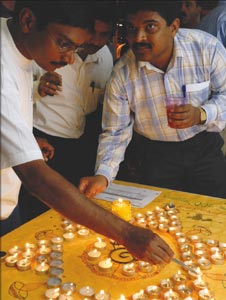
The SM18 community celebrated the Hindu festival of Diwali with a party in October 2006, and lit candles to represent the remaining magnets still to be tested. Diwali takes place on the date of the new moon, between the months of Asvina and Kartika on the Hindu calendar (usually in October or November).
To fulfil their roles at CERN, the technical engineers, all specialists in their own fields, had to take a leave of absence from their regular jobs. For example, Praveen Deshpande who was at CERN in 2006 designs instruments for accelerators and lasers, while Sampathkumar Raghunathan and Charudatta Kulkarni work on the R&D of nuclear instrumentation. For Deshpande, the best part about working at CERN was the interaction with different people. “I’m exposed to many people and agencies here, which I don’t get at home working in a small design section,” he explained in an interview for the CERN Bulletin. The logistics of implementing large-scale projects at CERN proved an eye opener. “The template approach with documentation and foresight is important in a big job like this,” said Raghunathan. Kulkarni agreed, and further identified excellent leadership skills as an important lesson that he learned.
The technical engineers could also use their free time to further their own knowledge. “Everyone was given the name of someone at CERN who works in a similar field to contact, if we wished. This is for our intellectual development. Because we work in R&D, it is important that we are up to date with new developments, so we are not left behind when we return a year later,” explained Kulkarni.
On their days off, the SM18 community organized group visits to tourist destinations, celebrated Indian festivals, such as Diwali, and even formed teams for cricket matches. Many of the technical engineers brought their families over, and some of their children attended local schools. For example, Raghunathan’s wife, two children and his mother moved to Switzerland for nine months. His seven-year-old daughter attended a French school for a full academic year. “They all enjoyed living here. My daughter also learned a lot of French. It’s an added asset.”
At the end of their year at CERN, when the technical engineers returned home, enriched by their experiences, they hoped to incorporate what they had learnt at CERN into their work, in particular the methods of coordinating and managing large-scale projects. However, the experience gained extends far beyond a professional level. The magnet test has facilitated international friendships and even reunited lost ones from home. Deshpande met friends that he knew from 13 years ago when he was undergoing training, but with whom he had since lost touch, as well as colleagues at the same establishment in India whom he has never met owing to the size of the organization.
To attain a high throughput it was also necessary to reduce the time and cryogenic resources taken in testing the magnets, including the “training” required to reach the operational magnetic field. In this, the current is increased until the magnet quenches (reverts from its superconducting state to a normally conducting state) and then the process is repeated. In the early stages, each dipole was trained to reach a field about 8% higher than required for LHC operation – a major time-consuming activity. During 2003, the Operation Team observed that the majority of magnets cross their nominal field (8.33 T or 11,850 A) on the second attempt, and that not much additional information on the quality of a magnet came from a third quench or more. This led to a “two-quench rule” being agreed by the magnet experts, in which a magnet was accepted after two quenches providing it crossed the nominal field by a small margin. Later a “three-quench rule” allowed a magnet to be accepted if it had failed the two-quench rule, but crossed a field of 8.6 T (12,250 A) in the third quench. This strategy drastically reduced the overall time for the cold tests.
Another important step towards reducing the overall test time was the introduction of a rapid on-bench thermal cycle for magnets that had a poor performance in the first run. Further time-saving came from the round-the-clock decision-making on the performance of a magnet by the operator, based on the results in the Magnet Appraisal and Performance Sheet, provided by the web-based SMTMS.
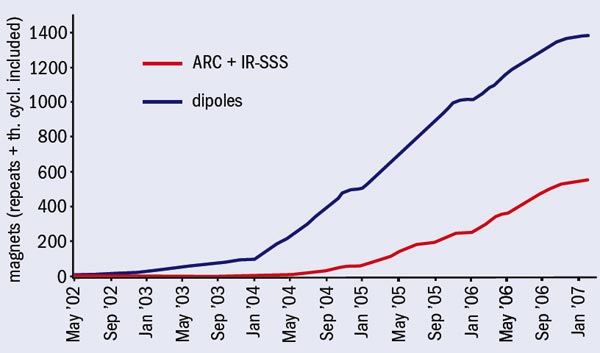
Figure 1 shows the cumulative number of magnet tests, including repeats, since 2003, both for dipoles and for SSS. While throughput was low until the end of 2003, it increased sharply after the introduction of the new tools and strategies. The flat regions at the end of each year are due to the annual shutdown of the cryogenic infrastructure, typically for seven weeks. More details are shown in table 1.
Testing the SSS magnets was a challenging task until the end of 2004, when all of the necessary information had finally been gathered and collated. The special IR-SSS magnets were even more of a challenge as they have a wide variety of types, structures and temperature regimes, and required the collection of a large amount of information for the tests. Each of the 114 magnets needed its own dedicated to-do list. As the table shows, the majority of the special SSS magnets were tested in 2006, together with significant numbers of standard SSS and dipole magnets, marking altogether a remarkable achievement for the year. While delays in delivery of the magnets to SM18 meant that not all of the magnets had been tested by the end of 2006, the target was achieved only a few weeks later by 23 February 2007.
Around 9% of the dipoles required the test procedure to be repeated, with repeat rates of a little over 12% for the SSS and IR-SSS magnets. In addition, some 3% of dipoles and 6% of the SSS had to be repaired or were rejected after the cold tests. These results alone justify the effort required for testing all of the magnets under the real cryogenic conditions. Moreover, the successful completion of this huge operation has been a unique example of international collaboration on an unprecedented scale in the accelerator domain.
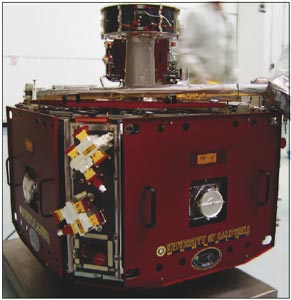
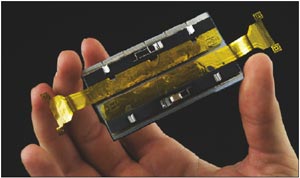
Particle detectors developed for high-energy and nuclear physics often find uses in many other fields. Now silicon detectors with thin entrance contacts have been launched into space aboard the five spacecraft in NASA’s THEMIS (Time History of Events and Macroscale Interactions during Substorms) mission. Fabricated at the Lawrence Berkeley National Laboratory (LBNL), the detectors comprise the heart of solid-state telescopes (SSTs). They will study electrons and ions with energies between 25 keV and 6 MeV.
THEMIS will study the Aurora Borealis. Typically, the aurora is seen as a steady greenish-white band of light. Occasionally the band will move south and become brighter. Then, the auroral band may break up into many bands, some of which will move back towards the north, dancing rapidly and turning red, purple and white. This display is caused by an auroral substorm. The THEMIS mission will study the origin of these substorms. The five separate satellites were launched into highly elliptical orbits using a single Delta 2 rocket. The craft are strategically positioned to determine the location and sequence of the events that lead to these colourful displays.
Two SSTs are on board each of the spacecraft. Their purpose is to measure the distribution of energies of the electrons and ions arriving at each spacecraft from different parts of the magnetosphere. LBNL’s Microsystems Laboratory fabricated the silicon-diode detectors. They are large-area detectors that have very thin entrance contacts, only a few tens of nanometres thick. This allows them to detect electrons and ions with energies much lower than those that can be detected with standard silicon detectors. The detectors themselves can detect 2 keV electrons and 5 keV protons. However, the low energy threshold of the SSTs is determined not by the detectors, but by the noise performance of the electronics, which is limited by the available power.
Because the detector contacts are so thin, making enough large detectors posed a significant challenge: the project required 80 flight detectors. However, the Microsystems Laboratory provided advanced equipment and processes in an ultra-clean environment that enabled the fabrication of these detectors with high yield.
The SSTs have been commissioned and are now returning scientific data on the magnetosphere during the current “Coast Phase”. In December, when the satellites will be in their required orbits, the primary task of studying the auroral substorms will begin.
After 10 years of hard work the last of the 42 modules for the LHCb Vertex Locator (VELO) arrived at CERN in early March. The VELO comprises two rows of 21 double-sided semi-circular silicon detectors, each about 8 cm in diameter. It was designed and constructed at Liverpool University and will be placed just 5 mm from the beam line.
The LHCb experiment will study B particles at the LHC to explore the imbalance between matter and antimatter, and the VELO is crucial. It will track particles spraying out of the forward regions of the detector, where the greatest numbers of b– b pairs are expected.
The VELO is unique in that it will act as both detector and beam pipe. Special bellows designed at NIKHEF will allow both sides of the VELO to retract to a safer distance of 3 cm away from the beam line while the beam is being set up. In addition, to maintain the LHC vacuum of 10–8 millibar, a special corrugated foil will separate the beam line from the VELO detector vacuum. By the summer the VELO team will finish assembly and prepare for installation in the pit.
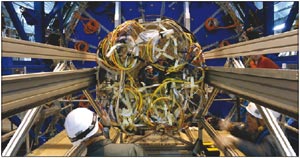
On 15 March 100 physicists and engineers gathered in the ALICE underground cavern to witness the end of a 15 year journey of development, construction, commissioning and testing before the Inner Tracking System (ITS) was inserted into the time projection chamber (TPC) at the heart of the experiment. Using the smallest amounts of the lightest material, the ITS has been made as lightweight and delicate as possible.
The ITS comprises six layers of high-precision silicon detectors, with double-sided silicon strips in the outer two layers, silicon drift detectors in the middle two layers and silicon pixels in the two inner layers. With almost 5 m2 of double-sided silicon strip detectors and more than 1 m2 of silicon drift detectors, it is the largest system using both types of silicon detector.
The silicon layers were integrated in Utrecht and Torino for a testing phase before being moved to the ALICE underground cavern. Passing the ITS through the TPC was challenging, with barely enough room for it to fit inside. It took two hours to move just a few dozen metres. The four outermost layers have been installed and the silicon pixel detector is scheduled to be installed this summer.
To provide the best experiences, we use technologies like cookies to store and/or access device information. Consenting to these technologies will allow us to process data such as browsing behavior or unique IDs on this site. Not consenting or withdrawing consent, may adversely affect certain features and functions.
Functional
Always active
The technical storage or access is strictly necessary for the legitimate purpose of enabling the use of a specific service explicitly requested by the subscriber or user, or for the sole purpose of carrying out the transmission of a communication over an electronic communications network.
Preferences
The technical storage or access is necessary for the legitimate purpose of storing preferences that are not requested by the subscriber or user.
Statistics
The technical storage or access that is used exclusively for statistical purposes.The technical storage or access that is used exclusively for anonymous statistical purposes. Without a subpoena, voluntary compliance on the part of your Internet Service Provider, or additional records from a third party, information stored or retrieved for this purpose alone cannot usually be used to identify you.
Marketing
The technical storage or access is required to create user profiles to send advertising, or to track the user on a website or across several websites for similar marketing purposes.